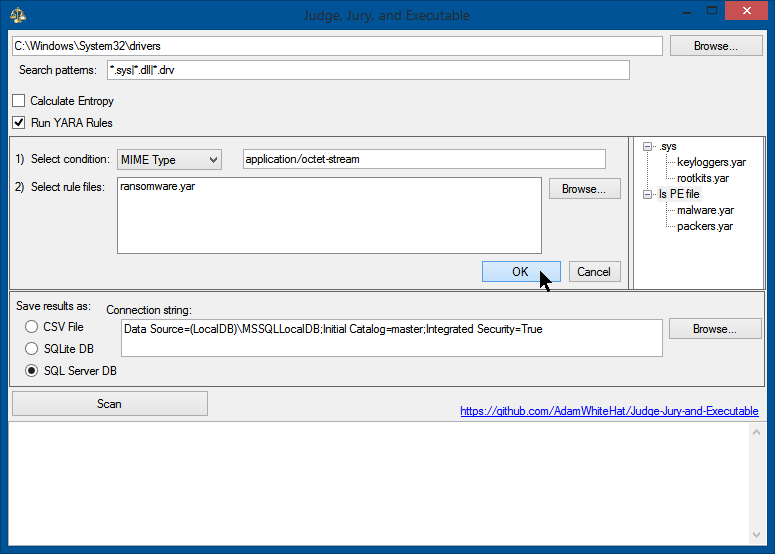
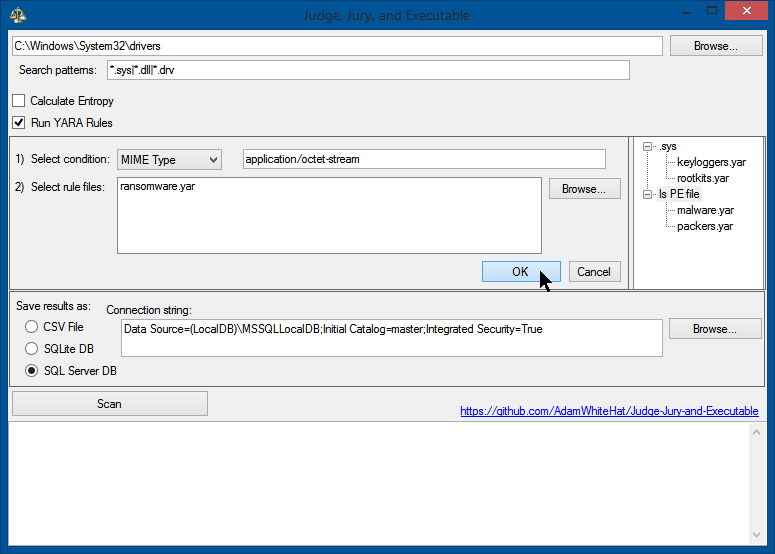
 adamwhitehat/judge-jury-and-executable
A file system forensics analysis scanner and threat hunting tool. Scans file systems at the MFT and OS level and stores data in SQL, SQLite or CSV. Threats and data can be probed harnessing the power and syntax of SQL.


Allow me to elaborate...
You start with a disk or disk images that are potentially dirty with malware, viruses, APT's (advanced persistent threats) or the like, and then scan them with this tool. (Optionally, and assuming you have the wisdom and foresight to do so, you may wish to scan a known good baseline disk image with this tool first (or later--doesn't matter). This is certainly not necessary, but can only serve to aid you.) The forensics-level scanning portion of this tool collects a bunch of properties about each file in a file system (or an image(s) of one), and places these properties in a SQL relational database table. The secret sauce comes from being able to threat hunt, investigate, or ask questions about the data through the use of queries, in the language of SQL, against the database that is created. A key feature here was NOT inventing a proprietary query language. If you know SQL, and how to click a button, then you already know how to use this tool like a boss. Even if you don't, this concept is powerful enough that canned queries (see below) will get you a lot of mileage.
Firstly, the tool creates an entry in the database for each record found in the MFT (master file table--its how NTFS does its record keeping). This bypasses file security permissions, file hiding, stealth or obfuscation techniques, file deletion, or timestamp tampering. These techniques will not prevent the file from being scanned and catalogued. The bytes of the file are read from the MFT and as many data points as possible are taken from the bytes of the file read from the MFT before attempting to access any data points using the higher-level OS API calls.
After the MFT and forensics-level data is secured, operating-system-level properties, data and meta-data available about each file is collected and augments each entry created from the MFT entry. As a result of this, even if the file or its properties from the Operating System API or the dotnet framework cannot be accessed due to file permissions (ACL), file locks (is in use), disk corruption, a zero-byte-length file, or any of the various other reasons, the file's existence will still be recorded, logged and tracked. The entry, however, will simply not contain the information about it that was not accessible to the operating system. Up to 51 different data points may be collected for every file.
| MFTNumber | SequenceNumber | SHA256 | FullPath | Length | FileOwner | Attributes | IsExe | IsDll | IsDriver | BinaryType | IsSigned | IsSignatureValid | IsValidCertChain | IsTrusted | ImpHash | MD5 | SHA1 | CompileDate | MimeType | InternalName | ProductName | OriginalFileName | FileVersion | FileDescription | Copyright | Company | Language | Trademarks | Project | ApplicationName | Comment | Title | Link | ProviderItemID | ComputerName | DriveLetter | DirectoryLocation | Filename | Extension | CertSubject | CertIssuer | CertSerialNumber | CertThumbprint | CertNotBefore | CertNotAfter | PrevalenceCount | Entropy | YaraRulesMatched | DateSeen | MftTimeAccessed | MftTimeCreation | MftTimeModified | MftTimeMftModified | CreationTime | LastAccessTime | LastWriteTime |
|---|---|---|---|---|---|---|---|---|---|---|---|---|---|---|---|---|---|---|---|---|---|---|---|---|---|---|---|---|---|---|---|---|---|---|---|---|---|---|---|---|---|---|---|---|---|---|---|---|---|---|---|---|---|---|---|---|
| 18010 | 0 | C67BE7D3F54D44AC264A18E33909482F1F8CA7B7FBAAF5659EF71ED9F8092C34 | C:\Windows\WinSxS\amd64_windows-defender-service-cloudclean_31bf3856ad364e35_6.3.9600.18603_none_73d12e8145b3841b\SymSrv.dll | 149264 | TrustedInstaller | A | 1 | 1 | 0 | 16 | 1 | 1 | 0 | 1 | 5D54F5D721E301667338323AC07578E3 | 65FB3391EB26F5AC647FC40501D8E21D | 4B46DB2A99A47FF6A6EE376F4D79F5298BFF28A2 | 2010-02-01 20:15:48.0000000 | application/x-msdownload | symsrv.dll | Debugging Tools for Windows(R) | symsrv.dll | 6.12.2.633 | Symbol Server | © Microsoft Corporation. All rights reserved. | Microsoft Corporation | English (United States) | L | C | C:\Windows\WinSxS\amd64_windows-defender-service-cloudclean_31bf3856ad364e35_6.3.9600.18603_none_73d12e8145b3841b | SymSrv.dll | .dll | CN=Microsoft Corporation, OU=MOPR, O=Microsoft Corporation, L=Redmond, S=Washington, C=US | CN=Microsoft Code Signing PCA, O=Microsoft Corporation, L=Redmond, S=Washington, C=US | 6105F71E000000000032 | D468FAEB5190BF9DECD9827AF470F799C41A769C | 7/13/2009 5:00:18 PM | 10/13/2010 5:10:18 PM | 1 | 0 | NULL | 2020-10-25 06:17:12.0133333 | 2013-06-18 14:43:52.6497911 | 2013-08-22 06:56:50.9086288 | 2013-08-22 06:56:50.9086288 | 2019-01-15 19:13:49.1704756 | 2013-08-22 06:56:50.9086288 | 2013-08-22 06:56:50.9086288 | 2013-06-18 14:43:52.6497911 |
