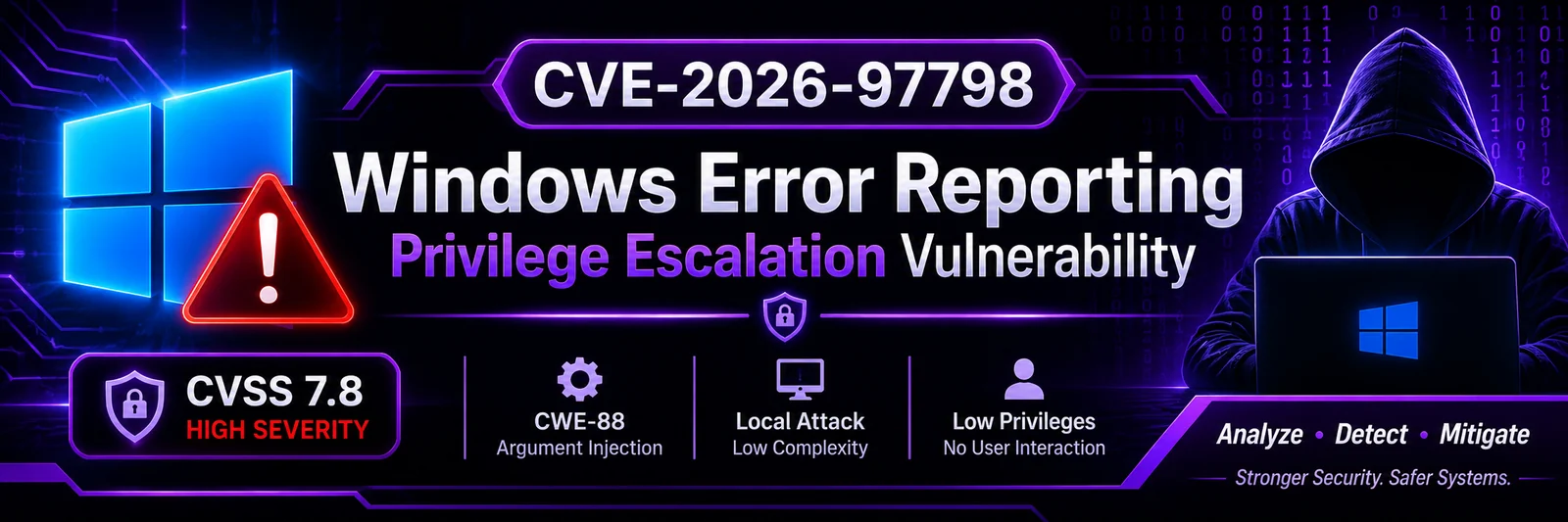
 0xblackash/cve-2026-97798
Documents CVE-2026-97798, a Windows Error Reporting argument-injection privilege escalation flaw, with affected builds, detection scripts, and remediation guidance.





CVE-2026-97798 is a Windows Error Reporting (WER) Service vulnerability involving improper neutralization of argument delimiters in a command, commonly known as Argument Injection.
The vulnerability could allow an authorized local attacker to elevate privileges on an affected Windows system.
This repository documents the vulnerability, its technical classification, potential security impact, affected Windows versions, defensive investigation, and remediation recommendations.
| Attribute | Details |
|---|---|
| CVE ID | CVE-2026-97798 |
| Vendor | Microsoft |
| Component | Windows Error Reporting |
| Vulnerability Type | Argument Injection |
| CWE | CWE-88 |
| Attack Vector | Local |
| Attack Complexity | Low |
| Privileges Required | Low |
| User Interaction | None |
| Scope | Unchanged |
| CVSS Version | 3.1 |
| CVSS Score | 7.8 |
| Severity | HIGH |
| Publication Date | October 13, 2026 |
Successful exploitation could potentially result in:
CVSS:3.1/AV:L/AC:L/PR:L/UI:N/S:U/C:H/I:H/A:H
CWE-88 — Improper Neutralization of Argument Delimiters in a Command ('Argument Injection')
Argument injection occurs when an application constructs a command without properly separating or validating its arguments.
This can allow untrusted input to influence how another process interprets command-line parameters.
# Conceptual example of unsafe command construction

user_input = get_user_input()

command = "application.exe " + user_input
The example illustrates an unsafe programming pattern. It is not an exploit for CVE-2026-97798.
The following Windows product branches have been identified in vulnerability records.
| Operating System | Affected Before Fixed Build |
|---|---|
| Windows 10 21H2 | 19044.7807 |
| Windows 10 22H2 | 19045.7807 |
| Windows 11 23H2 | 22631.7652 |
| Windows 11 24H2 | 26100.9711 |
| Windows 11 25H2 | 26200.9711 |
| Windows 11 26H1 | 28000.3231 |
| Windows 11 26H2 | 26300.9711 |
| Windows Server 2022 | 20348.5761 |
| Windows Server 2025 | 26100.33650 |
Important: The versions shown are branch-specific remediation thresholds. Verify the applicable cumulative update and servicing status through Microsoft's official advisory.
The following commands can help administrators inspect Windows system information.
Get-ComputerInfo |
Select-Object WindowsProductName, WindowsVersion, OsBuildNumber
[System.Environment]:https://raw.githubusercontent.com/0xblackash/cve-2026-97798/main/:OSVersion.Version
Get-WinEvent -ListLog *Windows Error Reporting*
Get-WinEvent -LogName System -MaxEvents 50 |
Select-Object TimeCreated, Id, ProviderName, Message
Get-HotFix |
Sort-Object InstalledOn -Descending |
Select-Object -First 10
These commands perform basic defensive inspection. They do not exploit the vulnerability or independently prove whether a system is vulnerable.
Recommended defensive actions:
Microsoft Security Response Center — CVE-2026-97798
This repository is organized around defensive vulnerability research.
| Phase | Activity |
|---|---|
| 01 | CVE identification |
| 02 | Vulnerability classification |
| 03 | Affected version analysis |
| 04 | Root cause research |
| 05 | Defensive system inspection |
| 06 | Patch verification |
| 07 | Security documentation |
CVE-2026-97798/
│
├── README.md
│
├── assets/
│   └── banner.png
│
├── detection/
│   └── check_windows_version.ps1
│
├── documentation/
│   ├── technical-analysis.md
│   └── remediation.md
│
└── LICENSE
This repository is intended exclusively for educational purposes, cybersecurity research, vulnerability awareness, and authorized defensive security assessments.
All testing should be conducted in isolated laboratory environments or on systems for which explicit authorization has been obtained.
The author is not responsible for misuse of the information provided in this repository.
🔐 Cybersecurity Research | Vulnerability Analysis | Defensive Security
Understand vulnerabilities. Strengthen security. Protect systems.
