 0xblackash/cve-2026-86950
Defensive research documentation for CVE-2026-86950, an Apple CoreGraphics out-of-bounds write, covering vulnerability triage, affected versions, detection, and patch guidance.





🔬 Defensive Security Research • Vulnerability Analysis • Detection
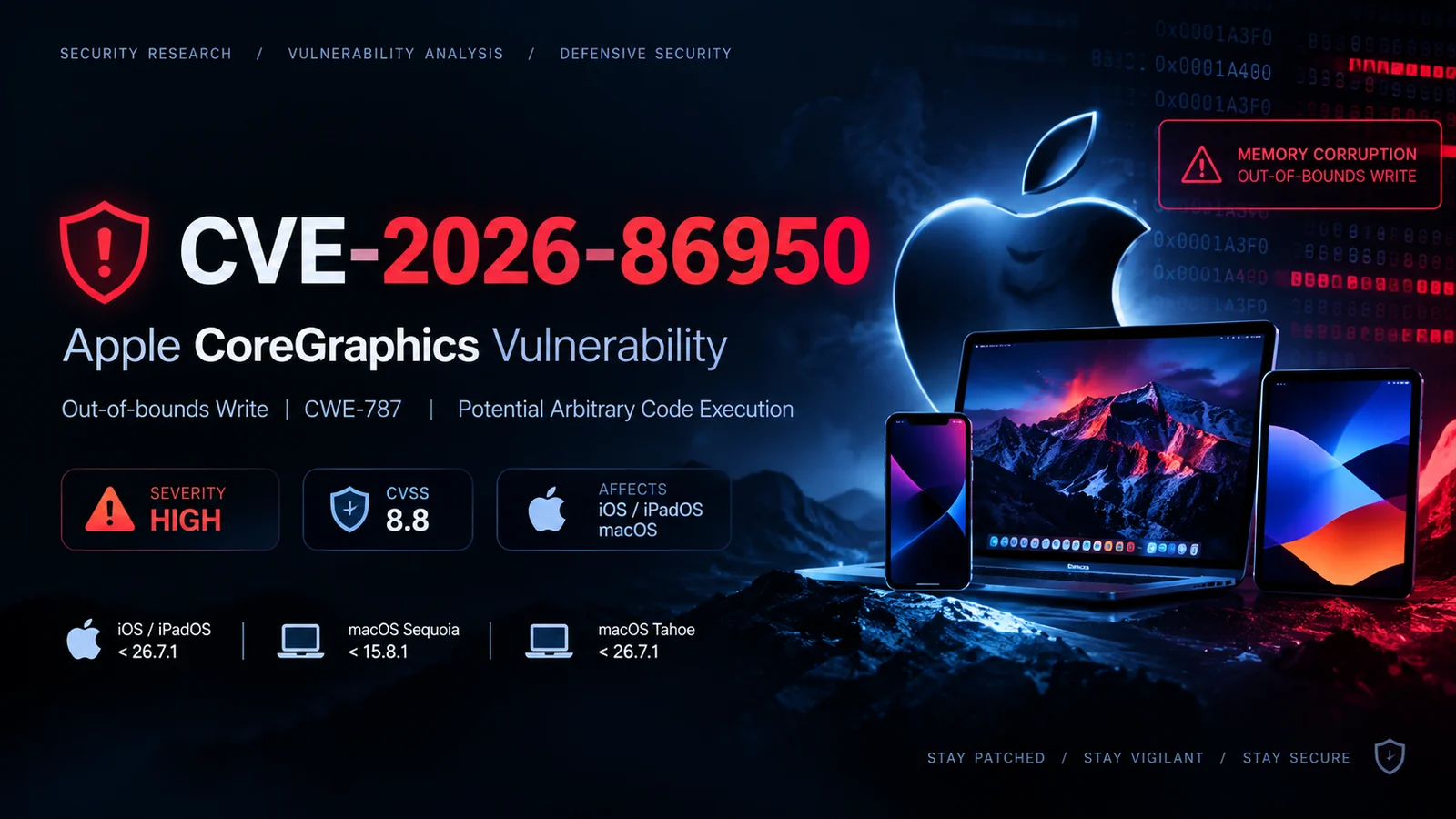
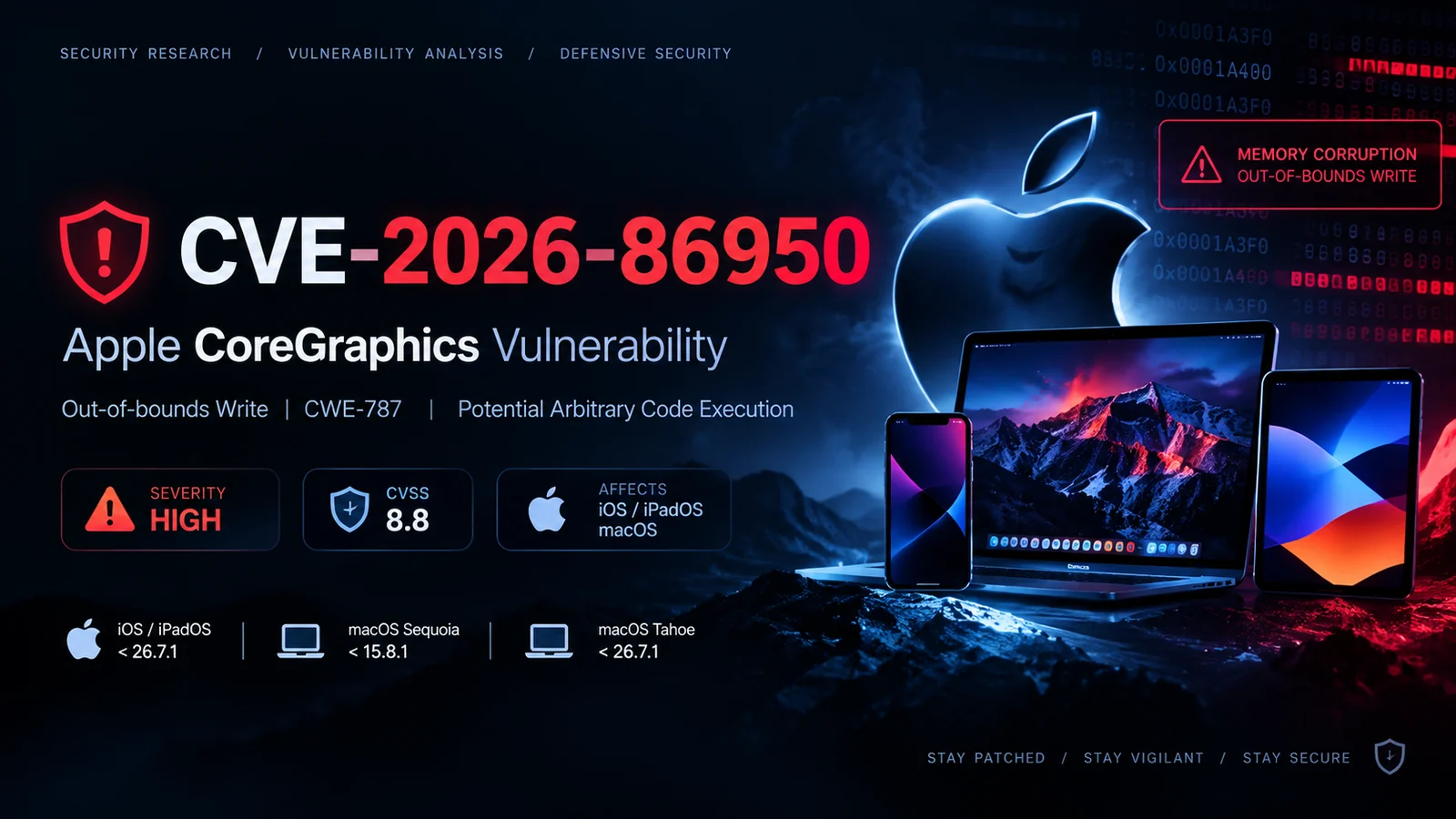
CVE-2026-86950 is a high-severity vulnerability affecting Apple's CoreGraphics component.
The vulnerability is classified as an out-of-bounds write (CWE-787) and can potentially result in memory corruption and arbitrary code execution when a vulnerable system processes specially crafted content.
⚠️ Security Notice
This repository is intended for authorized security research, vulnerability assessment, detection, and defensive analysis only.
| Property | Details |
|---|---|
| 🆔 CVE | CVE-2026-86950 |
| 🧩 Component | Apple CoreGraphics |
| 🐛 Weakness | CWE-787 — Out-of-bounds Write |
| 🔥 Severity | High |
| 📊 CVSS | 8.8 |
| 🌐 Attack Vector | Network |
| 👤 Privileges Required | None |
| 🖱️ User Interaction | Required |
| 💥 Potential Impact | Code execution / memory corruption |
| 🎯 Exploitation Status | Reported targeted exploitation |
The vulnerability affects specific versions of Apple's operating systems containing the vulnerable CoreGraphics implementation.
iOS / iPadOS
macOS Sequoia
macOS Tahoe
iOS / iPadOS       → 26.7.1+
macOS Sequoia     → 15.8.1+
macOS Tahoe       → 26.7.1+
💡 Version numbers should be verified against Apple's current security advisories before performing an assessment.
The vulnerability falls under:
CWE-787
Out-of-bounds Write
Conceptually, an out-of-bounds write occurs when software writes data outside the memory region allocated for an object or buffer.
A simplified representation:
┌───────────────────────────────┐
│       Allocated Buffer        │
├───────────────┬───────────────┤
│   Valid Data  │     Valid     │
└───────────────┴───────────────┘
                  ↓
             ❌ Invalid Write
                  ↓
┌──────────────────────────────────────┐
│ Adjacent Memory / Control Structures │
└──────────────────────────────────────┘
Depending on the surrounding memory layout and exploitability of the specific flaw, memory corruption vulnerabilities can have serious security consequences.
Potential security consequences may include:
The practical impact depends on the vulnerable execution path, affected process, mitigations, and the way malicious content reaches the target system.
For defensive assessments, first determine the installed operating-system version.
sw_vers
Example:
ProductName:    macOS
ProductVersion: 15.x.x
BuildVersion:   XXXXX
Navigate to:
Settings
   ↓
General
   ↓
About
   ↓
iOS Version / iPadOS Version
Then compare the installed version against Apple's security update information.
The primary mitigation is to update affected Apple devices to a security-fixed release.
1. 🔎 Identify affected devices
2. 📋 Determine installed OS versions
3. 🔐 Apply Apple's security updates
4. 🔄 Reboot if required
5. 🧪 Verify the patched version
6. 📊 Monitor endpoints for suspicious activity
Organizations should prioritize systems that process untrusted files or content.
This project deliberately focuses on non-destructive vulnerability research.
Recommended workflow:
                 ┌─────────────────┐
                 │ Identify Target  │
                 └────────┬────────┘
                          ↓
                 ┌─────────────────┐
                 │ Determine Build │
                 └────────┬────────┘
                          ↓
                 ┌─────────────────┐
                 │ Check Exposure  │
                 └────────┬────────┘
                          ↓
                 ┌─────────────────┐
                 │ Apply Patch     │
                 └────────┬────────┘
                          ↓
                 ┌─────────────────┐
                 │ Verify Fix      │
                 └────────┬────────┘
                          ↓
                 ┌─────────────────┐
                 │ Document Result │
                 └─────────────────┘
For lab research, use isolated devices or virtualized test environments where possible.
| Category | Rating |
|---|---|
| 🔥 Severity | HIGH |
| 🌐 Remote Attack Potential | Potentially applicable |
| 👤 Authentication | Not required according to CVSS vector |
| 🖱️ User Interaction | Required |
| 💻 Confidentiality | High impact |
| ✏️ Integrity | High impact |
| 📴 Availability | High impact |
[ ] Identify Apple devices in the environment
[ ] Collect OS/build versions
[ ] Identify systems below the fixed versions
[ ] Prioritize internet-facing / high-value endpoints
[ ] Deploy Apple's security updates
[ ] Verify successful patch deployment
[ ] Review endpoint telemetry
[ ] Investigate suspicious crashes or document-processing events
[ ] Record remediation status
This repository can be used for:
It intentionally avoids providing weaponized exploitation against real-world systems.
This project is intended exclusively for:
Authorized security testing, defensive research, education, and vulnerability assessment.
Do not use research material from this repository to attack systems without explicit authorization.
The maintainers are not responsible for misuse of the information provided here.
🔎 NIST National Vulnerability Database
CVE-2026-86950🍎 Apple Security Releases
🛡️ CISA Known Exploited Vulnerabilities Catalog
