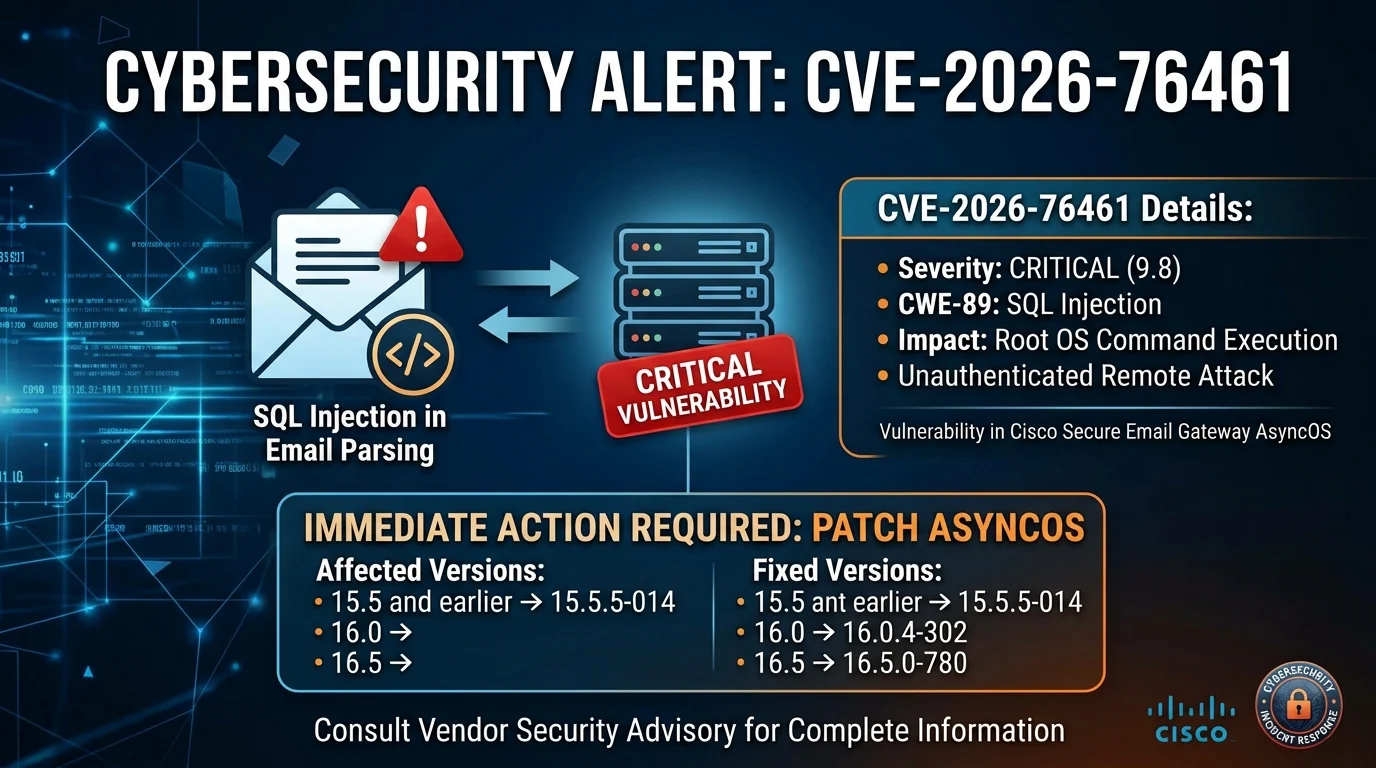
Research repository for CVE-2026-76461, a critical SQL injection in Cisco Secure Email Gateway leading to root RCE, with detection rules, mitigation guidance, and lab validation.
Critical SQL Injection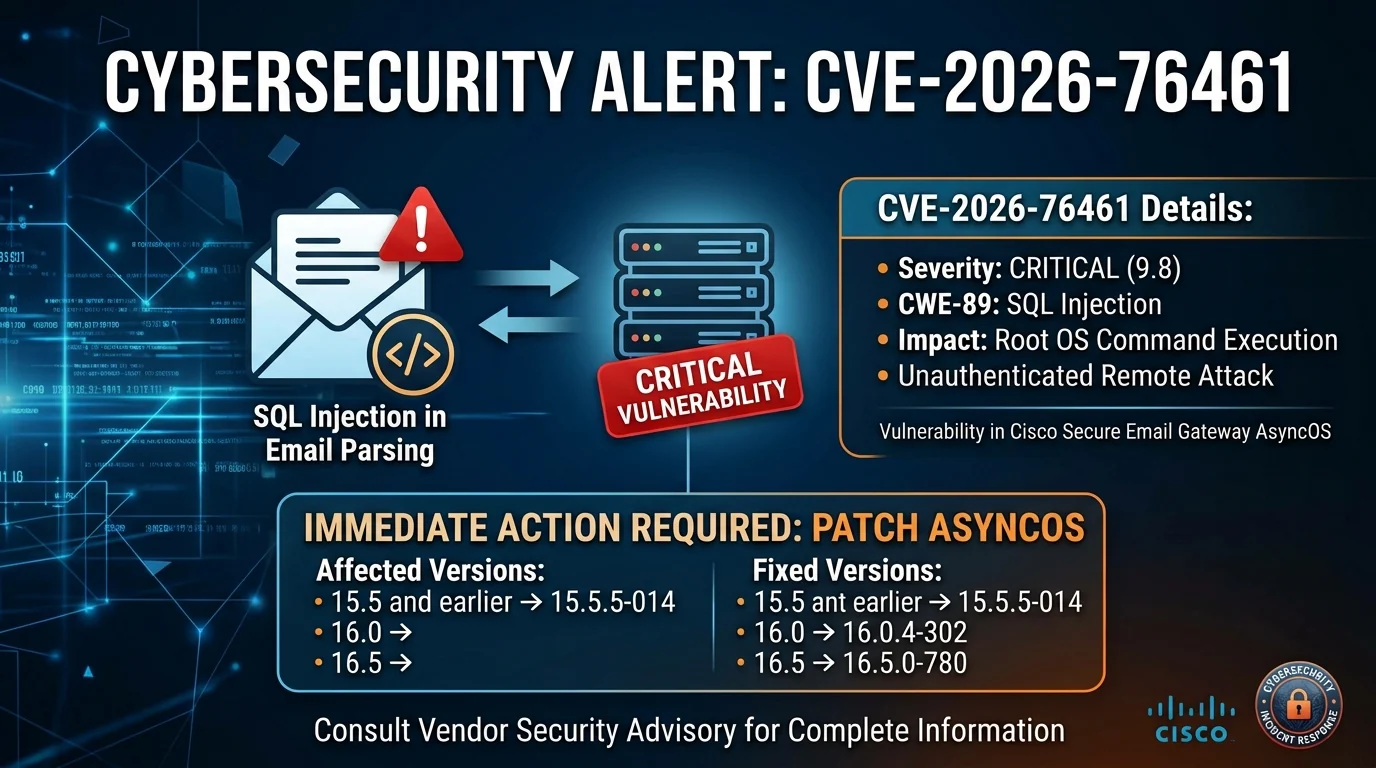












A critical, remotely exploitable SQL injection vulnerability in Cisco Secure Email Gateway's email parsing logic that can lead to arbitrary command execution with root privileges.

CVE-2026-76461 is a critical SQL injection vulnerability affecting Cisco AsyncOS Software for Cisco Secure Email Gateway.
The vulnerability exists due to insufficient validation in the email parsing logic.
An unauthenticated remote attacker can send a specially crafted email containing malicious SQL statements to an affected gateway. Successful exploitation can result in arbitrary SQL execution and ultimately command execution with root privileges on the underlying operating system.
Cisco confirmed that the vulnerability is actively exploited in the wild.
Severity: CRITICAL — Immediate remediation recommended.
                 INTERNET
                     │
                     │
              Crafted Email
                     │
                     ▼
        ┌─────────────────────────┐
        │  Cisco Secure Email     │
        │        Gateway          │
        └────────────┬────────────┘
                     │
                     ▼
             Email Parser
                     │
             Insufficient
              Validation
                     │
                     ▼
               SQL Injection
                     │
                     ▼
             Arbitrary SQL
                 Execution
                     │
                     ▼
          OS Command Execution
                     │
                     ▼
                ┌───────┐
                │ ROOT  │
                └───────┘
| Attribute | Details |
|---|---|
| CVE | CVE-2026-76461 |
| Vendor | Cisco |
| Product | Cisco Secure Email Gateway |
| Software | Cisco AsyncOS |
| Vulnerability Type | SQL Injection |
| CWE | CWE-89 |
| CVSS | 9.8 Critical |
| Attack Vector | Network |
| Attack Complexity | Low |
| Privileges Required | None |
| User Interaction | None |
| Scope | Unchanged |
| Confidentiality | High |
| Integrity | High |
| Availability | High |
| Authentication | Not required |
| Impact | Root command execution |
| Exploitation | Active exploitation reported |
Malicious Email
      │
      ▼
Email Parsing
      │
      ▼
Insufficient Input Validation
      │
      ▼
SQL Injection
      │
      ▼
Arbitrary SQL Statements
      │
      ▼
Command Execution
      │
      ▼
ROOT PRIVILEGES
The important characteristic of this vulnerability is that the attack surface is the email-processing path itself, rather than requiring access to the administrative interface.
An attacker does not need:
❌ Valid credentials
❌ Administrative privileges
❌ Existing account
❌ User interaction
❌ Local network access
The fundamental requirement is the ability to deliver a maliciously crafted email to an affected gateway.
Remote Attacker
      │
      │  Malicious Email
      ▼
Cisco Secure Email Gateway
      │
      ▼
Vulnerable Email Parser
      │
      ▼
SQL Injection
      │
      ▼
Root Command Execution
Successful compromise of the gateway can have severe consequences:
Because exploitation can result in root privileges, post-compromise investigation should not rely exclusively on logs stored on the affected appliance.
Cisco reported active exploitation in September 2026.
The vulnerability has also been added to the CISA Known Exploited Vulnerabilities (KEV) catalog.
Organizations operating affected Cisco Secure Email Gateway deployments should therefore treat this as an emergency remediation issue, rather than a routine patching event.
Cisco recommends reviewing the appliance's mail_logs for suspicious SQL statements.
A particularly important detection pattern is:
COPY.*TO PROGRAM
Administrators can investigate the mail logs using the Cisco ESA CLI:
grep -i "COPY.*TO PROGRAM" [mail_logs]
Any matching entry should be investigated as a potential indicator of malicious activity.
Do not limit investigation to the affected appliance.
Review:
├── mail_logs
├── Network firewall logs
├── DNS logs
├── Proxy logs
├── Egress traffic
├── Authentication logs
├── Cluster member logs
└── Endpoint telemetry
Look for:
Unexpected outbound connections
Unexpected downloads
Unexpected uploads
Suspicious external IP addresses
Unexpected configuration changes
Unknown processes
Unexpected authentication activity
Cisco has warned that attackers with root access may be able to remove or conceal evidence on the compromised device.