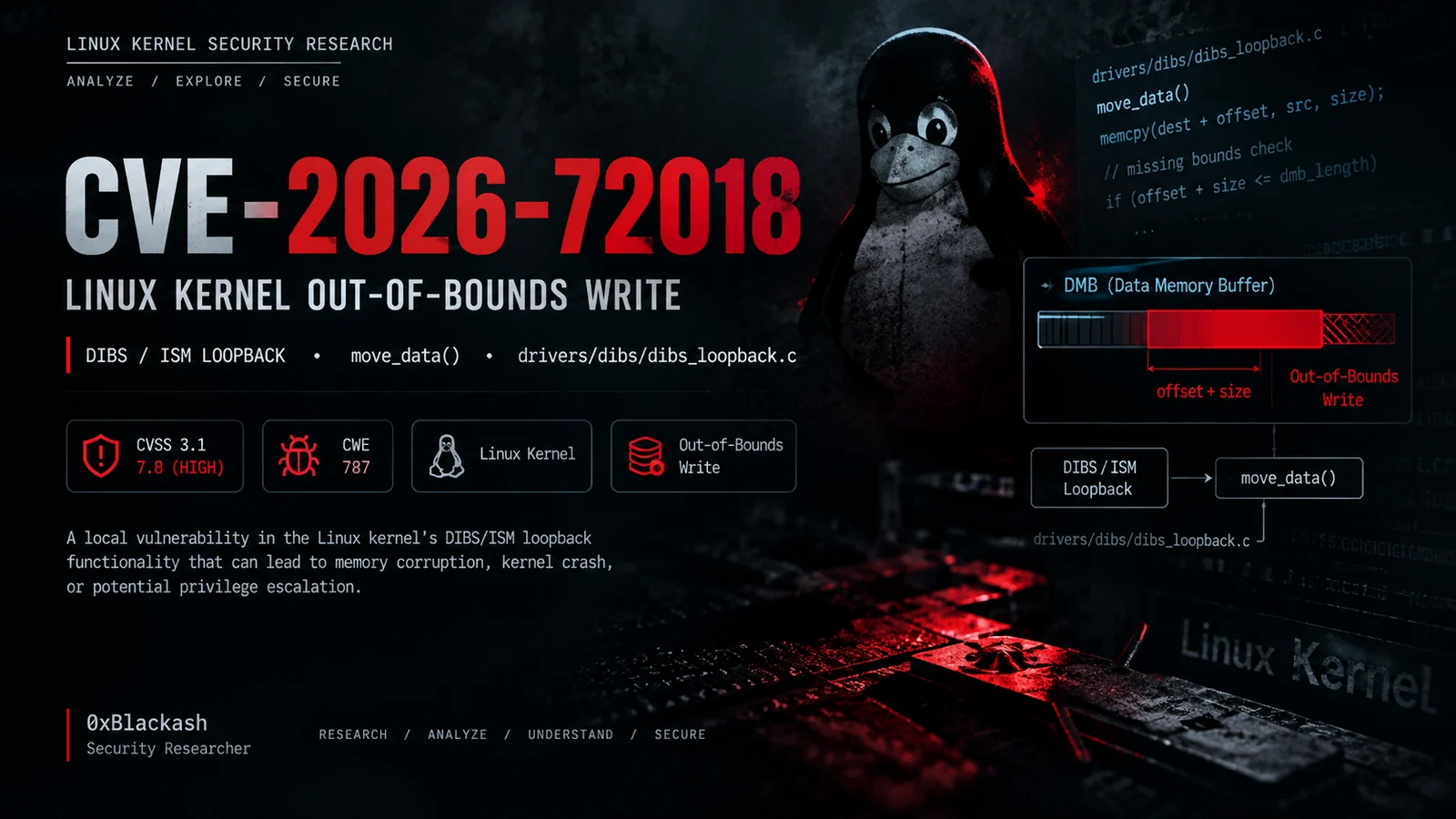
 0xblackash/cve-2026-72018
Technical analysis of CVE-2026-72018, a Linux kernel out-of-bounds write in DIBS/ISM loopback, covering root cause, affected versions, detection, and mitigation.

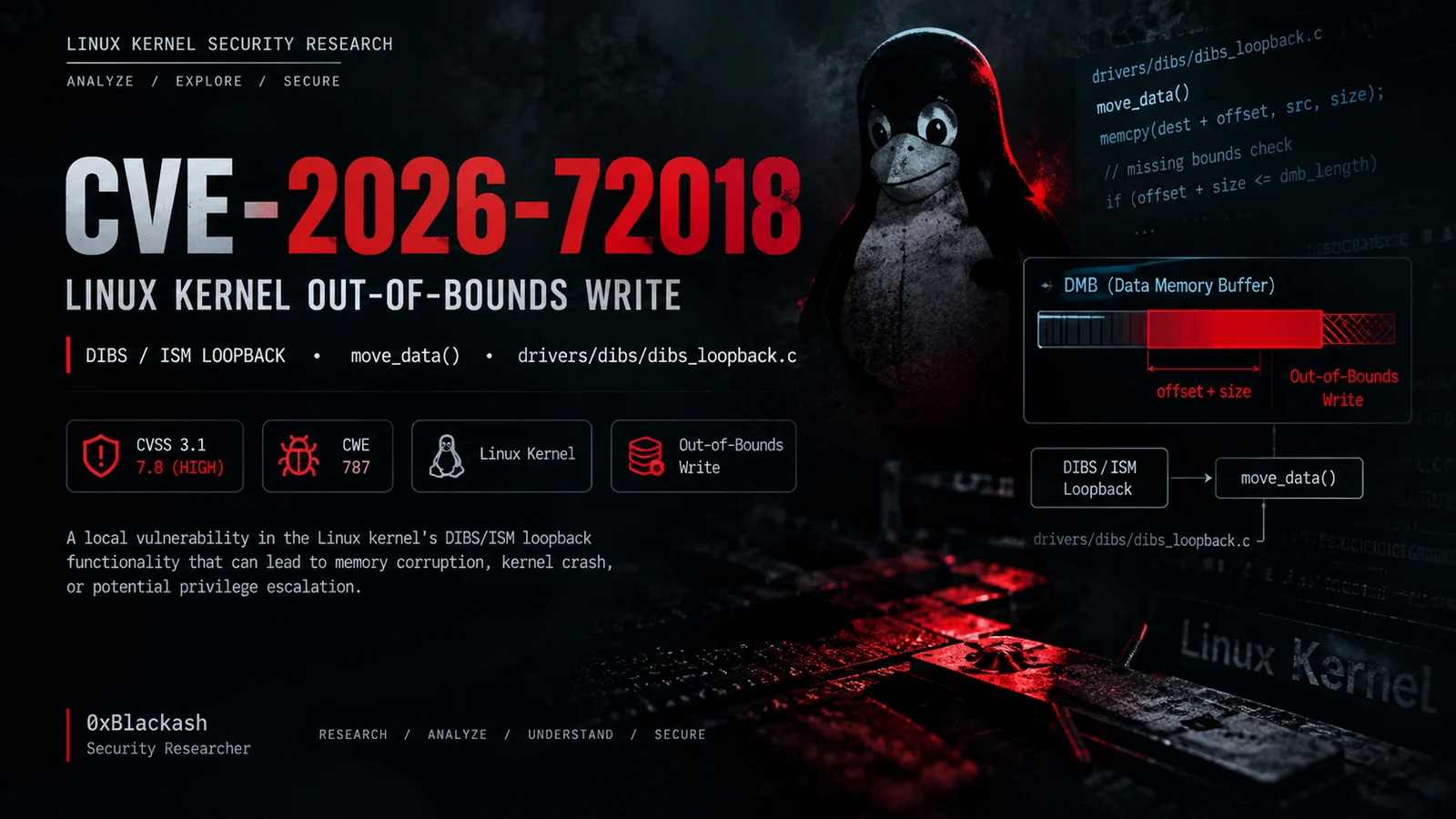




Linux Kernel • DIBS Loopback • Out-of-Bounds Write
Security research and technical analysis of CVE-2026-72018.
01 — OverviewCVE-2026-72018 is a Linux kernel out-of-bounds write vulnerability affecting the DIBS/ISM loopback functionality.
The vulnerability is associated with the handling of data transferred into a registered DMB (Data Memory Buffer).
The affected implementation does not adequately validate the relationship between the supplied offset, transfer size, and the actual DMB boundaries before performing the memory operation.
| Property | Value |
|---|---|
| CVE | CVE-2026-72018 |
| CWE | CWE-787 — Out-of-bounds Write |
| CVSS v3.1 | 7.8 — High |
| Attack Vector | Local |
| Privileges Required | Low |
| User Interaction | None |
| Confidentiality | High |
| Integrity | High |
| Availability | High |
| Component | Linux Kernel |
| Area | DIBS / ISM Loopback |
02 — Technical SummaryThe vulnerable code path involves:
drivers/dibs/dibs_loopback.c
and the:
move_data()
function.
Conceptually, the problematic operation can be represented as:
memcpy(destination + offset, source, size);
The security boundary that must be maintained is:
offset + size <= DMB_length
If this relationship is not correctly enforced, the resulting memory operation may extend beyond the valid DMB region.
             DMB
┌──────────────────────────────────────┐
│                                      │
│        Valid Memory Region           │
│                                      │
│   ┌────────────────────────────┐     │
│   │      offset + size         │     │
│   └────────────────────────────┘     │
│                                      │
└──────────────────────────────────────┘
                    │
                    ▼
              Boundary Check
                    │
          ┌─────────┴─────────┐
          │                   │
        VALID               INVALID
          │                   │
          ▼                   ▼
       memcpy()        Out-of-Bounds Write
03 — Root CauseThe underlying issue is insufficient bounds validation before copying data into the destination DMB.
A secure implementation should ensure that:
offset <= dmb_length
and:
size <= dmb_length - offset
before performing the copy.
Using subtraction for the second check also avoids an integer-overflow-style comparison such as:
offset + size <= dmb_length
when dealing with attacker-controlled integer values.
if (offset > dmb_length)
    return -EINVAL;

if (size > dmb_length - offset)
    return -EINVAL;
Only after these checks should the memory operation proceed.
04 — Security ImpactAn out-of-bounds write in kernel space can potentially result in:
User-controlled input
        │
        ▼
Insufficient bounds validation
        │
        ▼
Out-of-bounds memory write
        │
        ├──► Kernel memory corruption
        │
        ├──► Kernel crash / DoS
        │
        └──► Potential privilege escalation
The actual exploitability and impact depend on the kernel configuration, memory layout, reachable code paths, mitigations, and system configuration.
Important: CVSS describes the potential severity of the vulnerability; it does not by itself demonstrate a working privilege-escalation or code-execution exploit.
05 — Affected Codedrivers/
└── dibs/
└── dibs_loopback.c
Relevant function:
move_data()
The vulnerability involves the interaction between:
DIBS
 │
 └── ISM Loopback
       │
       └── DMB
            │
            └── Memory Transfer
06 — Affected VersionsAlways verify the status against the kernel distribution you are testing because Linux distributions may backport security fixes.
Reported affected ranges include:
6.10.x

6.13.x – 6.18.39

6.19.x – 7.1.4
Reported fixed versions include:
6.12.97
6.18.40
7.1.5
Development branches may contain the fix at different revision points.
uname -r
Additional information:
uname -a
For distribution-specific package information:
cat /etc/os-release
07 — Lab VerificationThis repository is intended for authorized security research and defensive testing.
Recommended workflow:
# Identify the running kernel
uname -r

# Identify distribution
cat /etc/os-release

# Inspect kernel configuration
zgrep -i "DIBS\|ISM" /proc/config.gz 2>/dev/null

# Check loaded modules
lsmod | grep -Ei "dibs|ism"

# Inspect kernel messages
dmesg | grep -Ei "dibs|ism|smc"
For source-code analysis:
grep -R "move_data" drivers/dibs/ 2>/dev/null
The exact commands available depend on the kernel source and distribution configuration.
08 — Research MethodologyA useful analysis workflow is:
       ┌──────────────────┐
       │ Identify Kernel  │
       └────────┬─────────┘
                │
                ▼
       ┌──────────────────┐
       │ Locate Component │
       └────────┬─────────┘
                │
                ▼
       ┌──────────────────┐
       │ Review Data Flow │
       └────────┬─────────┘
                │
                ▼
       ┌──────────────────┐
       │ Find Boundary    │
       │ Validation       │
       └────────┬─────────┘
                │
                ▼
       ┌──────────────────┐
       │ Compare Patched  │
       │ / Vulnerable     │
       │ Implementations  │
       └────────┬─────────┘
                │
                ▼
       ┌──────────────────┐
       │ Validate in an   │
       │ Isolated Lab     │
       └──────────────────┘
09 — Defensive AnalysisWhen investigating a potentially affected system:
uname -r
cat /etc/os-release
Use the security advisory provided by your Linux distribution rather than relying only on the upstream kernel version.
Install the security update supplied by the distribution.
A running kernel continues to use the currently loaded kernel image until reboot.
10 — Detection IdeasSecurity teams can monitor for unusual kernel behavior associated with the affected subsystem.
Potential indicators include:
