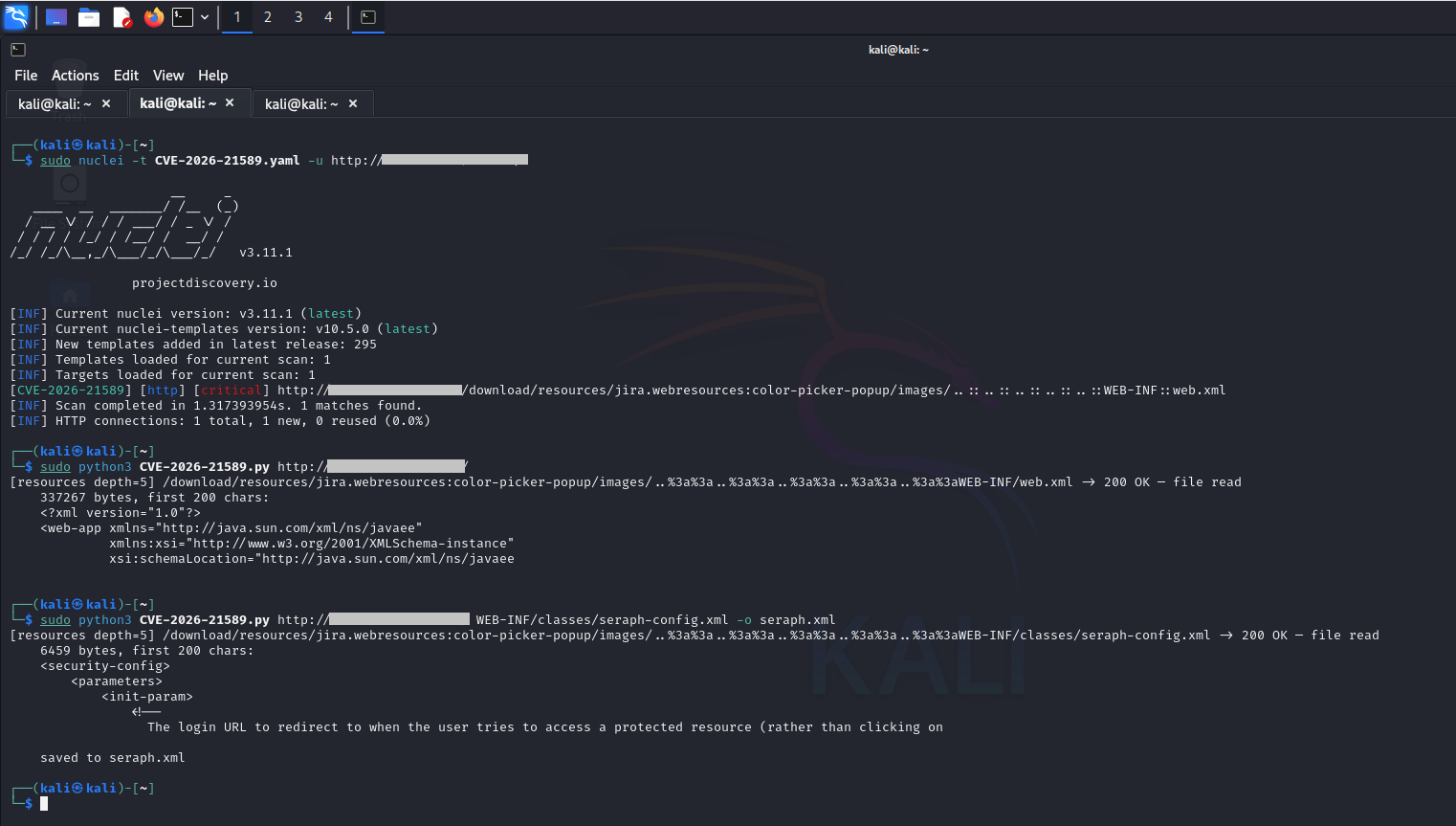

Technical analysis and detection guidance for CVE-2026-21589, a pre-auth path traversal arbitrary file access flaw in Atlassian Data Center products.
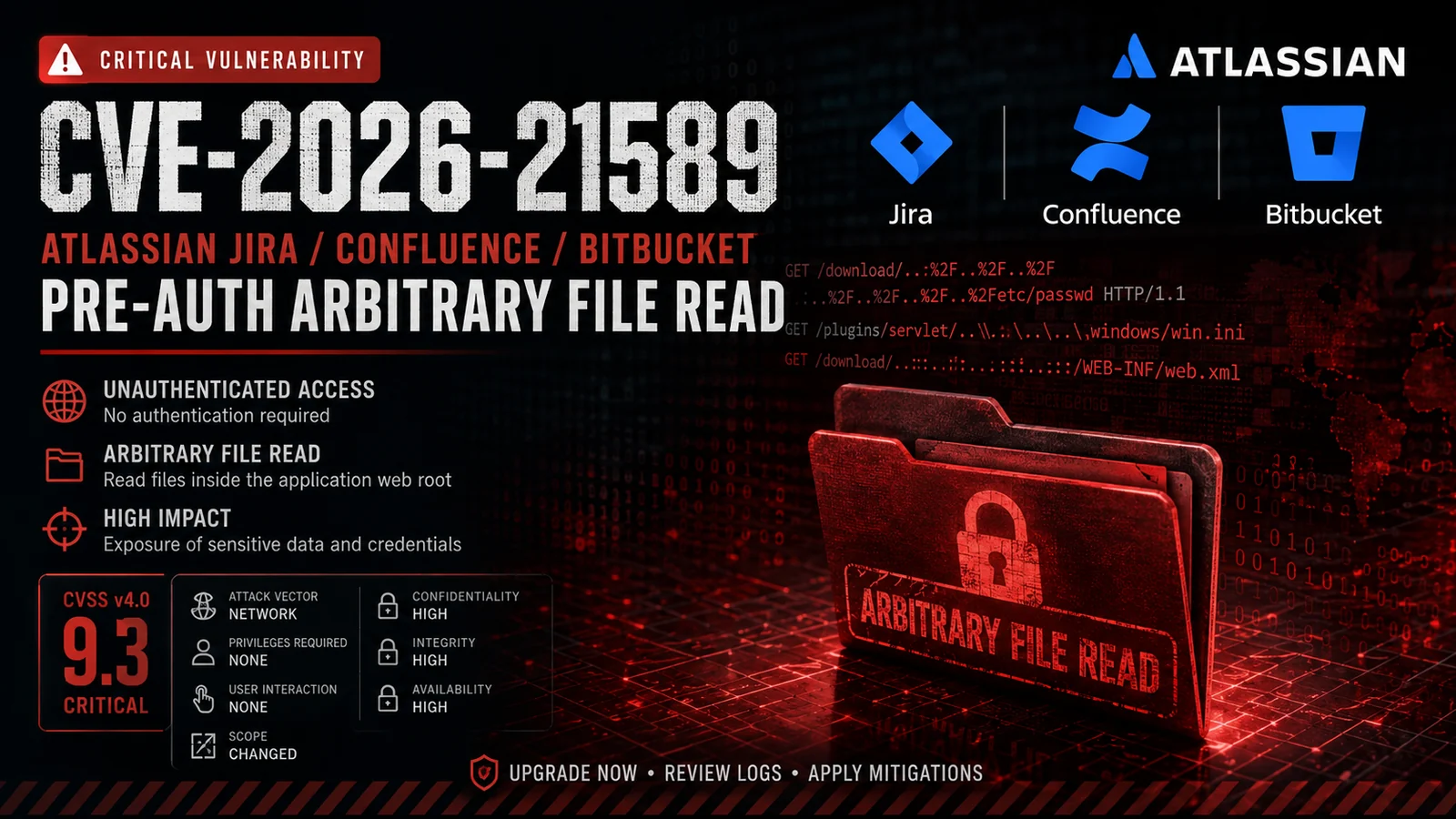






Unauthenticated Arbitrary File Access via Path Traversal
Security research and technical analysis of CVE-2026-21589 affecting multiple Atlassian Data Center products.
CVE-2026-21589 is a critical unauthenticated arbitrary file access vulnerability affecting multiple Atlassian Data Center products.
The vulnerability allows a remote, unauthenticated attacker to access specific files located within the application's web application root.
Exploitation does not require valid credentials or user interaction, but the attacker must know the exact name and path of the target file. The vulnerability does not provide directory listing or arbitrary file enumeration.
CVE: CVE-2026-21589
Severity: Critical
CVSS v4.0: 9.3
Attack Vector: Network
Privileges Required: None
User Interaction: None
Vulnerability Class: Path Traversal / Arbitrary File Access
Important: This vulnerability should be considered particularly serious for internet-facing self-hosted Atlassian deployments.
CVE-2026-21589 affects the following Atlassian products:
| Product | Fixed Versions |
|---|---|
| Bitbucket Data Center | 9.4.26, 10.2.8, 10.5.1 |
| Confluence Data Center | 9.2.26, 10.2.19 |
| Jira Software Data Center | 9.12.40, 10.3.26, 11.3.12 |
| Jira Service Management Data Center | 5.12.40, 10.3.26, 11.3.12 |
| Bamboo Data Center | 10.2.24, 12.1.12 |
| Crowd Data Center | 6.3.7, 7.0.3, 7.1.7, 7.2.4 |
| Crucible | 4.9.15 |
| Fisheye | 4.9.15 |
All versions prior to the applicable fixed releases are considered affected by Atlassian's advisory.
The vulnerability is associated with improper handling of path information in Atlassian's web-resource processing.
A specially crafted request can cause traversal components to be interpreted as path separators, allowing the request to reach files that should not normally be exposed through the affected resource-handling mechanism.
Conceptually:
Unauthenticated HTTP Request
          |
          v
   Crafted Resource Path
          |
          v
   Path Traversal Handling
          |
          v
Application Web Root
          |
          v
   Target File Disclosure
The attack does not inherently provide directory listing.
An attacker therefore needs prior knowledge of a target file's:
Filename
+
Path
before attempting to retrieve it.
The underlying issue involves path normalization and traversal handling in shared Atlassian web-resource functionality.
Security research published after the advisory demonstrated that specially constructed traversal sequences can interact with the application's resource-loading logic.
One important characteristic identified during research is the handling of :: sequences as path separators during request processing.
Conceptually:
Normal Path
    |
    v
Resource Resolver
    |
    v
Expected Application Resource


Malicious Path
    |
    v
Traversal Sequence
    |
    v
Resource Resolver
    |
    v
Unexpected File
The exact exploitation behavior depends on the affected product and deployment configuration.
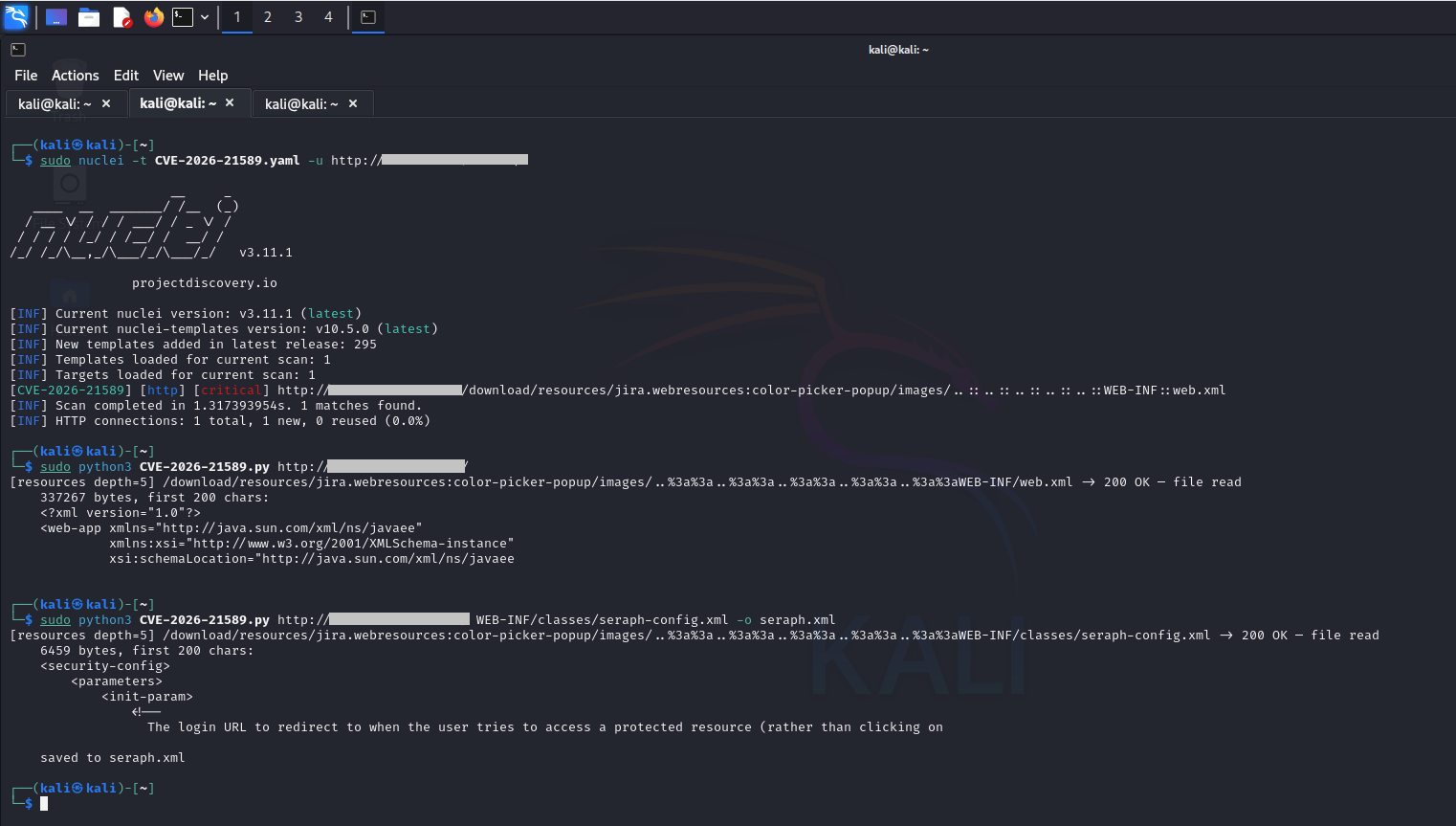
| Property | Value |
|---|---|
| Authentication | Not required |
| User Interaction | Not required |
| Attack Vector | Network |
| Attack Complexity | Low |
| Privileges Required | None |
| Primary Impact | Confidentiality |
| Secondary Impact | Potential system compromise depending on exposed files/configuration |
| Directory Enumeration | Not provided directly |
| Remote Exploitation | Yes |
| Internet Exposure Risk | High |
The official CVSS v4.0 vector is:
CVSS:4.0/AV:N/AC:L/AT:N/PR:N/UI:N/VC:H/VI:N/VA:N/SC:H/SI:H/SA:H
CVSS Score:
9.3 — CRITICAL
The primary security impact is unauthorized access to files inside the application's web root.
Depending on the product, installation, and exposed file, this may result in disclosure of:
Application configuration
Deployment information
Internal application resources
Credentials or secrets
Integration configuration
Other sensitive application data
The actual impact depends heavily on what files exist within the affected application's web root.
A particularly dangerous scenario can occur when Atlassian products are integrated with Crowd or other centralized authentication infrastructure and sensitive configuration files contain reusable credentials.
Security researchers demonstrated scenarios where exposed Crowd configuration information could potentially be chained into further compromise in certain deployments.
An attacker requires:
1. Network access to the vulnerable Atlassian instance
2. No authentication
3. Knowledge of a target file path
4. A vulnerable product/version
The vulnerability does not provide:
Directory listing
Automatic filesystem enumeration
Authentication bypass by itself
Direct arbitrary command execution
The impact therefore depends strongly on the files that can be identified and retrieved.
Organizations should investigate HTTP access logs for traversal attempts.

