

cicd-sensor vrules/v20260714-002
eBPF-powered runtime security sensor for CI/CD pipelines. Detects supply-chain attacks, logs process ancestry and file access, and provides forensic evidence for GitHub Actions and GitLab CI/CD.
🚧 Pre-release: Active development. cicd-sensor is currently in pre-release and under active development. Feedback is very welcome.

cicd-sensor
Think EDR, but for CI/CD Pipelines.
Open-source eBPF-powered runtime security sensor for GitHub Actions and GitLab CI/CD.
→ Full documentation




Demo
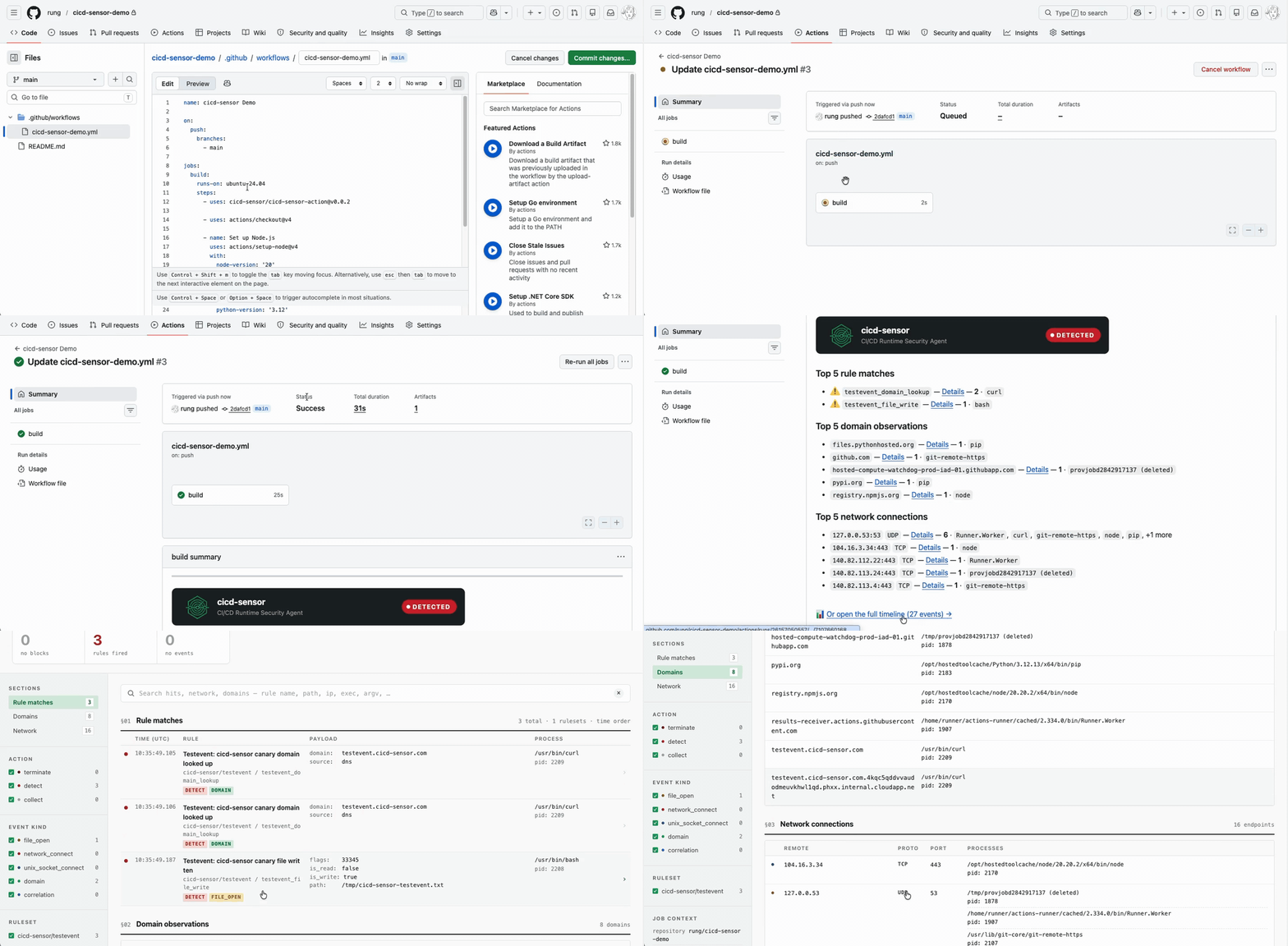
|
What cicd-sensor does
When a compromised dependency in a CI/CD job steals your cloud credentials and leaks them, would you catch it? Would you have the logs to investigate afterward? cicd-sensor is an open-source sensor that lets every team answer both.
Detection: Detects supply-chain attacks at runtime using process ancestry (e.g. credential access from a process descended from npm install) and correlation across signals (e.g. multiple credential categories read in one job). Baseline rules target patterns seen in real CI/CD attacks, and are opt-out: turn them off if you only want the logs and evidence below.
Logs and evidence: Per run, cicd-sensor can emit logs for review, alerting, and forensics, routed through cicd-sensor Manager to cloud sinks like S3, GCS, Azure Blob, and Pub/Sub. The cicd-sensor-action can also produce a graphical report and a build attestation per run. Your data stays under your control. cicd-sensor never sends anything to servers operated by the cicd-sensor project.
Quick start
On GitHub-hosted runners, add the cicd-sensor action as the first step in your workflow.
jobs:
  build:
    runs-on: ubuntu-24.04
    steps:
      - uses: cicd-sensor/cicd-sensor-action@2bc31a18949a77cd5f5bd452f24f00fbb507cdf6 # v0.0.41
For self-hosted GitHub Actions or GitLab CI/CD, see the User Guide.
Why CI/CD runtime needs this
CI/CD pipelines build, release, deploy, and manage cloud infrastructure, and they hold the cloud credentials, signing keys, and registry tokens to do it. Supply-chain attackers run inside those jobs and disappear with the evidence when the job ends.
Most other runtimes have their open-source defenders: Falco, Tetragon, Tracee, Wazuh, OSQuery. Open-source coverage for CI/CD runtime has lagged behind. Sigstore proved where and how artifacts were built; cicd-sensor preserves what actually ran so teams can detect, respond, and audit.
Feature comparison
| Capability | cicd-sensor | Harden-Runner (Free) | Comment |
|---|---|---|---|
| Licensing & deployment | |||
| Open source | ✅ Yes | ✅ Yes | |
| Data privacy | ✅ Self-hosted | SaaS backend | cicd-sensor runs entirely in your infrastructure, so logs and events stay in your environment. |
| Platform coverage | |||
| Private repos | ✅ Yes | ❌ No | |
| Self-hosted runners | ✅ Yes | ❌ No | Enforcing self-hosted runners enables organization-wide log collection across every job. |
| GitHub Actions support | ✅ Yes | ✅ Yes | |
| GitLab CI/CD support | ✅ Yes | ❌ No | |
| Capabilities | |||
| Detection rules | ✅ Yes | ✅ Yes | |
| Flexible custom rules | ✅ Yes | 🔶 Limited | cicd-sensor rules cover process ancestry, file access, and correlation across signals; Harden-Runner is mainly a network egress allowlist. |
| Network blocking | 🔶 Partial | ✅ Yes | cicd-sensor kills the process and stops the job on detection instead of filtering traffic like a firewall. |
| Log export | ✅ Yes | ❌ No |
This table compares the free version of Harden-Runner. StepSecurity's paid platform adds more, such as private repository and self-hosted runner support, dashboards, and policy management.
Based on public information as of May 2026. Corrections welcome.
Third-party services
Takumi Runner by GMO Flatt Security acts as a hosted cicd-sensor Manager and adds its own threat detection and trace analysis on top of the collected logs. See their integration guide (English / Japanese) for setup. It is a separate commercial product, and cicd-sensor works without it.
cicd-sensor is a vendor-neutral open-source project: it works on its own, and any manager it talks to is one you choose to run. Other vendors and services are equally welcome to integrate with cicd-sensor.
When cicd-sensor is pointed at a third-party hosted manager, the logs and events it collects are sent to that vendor's service.
Supported CI/CD pipelines
| Platform | Environment | Status |
|---|---|---|
| GitHub Actions | GitHub-hosted runner | ✅ Supported |
| GitHub Actions | Self-hosted runner on a machine | ✅ Supported |
| GitHub Actions | Actions Runner Controller on Kubernetes | 🧪 Preview support |
| GitLab CI/CD | GitLab Runner Docker executor | ✅ Supported |
| GitLab CI/CD | GitLab Runner Kubernetes executor | 🧪 Preview support |
| GitLab CI/CD | GitLab-hosted runner | ❌ Not supported (technical constraints) |
Works on both public and private repositories, with no third-party SaaS dependency.
Linux kernel: 5.15 or later on amd64, 6.1 or later on arm64.
Rules
cicd-sensor ships with a set of baseline rules. See the Baseline Rules guide for how they work; the rule definitions themselves live in rules/. You can also write your own rules, or turn the baseline off entirely.
Documentation
- Getting Started: what cicd-sensor is and how to start.
- User Guide: deployment paths for GitHub Actions and GitLab CI/CD.
- Rules: write detection, collection, and correlation rules.
- Logging: log format delivered by the manager.
- Attestation predicate: runtime-trace predicate for CI/CD runtime evidence.
- Developer Guide: agent, eBPF runtime, manager, and rule engine internals.