
Skip to content
KitploitKITPLOIT
ToolsBlog
Einreichen
ToolsBlog
Einreichen

Hacking-, PenTest- und Cybersicherheits-Tools für Ihr Sicherheitsarsenal!

Kitploit ist ein Verzeichnis von Hacking-, Cybersicherheits- und Pentesting-Tools. Entdecken Sie die neuesten Projekt-Updates, um Schwachstellen zu finden, Systeme zu analysieren, Tests zu automatisieren und Ihre Sicherheit zu stärken.

··Feeds·Kontakt·Datenschutz·© 2026 Kitploit

Tool-Verzeichnis

Kategorien

Alle Kategorien anzeigen
Loading categories
asterion-network-minotaur — Netzwerk- und Domänensicherheits-Auditor, der Windows Active Directory, Linux-Systeme und Netzwerkinfrastruktur scannt, mit KI-gestützten Härtungsleitfäden und professioneller Berichterstattung. | Kitploit
Tools/GitHubGitHub/rodhnin/asterion-network-minotaur
AufklärungSchwachstellenscannerKonfigurationsprüfungInformationsbeschaffungNetzwerksicherheitPenetrationstestsCloud-SicherheitKI-Sicherheit

Beliebteste

Alle anzeigen →

Entdecken Sie die meistgenutzten Tools unserer Community.

Alle Tools erkunden

Durchsuchen Sie unsere Tool-Sammlung

Alle Tools anzeigen →
GitHub
rodhnin/asterion-network-minotaur

asterion-network-minotaur

Netzwerk- und Domänensicherheits-Auditor, der Windows Active Directory, Linux-Systeme und Netzwerkinfrastruktur scannt, mit KI-gestützten Härtungsleitfäden und professioneller Berichterstattung.

Repository anzeigen
31vor 3 MonatenNoch nicht geprüft
Teilen
Asterion — Netzwerk-Minotaurus

Version .NET Python Lizenz Docker Ethisch


Ethischer Netzwerksicherheits-Auditor — 50+ Prüfungen über SMB, RDP, LDAP, SSH, Kerberos und mehr, mit KI-gestützter CVE-Analyse und OWASP/CIS/NIST-Compliance-Zuordnung.


Schnellstart  ·  Dokumentation  ·  Docker  ·  KI-Funktionen  ·  Auf GitHub bewerten
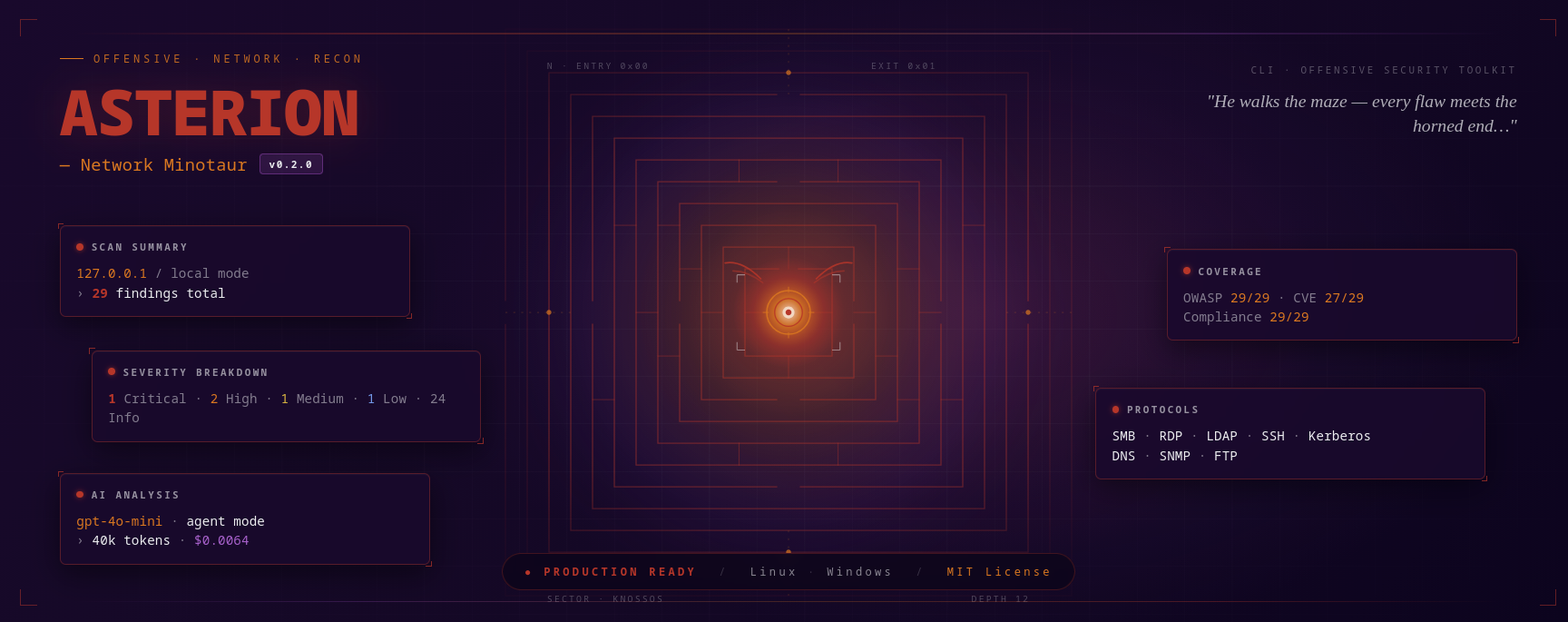

Asterion — Er durchstreift das Labyrinth, jede Schwachstelle trifft auf das gehörnte Ende

In Aktion

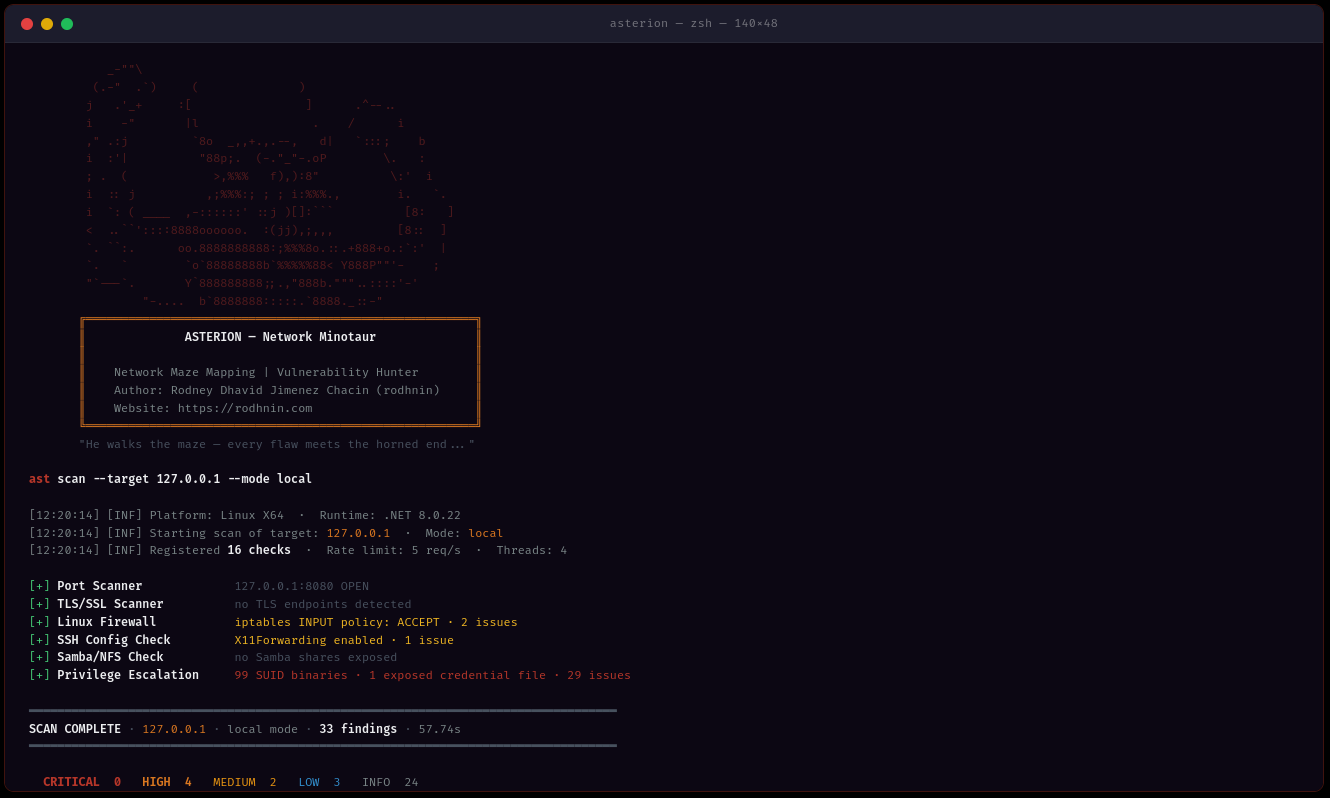
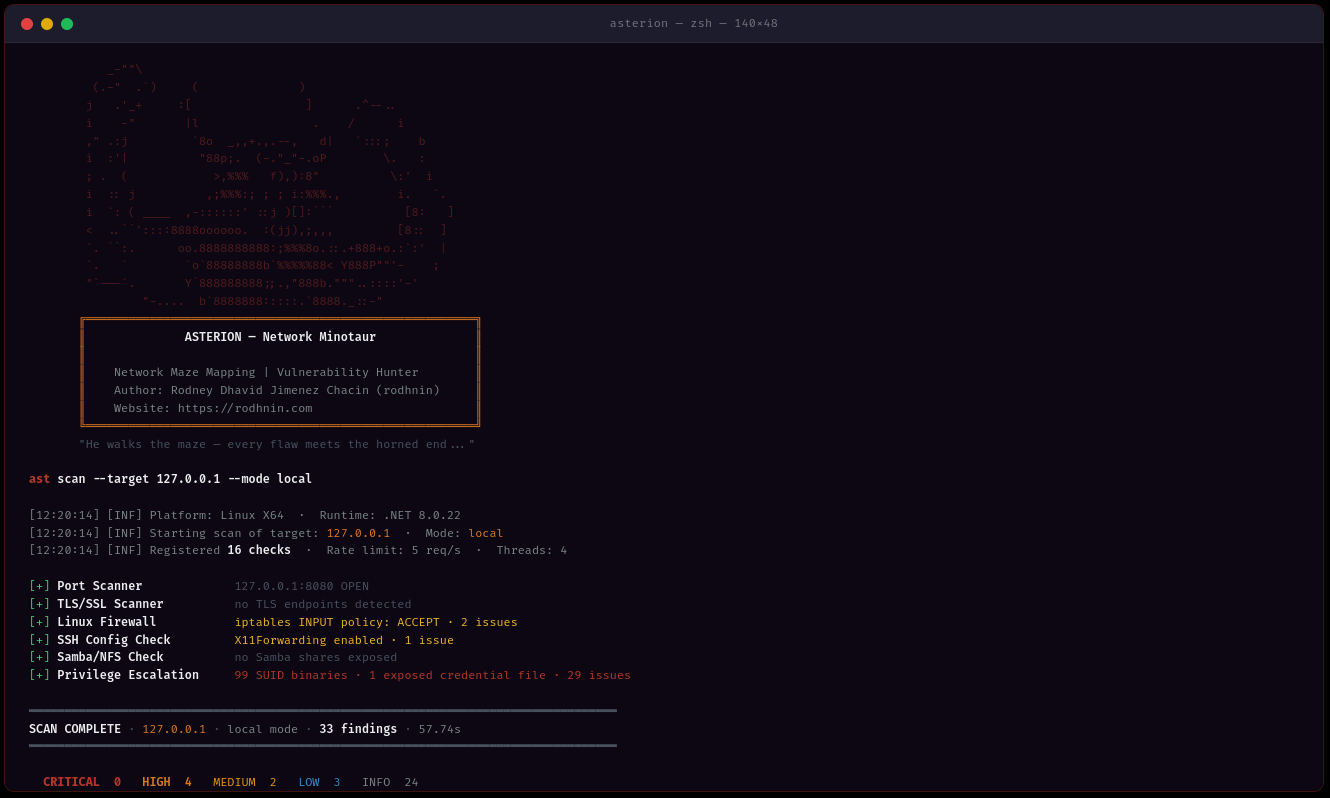
Asterion — echte Scan-Ausgabe
Lokaler Scan · 127.0.0.1 · 33 Ergebnisse (0C/4H/2M/3L/24I) · 16 Prüfungen · 57,74 s · .NET 8.0.22

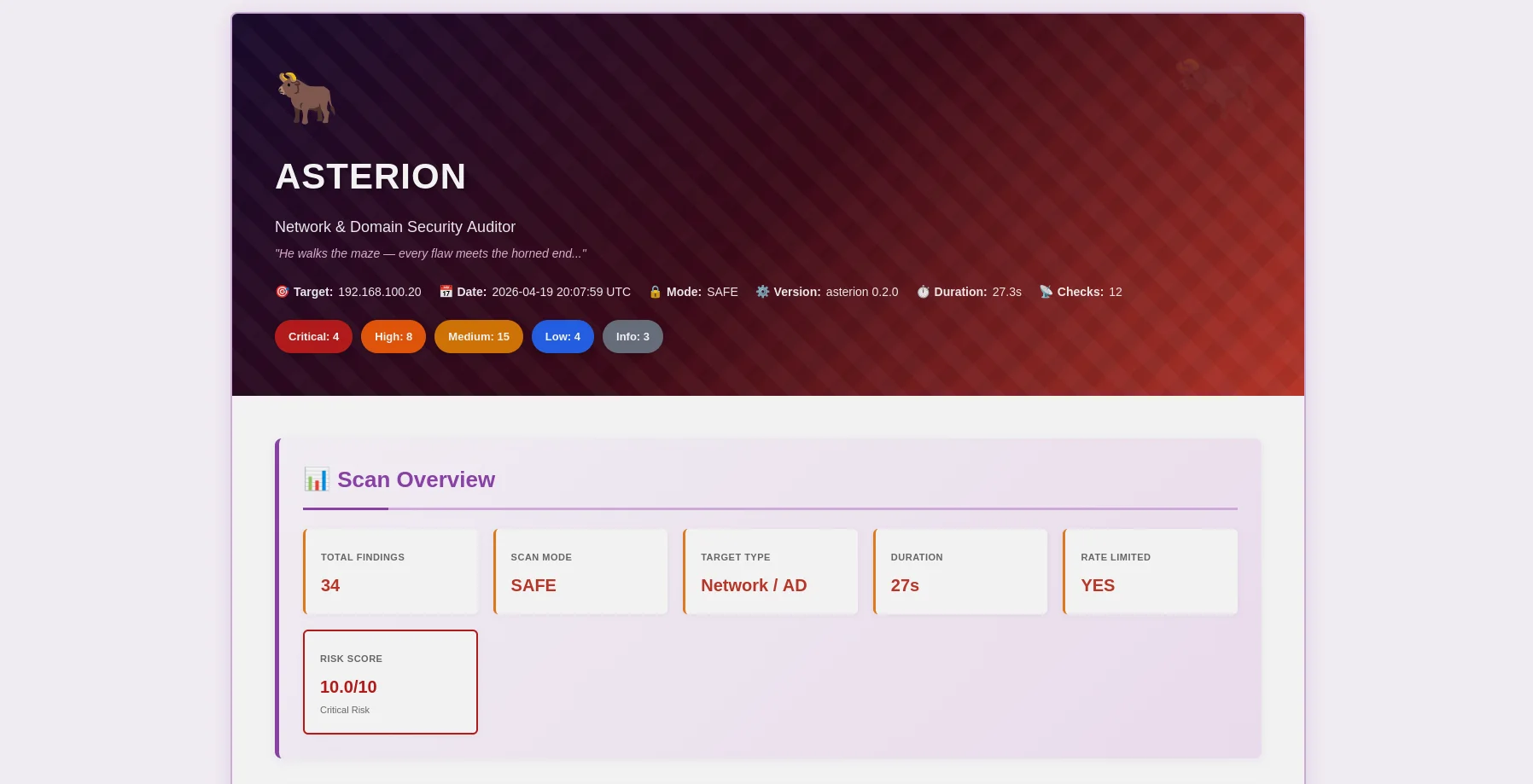
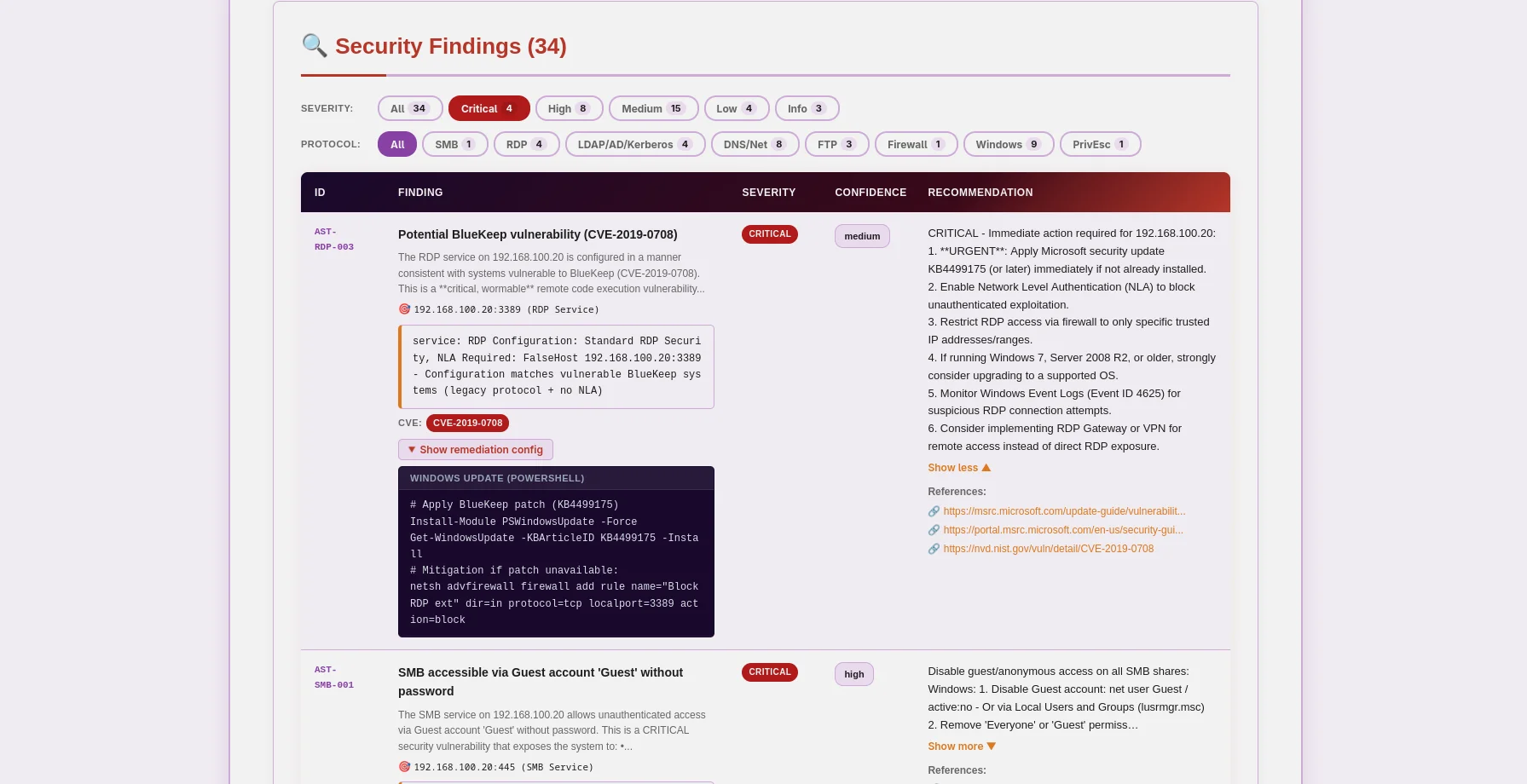
Asterion — HTML-Bericht mit Schweregrad-Abzeichen und KI-Analyse
Minotaurus-thematisierter HTML-Bericht — Schweregrad-Abzeichen, erweiterbare Beweise, KI-Behebung
Asterion — JSON-Bericht für Automatisierung
JSON-Bericht — OWASP/CIS/NIST/PCI-Zuordnung, CVE-Daten, maschinenlesbar

🎯 Was ist Asterion?

Asterion ist ein produktionsreifer Netzwerk- und Domänen-Sicherheitsauditor, der Ethik an erste Stelle setzt. Entwickelt für Penetrationstester, Sicherheitsforscher und Enterprise-Sicherheitsteams, kombiniert es traditionelle Schwachstellenscans mit modernster KI-Analyse, um umsetzbare Erkenntnisse für Windows Active Directory, Linux-Systeme und Netzwerkinfrastruktur zu liefern.

Warum Asterion?

  • 🔒 Ethisch von Grund auf: Consent-Token-System verhindert unbefugtes Scannen
  • 🤖 KI-gestützt: GPT-4, Claude oder lokales Ollama für intelligente Behebungsleitfäden
  • 📊 Professionelle Berichte: Schön gestaltetes HTML (Minotaurus-Thema) + maschinenlesbares JSON
  • 🚀 Schnell & Effizient: Multithreaded-Scanning mit intelligentem Rate-Limiting
  • 💾 Dauerhafte Nachverfolgung: Gemeinsame SQLite-Datenbank mit Argos Suite für Scan-Verlauf
  • 🐳 Docker-bereit: Containerisiertes Scannen für CI/CD-Integration

Was es scannt


✨ Funktionen

🛡️ Kernfunktionen Netzwerksicherheitsscanning```bash

One command, comprehensive network analysis

ast scan --target 10.0.0.0/24 --output html

root@kitploit:~
- **Multi-Methoden-Erkennung**: SMB, RDP, LDAP, Kerberos, SSH, FTP, DNS, SNMP-Protokollanalyse
- **Multi-Threading**: Gleichzeitiges Scannen mit 1–20 Worker-Threads
- **Intelligentes Raten-Limiting**: Konfigurierbare Anforderungsdrosselung (1–20 req/s) zur Vermeidung von Erkennung
- **Beweissammlung**: SMB-Freigaben, LDAP-Abfragen, PowerShell-Ausgabe erhalten

### 🤖 KI-gestützte Analyse

Wählen Sie Ihren KI-Anbieter je nach Bedarf:

| Anbieter               | Am besten für        | Geschwindigkeit | Kosten          | Datenschutz      |
| ---------------------- | -------------------- | --------------- | --------------- | ---------------- |
| **OpenAI GPT-4**       | Produktionsqualität  | ⚡ Schnell (40s) | 💰 $0.30/Scan  | 🔒 Standard      |
| **Anthropic Claude**   | Datenschutzorientiert | ⚡ Schnell (50s) | 💰 $0.35/Scan  | 🔒 Erweitert     |
| **Ollama (Lokal)**     | Vollständige Privatsphäre | 🐢 Langsam (30min) | 💰 Kostenlos | 🔐 100% Offline |

**Zwei Analysemodi:**

- **Technisch**: Schrittweise Behebung mit PowerShell-/GPO-Befehlen und Konfigurationsschnipseln
- **Management**: Einfach verständliche Zusammenfassungen für Stakeholder und Führungskräfte

### 📊 Professionelle Berichterstattung

**JSON-Berichte** (maschinenlesbar)```json
{
  "tool": "asterion",
  "version": "0.2.0",
  "target": "192.168.1.10",
  "riskScore": 10.0,
  "summary": {
    "critical": 3,
    "high": 8,
    "medium": 16,
    "low": 5,
    "info": 2
  },
  "findings": [
    {
      "id": "AST-SMB-003",
      "title": "SMBv1 protocol enabled (EternalBlue vector)",
      "severity": "high",
      "owasp": { "id": "A06", "name": "Vulnerable and Outdated Components" },
      "vulnerabilities": [
        {
          "cve_id": "CVE-2017-0143",
          "cvss_score": 9.8,
          "cwe_id": "CWE-119"
        }
      ],
      "cvss": 9.8
    }
  ],
  "attackChains": [...],
  "diff": { "refScanId": 41, "new": [...], "fixed": [...], "persisting": [...] }
}

HTML Reports (benutzerfreundlich)

  • 🎨 Minotaurus-Design (rot/orange/violettes Farbschema)
  • 🏷️ Farbcodierte Schweregrad-Badges
  • 📝 Erweiterbare Beweisabschnitte (SMB-Freigaben, LDAP-Abfragen, PowerShell-Ausgabe)
  • 🤖 KI-Analyse schön formatiert
  • 📱 Mobilfreundliches responsives Design

🔐 Einwilligungs-Token-System

Asterion erzwingt ethisches Hacken durch Technologie. Aggressives Scannen und KI-Analyse erfordern Eigentumsnachweis:```bash

1. Generate token

ast consent generate --domain corp.local

2. Place token (choose one method)

HTTP: Upload to https://corp.local/.well-known/verify-abc123.txt

DNS: Add TXT record: corp.local = "asterion-verify=verify-abc123"

SSH: Create file /tmp/consent_verify-abc123 with token content

3. Verify ownership

ast consent verify --method http --domain corp.local --token verify-abc123

4. Now you can use aggressive mode

ast scan --target corp.local --mode aggressive --use-ai

root@kitploit:~
### 💾 Datenbank-Persistenz

Gemeinsame SQLite-Datenbank mit Argos Suite verfolgt alles:

- **Scan-Historie**: Datum, Dauer, Anzahl der Funde, Schweregrad-Aufschlüsselung
- **Fund-Repository**: Durchsuchbare Schwachstellendatenbank über alle Argos-Tools hinweg
- **Verifizierte Domains**: Consent-Token-Tracking mit Ablauf
- **Trend-Analyse**: Scans im Zeitverlauf vergleichen```bash
# Query recent scans (works for all Argos Suite tools)
sqlite3 ~/.argos/argos.db "SELECT * FROM scans WHERE tool='asterion' ORDER BY started_at DESC LIMIT 10"

# Find critical issues
sqlite3 ~/.argos/argos.db "SELECT * FROM v_critical_findings WHERE tool='asterion'"

🚀 Schnellstart

Voraussetzungen

Alle Plattformen:

  • .NET 8.0 SDK (Download)
  • Python 3.10+ (Download)
  • git (zum Klonen des Repositorys)

Optional:

  • Docker (für containerisiertes Scannen)
  • API Keys (für KI-Analyse - OpenAI oder Anthropic)

Installation — Automatisierte Einrichtung (Empfohlen)

Linux / macOS```bash

Clone repository

git clone https://github.com/rodhnin/asterion-network-minotaur.git cd asterion-network-minotaur

Run setup script

chmod +x scripts/setup.py python3 scripts/setup.py

root@kitploit:~
**Das Skript wird:**

1. ✅ Überprüfe Voraussetzungen (.NET, Python)
2. ✅ Installiere Python-Abhängigkeiten
3. ✅ Richte die gemeinsame Argos Suite-Datenbank ein
4. ✅ Baue Asterion im Release-Modus
5. ✅ Erstelle Verzeichnisse (~/.asterion, ~/.argos)
6. ✅ Erstelle Wrapper-Skript `/usr/local/bin/ast` (optional)

#### Windows (PowerShell)```powershell
# Clone repository
git clone https://github.com/rodhnin/asterion-network-minotaur.git
cd asterion-network-minotaur

# Run setup (right-click PowerShell > Run as Administrator)
.\scripts\setup.ps1

Das Skript wird:

  1. ✅ Prüft Voraussetzungen (.NET, Python)
  2. ✅ Installiert Python-Abhängigkeiten
  3. ✅ Richtet die gemeinsame Argos Suite-Datenbank ein
  4. ✅ Erstellt Asterion im Release-Modus
  5. ✅ Erstellt Verzeichnisse (%USERPROFILE%.asterion, %USERPROFILE%.argos)

Installation — Manuelle Einrichtung

Wenn die automatisierten Skripte auf Ihrem System nicht funktionieren, folgen Sie diesen Schritten:

Schritt 1: Repository klonen```bash

git clone https://github.com/rodhnin/asterion-network-minotaur.git cd asterion-network-minotaur

root@kitploit:~
#### Schritt 2: Abhängigkeiten installieren

**Linux/macOS:**```bash
pip3 install -r scripts/requirements.txt

Windows (Eingabeaufforderung):```cmd pip install -r scripts\requirements.txt

root@kitploit:~
#### Schritt 3: Datenbank einrichten

**Linux/macOS:**```bash
python3 scripts/db_migrate.py

Windows:```cmd python scripts\db_migrate.py

root@kitploit:~
#### Schritt 4: Asterion erstellen

**Alle Plattformen:**```bash
dotnet build -c Release

Schritt 5: Konfigurationsverzeichnisse erstellen

Linux/macOS:```bash mkdir -p ~/.asterion/reports mkdir -p ~/.asterion/consent-proofs mkdir -p ~/.argos

root@kitploit:~
**Windows (PowerShell):**```powershell
New-Item -ItemType Directory -Force -Path "$env:USERPROFILE\.asterion\reports" | Out-Null
New-Item -ItemType Directory -Force -Path "$env:USERPROFILE\.asterion\consent-proofs" | Out-Null
New-Item -ItemType Directory -Force -Path "$env:USERPROFILE\.argos" | Out-Null

Schritt 6: (nur Linux/macOS) Globalen Befehl erstellen```bash

Create wrapper script

sudo nano /usr/local/bin/ast

Paste this content:

#!/bin/bash exec dotnet "$(cd "$(dirname "${BASH_SOURCE[0]}")/.." && pwd)/src/Asterion/bin/Release/net8.0/Asterion.dll" "$@"

Make executable

sudo chmod +x /usr/local/bin/ast

root@kitploit:~
#### Step 7: API-Schlüssel konfigurieren (optional)

Eine einzelne Umgebungsvariable funktioniert für alle KI-Anbieter (OpenAI, Anthropic):

**Linux/macOS:**```bash
export AI_API_KEY="sk-proj-..."   # OpenAI key
# or
export AI_API_KEY="sk-ant-..."    # Anthropic key
# Add to ~/.bashrc or ~/.zshrc to make permanent

Windows (PowerShell):```powershell $env:AI_API_KEY = "sk-proj-..."

Or permanently:

[Environment]::SetEnvironmentVariable("AI_API_KEY", "sk-proj-...", [System.EnvironmentVariableTarget]::User)

root@kitploit:~
#### Schritt 8: Installation überprüfen

**Linux/macOS (falls symlink erstellt wurde):**```bash
ast version

Windows oder direkter Aufruf:```cmd .\src\Asterion\bin\Release\net8.0\ast.exe version

Or with dotnet

dotnet .\src\Asterion\bin\Release\net8.0\Asterion.dll version

root@kitploit:~
### Ihr erster Scan

#### Automatisches Scannen des lokalen Netzwerks

**Asterion kann Ihr lokales Netzwerk automatisch erkennen und scannen!**

**Windows (PowerShell) — Nach der Einrichtung (empfohlen):**```powershell
# Test on localhost (simple)
ast scan --target localhost --output html

# Scan local subnet with AI analysis
ast scan --target 192.168.1.0/24 --output both --threads 10 --rate 5 --use-ai --ai-tone both

# Domain scan with authentication
ast scan --target corp.local --auth "CORP\admin:Password123" --use-ai

Windows (PowerShell) — Ohne PATH-Einrichtung:```powershell

Scan localhost (full path)

.\src\Asterion\bin\Release\net8.0\ast.exe scan --target localhost --output html --use-ai --ai-tone both

Scan local subnet (full path)

.\src\Asterion\bin\Release\net8.0\ast.exe scan --target 192.168.1.0/24 --output both --threads 10 --rate 5

root@kitploit:~
**Linux/macOS:**```bash
# Scan localhost
ast scan --target localhost \
  --output html \
  --use-ai \
  --ai-tone both

# Scan local subnet (e.g., 192.168.1.0/24)
ast scan --target 192.168.1.0/24 \
  --output both \
  --threads 10 \
  --rate 5

# Scan domain
ast scan --target corp.local \
  --auth "CORP\admin:Password123" \
  --output html \
  --use-ai

Ausgabeformate

Asterion unterstützt drei Ausgabeformate mit --output:

KI-Ton-Optionen

Steuern Sie, wie die KI-Analyse formatiert wird mit --ai-tone:

TonVerwendungszweckAusgabe

Basisbeispiele

Einfacher Netzwerkscan (keine Authentifizierung):```bash ast scan --target 10.0.0.0/24

root@kitploit:~
**Mit HTML-Bericht:**```bash
ast scan --target 192.168.1.0/24 --output html

Authentifizierter Scan (Windows-Domäne):```bash ast scan --target dc01.corp.local
--auth "CORP\Administrator:P@ssw0rd"
--output html

root@kitploit:~
**Mit KI-Analyse (technisch + Führungsebene):**```bash
ast scan --target 10.0.0.0/24 \
  --use-ai \
  --ai-tone both \
  --output html

Schnelles Scannen (10 threads, 10 req/s):```bash ast scan --target 10.0.0.0/24
--threads 10
--rate 10
--output json

root@kitploit:~
#### Berichtsverzeichnisse

**Native Installation:**

- Berichte: `~/.asterion/reports/`
- Datenbank: `~/.argos/argos.db`

**Windows:**

- Berichte: `%USERPROFILE%\.asterion\reports\`
- Datenbank: `%USERPROFILE%\.argos\argos.db`

**Docker-Bereitstellung:**

- Berichte: `docker/reports/`
- Datenbank: `docker/data/argos.db`

**🎉 Erfolg!** Überprüfen Sie das reports-Verzeichnis auf JSON- und HTML-Ausgabedateien.

---

### Ausführen mit Docker

**Automatische Bereitstellung:**```bash
cd docker
./deploy.sh    # Linux/macOS
.\deploy.ps1   # Windows

Manuelles Docker-Deployment:```bash

Build and start

docker compose up -d

Run a scan

docker compose exec asterion dotnet /app/ast.dll scan
--target 192.168.1.0/24
--output html

View logs

docker compose logs -f asterion

Stop services

docker compose down

root@kitploit:~
---

## 📘 Benutzerhandbuch

### Befehlsstruktur```bash
ast <command> [options]

Verfügbare Befehle:

  • scan — Sicherheitsscan ausführen
  • consent — Einwilligungstoken verwalten
  • version — Versionsinformationen anzeigen

Optionen des Scan-Befehls

Kern-Flags

Anmeldedaten-Flags

KI-Flags

Kurzreferenz-Beispiele

Grundlegendes Scannen```bash

Scan local subnet (default: JSON output, safe mode)

ast scan --target 192.168.1.0/24

Scan with HTML report

ast scan --target 192.168.1.0/24 --output html

Scan specific IP

ast scan --target 10.0.0.5 --output both

root@kitploit:~
#### Netzwerk-Targeting```bash
# CIDR notation
ast scan --target 10.0.0.0/24

# IP range
ast scan --target 192.168.1.10-50

# Domain name
ast scan --target corp.local

# Single host
ast scan --target 192.168.1.1

Leistungsoptimierung```bash

Slow, stealthy scan (3 threads, 2 req/s)

ast scan --target 10.0.0.0/24 --threads 3 --rate 2

Fast scan (15 threads, 15 req/s)

ast scan --target 10.0.0.0/24 --threads 15 --rate 15

Specific ports only

ast scan --target 10.0.0.0/24 --ports 445,3389,22,139

root@kitploit:~
#### Windows-Domänen-Scanning```bash
# Network + LDAP/Kerberos/AD checks
ast scan --target dc01.corp.local \
  --auth "CORP\Administrator:P@ssw0rd"

# WinRM: remote firewall, registry, services, privesc
ast scan --target 192.168.1.10 \
  --winrm "CORP\admin:P@ssw0rd"

# Full Windows audit: auth + WinRM + AI + HTML
ast scan --target 192.168.1.10 \
  --auth "CORP\admin:P@ssw0rd" \
  --winrm "CORP\admin:P@ssw0rd" \
  --use-ai --ai-tone technical -o both -v

# With NTLM hash (Pass-the-Hash)
ast scan --target 10.0.0.5 \
  --auth-ntlm "admin:aad3b435b51404eeaad3b435b51404ee:8846f7eaee8fb117ad06bdd830b7586c"

# Diff against last scan (track security changes)
ast scan --target 192.168.1.10 --winrm "CORP\admin:P@ssw0rd" --diff last -o both

Linux System-Auditierung```bash

Remote Linux SSH scan (password)

ast scan --target 10.0.0.25 --ssh "admin:password"

SSH with sudo elevation (for privileged checks)

ast scan --target 10.0.0.25 --ssh "admin:password" --sudo-password "sudopass"

SSH key authentication

ast scan --target 10.0.0.25 --ssh-key "admin:~/.ssh/id_rsa"

Via bastion host

ast scan --target internal.corp.local
--bastion "bastion.corp.local:jumpuser:~/.ssh/bastion_key"
--ssh "admin:password"

Full Linux audit: SSH + sudo + AI + HTML

ast scan --target 10.0.0.25
--ssh "root:toor"
--use-ai --ai-tone technical -o both -v

root@kitploit:~
#### KI-gestützte Analyse```bash
# Technical remediation (default, for security teams)
ast scan --target 10.0.0.5 \
  --ssh "root:pass" \
  --use-ai --ai-tone technical -o html

# Executive summary (for management)
ast scan --target 10.0.0.5 \
  --use-ai --ai-tone non_technical -o html

# Both formats + streaming output
ast scan --target 10.0.0.5 --use-ai --ai-tone both --ai-stream -o both

# Agent mode (NVD CVE lookup tool enabled)
ast scan --target 10.0.0.5 --ssh "root:pass" --use-ai --ai-agent -v

# Compare two models
ast scan --target 10.0.0.5 --use-ai \
  --ai-compare "openai/gpt-4o-mini-2024-07-18,anthropic/claude-3-5-haiku-20241022"

# Enforce cost budget
ast scan --target 10.0.0.5 --winrm "admin:pass" --use-ai --ai-budget 0.05

Debuggen```bash

Verbose output

ast scan --target 10.0.0.5 -v

Verbose + custom timeout

ast scan --target 10.0.0.5 -v --timeout 20

Test connectivity only (timeout 5s)

ast scan --target 10.0.0.5 --timeout 5

root@kitploit:~
### Einwilligungstoken-Verwaltung

#### Einwilligungstoken generieren```bash
ast consent generate --domain corp.local

# Output: Token: verify-a3f9b2c1d8e4f5a6

Zustimmung überprüfen (3 Methoden)

HTTP-Methode (Datei auf Webserver platzieren):```bash

1. Create file at: https://corp.local/.well-known/verify-a3f9b2c1d8e4f5a6.txt

2. Verify:

ast consent verify
--method http
--domain corp.local
--token verify-a3f9b2c1d8e4f5a6

root@kitploit:~
**DNS-Methode** (TXT-Eintrag hinzufügen):```bash
# 1. Add DNS TXT record: corp.local = "asterion-verify=verify-a3f9b2c1d8e4f5a6"
# 2. Verify:
ast consent verify \
  --method dns \
  --domain corp.local \
  --token verify-a3f9b2c1d8e4f5a6

SSH-Methode (Datei auf dem System erstellen):```bash

1. Create file: /tmp/consent_verify-a3f9b2c1d8e4f5a6

2. Verify:

ast consent verify
--method ssh
--domain corp.local
--token verify-a3f9b2c1d8e4f5a6
--ssh "user:password"

root@kitploit:~
#### Aggressiven Modus ausführen```bash
# After verifying consent token:
ast scan --target corp.local --mode aggressive

Praxisnahe Szenarien

Szenario 1: Schnelle Netzwerkbewertung```bash

Fast, no-auth scan with HTML report

ast scan --target 192.168.1.0/24 --output html --threads 10 --rate 10

root@kitploit:~
#### Szenario 2: Vollständiges Domain-Audit```bash
# Complete Windows AD assessment with AI analysis
ast scan --target corp.local \
  --auth "CORP\admin:P@ssw0rd" \
  --use-ai \
  --ai-tone both \
  --output both \
  --threads 8 \
  --rate 8

Szenario 3: Stealth-Scanning```bash

Slow, careful scan to avoid detection

ast scan --target 10.0.0.0/24
--threads 2
--rate 1
--timeout 20
--output json

root@kitploit:~
#### Szenario 4: Penetrationstests```bash
# Generate consent first
ast consent generate --domain internal.corp

# Place token and verify
ast consent verify --method http --domain internal.corp --token <token>

# Run aggressive assessment
ast scan --target internal.corp \
  --mode aggressive \
  --auth "CORP\pentest:P@ssw0rd" \
  --use-ai \
  --output both

🤖 KI-gestützte Analyse

Asterion verwendet LangChain 1.0.0 mit Unterstützung für mehrere KI-Anbieter über eine Python-Brücke, was Ihnen Flexibilität basierend auf Ihren Sicherheits-, Datenschutz- und Budgetanforderungen bietet.

Unterstützte Anbieter

OpenAI GPT-4 Turbo

Am besten für: Produktionseinsatz

  • ⭐ Qualität: Hervorragend (5/5)
  • ⚡ Geschwindigkeit: ~60–80 Sekunden (gpt-4o-mini, Standard)
  • 💰 Kosten: ~0,004–0,009 $ pro Scan (gpt-4o-mini mit ~30 Ergebnissen)
  • 🔒 Datenschutz: Standard (Daten während der Übertragung verschlüsselt)```bash export AI_API_KEY="sk-proj-..." # Use AI_API_KEY for all providers
root@kitploit:~
#### Anthropic Claude

**Am besten für: Verbesserte Privatsphäre**

- ⭐ Qualität: Hervorragend (5/5)
- ⚡ Geschwindigkeit: ~50–70 Sekunden
- 💰 Kosten: ~$0.007–0.015 pro Scan (claude-3-5-haiku)
- 🔒 Privatsphäre: Verbessert (Anthropics datenschutzorientierter Ansatz)```bash
export AI_API_KEY="sk-ant-..."   # Same variable, Anthropic key format

Ollama (Lokale Modelle)

Am besten für: Vollständige Privatsphäre

  • ⭐ Qualität: Gut (3/5)
  • 🐢 Geschwindigkeit: ~30 Minuten (CPU) oder ~90 Sekunden (GPU)
  • 💰 Kosten: Kostenlos
  • 🔐 Datenschutz: 100 % offline (Daten verlassen niemals Ihren Rechner)```bash

Install Ollama: https://ollama.ai

ollama pull llama3.2

root@kitploit:~
### Privacy & Security

**Automatische Bereinigung**
Bevor Daten an KI-Anbieter gesendet werden, entfernt Asterion automatisch:

- ✅ Einwilligungs-Tokens
- ✅ Domain-Anmeldedaten (Passwörter, NTLM-Hashes)
- ✅ Personenbezogene Daten (PII)
- ✅ Interne IP-Adressen (auf Anfrage)
- ✅ SMB-Freigabepfade mit sensiblen Daten

**Nur mit Zustimmung**

- KI-Analyse erfordert explizites Flag `--use-ai`
- Aggressives Scannen erfordert verifizierten Einwilligungs-Token
- Sie kontrollieren, welcher Anbieter Ihre Daten sieht

**Für maximale Privatsphäre**
Verwenden Sie Ollama lokal. Obwohl langsamer und weniger genau, verlassen Ihre Scandaten niemals Ihren Rechner.

### Anbieter wechseln

**Aktuelle Methode (v0.2.0):** Bearbeiten Sie `config/defaults.yaml````yaml
ai:
    langchain:
        provider: "ollama" # Changed from "openai"
        model: "llama3.2" # Ollama model
        ollama_base_url: "http://localhost:11434"

Kommt in v0.3.0: Interaktives Konfigurationsmenü (Metasploit-Stil)```bash

Future feature

ast --show-options ast --set ai.provider=anthropic ast --save-profile privacy-mode

root@kitploit:~
## 🧪 Sicheres Testlabor

**⚠️ SCANNEN SIE NIEMALS Produktionsnetzwerke ohne schriftliche Genehmigung!**

Nutzen Sie unser Docker-Labor zum sicheren Üben:

### Testumgebung einrichten```bash
# Navigate to docker directory
cd docker

# Deploy vulnerable network lab
docker-compose -f compose.testing.yml up -d

# Wait for services to start (~60 seconds)
docker-compose -f compose.testing.yml logs -f

# Create vulnerable conditions
docker-compose -f compose.testing.yml exec windows-target powershell -c "Disable-NetFirewallProfile -All"

Das Lab scannen```bash

Return to project root

cd ..

Run scan against lab network

ast scan --target 172.20.0.0/24 --output html

Try authenticated scan

ast scan --target 172.20.0.2 --auth "LAB\admin:P@ssw0rd123" --output both

Try AI analysis (requires API key)

ast scan --target 172.20.0.0/24 --use-ai --output html

root@kitploit:~
### Bereinigung```bash
cd docker
docker-compose -f compose.testing.yml down -v  # -v removes all data

Ausführliche Testszenarien finden Sie unter docs/TESTING_GUIDE.md


🔒 Ethik & Rechtliches

Die goldene Regel

Scannen Sie nur Netzwerke und Systeme, die Sie besitzen oder für die Sie eine ausdrückliche schriftliche Erlaubnis zum Testen haben.

Einwilligungsdurchsetzung

Asterion implementiert technische Kontrollen, um Missbrauch zu verhindern:

Rechtlicher Rahmen

Unbefugter Zugriff auf Computersysteme ist in den meisten Rechtsordnungen illegal:

  • 🇺🇸 USA: Computer Fraud and Abuse Act (CFAA)
  • 🇬🇧 UK: Computer Misuse Act 1990
  • 🇪🇺 EU: Directive 2013/40/EU
  • 🌍 International: Verschiedene Cyberkriminalitätsgesetze

Bewährte Verfahren

  1. ✅ Schriftliche Genehmigung einholen vor dem Scannen
  2. ✅ Umfang klar definieren (welche Netzwerke/Domains/IPs)
  3. ✅ Alles dokumentieren (Einwilligung, Ergebnisse, Behebung)
  4. ✅ Safe-Modus zuerst verwenden zur Basisermittlung
  5. ✅ Ergebnisse verantwortungsvoll melden (koordinierte Offenlegung)
  6. ❌ Schwachstellen niemals ausnutzen ohne ausdrückliche Genehmigung (z. B. keine EternalBlue-Ausnutzung)
  7. ❌ Netzwerke Dritter niemals scannen (z. B. google.com, microsoft.com)

Vollständige ethische Richtlinien finden Sie unter docs/ETHICS.md


🐳 Docker-Bereitstellung

Interaktive Bereitstellungsskripte (Empfohlen)

Asterion bietet plattformübergreifende Bereitstellungsskripte:

Linux/macOS:```bash cd docker ./deploy.sh

root@kitploit:~
**Windows (PowerShell):**```powershell
cd docker
.\deploy.ps1

Bereitstellungsoptionen:

  1. Produktion - Asterion Scanner bereitstellen
  2. Alle Dienste stoppen
  3. Alle Container und Daten entfernen (zurücksetzen)

Manuelle Docker-Bereitstellung

Linux/macOS:```bash cd docker docker compose up -d

Execute scans (note the dotnet wrapper)

docker compose exec asterion dotnet /app/ast.dll scan --target 10.0.0.0/24

View logs

docker compose logs -f asterion

Stop service

docker compose down

root@kitploit:~
**Windows (PowerShell):**```powershell
cd docker
docker compose up -d

# Execute scans (note the dotnet wrapper)
docker compose exec asterion dotnet /app/ast.dll scan --target 10.0.0.0/24

# View logs
docker compose logs -f asterion

# Stop service
docker compose down

Persistente Daten:

  • Reports: ./reports/ → Host-Verzeichnis docker/reports/
  • Datenbank: ./data/argos.db → Host-Verzeichnis docker/data/argos.db (gemeinsame Argos Suite DB)
  • Logs: ./logs/asterion.log → Host-Verzeichnis docker/logs/asterion.log

Hinweis: Asterion erkennt die Docker-Umgebung automatisch über die Umgebungsvariable ASTERION_IN_DOCKER.

Für die vollständige Docker-Dokumentation (Linux/Windows) siehe: docker/README.md


📊 Reports verstehen

Berichtsstruktur

Native Installation:``` ~/.asterion/ ├── reports/ │ ├── asterion_report_10_0_0_0_24_20260419_143000.json # Machine-readable │ └── asterion_report_10_0_0_0_24_20260419_143000.html # Human-friendly (Minotaur-themed) └── consent-proofs/ └── corp_local_verify-abc123_20260419.txt

~/.argos/ ├── argos.db # Shared Argos Suite database └── logs/ └── argos.log # Shared log file

root@kitploit:~
**Docker-Bereitstellung:**```
asterion-network-minotaur/
├── docker/
│   ├── reports/
│   │   ├── asterion_report_10_0_0_0_24_20260419_143000.json
│   │   └── asterion_report_10_0_0_0_24_20260419_143000.html
│   ├── data/
│   │   └── argos.db          # Shared Argos Suite database (Docker)
│   ├── logs/
│   │   └── asterion.log
│   └── workspace/
│       └── consent-proofs/

Hinweis: Die Docker-Umgebung wird automatisch über die Umgebungsvariable ASTERION_IN_DOCKER erkannt.

JSON-Berichtsschema```json

{ "tool": "asterion", "version": "0.2.0", "target": "10.0.0.0/24", "date": "2026-04-13T14:30:00Z", "mode": "safe", "summary": { "critical": 12, "high": 8, "medium": 15, "low": 5, "info": 20 }, "findings": [ { "id": "AST-SMB-003", "title": "SMBv1 enabled (EternalBlue vulnerability)", "severity": "critical", "confidence": "high", "description": "SMBv1 is enabled on this system. This protocol is vulnerable to EternalBlue (CVE-2017-0143), a critical remote code execution vulnerability exploited by WannaCry ransomware.", "evidence": { "type": "smb", "value": "SMBv1 negotiated successfully", "context": "Port 445/tcp open, SMB signing not required" }, "recommendation": "URGENT - Disable SMBv1 immediately:\n\nPowerShell:\nDisable-WindowsOptionalFeature -Online -FeatureName SMB1Protocol -NoRestart\n\nGroup Policy:\nComputer Configuration → Administrative Templates → MS Security Guide\n→ Configure SMBv1 client driver startup = Disabled\n→ Configure SMBv1 server = Disabled\n\nVerify:\nGet-SmbServerConfiguration | Select EnableSMB1Protocol", "references": [ "https://docs.microsoft.com/en-us/windows-server/storage/file-server/troubleshoot/detect-enable-and-disable-smbv1-v2-v3", "https://nvd.nist.gov/vuln/detail/CVE-2017-0143" ], "affected_component": "SMB Server" }, { "id": "AST-LDAP-001", "title": "LDAP anonymous bind allowed", "severity": "high", "confidence": "high", "description": "LDAP server allows anonymous bind, permitting unauthenticated enumeration of domain users, groups, and configuration.", "evidence": { "type": "ldap", "value": "Anonymous bind successful to port 389/tcp", "context": "Retrieved domain base DN: DC=corp,DC=local" }, "recommendation": "Disable LDAP anonymous bind:\n\nGroup Policy:\nComputer Configuration → Policies → Windows Settings → Security Settings → Local Policies → Security Options\n→ Network access: Allow anonymous SID/Name translation = Disabled\n→ Network access: Do not allow anonymous enumeration of SAM accounts = Enabled\n→ Network access: Do not allow anonymous enumeration of SAM accounts and shares = Enabled\n\nRegistry:\nreg add "HKLM\SYSTEM\CurrentControlSet\Control\Lsa" /v RestrictAnonymous /t REG_DWORD /d 1 /f", "affected_component": "LDAP Server" }, { "id": "AST-RDP-001", "title": "RDP without Network Level Authentication (NLA)", "severity": "high", "confidence": "high", "description": "Remote Desktop Protocol (RDP) is configured without Network Level Authentication (NLA). This allows unauthenticated attackers to reach the login screen and attempt brute-force attacks.", "evidence": { "type": "rdp", "value": "RDP port 3389/tcp open, NLA not required", "context": "Encryption level: High" }, "recommendation": "Enable Network Level Authentication:\n\nPowerShell:\n(Get-WmiObject -class Win32_TSGeneralSetting -Namespace root\cimv2\terminalservices -Filter "TerminalName='RDP-tcp'").SetUserAuthenticationRequired(1)\n\nGroup Policy:\nComputer Configuration → Administrative Templates → Windows Components → Remote Desktop Services → Remote Desktop Session Host → Security\n→ Require user authentication for remote connections by using Network Level Authentication = Enabled", "affected_component": "RDP Server" } ], "notes": { "scan_duration_seconds": 67.5, "targets_scanned": 12, "rate_limit_applied": true, "scope_limitations": "Scan limited to network services. Local system checks require SSH/WinRM credentials.", "false_positive_disclaimer": "Manual verification recommended for all findings before remediation." }, "aiAnalysis": { "executiveSummary": "The network scan identified 12 critical security vulnerabilities requiring immediate attention...", "technicalRemediation": "### Critical Issues\n\n1. \n - Affected systems: 10.0.0.5, 10.0.0.10\n - Remediation: Disable SMBv1...", "generatedAt": "2026-04-19T14:35:00Z", "modelUsed": "gpt-4o-mini-2024-07-18", "provider": "openai" } }

root@kitploit:~
### HTML-Berichtsfunktionen

- **📊 Executive Dashboard**: Zusammenfassungskarten mit Schweregradzählungen und Minotaur-Branding
- **🤖 KI-Analyse**: Ausklappbare Abschnitte für Führungs- und technische Einblicke
- **🔍 Detaillierte Ergebnisse**: Nach Schweregrad organisiert mit PowerShell/GPO-Reparaturbefehlen
- **📋 Nachweise**: SMB-Freigaben, LDAP-Abfragen, RDP-Konfigurationen, PowerShell-Ausgaben
- **🔗 Externe Referenzen**: Links zu CVE, Microsoft-Dokumentation, OWASP-Anleitungen
- **📱 Mobil responsiv**: Funktioniert auf allen Geräten
- **🎨 Minotaur-Design**: Rot/Orange/Lila-Farbschema

---

## 📁 Projektstruktur```
asterion-network-minotaur/
│
├── src/
│   ├── Asterion/                     # Main C# application
│   │   ├── Asterion.csproj           # .NET project file
│   │   │
│   │   ├── Checks/                   # Security check modules
│   │   │   ├── ICheck.cs             # Check interface
│   │   │   ├── BaseCheck.cs          # Abstract base class (350 lines)
│   │   │   ├── CheckCategory.cs      # Check category enum
│   │   │   │
│   │   │   ├── CrossPlatform/        # Network service scanners (work from any OS)
│   │   │   │   ├── PortScanner.cs    # TCP port scanning
│   │   │   │   ├── SmbScanner.cs     # SMB/CIFS security (42KB)
│   │   │   │   ├── RdpScanner.cs     # RDP configuration (24KB)
│   │   │   │   ├── LdapScanner.cs    # LDAP/AD security (38KB)
│   │   │   │   ├── KerberosScanner.cs # Kerberos security (22KB)
│   │   │   │   ├── SnmpScanner.cs    # SNMP vulnerabilities (21KB)
│   │   │   │   ├── DnsScanner.cs     # DNS misconfigurations (14KB)
│   │   │   │   ├── FtpScanner.cs     # FTP security (27KB)
│   │   │   │   ├── TlsScanner.cs     # TLS/SSL certificate checks
│   │   │   │   ├── SysvolCheck.cs    # SYSVOL/GPP password exposure
│   │   │   │   ├── AdAggressiveCheck.cs # AS-REP roasting, delegation, weak ACLs
│   │   │   │   └── WinRmChecks.cs    # Remote Windows audit via WS-Man
│   │   │   │
│   │   │   ├── Windows/              # Local Windows system checks
│   │   │   │   ├── WinFirewallCheck.cs # Firewall configuration
│   │   │   │   ├── WinRegistryCheck.cs # Registry security
│   │   │   │   ├── AdPolicyCheck.cs    # Active Directory policies
│   │   │   │   ├── WinServicesCheck.cs # Service misconfigurations
│   │   │   │   └── PrivEscCheckWin.cs  # Windows privilege escalation
│   │   │   │
│   │   │   └── Linux/                # Local/remote Linux checks (via SSH)
│   │   │       ├── LinuxFirewallCheck.cs # iptables/nftables/ufw
│   │   │       ├── SshConfigCheck.cs     # SSH hardening
│   │   │       ├── SambaNfsCheck.cs      # Samba/NFS security
│   │   │       └── PrivEscCheckLinux.cs  # SUID, sudo misconfig
│   │   │
│   │   ├── Core/                     # Core infrastructure
│   │   │   ├── Orchestrator.cs       # Main execution engine (1,243 lines)
│   │   │   ├── Config.cs             # YAML configuration loader
│   │   │   ├── ScanOptions.cs        # Scan configuration
│   │   │   ├── Database.cs           # SQLite operations
│   │   │   ├── ConsentValidator.cs   # Consent token verification
│   │   │   ├── SshConnectionManager.cs  # SSH.NET wrapper (password/key/bastion)
│   │   │   ├── WinRmConnectionManager.cs # WS-Man HTTP/NTLM (Linux → Windows)
│   │   │   ├── AttackChainAnalyzer.cs   # Multi-step attack chain correlation
│   │   │   ├── NtlmSpnego.cs         # NTLM/SPNEGO auth implementation
│   │   │   ├── NtlmV2Auth.cs         # NTLMv2 auth implementation
│   │   │   │
│   │   │   ├── Output/
│   │   │   │   └── ReportBuilder.cs  # Report generation (risk score, labels)
│   │   │   │
│   │   │   └── Utils/
│   │   │       ├── NetworkUtils.cs   # Network operations
│   │   │       ├── CidrParser.cs     # CIDR/IP range parsing
│   │   │       ├── AuthenticationManager.cs # Credential handling
│   │   │       └── OsDetector.cs     # Per-target OS detection (SSH/SMB/TTL)
│   │   │
│   │   ├── Models/                   # Data models
│   │   │   ├── Report.cs             # Main report structure
│   │   │   ├── Finding.cs            # Security finding (OWASP/CVE/Compliance)
│   │   │   ├── Evidence.cs           # Finding proof
│   │   │   ├── ConsentInfo.cs        # Consent verification
│   │   │   └── AiAnalysis.cs         # AI-generated content (cost tracking)
│   │   │
│   │   ├── Program.cs                # Application entry point
│   │   └── Cli.cs                    # CLI argument parser (all flags)
│   │
│   └── Asterion.sln                  # Visual Studio solution
│
├── scripts/                          # Python bridge scripts
│   ├── ai_analyzer.py                # LangChain AI integration (stream/agent/compare)
│   ├── cve_lookup.py                 # NVD API v2 CVE enrichment
│   ├── owasp.py                      # OWASP Top 10 mapping (139 entries)
│   ├── compliance.py                 # CIS/NIST/PCI mapping (95 entries)
│   ├── db_migrate.py                 # Database setup
│   ├── render_html.py                # HTML report generation (Jinja2)
│   ├── setup.sh                      # Linux/macOS installation script
│   ├── setup.ps1                     # Windows PowerShell setup
│   └── requirements.txt              # Python dependencies
│
├── config/                           # Configuration files
│   ├── defaults.yaml                 # Default settings
│   └── prompts/                      # AI prompt templates
│       ├── technical.txt             # Technical remediation prompts
│       └── non_technical.txt         # Executive summary prompts
│
├── db/
│   └── migrate.sql                   # Database schema (shared with Argos Suite)
│
├── docker/                           # Docker deployment
│   ├── Dockerfile                    # Production image
│   ├── docker-compose.yml            # Production deployment
│   ├── compose.testing.yml           # Vulnerable lab environment
│   ├── .dockerignore
│   ├── .env.example
│   └── README.md                     # Docker instructions
│
├── docs/                             # Documentation
│   ├── AI_INTEGRATION.md             # AI setup guide
│   ├── CONSENT.md                    # Consent token system
│   ├── DATABASE_GUIDE.md             # SQLite schema and queries
│   ├── ETHICS.md                     # Ethical guidelines
│   ├── NETWORK_CHECKS.md             # Complete check catalog (50+ checks)
│   └── ROADMAP.md                    # Development roadmap
│
├── schema/
│   └── report.schema.json            # Argos Suite unified schema
│
├── templates/
│   └── report.html.j2                # HTML report template (35KB, Minotaur-themed)
│
├── assets/
│   └── ascii.txt                     # Minotaur ASCII art banner
│
├── CHANGELOG.md                      # Version history
├── README_PATTERN.md                 # README visual branding guide
├── LICENSE                           # MIT License
└── README.md                         # This file

Statistiken:

  • Gesamtzahl C#-Dateien: ~46 Dateien
  • Gesamtzahl Python-Dateien: 6 Skripte
  • Plattform: Plattformübergreifend (.NET 8.0)
  • Sprache: C# (primär), Python (KI-Brücke)

🗺️ Roadmap

v0.1.0 — Erstveröffentlichung ✅ (November 2025)

  • ✅ 50+ Sicherheitsprüfungen (SMB, RDP, LDAP, Kerberos, Windows, Linux)
  • ✅ KI-gestützte Analyse (OpenAI, Anthropic, Ollama)
  • ✅ Zustimmungs-Token-System (HTTP + DNS + SSH-Verifizierung)
  • ✅ JSON- + HTML-Berichte (Minotaur-Design), geteilte Argos Suite-Datenbank
  • ✅ Docker-Unterstützung, plattformübergreifend (.NET 8.0)

v0.2.0 — Fernprüfung von Systemen ✅ (Mai 2026)

Status: 🎉 Veröffentlicht

  • ✅ WinRM-Fernprüfungen für Windows: Windows-Server von Linux/macOS aus prüfen (--winrm)
  • ✅ Erweitertes SSH: Schlüsselauthentifizierung, Bastion-Hosts, sudo-Erhöhung (--ssh-key, --bastion, --sudo-password)
  • ✅ BS-Erkennung: Zielbezogene Erkennung (SSH-Banner + SMB/RDP-Port + TTL)
  • ✅ Aggressiver Modus: AS-REP-Roasting, Delegation, schwache ACLs, LAPS, AdminCount
  • ✅ TLS-Scanner: Abgelaufene/selbstsignierte Zertifikate, TLS 1.0/1.1, schwache Ciphers
  • ✅ SYSVOL/GPP-Prüfung: Offenlegung von Gruppenrichtlinien-Präferenz-Passwörtern
  • ✅ Angriffsketten-Korrelation: 8 mehrstufige Vektoren mit MITRE-IDs
  • ✅ Diff-Berichte: --diff last / --diff <id> — Sicherheits-Rückschritte verfolgen
  • ✅ Multi-Cred-Datei: --creds-file credentials.yaml
  • ✅ KI-Kostenverfolgung: --ai-budget, Kosten in DB + costs.json gespeichert
  • ✅ KI-Streaming / Agentenmodus / : , ,

v0.3.0 — Enterprise-Funktionen (Q3 2026)

Schwerpunkt: Benutzerfreundlichkeit, Skalierung, interaktive KI

  • 🔜 Metasploit-ähnliche CLI: Interaktive Konfigurationsverwaltung (--show-options, --set)
  • 🔜 Datenbank-CLI: Kein SQL erforderlich (ast db scans list, ast db findings search)
  • 🔜 Multi-Netzwerk-Scanning: Batch-Verarbeitung aus Datei
  • 🔜 KI-Chat-Schnittstelle: Konversationelle Schwachstellenanalyse mit BloodHound-Integration
  • 🔜 CI/CD-Integration: GitHub Actions-, Jenkins-, GitLab-Vorlagen
  • 🔜 REST-API-Server: ASP.NET Core-API für Automatisierung

v0.4.0 — Intelligence & Automatisierung (Q4 2026)

Schwerpunkt: Automatische Behebung, ML-Erkennung, verteiltes Scannen

  • 🔜 Automatische Behebung: PowerShell DSC + Ansible-Playbook-Generierung
  • 🔜 ML-basierte Erkennung: Anomalieerkennung, Reduzierung von Fehlalarmen
  • 🔜 Verteiltes Scannen: Worker-Knoten für große Umgebungen
  • 🔜 Erweiterte KI-Agenten: BloodHound-Abfragegenerierung, Angriffspfadanalyse

Für detaillierte Funktionsbeschreibungen siehe docs/ROADMAP.md


🤝 Mitwirken

Wir begrüßen Beiträge! Ob es sich um Folgendes handelt:

  • 🐛 Fehlerberichte
  • 💡 Funktionsanfragen
  • 📝 Dokumentationsverbesserungen
  • 🔧 Code-Beiträge

So können Sie mitwirken

  1. Repository forken
  2. Feature-Branch erstellen (git checkout -b feature/amazing-feature)
  3. Änderungen vornehmen
  4. Tests schreiben/aktualisieren (falls zutreffend)
  5. Änderungen committen (git commit -m 'Add amazing feature')
  6. In den Branch pushen (git push origin feature/amazing-feature)
  7. Pull Request öffnen

Entwicklungsumgebung einrichten```bash

Clone your fork

git clone https://github.com/YOUR-USERNAME/asterion-network-minotaur.git cd asterion-network-minotaur

Install dependencies

pip install -r scripts/requirements.txt dotnet restore

Build solution

dotnet build

Run with debugging

dotnet run --project src/Asterion -- scan --target 192.168.1.1 -v

root@kitploit:~
### Code-Stil

- **C#-Formatierung**: Befolge die Microsoft C#-Codierungskonventionen
- **Python-Formatierung**: Wir verwenden [Black](https://github.com/psf/black) (Zeilenlänge: 88)
- **XML-Dokumentation**: Erforderlich für alle öffentlichen Klassen/Methoden
- **Code-Kommentare**: Verwende `//` für Inline-Kommentare, `///` für XML-Dokumentation

### Probleme melden

Einen Bug gefunden? Einen Feature-Wunsch?

**Ein Issue öffnen**: https://github.com/rodhnin/asterion-network-minotaur/issues

Bitte füge Folgendes hinzu:

- Asterion-Version (`ast version`)
- .NET-Version (`dotnet --version`)
- Python-Version (`python --version`)
- Betriebssystem
- Schritte zur Reproduktion (für Bugs)
- Erwartetes vs. tatsächliches Verhalten

---

## 📚 Dokumentation

Umfassende Dokumentation verfügbar im `docs/`-Verzeichnis:

| Dokument                                    | Beschreibung                                 |
| ------------------------------------------- | -------------------------------------------- |
| [AI_INTEGRATION.md](https://github.com/rodhnin/asterion-network-minotaur/blob/HEAD/docs/AI_INTEGRATION.md) | Vollständiger KI-Einrichtungsleitfaden (alle 3 Anbieter) |
| [CONSENT.md](https://github.com/rodhnin/asterion-network-minotaur/blob/HEAD/docs/CONSENT.md)               | Technische Details des Consent-Token-Systems |
| [DATABASE_GUIDE.md](https://github.com/rodhnin/asterion-network-minotaur/blob/HEAD/docs/DATABASE_GUIDE.md) | SQLite-Schema, Abfragen, Verwaltung          |
| [ETHICS.md](https://github.com/rodhnin/asterion-network-minotaur/blob/HEAD/docs/ETHICS.md)                 | Rechtlicher Rahmen und ethische Richtlinien  |
| [NETWORK_CHECKS.md](https://github.com/rodhnin/asterion-network-minotaur/blob/HEAD/docs/NETWORK_CHECKS.md) | Vollständiger Katalog von 50+ Sicherheitsprüfungen |
| [ROADMAP.md](https://github.com/rodhnin/asterion-network-minotaur/blob/HEAD/docs/ROADMAP.md)               | Zukünftige Funktionen und Entwicklungspläne  |

### Schnellzugriffe

- **Changelog**: [CHANGELOG.md](https://github.com/rodhnin/asterion-network-minotaur/blob/HEAD/CHANGELOG.md)
- **Lizenz**: [LICENSE](https://github.com/rodhnin/asterion-network-minotaur/blob/HEAD/LICENSE)
- **ASCII-Kunst**: [assets/ascii.txt](https://github.com/rodhnin/asterion-network-minotaur/blob/HEAD/assets/ascii.txt)

---

## 🤝 Teil der Argos Suite

Asterion ist die vierte Komponente der **Argos Security Suite**:

| Tool           | Sprache     | Ziel                     | Status          |
| -------------- | ----------- | ------------------------ | --------------- |
| **Argus**      | Python      | WordPress                | ✅ Stabil       |
| **Hephaestus** | Python      | Server (Linux/Windows)   | ✅ Stabil       |
| **Pythia**     | Python      | SQL-Injection            | ✅ Stabil       |
| **Asterion**   | C# + Python | Netzwerke/Domänen/AD     | 🎉 Veröffentlicht |

**Gemeinsame Infrastruktur:**

- SQLite-Datenbank (`~/.argos/argos.db`)
- Einheitliches JSON-Berichtsschema
- Consent-Token-System
- KI-Analyse via LangChain

---

## ⚖️ Lizenz

Dieses Projekt ist unter der **MIT-Lizenz** lizenziert – siehe die Datei [LICENSE](https://github.com/rodhnin/asterion-network-minotaur/blob/HEAD/LICENSE) für Details.```
MIT License

Copyright (c) 2025-2026 Rodney Dhavid Jimenez Chacin

Permission is hereby granted, free of charge, to any person obtaining a copy
of this software and associated documentation files (the "Software"), to deal
in the Software without restriction, including without limitation the rights
to use, copy, modify, merge, publish, distribute, sublicense, and/or sell
copies of the Software, and to permit persons to whom the Software is
furnished to do so, subject to the following conditions:

The above copyright notice and this permission notice shall be included in all
copies or substantial portions of the Software.

THE SOFTWARE IS PROVIDED "AS IS", WITHOUT WARRANTY OF ANY KIND, EXPRESS OR
IMPLIED, INCLUDING BUT NOT LIMITED TO THE WARRANTIES OF MERCHANTABILITY,
FITNESS FOR A PARTICULAR PURPOSE AND NONINFRINGEMENT.

⚠️ Haftungsausschluss

WICHTIG: Dieses Tool ist nur für autorisierte Sicherheitstests bestimmt.

Rechtlicher Hinweis

Durch die Nutzung von Asterion erkennen Sie Folgendes an und stimmen zu:

  1. ✅ Sie werden nur Netzwerke/Systeme scannen, die Ihnen gehören oder für die Sie ausdrückliche schriftliche Genehmigung zum Testen haben
  2. ✅ Sie werden alle geltenden Gesetze und Vorschriften einhalten
  3. ✅ Sie verstehen, dass unautorisierter Zugriff illegal ist (CFAA, Computer Misuse Act, usw.)
  4. ✅ Der Autor und die Mitwirkenden übernehmen keine Haftung für Missbrauch
  5. ✅ Diese Software wird „wie besehen“ ohne jegliche Gewährleistung bereitgestellt

Verantwortungsvolle Offenlegung

Wenn Sie mit Asterion Schwachstellen entdecken:

  • 📧 Kontaktieren Sie zuerst privat den Netzwerk-/Systembesitzer
  • ⏰ Geben Sie angemessene Zeit zur Behebung (in der Regel 90 Tage)
  • 🤝 Koordinieren Sie den Zeitplan der Offenlegung
  • 📝 Dokumentieren Sie Ihre Ergebnisse professionell

Im Zweifelsfall

Scannen Sie nicht. Wenn Sie nicht sicher sind, ob Sie eine Erlaubnis haben, haben Sie wahrscheinlich keine.


🙏 Danksagungen

Asterion steht auf den Schultern von Giganten:

  • Microsoft — .NET-Plattform und Sicherheitsdokumentation
  • BloodHound — AD-Sicherheitsforschung und Angriffspfadanalyse
  • OWASP — Sicherheitsstandards (Top 10, Testing Guide, ASVS)
  • SMBLibrary — Reine C#-SMB-Implementierung von Tal Aloni
  • SSH.NET — SSH-Protokollimplementierung für .NET
  • DnsClient.NET — DNS-Client-Bibliothek von Michael Conrad
  • LangChain — KI-Framework für intelligente Analysen
  • Anthropic & OpenAI — KI-Modelle für Schwachstellenanalysen
  • Ollama — Lokale KI-Inferenz für datenschutzfreundliches Scannen

Besonderer Dank gilt allen Sicherheitsforschern, die ethischen Hacken praktizieren und fördern.


👤 Autor

Rodney Dhavid Jimenez Chacin (rodhnin)

  • 🌐 Website & Kontakt: rodhnin.com
  • 💼 GitHub: @rodhnin
  • 🐦 Twitter: @rodhnin

Bei Fragen, Feedback oder Kooperationsanfragen besuchen Sie bitte rodhnin.com


💬 Community

  • Diskussionen: GitHub Discussions
  • Probleme: GitHub Issues
  • Veröffentlichungen: GitHub Releases

Mit ❤️ erstellt für Sicherheitsexperten und Netzwerkadministratoren weltweit

⭐ Markieren Sie dieses Repository mit einem Stern, wenn Sie es nützlich finden! ⭐

Fehler melden • Funktion anfragen • Dokumentation


🐂 Asterion — Navigieren im Netzwerklabyrinth 🐂

Asterion v0.2.0 — Mai 2026

Mit ❤️ gemacht von rodhnin | Teil der Argos Security Suite

Tool herunterladen
PrüfkategorieDetails
SMB/CIFS-SicherheitAnonyme Freigaben, SMB-Signierung, SMBv1 (EternalBlue), NTLMv1, beschreibbare Freigaben
RDP-SicherheitNetzwerkebenen-Authentifizierung (NLA), Verschlüsselungsstufen, exponiertes RDP
LDAP/Active DirectoryAnonymer Bind, LDAP-Signierung, Kennwortrichtlinien, Kerberos-Vorauthentifizierung
Kerberos-SicherheitAS-REP-Roasting, Kerberoasting, übermäßige Ticket-Lebensdauer
SNMPStandard-Community-Strings, SNMPv1/v2c, Schreibzugriff
DNS/NetBIOSZonentransfer (AXFR), LLMNR/NetBIOS-Vergiftung, mDNS
Windows-SystemeFirewall, Registry (UAC, LSA), Dienste, Privilegieneskalation
Linux-Systemeiptables/nftables, SSH, Samba/NFS, SUID-Binärdateien, sudo-Fehlkonfiguration
FormatBefehlAusgabe
JSON--output jsonMaschinenlesbare Berichte (Standard)
HTML--output htmlSchöne Minotaurus-thematische Berichte
Both--output bothBeide Formate generieren: JSON und HTML
technical
Sicherheitsteams
Schritt-für-Schritt-Behebung mit PowerShell/GPO-Befehlen
non_technicalZusammenfassung für FührungsebeneEinfache Beschreibungen für das Management
bothVollständige AnalyseSowohl technische als auch Führungsformate
OptionWerteStandardBeschreibung
--target, -tIP/CIDR/DomainErforderlichZiel(e): 192.168.1.0/24, 10.0.0.1, corp.local, Komma-getrennte Liste
--mode, -msafe, aggressivesafeScan-Modus (aggressiv erfordert Einwilligungstoken)
--output, -ojson, html, bothjsonAusgabeformat
--ports, -pPortlisteAuto-DetectZu scannende Ports (z.B. 22,80,443 oder 8000-9000)
--threads1-205Anzahl gleichzeitiger Threads
--rate1-205Anfragenratenbegrenzung (req/s)
--timeoutSekunden10Verbindungs-Timeout
--verify-sslFlaggetrueSSL/TLS-Zertifikate überprüfen (für selbstsignierte Zertifikate deaktivieren)
--verbose, -vFlaggefalseAusführliche Protokollierung aktivieren
--difflast / scan_id-Mit vorherigem Scan vergleichen (--diff last oder --diff 42)
--creds-filePfad zu YAML-Alle Anmeldedaten aus YAML-Datei laden
OptionWerteBeschreibung
--authDOMAIN\user:passDomänenanmeldedaten für LDAP/Kerberos/SMB/AD-Prüfungen
--auth-ntlmuser:hashPass-the-Hash NTLM-Authentifizierung
--kerberosuser:pass@REALMKerberos-Anmeldedaten
--winrmDOMAIN\user:passWinRM-Fernprüfungen für Windows (Firewall, Registrierung, Dienste, AD)
--sshuser:passSSH-Passwort-Authentifizierung für entfernte Linux-Prüfungen
--ssh-keyuser:/path/keySSH-Schlüsselbasierte Authentifizierung
--sudo-passwordpassSudo-Erhöhungspasswort für privilegierte Linux-Prüfungen
--bastionhost:user:keyJump-/Bastion-Host für Multi-Hop-SSH
OptionWerteStandardBeschreibung
--use-aiFlaggefalseKI-gestützte Analyse aktivieren
--ai-tonetechnical, non_technical, bothtechnicalKI-Analyseformat
--ai-provideropenai, anthropic, ollamaopenaiKI-Anbieter
--ai-modelModellnamegpt-4o-mini-2024-07-18Zu verwendendes KI-Modell
--ai-budgetUSD-Betrag-KI abbrechen, wenn geschätzte Kosten diesen Wert überschreiten
--ai-streamFlaggefalseKI-Token in Echtzeit an stdout streamen
--ai-agentFlaggefalseLangChain-Agentenmodus mit NVD-CVE-Suchtool
--ai-compareprov/model,prov/model-Multi-Modell-Vergleich
ModeChecksConsent RequiredRate Limit
SafeNicht-intrusive Netzwerkprüfungen❌ Nein5 req/s
AggressiveTiefgehende AD/System-Tests✅ Ja10 req/s
AI AnalysisSchwachstellenanalyse✅ JaN/A
SMBv1 Enabled (EternalBlue)
Vergleichsmodus
--ai-stream
--ai-agent
--ai-compare
  • ✅ CVE-Anreicherung: NVD-API v2 pro Fund mit CVE/CWE/CVSS-Daten
  • ✅ OWASP- und Compliance-Zuordnung: Alle Funde mit OWASP Top 10, CIS, NIST, PCI gekennzeichnet
  • ✅ Erweitertes HTML: Filterleiste, CVE/CWE-Badges, Angriffsketten-Abschnitt, KI-Tabs