
Skip to content
KitploitKITPLOIT
ToolsBlog
Einreichen
ToolsBlog
Einreichen

Hacking-, PenTest- und Cybersicherheits-Tools für Ihr Sicherheitsarsenal!

Kitploit ist ein Verzeichnis von Hacking-, Cybersicherheits- und Pentesting-Tools. Entdecken Sie die neuesten Projekt-Updates, um Schwachstellen zu finden, Systeme zu analysieren, Tests zu automatisieren und Ihre Sicherheit zu stärken.

··Feeds·Kontakt·Datenschutz·© 2026 Kitploit

Tool-Verzeichnis

Kategorien

Alle Kategorien anzeigen
Loading categories
yaraQA — YARA-Regelanalysator zur Verbesserung der Regelqualität und -leistung | Kitploit
Tools/GitHubGitHub/neo23x0/yaraqa
Statische AnalyseSchwachstellenanalyseCode-AnalyseMalware-Analyse
GitHubneo23x0/yaraqa

yaraQA

YARA-Regelanalysator zur Verbesserung der Regelqualität und -leistung

Repository anzeigen
11782vor 3 MonatenVon Kitploit geprüft

Beliebteste

Alle anzeigen →

Entdecken Sie die meistgenutzten Tools unserer Community.

Alle Tools erkunden

Durchsuchen Sie unsere Tool-Sammlung

Alle Tools anzeigen →
Teilen

yaraQA

YARA-Regel-Analyzer zur Verbesserung der Regelqualität und -leistung

Warum?

YARA-Regeln können syntaktisch korrekt, aber dennoch funktionsuntüchtig sein. yaraQA versucht, diese Probleme zu finden und dem Autor oder Betreuer eines YARA-Regelsatzes zu melden.

Die Probleme, die yaraQA zu erkennen versucht, sind z. B.:

  • Regeln, die syntaktisch korrekt sind, aber aufgrund von Fehlern in der Bedingung nie zutreffen (z. B. Regel mit einem String und 2 of them in der Bedingung)
  • Regeln, die String- und Modifikatorkombinationen verwenden, die wahrscheinlich falsch sind (z. B. $ = "\\Debug\\" fullword)
  • Leistungsprobleme, die durch kurze Atome, sich wiederholende Zeichen oder Schleifen verursacht werden (z. B. $ = "AA"; kann mit --ignore-performance von der Analyse ausgeschlossen werden)

Ich werde den Testsatz im Laufe der Zeit erweitern. Jede Nebenversion wird neue Funktionen oder neue Tests enthalten.

Installationsanforderungen

root@kitploit:~
pip install -r requirements.txt

Verwendung

Tool herunterladen
root@kitploit:~
usage: yaraQA.py [-h] [-f yara files [yara files ...]] [-d yara files [yara files ...]] [-o outfile] [-b baseline] [-l level]
                 [--ignore-performance] [--debug]

YARA RULE ANALYZER

optional arguments:
  -h, --help            show this help message and exit
  -f yara files [yara files ...]
                        Path to input files (one or more YARA rules, separated by space)
  -d yara files [yara files ...]
                        Path to input directory (YARA rules folders, separated by space)
  -o outfile            Output file that lists the issues (JSON, default: 'yaraQA-issues.json') 
  -b baseline           Use a issues baseline (issues found and reviewed before) to filter issues
  -l level              Minium level to show (1=informational, 2=warning, 3=critical)
  --ignore-performance  Suppress performance-related rule issues
  --debug               Debug output

Ausprobieren

root@kitploit:~
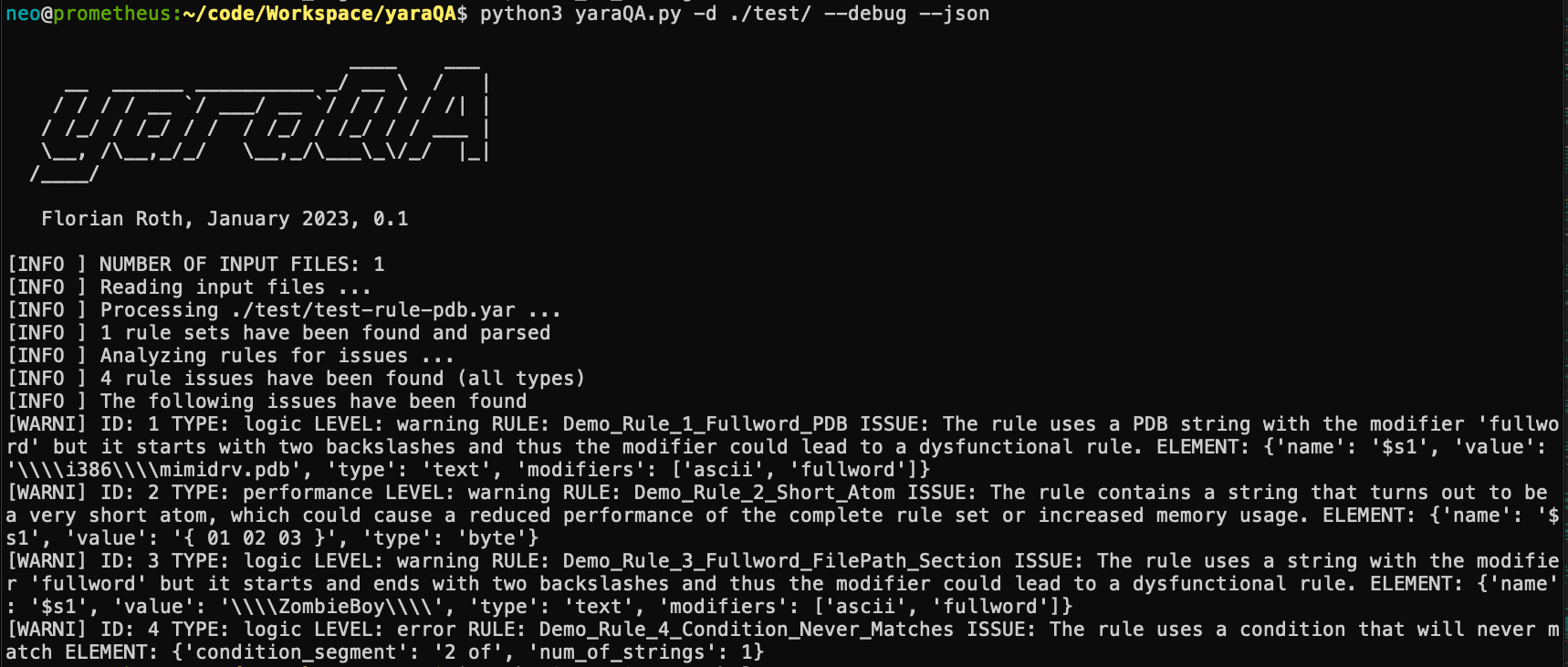
python3 yaraQA.py -d ./test/

Alle Leistungsprobleme unterdrücken und nur Erkennungs-/Logikprobleme anzeigen.

root@kitploit:~
python3 yaraQA.py -d ./test/ --ignore-performance

Alle Probleme mit informationsmäßigem Charakter unterdrücken.

root@kitploit:~
python3 yaraQA.py -d ./test/ -level 2

Eine Basislinie verwenden, um nur neue Probleme zu sehen (nicht die, die Sie bereits überprüft haben). Die Basislinie ist eine alte JSON-Ausgabe eines überprüften Zustands.

root@kitploit:~
python3 yaraQA.py -d ./test/ -b yaraQA-reviewed-issues.json

Beispielregeln mit Problemen

Beispielregeln mit Problemen finden Sie im Ordner ./test.

Ausgabe

yaraQA schreibt die erkannten Probleme standardmäßig in eine Datei mit dem Namen yaraQA-issues.json.

Diese Auflistung zeigt ein Beispiel der von yaraQA im JSON-Format erzeugten Ausgabe:

root@kitploit:~
[
    {
        "rule": "Demo_Rule_1_Fullword_PDB",
        "id": "SM1",
        "issue": "The rule uses a PDB string with the modifier 'wide'. PDB strings are always included as ASCII strings. The 'wide' keyword is unneeded.",
        "element": {
            "name": "$s1",
            "value": "\\\\i386\\\\mimidrv.pdb",
            "type": "text",
            "modifiers": [
                "ascii",
                "wide",
                "fullword"
            ]
        },
        "level": "info",
        "type": "logic",
        "recommendation": "Remove the 'wide' modifier"
    },
    {
        "rule": "Demo_Rule_1_Fullword_PDB",
        "id": "SM2",
        "issue": "The rule uses a PDB string with the modifier 'fullword' but it starts with two backslashes and thus the modifier could lead to a dysfunctional rule.",
        "element": {
            "name": "$s1",
            "value": "\\\\i386\\\\mimidrv.pdb",
            "type": "text",
            "modifiers": [
                "ascii",
                "wide",
                "fullword"
            ]
        },
        "level": "warning",
        "type": "logic",
        "recommendation": "Remove the 'fullword' modifier"
    },
    {
        "rule": "Demo_Rule_2_Short_Atom",
        "id": "PA2",
        "issue": "The rule contains a string that turns out to be a very short atom, which could cause a reduced performance of the complete rule set or increased memory usage.",
        "element": {
            "name": "$s1",
            "value": "{ 01 02 03 }",
            "type": "byte"
        },
        "level": "warning",
        "type": "performance",
        "recommendation": "Try to avoid using such short atoms, by e.g. adding a few more bytes to the beginning or the end (e.g. add a binary 0 in front or a space after the string). Every additional byte helps."
    },
    {
        "rule": "Demo_Rule_3_Fullword_FilePath_Section",
        "id": "SM3",
        "issue": "The rule uses a string with the modifier 'fullword' but it starts and ends with two backslashes and thus the modifier could lead to a dysfunctional rule.",
        "element": {
            "name": "$s1",
            "value": "\\\\ZombieBoy\\\\",
            "type": "text",
            "modifiers": [
                "ascii",
                "fullword"
            ]
        },
        "level": "warning",
        "type": "logic",
        "recommendation": "Remove the 'fullword' modifier"
    },
    {
        "rule": "Demo_Rule_4_Condition_Never_Matches",
        "id": "CE1",
        "issue": "The rule uses a condition that will never match",
        "element": {
            "condition_segment": "2 of",
            "num_of_strings": 1
        },
        "level": "error",
        "type": "logic",
        "recommendation": "Fix the condition"
    },
    {
        "rule": "Demo_Rule_5_Condition_Short_String_At_Pos",
        "id": "PA1",
        "issue": "This rule looks for a short string at a particular position. A short string represents a short atom and could be rewritten to an expression using uint(x) at position.",
        "element": {
            "condition_segment": "$mz at 0",
            "string": "$mz",
            "value": "MZ"
        },
        "level": "warning",
        "type": "performance",
        "recommendation": ""
    },
    {
        "rule": "Demo_Rule_5_Condition_Short_String_At_Pos",
        "id": "PA2",
        "issue": "The rule contains a string that turns out to be a very short atom, which could cause a reduced performance of the complete rule set or increased memory usage.",
        "element": {
            "name": "$mz",
            "value": "MZ",
            "type": "text",
            "modifiers": [
                "ascii"
            ]
        },
        "level": "warning",
        "type": "performance",
        "recommendation": "Try to avoid using such short atoms, by e.g. adding a few more bytes to the beginning or the end (e.g. add a binary 0 in front or a space after the string). Every additional byte helps."
    },
    {
        "rule": "Demo_Rule_6_Condition_Short_Byte_At_Pos",
        "id": "PA1",
        "issue": "This rule looks for a short string at a particular position. A short string represents a short atom and could be rewritten to an expression using uint(x) at position.",
        "element": {
            "condition_segment": "$mz at 0",
            "string": "$mz",
            "value": "{ 4d 5a }"
        },
        "level": "warning",
        "type": "performance",
        "recommendation": ""
    },
    {
        "rule": "Demo_Rule_6_Condition_Short_Byte_At_Pos",
        "id": "PA2",
        "issue": "The rule contains a string that turns out to be a very short atom, which could cause a reduced performance of the complete rule set or increased memory usage.",
        "element": {
            "name": "$mz",
            "value": "{ 4d 5a }",
            "type": "byte"
        },
        "level": "warning",
        "type": "performance",
        "recommendation": "Try to avoid using such short atoms, by e.g. adding a few more bytes to the beginning or the end (e.g. add a binary 0 in front or a space after the string). Every additional byte helps."
    },
    {
        "rule": "Demo_Rule_6_Condition_Short_Byte_At_Pos",
        "id": "SM3",
        "issue": "The rule uses a string with the modifier 'fullword' but it starts and ends with two backslashes and thus the modifier could lead to a dysfunctional rule.",
        "element": {
            "name": "$s1",
            "value": "\\\\Section\\\\in\\\\Path\\\\",
            "type": "text",
            "modifiers": [
                "ascii",
                "fullword"
            ]
        },
        "level": "warning",
        "type": "logic",
        "recommendation": "Remove the 'fullword' modifier"
    }
]

Screenshots

yaraQA