 kuniyal08/copy-fail-cve-2026-31431-lab
Reproduced the fileless LPE CVE‑2026‑31431 (“Copy Fail”) on Kali Linux, then built auditd, Sigma & YARA detections to catch this stealthy kernel exploit that leaves no disk footprint.

This repository documents the end-to-end reproduction, detection engineering, and incident response for CVE-2026-31431 ("Copy Fail"), a critical Linux kernel local privilege escalation vulnerability affecting kernels 4.14 through 7.0-rc.
Copy Fail is a logic flaw, not a memory corruption. It is deterministic, affects virtually every Linux distribution shipped since 2017, and is completely fileless—traditional file integrity monitoring (AIDE, Tripwire) cannot see it. A working proof-of-concept fits in just 732 bytes of Python.
| Component | Details |
|---|---|
| Hypervisor | VirtualBox |
| Target VM | Kali Linux 2026.1 |
| Kernel | 6.18.12+kali-amd64 |
| Exploit PoC | theori-io/copy-fail-CVE-2026-31431 |
| Detection | auditd, Sigma, YARA |
The lab starts by confirming the target is running a vulnerable kernel.
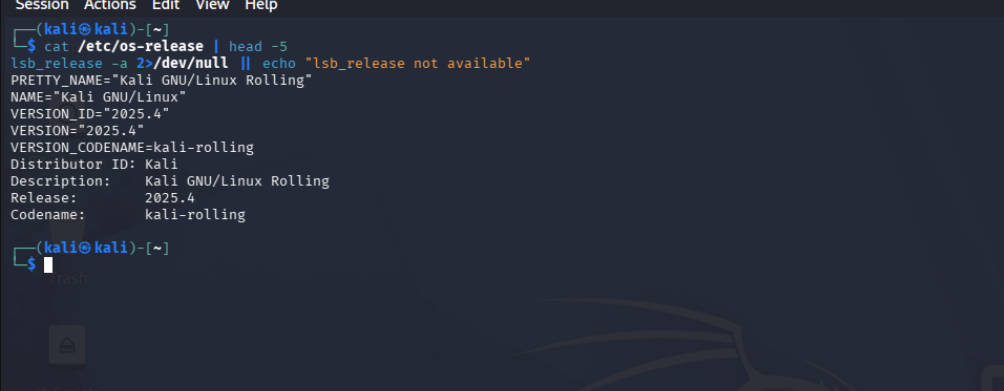 Kali Linux 2026.1 release and kernel details.
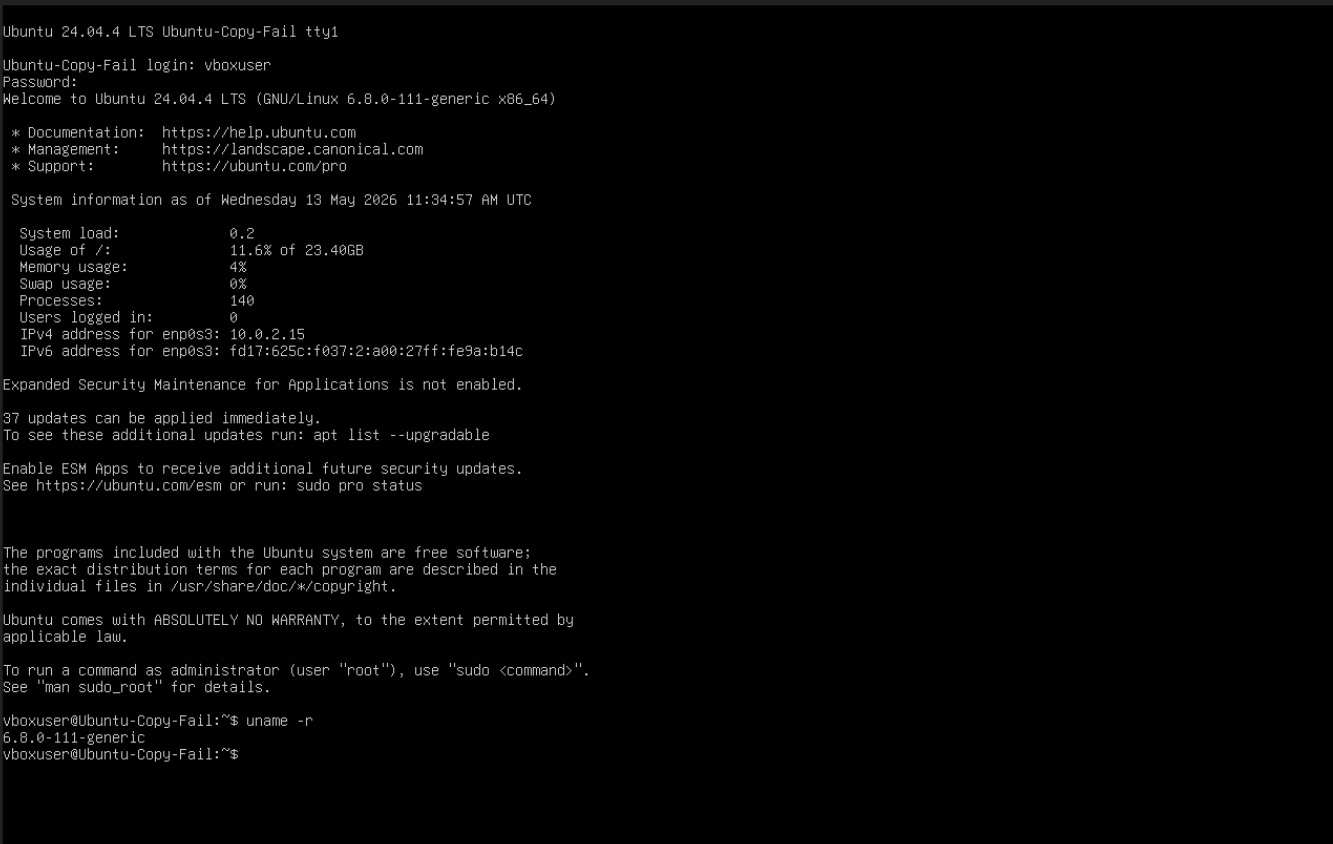 Output of
 uname -r showing vulnerable kernel 6.18.12+kali-amd64.
The exploit requires the algif_aead kernel module and the authencesn crypto template.
Module Loaded
lsmod and modinfo confirm algif_aead is available; /proc/crypto shows the vulnerable authencesn template.
The PoC uses os.splice, which needs Python 3.10+. We verify the interpreter.
Python Version Python 3.12 is installed and ready.
Before running the full exploit, a safe checker confirms the system is vulnerable.
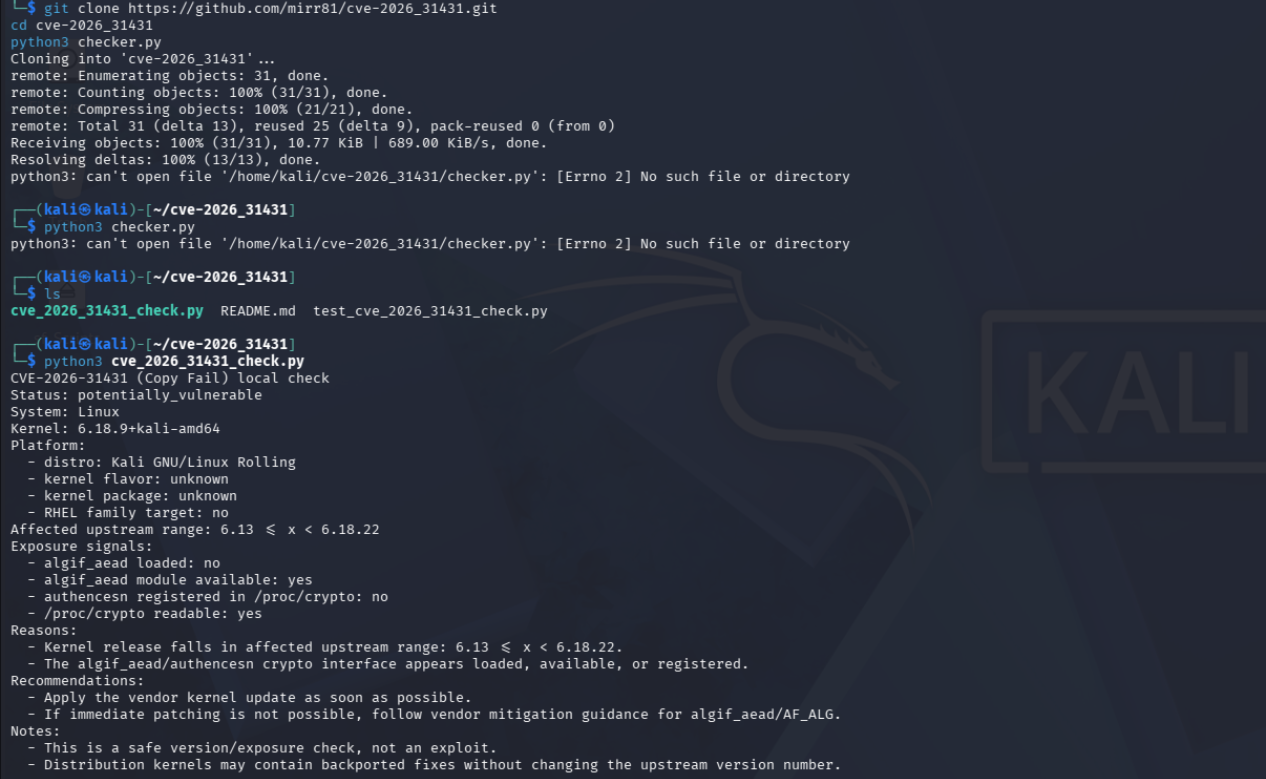 The checker reports "potentially vulnerable", clearing the way for exploitation.
An unprivileged testuser account is created to simulate an attacker without special rights.
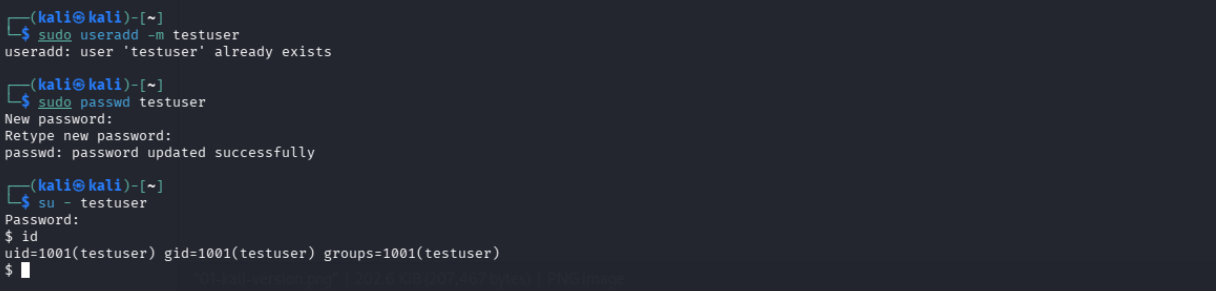
id shows UID 1001, confirming non‑root access.
The official Theori PoC is cloned and executed from the unprivileged account.
 Successfully cloned the exploit repository.
Exploit Execution
The Python exploit overwrites the page cache and detonates the corrupted /usr/bin/su binary.

whoami and id output prove full root escalation.
The exploit only corrupts the in‑memory page cache. The on‑disk /usr/bin/su retains its original checksum.
SHA256 Match
The sha256sum matches the original package hash even after exploitation, confirming no disk modification.
Copy Fail cannot be detected by file integrity monitoring. Instead, we focus on the syscall‑level primitives it uses.
We deploy custom auditd rules that trigger on:
AF_ALG socket creation (family 38)splice() syscall usage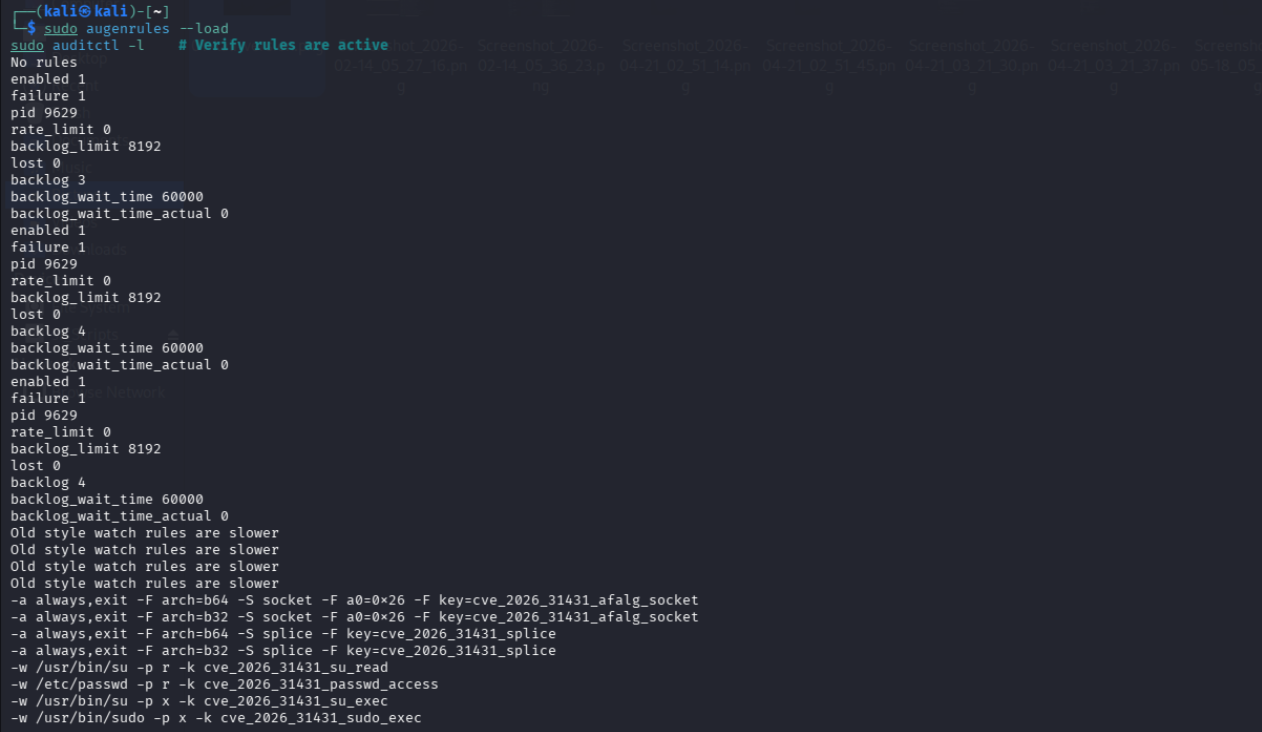 All custom rules are active, verified with
 auditctl -l.
After running the exploit a second time, we see alerts for the exact syscalls used:
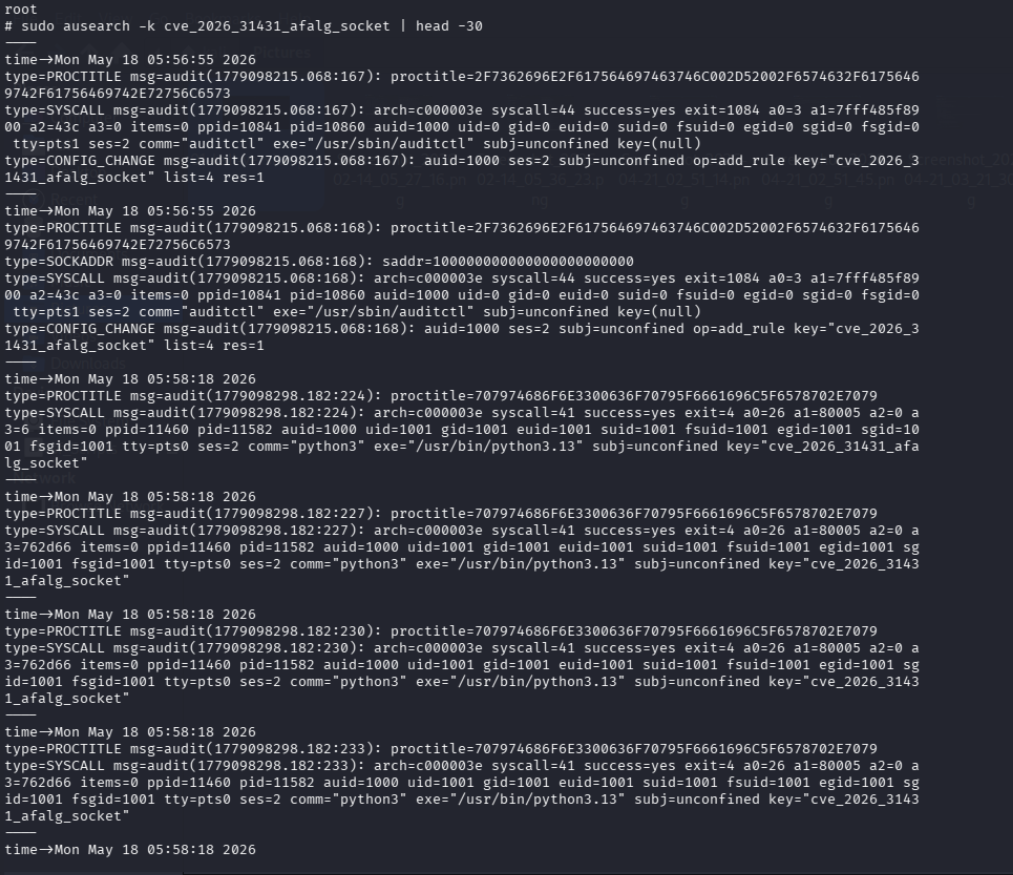
ausearch shows an AF_ALG socket creation event from the testuser process.

ausearch shows a splice() event from the same PID, a strong correlation.
A Sigma rule translates the auditd findings into a vendor‑neutral SIEM format.
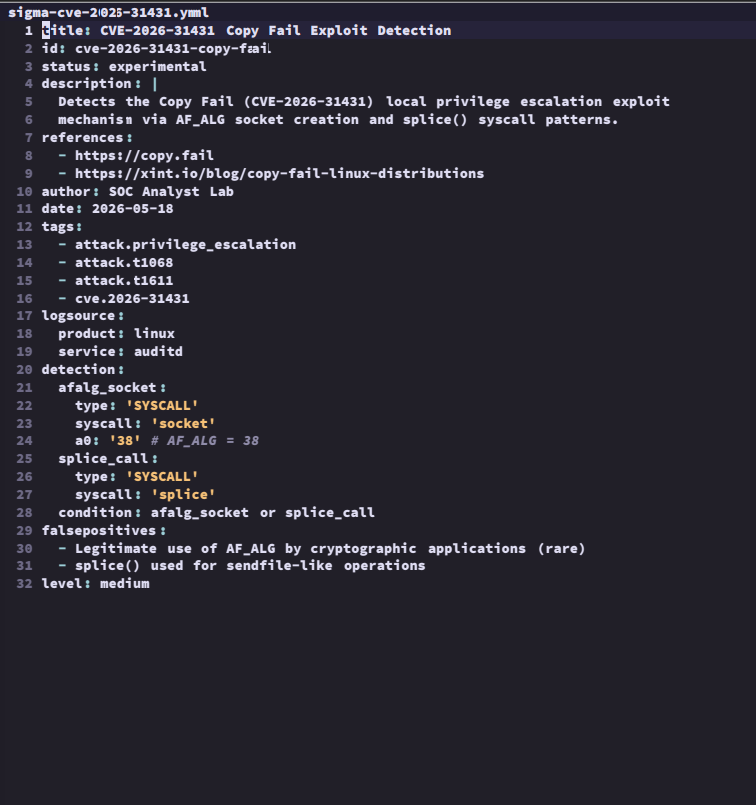 Sigma YAML rule detecting
 AF_ALG socket creation and splice() calls.
A YARA rule helps identify Copy Fail exploit code on disk.
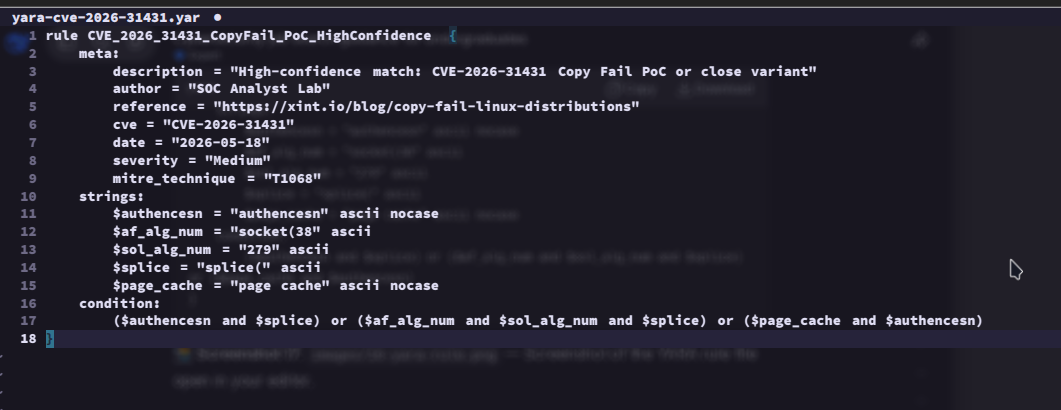 YARA rule matching the
 authencesn string, socket constants, and splice() references found in PoCs.
| Layer | What it Sees | Status |
|---|---|---|
| auditd | AF_ALG socket + splice syscalls | ✅ Deployed |
| Sigma | Syscall patterns via SIEM | ✅ Rule ready |
| YARA | PoC code on disk | ✅ Rule ready |
| FIM (AIDE/Tripwire) | File changes | ❌ Blind – no disk write occurs |
A full incident response report is available in reports/incident-copy-fail.md. It includes:
Immediate mitigation (no reboot required):
echo "install algif_aead /bin/false" | sudo tee /etc/modprobe.d/disable-algif.conf
sudo rmmod algif_aead
