
Skip to content
KitploitKITPLOIT
ToolsBlog
Einreichen
ToolsBlog
Einreichen

Hacking-, PenTest- und Cybersicherheits-Tools für Ihr Sicherheitsarsenal!

Kitploit ist ein Verzeichnis von Hacking-, Cybersicherheits- und Pentesting-Tools. Entdecken Sie die neuesten Projekt-Updates, um Schwachstellen zu finden, Systeme zu analysieren, Tests zu automatisieren und Ihre Sicherheit zu stärken.

··Feeds·Kontakt·Datenschutz·© 2026 Kitploit

Tool-Verzeichnis

Kategorien

Alle Kategorien anzeigen
Loading categories
scilla — Tool zur Informationssammlung - DNS / Subdomains / Ports / Verzeichnis-Enumeration | Kitploit
Tools/GitHubGitHub/edoardottt/scilla
AufklärungPort-ScanningDNS- und Subdomain-EnumerationInformationsbeschaffungPenetrationstestsSubdomain-EnumerationDNS-Analyse
GitHubedoardottt/scilla

scilla

Tool zur Informationssammlung - DNS / Subdomains / Ports / Verzeichnis-Enumeration

Repository anzeigen
1.2k144vor 1 MonatVon Kitploit geprüft

Beliebteste

Alle anzeigen →

Entdecken Sie die meistgenutzten Tools unserer Community.

Alle Tools erkunden

Durchsuchen Sie unsere Tool-Sammlung

Alle Tools anzeigen →
Teilen
Webseite


🏴‍☠️ Tool zur Informationssammlung 🏴‍☠️ - DNS / Subdomains / Ports / Verzeichnisse-Enumeration

go-report-card workflows
Mit 💙 programmiert von edoardottt
Auf Twitter teilen!

Installation • Erste Schritte • Beispiele • Änderungsprotokoll • Mitwirken • Lizenz

Installation 📡

Homebrew

root@kitploit:~
brew install scilla

Snap

root@kitploit:~
sudo snap install scilla

Golang

root@kitploit:~
go install -v github.com/edoardottt/scilla/cmd/scilla@latest

Erstellen aus dem Quellcode

Sie benötigen Go (>=1.23)

Erstellen aus dem Quellcode für Linux und Windows

Linux

root@kitploit:~
git clone https://github.com/edoardottt/scilla.git
cd scilla
go get ./...
make linux # (to install)
make unlinux # (to uninstall)

Bearbeiten Sie die Datei ~/.config/scilla/keys.yaml, wenn Sie API-Schlüssel verwenden möchten.

Einzeiler: git clone https://github.com/edoardottt/scilla.git && cd scilla && go get ./... && make linux

Windows

Beachten Sie, dass die ausführbare Datei nur im Ordner cariddi funktioniert (Alias?).

root@kitploit:~
git clone https://github.com/edoardottt/scilla.git
cd scilla
.\make.bat windows # (to install)
.\make.bat unwindows # (to uninstall)

Erstellen Sie eine keys.yaml-Datei, wenn Sie API-Schlüssel verwenden möchten.

Docker verwenden

root@kitploit:~
docker build -t scilla .
docker run scilla help

Beispiele 💡

  • DNS-Enumeration:

    • scilla dns -target example.com
    • scilla dns -oj output -target example.com
    • scilla dns -oh output -target example.com
    • scilla dns -ot output -target example.com
    • scilla dns -plain -target example.com
  • Subdomain-Enumeration:

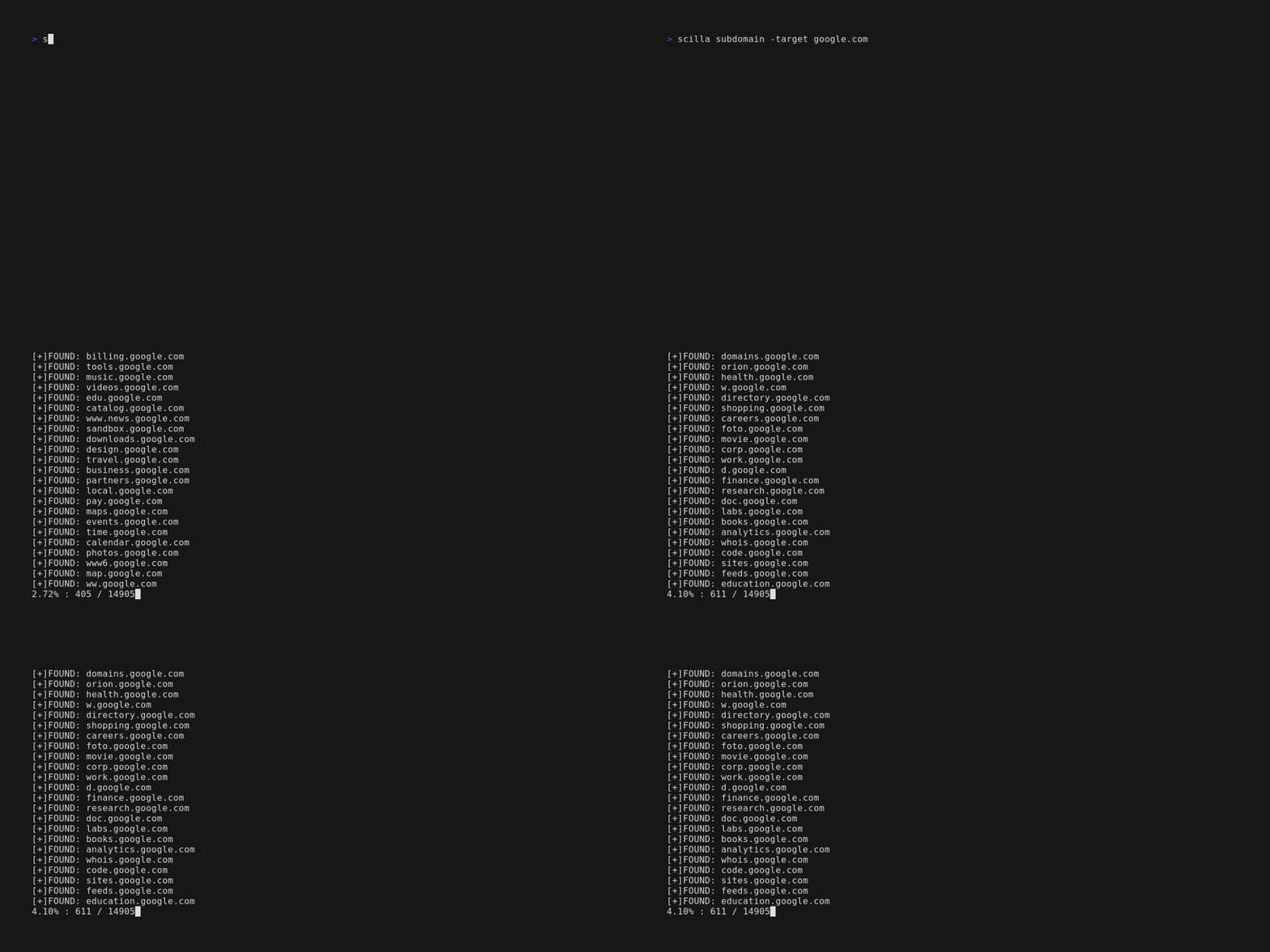
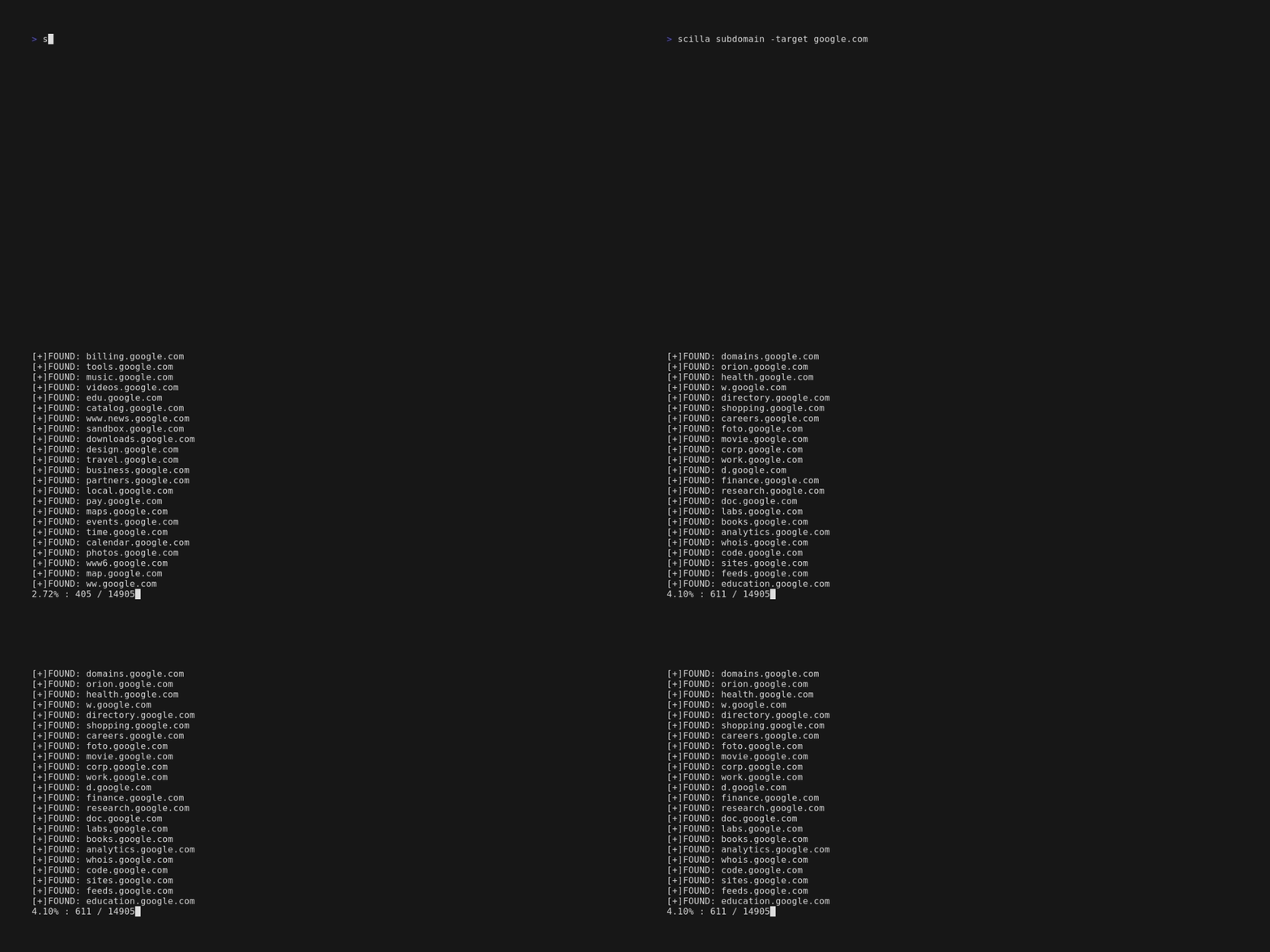
    • scilla subdomain -target example.com
    • scilla subdomain -w wordlist.txt -target example.com
    • scilla subdomain -oj output -target example.com
    • scilla subdomain -oh output -target example.com
    • scilla subdomain -ot output -target example.com
    • scilla subdomain -i 400 -target example.com

Erste Schritte 🎉

scilla help gibt die Hilfe in der Befehlszeile aus.

root@kitploit:~
usage: scilla subcommand { options }

   Available subcommands:
       - dns [-oj JSON output file]
             [-oh HTML output file]
             [-ot TXT output file]
             [-plain Print only results]
             -target <target (URL/IP)> REQUIRED
       - port [-p <start-end> or ports divided by comma]
              [-oj JSON output file]
              [-oh HTML output file]
              [-ot TXT output file]
              [-common scan common ports]
              [-plain Print only results]
              -target <target (URL/IP)> REQUIRED
       - subdomain [-w wordlist]
                   [-oj JSON output file]
                   [-oh HTML output file]
                   [-ot TXT output file]
                   [-i ignore status codes]
                   [-c use also a web crawler]
                   [-db use also a public database]
                   [-plain Print only results]
                   [-db -no-check Don't check status codes for subdomains]
                   [-db -vt Use VirusTotal as subdomains source]
                   [-db -bw Use BuiltWith as subdomains source]
                   [-ua Set the User Agent]
                   [-rua Generate a random user agent for each request]
                   [-dns Set DNS IP to resolve the subdomains]
                   [-alive Check also if the subdomains are alive]
                   -target <target (URL)> REQUIRED
       - dir [-w wordlist]
             [-oj JSON output file]
             [-oh HTML output file]
             [-ot TXT output file]
             [-i ignore status codes]
             [-c use also a web crawler]
             [-plain Print only results]
             [-nr No follow redirects]
             [-ua Set the User Agent]
             [-rua Generate a random user agent for each request]
             -target <target (URL/IP)> REQUIRED
       - report [-p <start-end> or ports divided by comma]
                [-ws subdomains wordlist]
                [-wd directories wordlist]
                [-oj JSON output file]
                [-oh HTML output file]
                [-ot TXT output file]
                [-id ignore status codes in directories scanning]
                [-is ignore status codes in subdomains scanning]
                [-cd use also a web crawler for directories scanning]
                [-cs use also a web crawler for subdomains scanning]
                [-db use also a public database for subdomains scanning]
                [-common scan common ports]
                [-nr No follow redirects]
                [-db -vt Use VirusTotal as subdomains source]
                [-ua Set the User Agent]
                [-rua Generate a random user agent for each request]
                [-dns Set DNS IP to resolve the subdomains]
                [-alive Check also if the subdomains are alive]
                -target <target (URL)> REQUIRED
       - help
       - examples

Änderungsprotokoll 📌

Detaillierte Änderungen für jedes Release sind in den Release-Notes dokumentiert.

Mitwirken 🛠

Öffnen Sie einfach ein Issue / einen Pull Request.

Bevor Sie einen Pull Request öffnen, laden Sie golangci-lint herunter und führen Sie aus:

root@kitploit:~
golangci-lint run

Wenn keine Fehler auftreten, machen Sie weiter :)

Zu erledigen:

  • Weitere Tests hinzufügen
  • Tor-Unterstützung
  • Proxy-Unterstützung

In den Nachrichten 📰

  • Kali Linux Tutorials
  • GeeksForGeeks.org
  • Brisk Infosec
  • Kalitut

Lizenz 📝

Dieses Repository steht unter der GNU General Public License v3.0.
edoardottt.com um mich zu kontaktieren.

Tool herunterladen
  • scilla subdomain -i 4** -target example.com
  • scilla subdomain -c -target example.com
  • scilla subdomain -db -target example.com
  • scilla subdomain -plain -target example.com
  • scilla subdomain -db -no-check -target example.com
  • scilla subdomain -db -vt -target example.com
  • scilla subdomain -db -bw -target example.com
  • scilla subdomain -ua "CustomUA" -target example.com
  • scilla subdomain -rua -target example.com
  • scilla subdomain -dns 8.8.8.8 -target example.com
  • scilla subdomain -alive -target example.com
  • Verzeichnis-Enumeration:

    • scilla dir -target example.com
    • scilla dir -w wordlist.txt -target example.com
    • scilla dir -oj output -target example.com
    • scilla dir -oh output -target example.com
    • scilla dir -ot output -target example.com
    • scilla dir -i 500,401 -target example.com
    • scilla dir -i 5**,401 -target example.com
    • scilla dir -c -target example.com
    • scilla dir -plain -target example.com
    • scilla dir -nr -target example.com
    • scilla dir -ua "CustomUA" -target example.com
    • scilla dir -rua -target example.com
  • Port-Enumeration:

    • Standard (alle Ports, also 1-65635) scilla port -target example.com
    • Portbereich angeben scilla port -p 20-90 -target example.com
    • Startport angeben (bis zum letzten) scilla port -p 20- -target example.com
    • Endport angeben (vom ersten ausgehend) scilla port -p -90 -target example.com
    • Mehrere Ports angeben scilla port -p 21,25,80 -target example.com
    • Häufige Ports angeben scilla port -common -target example.com
    • Einzelnen Port angeben scilla port -p 80 -target example.com
    • Ausgabeformat angeben (json) scilla port -oj output -target example.com
    • Ausgabeformat angeben (html) scilla port -oh output -target example.com
    • Ausgabeformat angeben (txt) scilla port -ot output -target example.com
    • Nur Ergebnisse anzeigen scilla port -plain -target example.com
  • Vollständiger Bericht:

    • Standard (alle Ports, also 1-65635) scilla report -target example.com
    • Portbereich angeben scilla report -p 20-90 -target example.com
    • Startport angeben (bis zum letzten) scilla report -p 20- -target example.com
    • Endport angeben (vom ersten ausgehend) scilla report -p -90 -target example.com
    • Einzelnen Port angeben scilla report -p 80 -target example.com
    • Mehrere Ports angeben scilla report -p 21,25,80 -target example.com
    • Ausgabeformat angeben (json) scilla report -oj output -target example.com
    • Ausgabeformat angeben (html) scilla report -oh output -target example.com
    • Ausgabeformat angeben (txt) scilla report -ot output -target example.com
    • Wortliste für Verzeichnisse angeben scilla report -wd dirs.txt -target example.com
    • Wortliste für Subdomains angeben scilla report -ws subdomains.txt -target example.com
    • Statuscodes angeben, die beim Verzeichnis-Scan ignoriert werden sollen scilla report -id 500,501,502 -target example.com
    • Statuscodes angeben, die beim Subdomain-Scan ignoriert werden sollen scilla report -is 500,501,502 -target example.com
    • Statuscode-Klassen angeben, die beim Verzeichnis-Scan ignoriert werden sollen scilla report -id 5**,4** -target example.com
    • Statuscode-Klassen angeben, die beim Subdomain-Scan ignoriert werden sollen scilla report -is 5**,4** -target example.com
    • Auch einen Webcrawler für die Verzeichnis-Enumeration verwenden scilla report -cd -target example.com
    • Auch einen Webcrawler für die Subdomain-Enumeration verwenden scilla report -cs -target example.com
    • Auch eine öffentliche Datenbank für die Subdomain-Enumeration verwenden scilla report -db -target example.com
    • Häufige Ports angeben scilla report -common -target example.com
    • Keine Weiterleitungen verfolgen scilla report -nr -target example.com
    • VirusTotal als Subdomain-Quelle verwenden scilla report -db -vt -target example.com
    • User-Agent festlegen scilla report -ua "CustomUA" -target example.com
    • Für jede Anfrage einen zufälligen User-Agent generieren scilla report -rua -target example.com
    • DNS-IP zum Auflösen der Subdomains festlegen scilla report -dns 8.8.8.8 -target example.com
    • Auch prüfen, ob die Subdomains erreichbar sind scilla report -alive -target example.com