A curated knowledge base to build, run and mature a SOC (including CSIRT).
An operational handbook and knowledge base to build, run and mature a SOC (including CSIRT). Covering:
Those are my view, based on my own experience as SOC/CSIRT analyst and team manager, as well as well-known papers. Focus is more on SOC than on CERT/CSIRT.
My motto is: without reaction (response), detection is useless.
NB: Generally speaking, SOC here refers to detection activity, and CERT/CSIRT to incident response activity. CERT is a well-known (formerly) US trademark, managed by , but I prefer the term as it precisely refers to incident response.
Prepare for handling incidents by defining incident categories, response steps, and escalation paths, and codifying those into SOPs and playbooks. Determine the priorities of incidents for the organization and allocate the resources to respond. Execute response with precision and care toward constituency mission and business.
Choose data by considering relative value of different data types such as sensor and log data collected by network and host systems, cloud resources, applications, and sensors. Consider the trade-offs of too little data and therefore not having the relevant information available and too much data such that tools and analysts become overwhelmed.
Consolidate and harmonize views into tools and data and integrate them to maximize SOC workflow. Consider how the many SOC tools, including SIEM, UEBA, SOAR, and others fit in with the organization’s technical landscape, to include cloud and OT environments
Tailor the collection and use of cyber threat intelligence by analyzing the intersection of adversary information, organization relevancy, and technical environment to prioritize defenses, monitoring, and other actions.
Cf. Watch
Consolidate and harmonize views into tools and data and integrate them to maximize SOC workflow. Consider how the many SOC tools, including SIEM, UEBA, SOAR, and others fit in with the organization’s technical landscape, to include cloud and OT environments.
Cf. SOAR
Develop situational awareness through understanding the mission; legal regulatory environment; technical and data environment; user, user behaviors and service interactions; and the threat. Prioritize gaining insights into critical systems and data and iterate understanding over time.
Choose data by considering relative value of different data types such as sensor and log data collected by network and host systems, cloud resources, applications, and sensors. Consider the trade-offs of too little data and therefore not having the relevant information available and too much data such that tools and analysts become overwhelmed.
Enhance SOC activities to include threat hunting, red teaming, deception, malware analysis, forensics, and/or tabletop exercises, once incident response is mature. Any of these can improve the SOCs operating ability and increase the likelihood of finding more sophisticated adversaries.
Tailor the collection and use of cyber threat intelligence by analyzing the intersection of adversary information, organization relevancy, and technical environment to prioritize defenses, monitoring, and other actions.
Cf. threat intelligence.
Based on experience, I propose a few SOP (Standard Operating Procedures), that one may want to call playbooks.
Develop situational awareness through understanding the mission; legal regulatory environment; technical and data environment; user, user behaviors and service interactions; and the threat. Prioritize gaining insights into critical systems and data and iterate understanding over time.
Empower the SOC to carry out the desired functions, scope, partnerships, and responsibilities through an approved charter and the SOCs alignment within the organization
Structure SOCs by considering the constituency, SOC functions and responsibilities, service availability, and any operational efficiencies gained by selecting one construct over another
Engage within the SOC, with stakeholders and constituents, and with the broader cyber community to evolve capabilities and contribute to the overall security of the broader community.
Enhance SOC activities to include threat hunting, red teaming, deception, malware analysis, forensics, and/or tabletop exercises, once incident response is mature. Any of these can improve the SOCs operating ability and increase the likelihood of finding more sophisticated adversaries.
Cf. Management.
Determine qualitative and quantitative measures to know what is working well, and where to improve. A SOC metrics program includes business objectives, data sources and collection, data synthesis, reporting, and decision-making and action
Create an environment to attract the right people and encourage them to stay through career progression opportunities and great culture and operating environment. Plan for turnover and build a pipeline to hire. Consider how many personnel are needed for the different SOC functions.
Cf. HR and training.
As per NCSC website:
Indications of an attack will rarely be isolated events on a single system component or system. So, where possible, having a single platform where analysts have the ability to see and query log data from all of your onboarded systems is invaluable. Having access to the log data from multiple (or all) components, will enable analysts to look for evidence of attack across an estate and create detection use-cases that utilise a multitude of sources. By creating temporal (actions over a period of time) and spatial (actions across the estate) use-cases, an organisation is better prepared to address cyber security attacks that occur system wide.
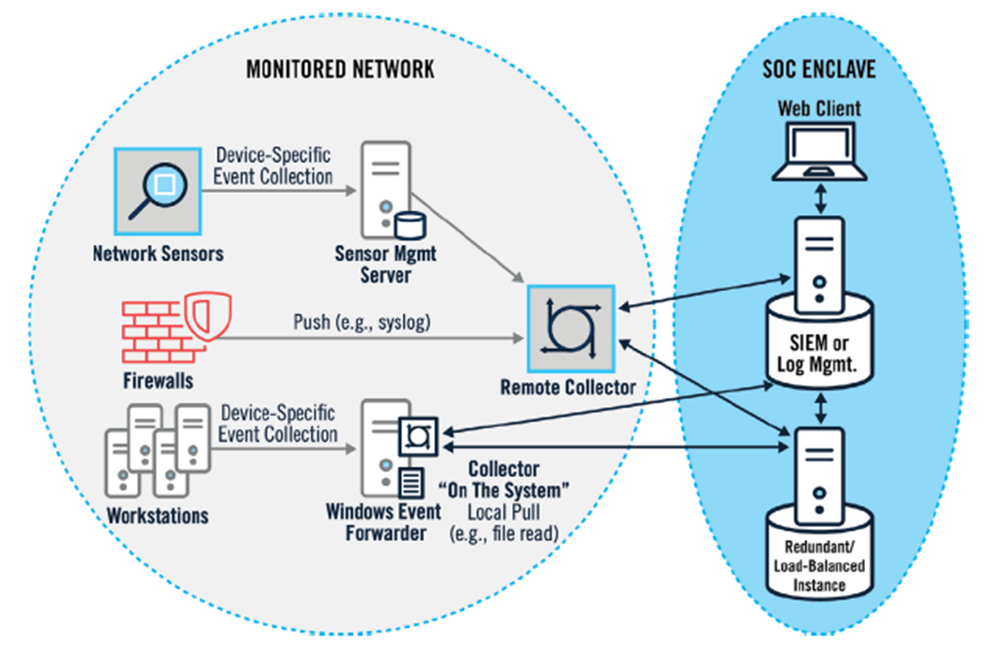
The goal is to prevent an attacker from achieving lateral movement from a compromised monitored zone, to the SOC/CSIRT work zone.
Implement SOC enclave (with network isolation), as per MITRE paper drawing:

only log collectors and WEF should be authorized to send data to the SOC/CSIRT enclave. Whenever possible, the SOC tools pull the data from the monitored environment, and not the contrary;
on top of a SOC enclave, implement at least a level 2 of network segmentation;
SOC’s assets should be part of a separate restricted AD forest, to allow AD isolation with the rest of the monitored AD domains.
Essential resources to build, run, and mature your SOC/CSIRT.
Additional resources to expand your knowledge.

Yann F., Wojtek S., Nicolas R., Clément G., Alexandre C., Jean B., Frédérique B., Pierre d'H., Julien C., Hamdi C., Fabien L., Michel de C., Gilles B., Olivier R., Jean-François L., Fabrice M., Pascal R., Florian S., Maxime P., Pascal L., Jérémy d'A., Olivier C. x2, David G., Guillaume D., Patrick C., Lesley K., Gérald G., Jean-Baptiste V., Antoine C., David Q., Philippe M., ...





