 arinerron/heaptrace
hilft bei der Visualisierung von Heap-Operationen für Pwn und Debugging

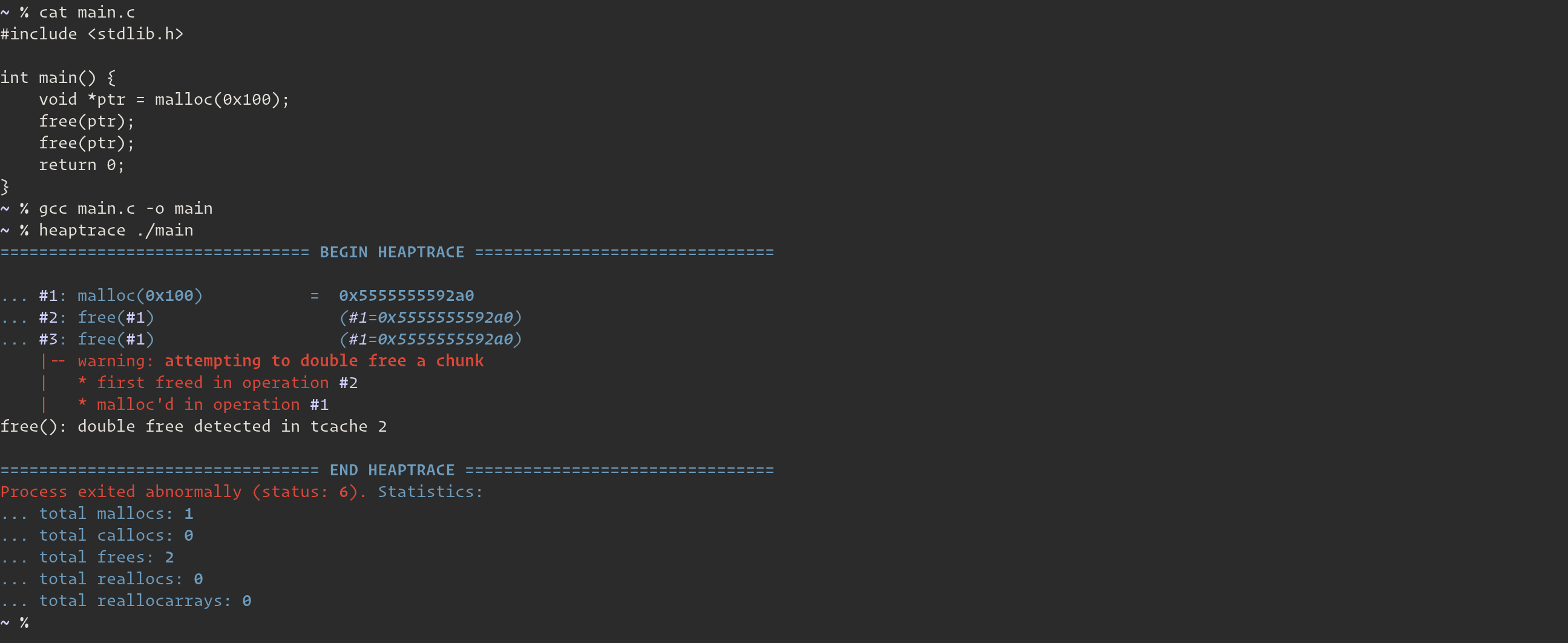
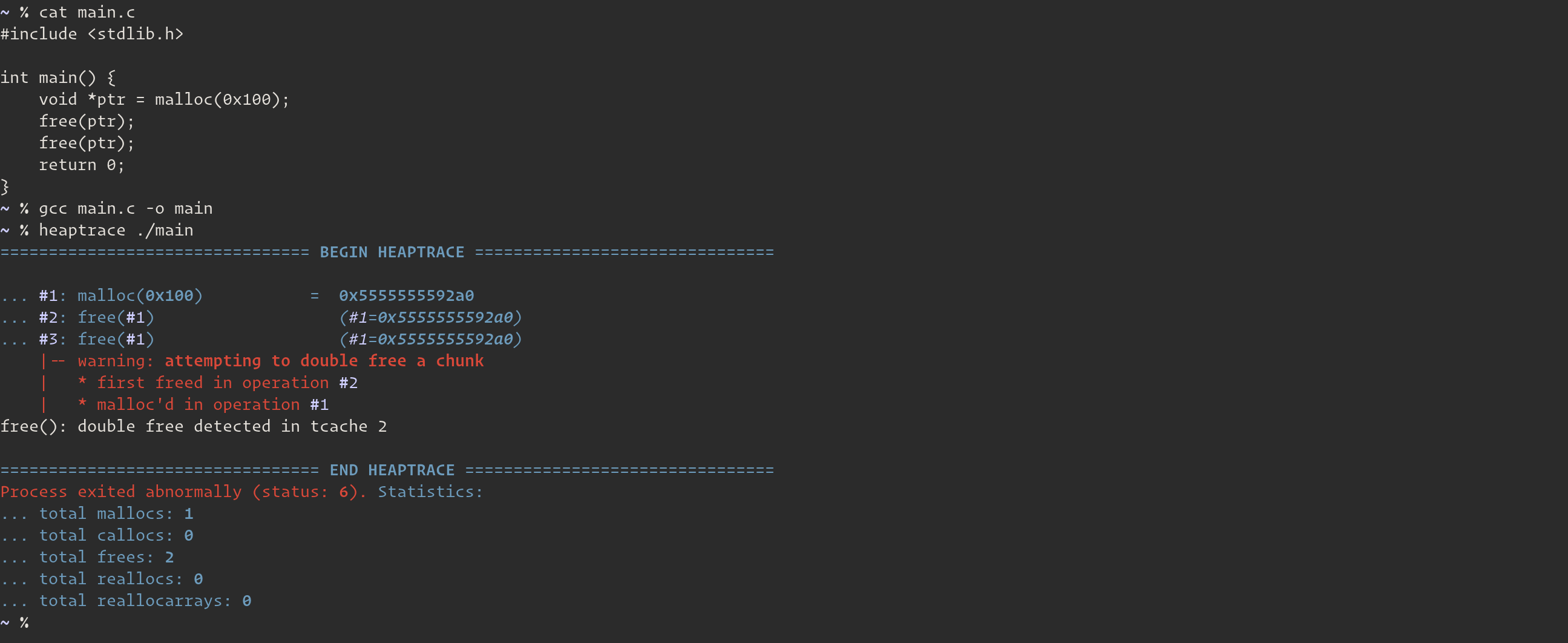
heaptrace ist ein Heap-Debugger zur Verfolgung von glibc-Heap-Operationen in ELF64 (x86_64)-Binärdateien. Sein Zweck ist es, Heap-Operationen beim Debuggen von Binärdateien oder beim Heap-Pwn zu visualisieren.
--break)Wie unterscheiden sich heaptrace und valgrind?
Siehe die .deb- und .rpm-Release-Dateien sowie eine vorkompilierte Binärdatei auf der Releases-Seite.
$ sudo add-apt-repository ppa:arinerron/heaptrace
$ sudo apt-get update
$ sudo apt-get install heaptrace
Verwenden Sie Ihren bevorzugten AUR-Helfer, um eines der beiden folgenden Pakete zu installieren:
heaptrace-git — Quellpaket (PKGBUILD)heaptrace — Binärpaket (PKGBUILD)$ trizen -S heaptrace-git
... ODER ...
$ trizen -S heaptrace
$ git clone https://github.com/Arinerron/heaptrace.git && cd heaptrace
$ make
$ sudo make install
...
$ heaptrace ./target
Sie können Argumente für heaptrace vor dem Binärnamen angeben:
Usage:
  heaptrace [options...] <target> [args...]
  heaptrace [options...] --attach <pid>

Options:
  -p <pid>, --attach <pid>, --pid <pid>
	 Tells heaptrace to attach to the specified pid
	 instead of running the binary from the `target`
	 argument. Note that if you specify this argument
	 you do not have to specify `target`.


  -b <expression>, --break=<expression>, --break-at=<expression>
	 Send SIGSTOP to the process when the specified
	 `expression` is satisfied and attach the GNU debugger
	 (gdb) to the process.

	 This argument supports complex expressions. Please
	 See the documentation for more information:
	 https://github.com/Arinerron/heaptrace/wiki/How-to-Create-Breakpoints


  -B <expression>, --break-after=<expression>
	 Similar to `--break`. Replaces the tracer
	 process with gdb, but only after the heap function
	 returns. See the documentation for more information:
	 https://github.com/Arinerron/heaptrace/wiki/How-to-Create-Breakpoints


  -e <name=value>, --environ=<name=value>, --environment=<name=value>
	 Sets a single environmental variable. Useful for
	 setting runtime settings for the target such as
	 LD_PRELOAD=./libc.so.6 without having them affect
	 heaptrace's runtime configuration. This option can
	 be used multiple times.


  -s <sym_defs>, --symbols=<sym_defs>
	 Override the values heaptrace detects for the
	 malloc/calloc/free/realloc/reallocarray symbols.
	 Useful if heaptrace fails to automatically
	 identify heap functions in a stripped binary. See
	 the wiki for more info.


  -F, --follow-fork, --follow
	 Tells heaptrace to detach the parent and follow
	 the child if the target calls fork(), vfork(), or
	 clone().

	 The default behavior is to detach the child and
	 only trace the parent.


  -G <path>, --gdb-path <path>
	 Tells heaptrace to use the path to gdb specified
	 in `path` instead of /usr/bin/gdb (default).


  -w <width>, --width=<width>, --term-width=<width>
	 Force a certain terminal width.


  -o <file>, --output=<file>
	 Write the heaptrace output to `file` instead of
	 /dev/stderr (which is the default output path).


  -v, --verbose
	 Prints verbose information such as line numbers in
	 source code given the required debugging info is
	 stored in the ELF.


  -V, --version
	 Displays the current heaptrace version.


  -h, --help
	 Shows this help menu.
heaptrace --break=3 ./my-binary ausführen. Weitere Informationen zur Verwendung dieses Arguments finden Sie in der Wiki-Dokumentation.-s/--symbol, um gestrippte Binärdateien zu debuggen, bei denen heaptrace nicht automatisch Funktionen identifizieren konnte.$NO_COLOR, um ANSI-Farbcodes aus der Ausgabe zu entfernen. Diese Option befindet sich noch in Entwicklung und wird bald in ein Argument umgewandelt.Ich helfe gerne, wenn Sie einen Fehler feststellen oder Feedback haben. Bitte besuchen Sie die GitHub Issues Seite.
