
محلل قواعد YARA لتحسين جودة القواعد والأداء
محلل قواعد YARA لتحسين جودة القواعد وأدائها
يمكن أن تكون قواعد YARA صحيحة نحويًا ولكنها لا تزال غير فعالة. يحاول yaraQA العثور على هذه المشكلات والإبلاغ عنها لمؤلف أو مشرف مجموعة قواعد YARA.
المشكلات التي يحاول yaraQA اكتشافها هي على سبيل المثال:
2 of them في الشرط)$ = "\\Debug\\" fullword)$ = "AA"؛ يمكن استبعادها من التحليل باستخدام --ignore-performance)سأقوم بتوسيع مجموعة الاختبارات بمرور الوقت. سيتضمن كل إصدار ثانوي ميزات جديدة أو اختبارات جديدة.
pip install -r requirements.txt
usage: yaraQA.py [-h] [-f yara files [yara files ...]] [-d yara files [yara files ...]] [-o outfile] [-b baseline] [-l level]
[--ignore-performance] [--debug]
YARA RULE ANALYZER
optional arguments:
-h, --help show this help message and exit
-f yara files [yara files ...]
Path to input files (one or more YARA rules, separated by space)
-d yara files [yara files ...]
Path to input directory (YARA rules folders, separated by space)
-o outfile Output file that lists the issues (JSON, default: 'yaraQA-issues.json')
-b baseline Use a issues baseline (issues found and reviewed before) to filter issues
-l level Minium level to show (1=informational, 2=warning, 3=critical)
--ignore-performance Suppress performance-related rule issues
--debug Debug output
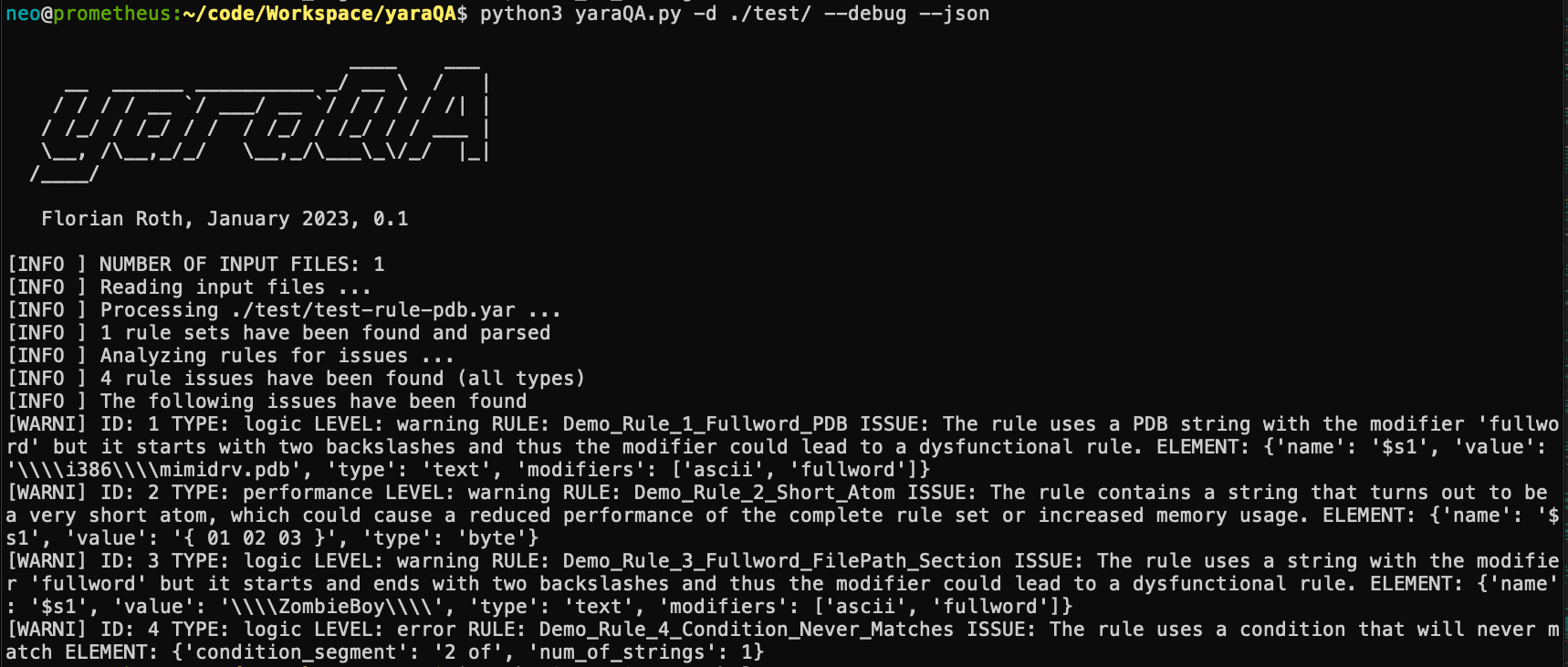
python3 yaraQA.py -d ./test/
قم بكتم جميع مشكلات الأداء وعرض مشكلات الكشف/المنطق فقط.
python3 yaraQA.py -d ./test/ --ignore-performance
قم بكتم جميع المشكلات ذات الطابع الإعلامي
python3 yaraQA.py -d ./test/ -level 2
استخدم خط الأساس لرؤية المشكلات الجديدة فقط (وليس تلك التي قمت بمراجعتها بالفعل). ملف خط الأساس هو إخراج JSON قديم لحالة تمت مراجعتها.
python3 yaraQA.py -d ./test/ -b yaraQA-reviewed-issues.json
يمكن العثور على أمثلة للقواعد التي تحتوي على مشكلات في المجلد ./test.
يكتب yaraQA المشكلات المكتشفة إلى ملف باسم yaraQA-issues.json افتراضيًا.
يعرض هذا القائمة مثالاً للمخرجات التي يولدها yaraQA بتنسيق JSON:
[
{
"rule": "Demo_Rule_1_Fullword_PDB",
"id": "SM1",
"issue": "The rule uses a PDB string with the modifier 'wide'. PDB strings are always included as ASCII strings. The 'wide' keyword is unneeded.",
"element": {
"name": "$s1",
"value": "\\\\i386\\\\mimidrv.pdb",
"type": "text",
"modifiers": [
"ascii",
"wide",
"fullword"
]
},
"level": "info",
"type": "logic",
"recommendation": "Remove the 'wide' modifier"
},
{
"rule": "Demo_Rule_1_Fullword_PDB",
"id": "SM2",
"issue": "The rule uses a PDB string with the modifier 'fullword' but it starts with two backslashes and thus the modifier could lead to a dysfunctional rule.",
"element": {
"name": "$s1",
"value": "\\\\i386\\\\mimidrv.pdb",
"type": "text",
"modifiers": [
"ascii",
"wide",
"fullword"
]
},
"level": "warning",
"type": "logic",
"recommendation": "Remove the 'fullword' modifier"
},
{
"rule": "Demo_Rule_2_Short_Atom",
"id": "PA2",
"issue": "The rule contains a string that turns out to be a very short atom, which could cause a reduced performance of the complete rule set or increased memory usage.",
"element": {
"name": "$s1",
"value": "{ 01 02 03 }",
"type": "byte"
},
"level": "warning",
"type": "performance",
"recommendation": "Try to avoid using such short atoms, by e.g. adding a few more bytes to the beginning or the end (e.g. add a binary 0 in front or a space after the string). Every additional byte helps."
},
{
"rule": "Demo_Rule_3_Fullword_FilePath_Section",
"id": "SM3",
"issue": "The rule uses a string with the modifier 'fullword' but it starts and ends with two backslashes and thus the modifier could lead to a dysfunctional rule.",
"element": {
"name": "$s1",
"value": "\\\\ZombieBoy\\\\",
"type": "text",
"modifiers": [
"ascii",
"fullword"
]
},
"level": "warning",
"type": "logic",
"recommendation": "Remove the 'fullword' modifier"
},
{
"rule": "Demo_Rule_4_Condition_Never_Matches",
"id": "CE1",
"issue": "The rule uses a condition that will never match",
"element": {
"condition_segment": "2 of",
"num_of_strings": 1
},
"level": "error",
"type": "logic",
"recommendation": "Fix the condition"
},
{
"rule": "Demo_Rule_5_Condition_Short_String_At_Pos",
"id": "PA1",
"issue": "This rule looks for a short string at a particular position. A short string represents a short atom and could be rewritten to an expression using uint(x) at position.",
"element": {
"condition_segment": "$mz at 0",
"string": "$mz",
"value": "MZ"
},
"level": "warning",
"type": "performance",
"recommendation": ""
},
{
"rule": "Demo_Rule_5_Condition_Short_String_At_Pos",
"id": "PA2",
"issue": "The rule contains a string that turns out to be a very short atom, which could cause a reduced performance of the complete rule set or increased memory usage.",
"element": {
"name": "$mz",
"value": "MZ",
"type": "text",
"modifiers": [
"ascii"
]
},
"level": "warning",
"type": "performance",
"recommendation": "Try to avoid using such short atoms, by e.g. adding a few more bytes to the beginning or the end (e.g. add a binary 0 in front or a space after the string). Every additional byte helps."
},
{
"rule": "Demo_Rule_6_Condition_Short_Byte_At_Pos",
"id": "PA1",
"issue": "This rule looks for a short string at a particular position. A short string represents a short atom and could be rewritten to an expression using uint(x) at position.",
"element": {
"condition_segment": "$mz at 0",
"string": "$mz",
"value": "{ 4d 5a }"
},
"level": "warning",
"type": "performance",
"recommendation": ""
},
{
"rule": "Demo_Rule_6_Condition_Short_Byte_At_Pos",
"id": "PA2",
"issue": "The rule contains a string that turns out to be a very short atom, which could cause a reduced performance of the complete rule set or increased memory usage.",
"element": {
"name": "$mz",
"value": "{ 4d 5a }",
"type": "byte"
},
"level": "warning",
"type": "performance",
"recommendation": "Try to avoid using such short atoms, by e.g. adding a few more bytes to the beginning or the end (e.g. add a binary 0 in front or a space after the string). Every additional byte helps."
},
{
"rule": "Demo_Rule_6_Condition_Short_Byte_At_Pos",
"id": "SM3",
"issue": "The rule uses a string with the modifier 'fullword' but it starts and ends with two backslashes and thus the modifier could lead to a dysfunctional rule.",
"element": {
"name": "$s1",
"value": "\\\\Section\\\\in\\\\Path\\\\",
"type": "text",
"modifiers": [
"ascii",
"fullword"
]
},
"level": "warning",
"type": "logic",
"recommendation": "Remove the 'fullword' modifier"
}
]
