 genksome/ghost-hoock
GhostLock stripped to one primitive: SELinux off on Galaxy A17 (BZA5) via futex PI UAF (CVE-2026-43499). No root, no cred patch, no rwforge.

A minimal fork of GhostLock that keeps only one primitive: turning off SELinux via CVE-2026-43499 (futex PI UAF).

-green)



ghost-hoock is a stripped-down fork of the GhostLock exploit by Mobile Hacking Lab, reduced to a single primitive:
One constrained write via futex PI UAF ->
selinux_enforcing = 0.
No root, no cred overwrite, no rwforge channel, no UMH, no configfs. Just the minimum needed to flip SELinux into permissive mode on the vulnerable kernel.
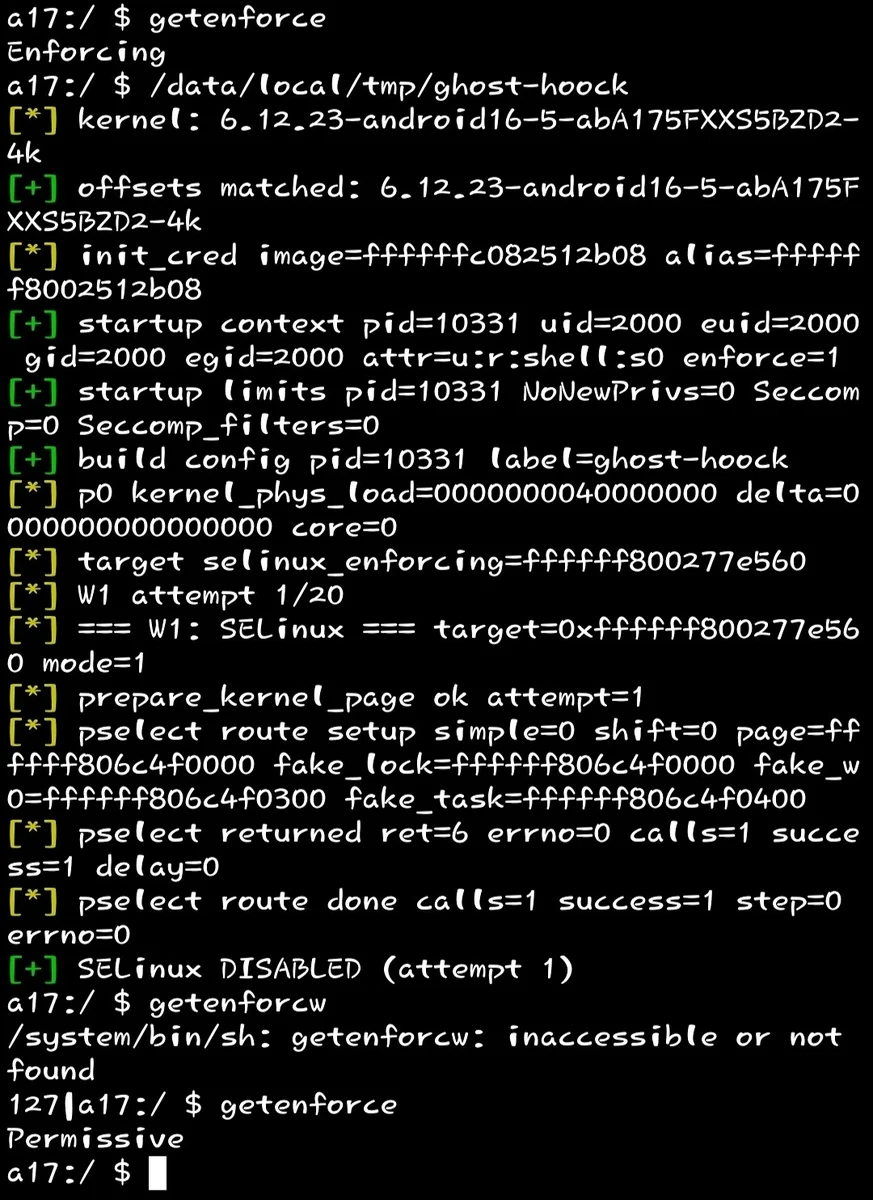
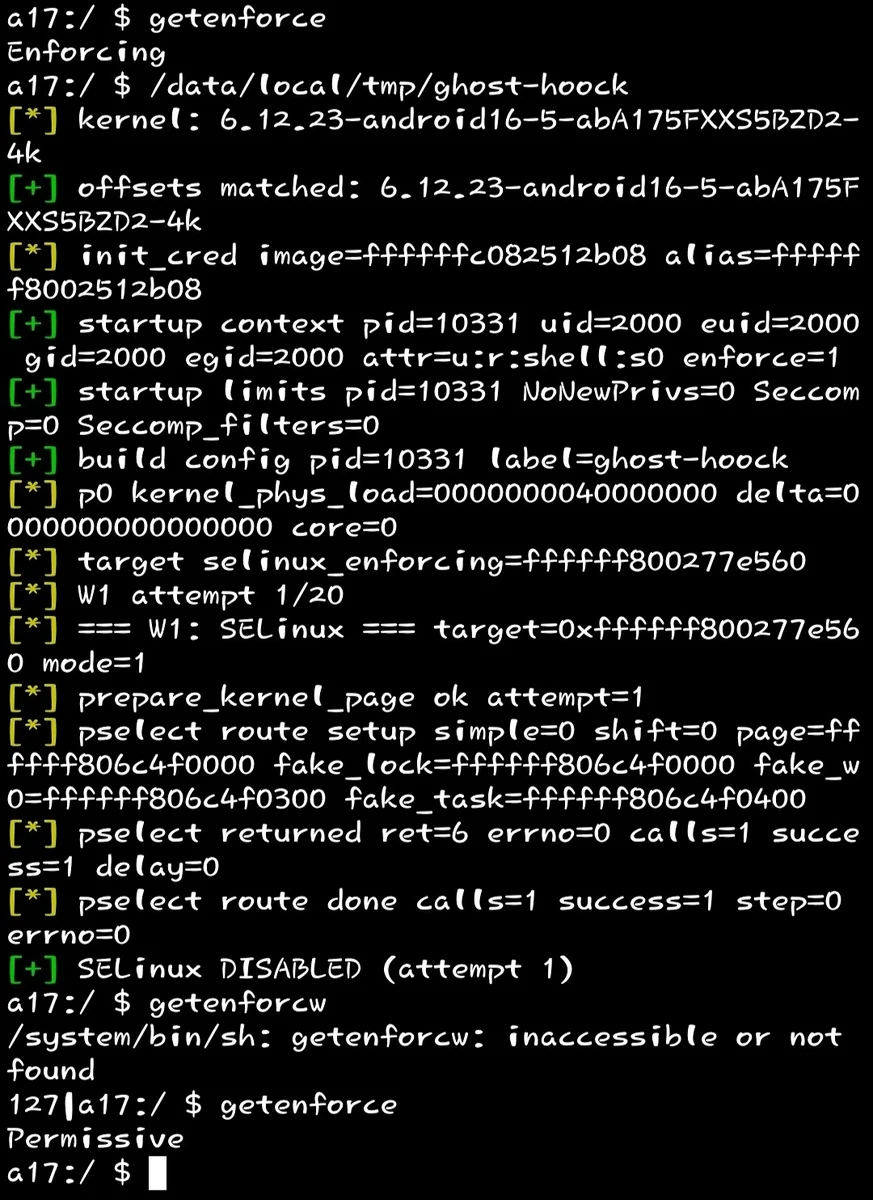
Example output on a Samsung Galaxy A17 (SM-A175F, BZA5):
[] kernel: 6.12.23-android16-5-abA175FXXS5BZD2-4k
[+] offsets matched: 6.12.23-android16-5-abA175FXXS5BZD2-4k
[] init_cred image=ffffffc082512b08 alias=ffffff8002512b08
[+] startup context pid=10331 uid=2000 euid=2000 gid=2000 egid=2000 attr=u:r:shell:s0 enforce=1
[+] startup limits pid=10331 NoNewPrivs=0 Seccomp=0 Seccomp_filters=0
[+] build config pid=10331 label=ghost-hoock
[] p0 kernel_phys_load=0000000040000000 delta=0000000000000000 core=0
[] target selinux_enforcing=ffffff800277e560
[] W1 attempt 1/20
[] === W1: SELinux === target=0xffffff800277e560 mode=1
[] prepare_kernel_page ok attempt=1
[] pselect route setup simple=0 shift=0 page=ffffff806c4f0000 fake_lock=ffffff806c4f0000 ...
[] pselect returned ret=6 errno=0 calls=1 success=1 delay=0
[] pselect route done calls=1 success=1 step=0 errno=0
[+] SELinux DISABLED (attempt 1)
Then:
$ getenforce
Permissive
getenforce returns Permissive
The exploit targets CVE-2026-43499 — a use-after-free in the Linux kernel's futex PI (Priority Inheritance) rt_mutex chain. The chain in ghost-hoock is four steps:
Timing side-channel against the kernel's futex hash table. We hammer FUTEX_WAKE_PRIVATE on a set of user-space futexes, measure rdtsc deltas, and correlate hash-bucket collisions. This recovers the address of our own mm_struct — the base of the spray page we later need.
This is the KernelSnitch technique, taken verbatim from the original exploit.
We allocate a large order-3 slab page, then lay it out with the fake-object layout used by the PI route:
| Offset | Object | Purpose |
|---|---|---|
0x0E80 | fake_lock | Fake rt_mutex |
0x0F80 | fake_fops | Fake file_operations table |
0x1180 | fake_w0 | Fake rt_mutex_waiter used as target tree |
0x1240 | fake_right | Fake rb-tree right node — this is where the write value comes from |
0x1260 | fake_left | Fake rb-tree left node |
0x1280 | fake_task | Fake task_struct |
The whole page is sent through an AF_UNIX socket as SKB_SEND_SIZE = 2 * ORDER3_SIZE of sendmsg, so the skb data lands on our leaked page. Then we free it in a controlled order so that our page ends up on a per-cpu partial slab we can reclaim.
Three threads:
FUTEX_WAIT_REQUEUE_PI on f_wait, targeting f_pi_target.FUTEX_LOCK_PI on f_pi_target and then on f_pi_chain.sched_setattr(tid, SCHED_BATCH, nice=19) on the waiter's TID, which triggers rt_mutex_setprio() and forces the kernel to walk the fake PI tree.A fourth call from the main thread — FUTEX_CMP_REQUEUE_PI(1, f_pi_target) — kicks off the requeue. Inside the kernel, rb_erase() runs against our fake tree.
pselect() / select() copies the user's fd_set into kernel stack and later walks it. We arrange the fd_set bitmaps so that the words the kernel treats as rb-tree pointers land on fake_right and its parent — and the resulting rb_set_parent(child, parent) becomes:
*(uint64_t *)target = value | color
For mode = 1 (Write 1), target = selinux_enforcing and value = base + 0x100, which encodes as byte0 = 0, byte1 = 1. The kernel writes 0 to selinux_enforcing[0] — SELinux is now permissive.
ret = 6 (instead of the default 9) confirms the write landed: the consumer hit the target during select(), waking it early.
This is a fork of mobilehackinglab/ghostlock-a17 (MIT). The following is taken 1:1 from the upstream exploit:
| Component | File | Notes |
|---|---|---|
| KernelSnitch | src/kernelsnitch/* | mm_struct leak via futex hash timing |
| Heap spray | src/spray.c | fake-object layout, prepare_skb_payload, prepare_kernel_page |
| PI route + pselect | src/route.c | prepare_pselect_fdsets, do_pselect_fake_lock_route, consumer_thread, waiter_thread, owner_thread |
| BZA5 offsets | include/offsets_bza5.h | Symbol table extracted from 6.12.23-android16-5-abA175FXXS5BZD2-4k |
| BZA5 target header | include/target.h | Address layout, payload offsets (W1-subset only) |
| Runtime struct offsets | include/runtime_struct_offsets.h | _RSO() macros for task_struct fields |
Auxiliary code (pr_* macros, SYSCHK, pin_to_core, set_limit, set_unbuffer) is also kept as-is from the original.
The original GhostLock achieves full root on the A17: it installs a rwforge physical R/W channel, patches cred / real_cred, runs a UMH helper with init creds, captures logs, and more. In ghost-hoock, everything past the first constrained write is gone.
| Removed file | Why it existed in the original |
|---|---|
rwforge_a17.c | Marching-forger physical R/W channel via pipe_buffers |
pipe_physrw.c, pipe_reclaim.c | Pipe-buffer reclaim -> arbitrary kernel read/write |
root.c | cred / real_cred overwrite, su install, SELinux SID patching |
umh_root.c, wq_umh_root() (in main.c) | Running an init-creds helper from a forged kernel workqueue item |
slide.c | KASLR leak via boot_id oracle — not needed on BZA5, KASLR is off |
miniadb.c | Bootstrap via ADB TCP |
try_cfi_stage() (in fops.c) | CFI-friendly configfs stage used to bootstrap the root path |
run_rwforge(), run_bootid_oracle(), rwforge_root_and_capture() | The whole root pipeline |
install_embedded_su(), install_embedded_wallpaper() | Root-install helpers |
Write 2 (cred), patch_cred_*, patch_task_seccomp | Post-W1 credential takeover |
