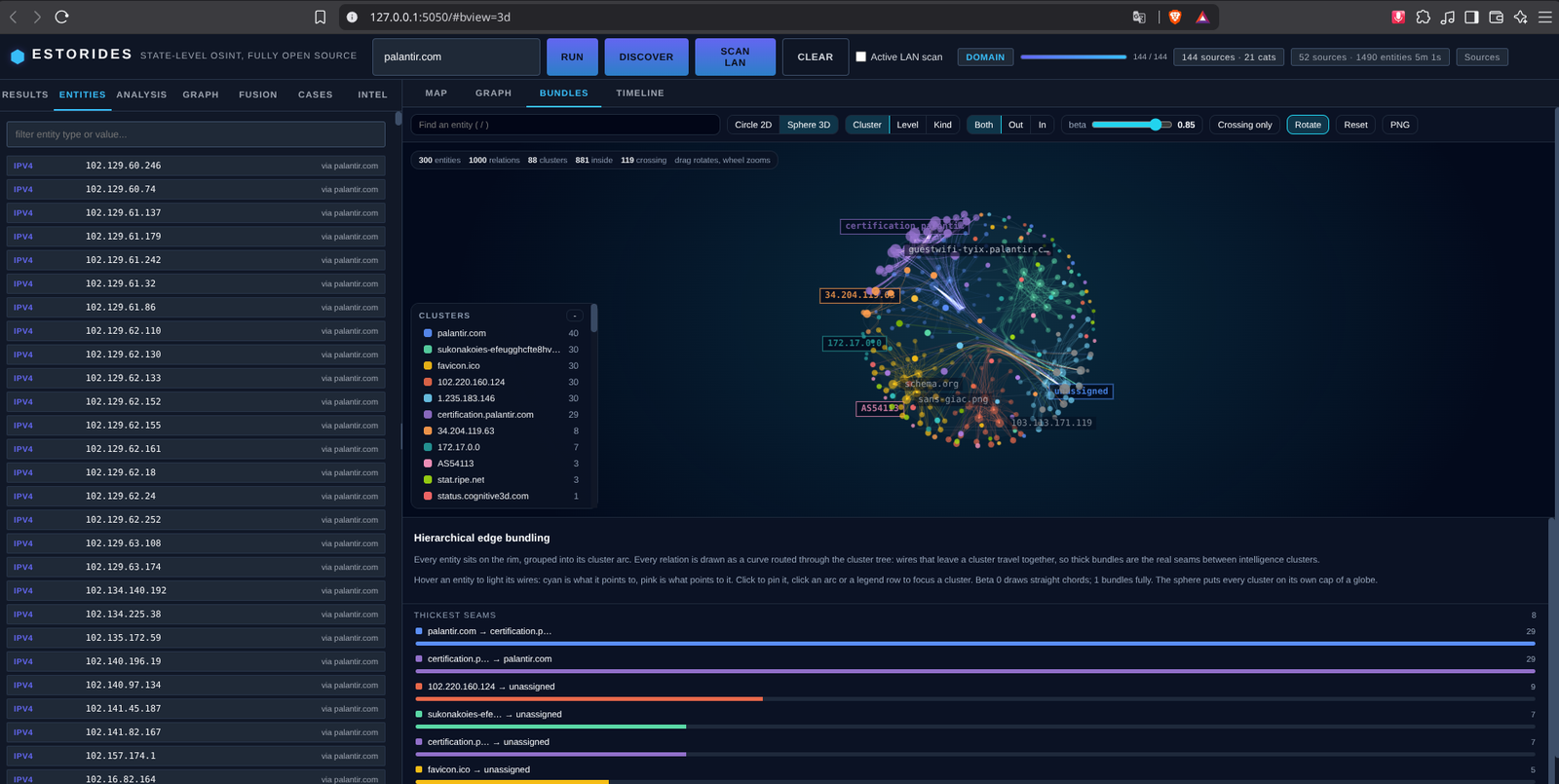

Aggregates 99+ free OSINT sources in parallel, resolves entities into a knowledge graph, and exports STIX 2.1, MISP, or GraphML with LLM-assisted analysis.
From the creators of LazyOwn Redteam Framework comes a free and open-source
intelligence (OSINT) aggregator and correlation engine
inspired by Palantir, Bellingcat, Maltego, and Citizen Lab workflows.
A pure open-source re-imagining of the original fucklantir /
osint_palantir toolchain, with a much bigger source catalogue, a
proper knowledge graph, structured parsers, and a multi-backend LLM
analyst.
No payloads. No active scanning. Just 99+ free public OSINT sources, fanned out in parallel, fused into a single intelligence picture.
                       +--------------------------+
   query "example.com" |  Estorides Orchestrator  |   -> STIX 2.1 bundle
---------------------> |  - async fanout          |   -> MISP event JSON
                       |  - 99+ free sources      |   -> GraphML for Gephi
                       |  - structured parsers    |   -> JSONL for training
                       |  - entity resolution     |
                       |  - knowledge graph       |
                       |  - ontology engine       |   <- OFAC SDN cross-check
                       |  - MITRE ATT&CK mapper   |   <- technique auto-tagging
                       |  - SSRF guard            |   <- blocklist at egress
                       |  - audit log + RL        |   <- per-IP trail
                       |  - multi-LLM analyst     |   <- BLUF / tactical / system
                       +--------------------------+
                                 |
                                 v
                           Web UI: map / graph / bundles / timeline / results
pip install estorides
estorides serve --port 5050
(From a source checkout the equivalent is python3 estorides_cli.py serve --port 5050
or python3 -m estorides_cli serve --port 5050.)
Estorides is structured around small, single-responsibility registries so adding a new source, backend, inferer, or feed never requires touching the central orchestrator. The five plug-in surfaces are:
| Surface | Decorator | File | Used for |
|---|---|---|---|
| Source parsers | @register_parser("name") | estorides_core/parsers.py | Translate raw HTTP into structured dicts |
| LLM backends | @register("name") | estorides_llm/manager.py | Add an LLM provider (ollama, openai, …) |
| Relationship inferers | @register_inferer("source") | estorides_core/relationship_inference.py | Source -> graph edges |
| Real-time feeds | subclass Feed | estorides_core/feeds.py | Map layers (quakes, fires, news, aircraft, satellites, launches) |
| Encrypted exporters | estorides_export.encryption | estorides_export/encryption.py | STIX/MISP + age encryption |
| Capability | Original | Estorides |
|---|---|---|
| Number of free OSINT sources | ~20 | 99 |
| Intelligence categories | 6 | 12 |
| HTTP fanout model | sequential | async |
| Retries + backoff + circuit breaker | basic | yes |
| Response cache (SQLite) | none | yes |
| Per-source parsers | none | 50+ |
| Entity extraction (IP, domain, CVE…) | regex only | structured + dedup |
| Knowledge graph | none | NetworkX + GraphML |
| STIX 2.1 / MISP export | none | yes |
| Multi-LLM (Ollama / OpenAI / Anthropic) | Ollama only | 4 backends + stub |
| Map (geolocation results) | PyVista 3D | Leaflet 2D |
| Force-directed graph view | none | D3.js |
| API key handling | none | per-source env vars |
| Paid source support | none | flag-based opt-in |
| OFAC SDN sanctions cross-check | none | ontology engine |
| MITRE ATT&CK technique auto-tagging | none | ~40 techniques |
| SSRF / private-NW egress guard | none | RFC1918 + cloud IMDS blocked |
| Audit log (per request, append-only) | none | JSONL with IP+query+latency |
| Per-IP rate limit (sliding window) | none | default 30/min, env-tunable |
| Encrypted export (age) | none | opt-in via ?key=age1… |
| Real-time feed layers | none | earthquakes + fires + news |
| Encrypted export (age) | none | opt-in via ?key=age1… |
| Capability | v1.0 | v1.1 (this) |
|---|---|---|
| Persistent graph (Cypher queries) | NetworkX dump | Kùzu embedded DB, cross-run joins |
| Run persistence | JSONL append | SQLite cases with FK observations/entities |
| Cross-feed entity resolver | none | Wikidata + OFAC + IP-API + NVD via intel_resolver |
| Fuzzy entity clustering | exact dedup | difflib SequenceMatcher, 0.85 threshold, aliases surfaced |
| Extra OSINT endpoints (keyless) | 99 YAML sources | +7 (BGP, MAC, phone, GitHub, leaks, CISA KEV, malware C2) |
| Read-only Cypher endpoint | none | /api/intel/graph?q=... with write-keyword guard |
| Case history UI | none | Cases tab + full-entity inspector |
The original engine was a data collector: a fan-out, parsers, a graph, an LLM that summarises. The v1.4 sprint introduces the information layer: every observation now carries a grounded confidence score; the orchestrator and downstream consumers (hypothesis engine, change detection, LLM analyst) stop using their own ad-hoc heuristics and use this single source of truth.

