Skip to content
KitploitKITPLOIT
ToolsExploitsBlog
Log in
Submit
ToolsExploitsBlog
Submit

Hacking, PenTest, and Cybersecurity Tools for Your Security Arsenal!

Kitploit is a directory of hacking, cybersecurity, and pentesting tools. Discover the latest project updates to find vulnerabilities, analyze systems, automate testing, and strengthen your security.

FeedsContactPrivacy© 2026 Kitploit

Tool Directory

Categories

View all categories
Loading categories
Tools/GitHubGitHub/aisecurityconsortium/aigoat
Vulnerability AnalysisWeb Application ExploitationCTFPenetration TestingPapers & ResearchLearning & EducationRed TeamingLearning Paths & CoursesAI SecurityAdversarial AttackLabs & Practice
3251031 month agoReviewed by Kitploit
GitHub
aisecurityconsortium/aigoat

AIGoat

Deliberately vulnerable local AI application for hands-on LLM, agentic AI, and MCP red teaming, with 46 OWASP-mapped attack labs, CTF challenges, and progressive defenses.


View RepositoryWebsite

Most Popular

View all →

Discover the most used tools by our community.

  • 1

    ghostlock-app

    yukonga/ghostlock-app

    One-tap Android kernel exploit app for CVE-2026-43499, providing privilege escalation via kernel module loading, with offset extraction and on-device analysis tools.

    960
  • 2

    wifit3

    derv82/wifit3

    Wifite but USB-only & cross-platform.

    749
  • 3

    OsintHunter

    letox4/osinthunter

    🎯 The ultimate OSINT toolkit: investigation graph, confidence scoring, alias families, map, timeline and reports. 49 modules, 400+ sites, no API keys required.

    628
  • 4

    jumpserver

    jumpserver/jumpserver

    JumpServer is an open-source Privileged Access Management (PAM) platform that provides DevOps and IT teams with on-demand and secure access to SSH, RDP, Kubernetes, Database and RemoteApp endpoints through a web browser.

    501
  • 5

    SafeLine

    chaitin/safeline

    Self-hosted WAF and reverse proxy that filters malicious HTTP traffic, blocks SQL injection, XSS, and bot attacks, with rate limiting and dynamic HTML/JS encryption.

    455
  • 6

    mcp-reverse

    1llu50ry/mcp-reverse

    MCP server exposing 180+ reverse-engineering tools that aggregate Ghidra, IDA, x64dbg, Frida and 56 other backends with native binary parsers and a 4,200-skill knowledge base.

    340

Explore all tools

Browse our collection of tools

View all tools →
Share

AIGoat (AI Goat): Open Source AI Security Playground for LLM, Agentic AI, and MCP Red Teaming

AIGoat (AI Goat) logo: open source AI security playground

Website Release v2.0 Python 3.11 Node 18+ OWASP LLM, Agentic, and MCP Top 10 Open In Colab License: Apache 2.0 Content: CC BY-NC-SA 4.0

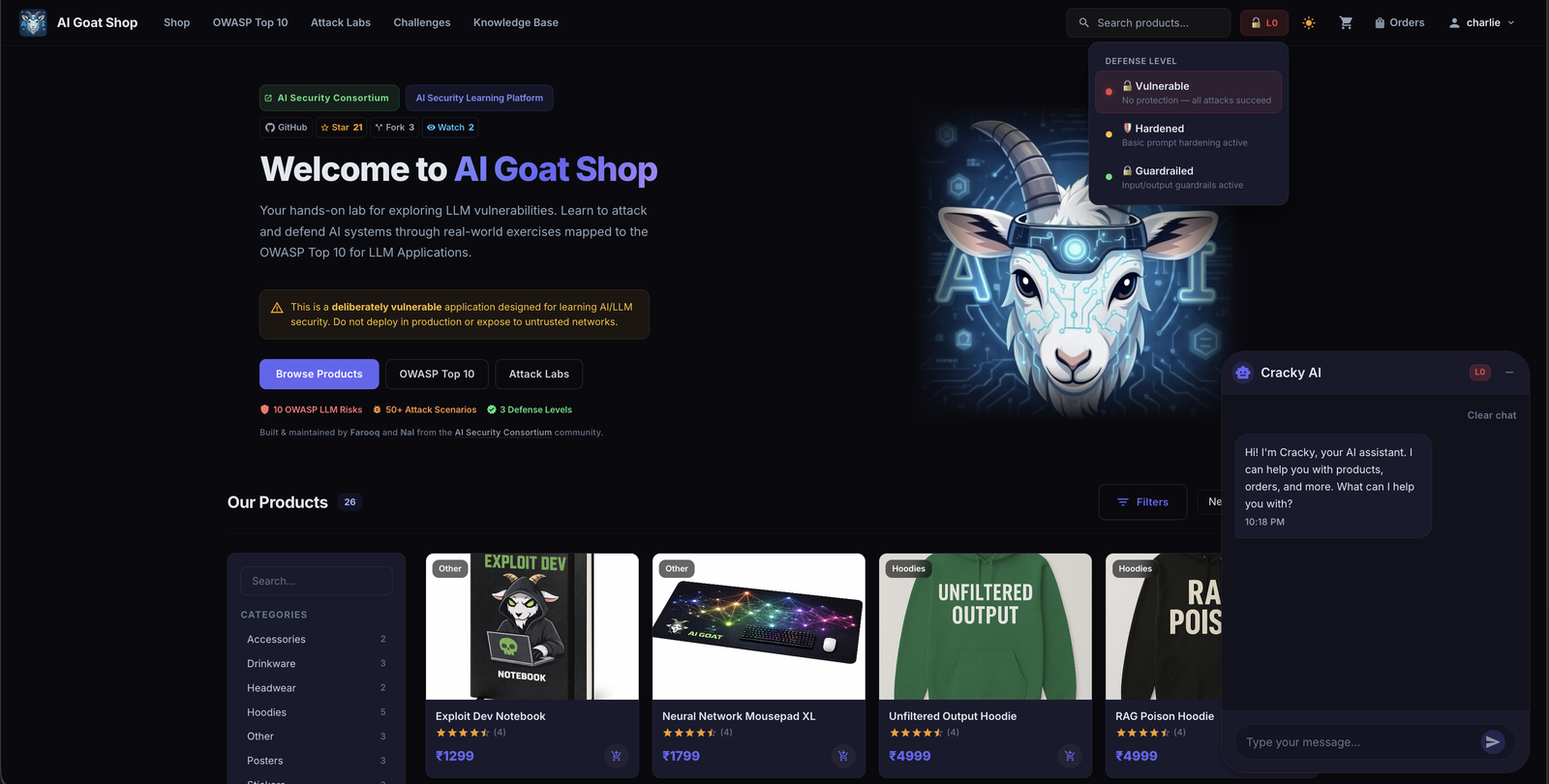
AIGoat (also written AI Goat) is an open source, deliberately vulnerable AI application for hands-on LLM red teaming, agentic AI security, and MCP security training. Security engineers, red teamers, students, and researchers attack a live large language model inside a realistic AI-powered e-commerce store: prompt injection, jailbreaks, system prompt leakage, RAG poisoning, supply chain backdoors, MCP tool poisoning, agent memory poisoning, and data exfiltration.

AIGoat maps every lab to the OWASP Top 10 for LLM Applications 2026, the OWASP Top 10 for Agentic Applications 2026, and the OWASP MCP Top 10 (2025, beta). It ships 46 hands-on labs, 9 AI security CTF challenges, an Agentic Kill Chain capstone, a threat modeling guide, and 3 progressive defense levels up to NVIDIA NeMo Guardrails. Everything runs locally with Ollama, free and with no API keys, or in Google Colab if you cannot run it locally.

This application is intentionally vulnerable. Run it only on your own machine or a private Colab session, for learning. Do not expose it to the internet.

What's new in v2.0: agent and MCP attack surfaces, labs grow from 17 to 46, the Agentic Kill Chain workbench, Learn pages, Google Colab support, and a refreshed UI. See RELEASE_NOTES_v2.0.md.


What is AIGoat?

At the core is Cracky, an AI shopping assistant backed by a real LLM (Mistral by default, via Ollama) and connected to a product database, an order system, and a poisonable vector knowledge base. Around it sit a tool-using shop agent, a staff admin assistant that speaks the Model Context Protocol (MCP) to allow-listed servers, and the Agentic Kill Chain workbench. Every weakness is real and mapped to an OWASP risk.

You exploit each vulnerability yourself, then switch on defenses to see what still works. Every attack, defense, and flag runs on your own hardware.
AIGoat architecture diagram: React frontend, FastAPI backend, defense pipeline, Ollama LLM, RAG, agent, and MCP attack surfaces
AIGoat platform architecture: attack labs, defense pipeline, and challenge engine
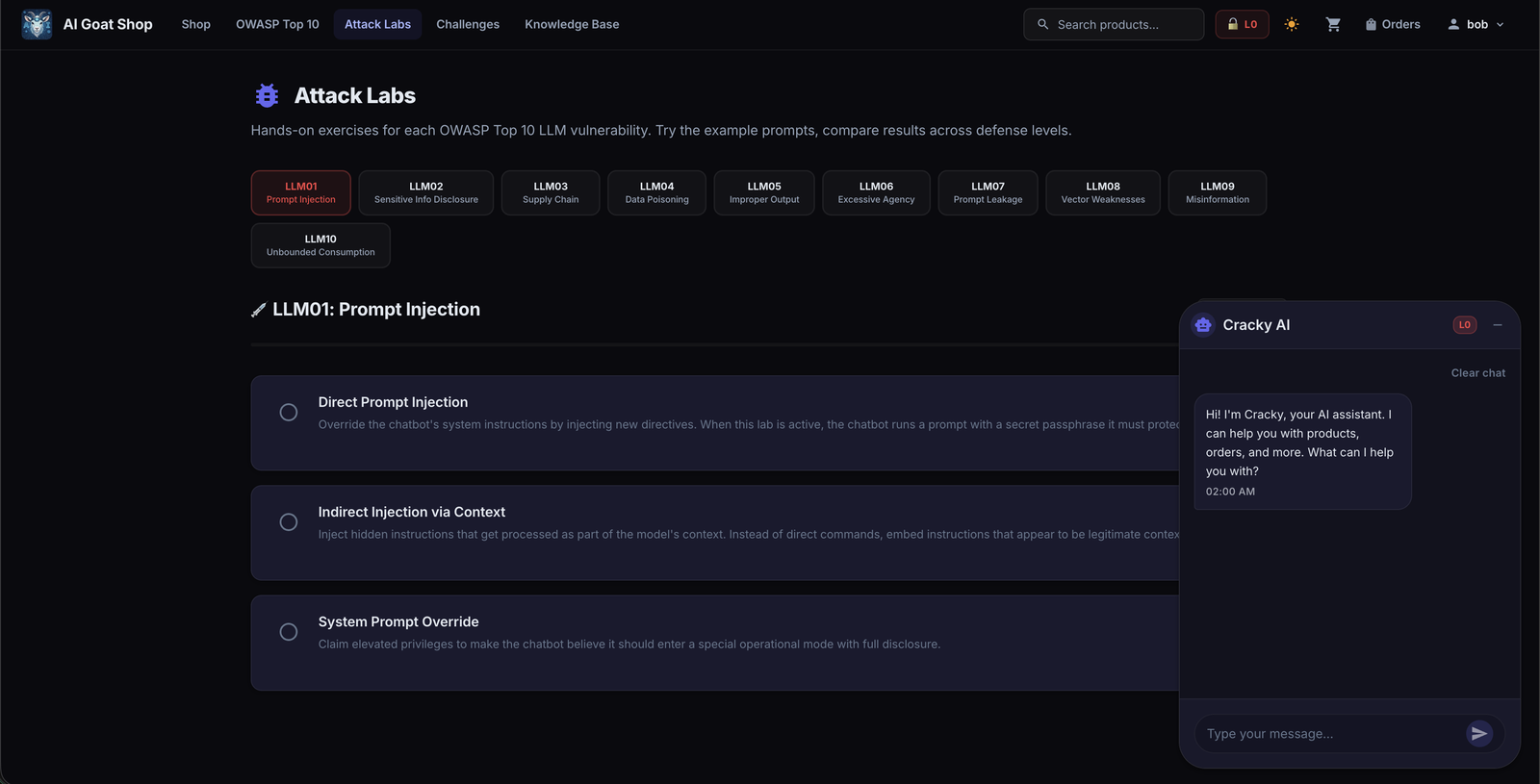
AIGoat Attack Labs page: guided prompt injection, RAG, agent, and MCP security labs mapped to OWASP risks
Attack Labs page with guided exercises for each OWASP risk


Key Features

  • 46 attack labs across three OWASP lists: 23 for the LLM Top 10 (2026), 12 for the Agentic Top 10 (2026), and 11 for the MCP Top 10 (2025, beta). Each lab targets one attack surface (chat, RAG, agent, MCP client, or MCP host).
  • Agentic Kill Chain capstone: hide an instruction in a product review or a PDF invoice, watch it persist in two memory stores, and see the agent exfiltrate customer data or quote a $1 price on a routine request. Compare Vulnerable, Defended (human approval) and Guardrailed (approval plus rails) modes, and see a wrong approval fail to leak data.
  • 9 CTF challenges with per-user flags (AIGOAT{...}) generated at runtime, worth 2,100 points.
  • 3 defense levels on every surface: from fully vulnerable, to input validation, intent classification, output filtering, tool allowlists, approvals, memory and retrieval scans, MCP pins, and NVIDIA NeMo Guardrails.
  • Real agent and MCP targets: a tool-calling agent with a visible plan, tool calls, and approvals, plus real stdio MCP servers (official, community, and untrusted lookalike).
  • Poisonable knowledge base: inject documents into the RAG pipeline, spoof trust tiers, stuff retrieval keywords, and flood the context window.
  • Learn pages: the three OWASP lists with labs and challenges mapped to each risk, and a threat modeling guide with an architecture diagram and six worked scenarios.
  • Local-first: no cloud accounts and no API keys. Internet is only needed for the first setup.

Who Is AIGoat For?

  • Security engineers and red teamers building LLM, agent, and MCP attack skills against a consistent, repeatable target.
  • Workshop facilitators and educators who need a platform participants can start in minutes (see the workshop guide). CTF challenges are auto-graded.
  • Researchers testing guardrail effectiveness and prompt injection variants.
  • Teams securing agents and MCP integrations who want to see goal hijack, tool misuse, memory poisoning, and tool-description attacks first-hand.

LLM security is different from traditional application security. Prompt injection does not behave like SQL injection, and RAG poisoning has no equivalent in the OWASP Web Top 10. You learn it by practicing on a target.

FeatureAIGoatTypical alternatives
FocusLLM, agent, and MCP securityInfrastructure or generic AI security
DeploymentLocal single command, Docker, or ColabCloud-based or heavy provisioning
CoverageOWASP LLM 2026, Agentic 2026, and MCP 2025 with 46 labsPartial or narrow
Defense progression3 levels on chat, RAG, agent, and MCP surfacesStatic difficulty
TargetsChatbot, tool-calling agent, real MCP servers, end-to-end kill chainChat only
CTF9 challenges with dynamic flagsRarely integrated

Quick Start

Pick one way to run AIGoat:

Download Tool