
Skip to content
KitploitKITPLOIT
ИнструментыБлог
Отправить
ИнструментыБлог
Отправить

Инструменты для хакинга, пентеста и кибербезопасности — ваш арсенал защиты!

Kitploit — это каталог инструментов для хакинга, кибербезопасности и пентестинга. Находите последние обновления проектов для поиска уязвимостей, анализа систем, автоматизации тестирования и усиления вашей безопасности.

··Ленты·Контакты·Конфиденциальность·© 2026 Kitploit

Каталог инструментов

Категории

Все категории
Loading categories
yaraQA — Анализатор YARA-правил для улучшения качества и производительности правил | Kitploit
Инструменты/GitHubGitHub/neo23x0/yaraqa
Статический анализАнализ уязвимостейАнализ КодаАнализ вредоносных программ
GitHubneo23x0/yaraqa

yaraQA

Анализатор YARA-правил для улучшения качества и производительности правил

Репозиторий
117823 месяцев назадПроверено Kitploit

Популярное

Смотреть все →

Откройте для себя самые используемые инструменты нашего сообщества.

Изучить все инструменты

Просмотрите нашу коллекцию инструментов

Смотреть все инструменты →
Поделиться

yaraQA

Анализатор YARA-правил для повышения качества и производительности правил

Зачем?

YARA-правила могут быть синтаксически корректными, но всё равно нефункциональными. yaraQA пытается найти и сообщить об этих проблемах автору или сопровождающему набора YARA-правил.

Проблемы, которые пытается обнаружить yaraQA, например:

  • правила, синтаксически корректные, но никогда не срабатывающие из-за ошибок в условии (например, правило с одной строкой и 2 of them в условии)
  • правила, использующие комбинации строк и модификаторов, которые, вероятно, ошибочны (например, $ = "\\Debug\\" fullword)
  • проблемы производительности, вызванные короткими атомами, повторяющимися символами или циклами (например, $ = "AA"; можно исключить из анализа с помощью --ignore-performance)

Я планирую со временем расширять набор тестов. Каждая минорная версия будет включать новые функции или новые тесты.

Установка зависимостей

root@kitploit:~
pip install -r requirements.txt

Использование

root@kitploit:~
usage: yaraQA.py [-h] [-f yara files [yara files ...]] [-d yara files [yara files ...]] [-o outfile] [-b baseline] [-l level]
                 [--ignore-performance] [--debug]

YARA RULE ANALYZER

optional arguments:
  -h, --help            show this help message and exit
  -f yara files [yara files ...]
                        Path to input files (one or more YARA rules, separated by space)
  -d yara files [yara files ...]
                        Path to input directory (YARA rules folders, separated by space)
  -o outfile            Output file that lists the issues (JSON, default: 'yaraQA-issues.json') 
  -b baseline           Use a issues baseline (issues found and reviewed before) to filter issues
  -l level              Minium level to show (1=informational, 2=warning, 3=critical)
  --ignore-performance  Suppress performance-related rule issues
  --debug               Debug output

Попробуйте

root@kitploit:~
python3 yaraQA.py -d ./test/

Подавить все проблемы производительности и показывать только проблемы обнаружения/логики.

root@kitploit:~
python3 yaraQA.py -d ./test/ --ignore-performance

Подавить все проблемы информационного характера

root@kitploit:~
python3 yaraQA.py -d ./test/ -level 2

Используйте базовый уровень, чтобы видеть только новые проблемы (не те, которые вы уже просмотрели). Файл базового уровня — это старый JSON-вывод просмотренного состояния.

root@kitploit:~
python3 yaraQA.py -d ./test/ -b yaraQA-reviewed-issues.json

Примеры правил с проблемами

Примеры правил с проблемами можно найти в папке ./test.

Вывод

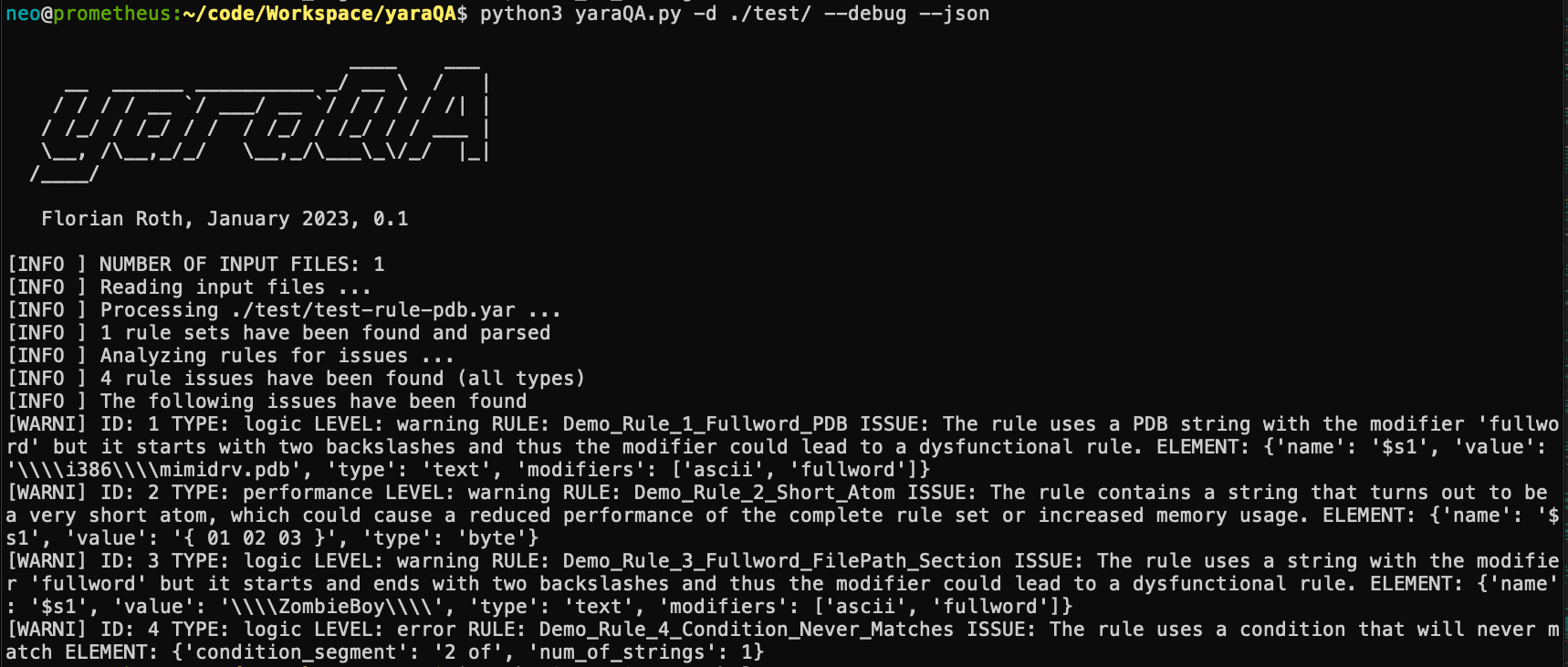
По умолчанию yaraQA записывает обнаруженные проблемы в файл с именем yaraQA-issues.json.

Ниже показан пример вывода, создаваемого yaraQA в формате JSON:

root@kitploit:~
[
    {
        "rule": "Demo_Rule_1_Fullword_PDB",
        "id": "SM1",
        "issue": "The rule uses a PDB string with the modifier 'wide'. PDB strings are always included as ASCII strings. The 'wide' keyword is unneeded.",
        "element": {
            "name": "$s1",
            "value": "\\\\i386\\\\mimidrv.pdb",
            "type": "text",
            "modifiers": [
                "ascii",
                "wide",
                "fullword"
            ]
        },
        "level": "info",
        "type": "logic",
        "recommendation": "Remove the 'wide' modifier"
    },
    {
        "rule": "Demo_Rule_1_Fullword_PDB",
        "id": "SM2",
        "issue": "The rule uses a PDB string with the modifier 'fullword' but it starts with two backslashes and thus the modifier could lead to a dysfunctional rule.",
        "element": {
            "name": "$s1",
            "value": "\\\\i386\\\\mimidrv.pdb",
            "type": "text",
            "modifiers": [
                "ascii",
                "wide",
                "fullword"
            ]
        },
        "level": "warning",
        "type": "logic",
        "recommendation": "Remove the 'fullword' modifier"
    },
    {
        "rule": "Demo_Rule_2_Short_Atom",
        "id": "PA2",
        "issue": "The rule contains a string that turns out to be a very short atom, which could cause a reduced performance of the complete rule set or increased memory usage.",
        "element": {
            "name": "$s1",
            "value": "{ 01 02 03 }",
            "type": "byte"
        },
        "level": "warning",
        "type": "performance",
        "recommendation": "Try to avoid using such short atoms, by e.g. adding a few more bytes to the beginning or the end (e.g. add a binary 0 in front or a space after the string). Every additional byte helps."
    },
    {
        "rule": "Demo_Rule_3_Fullword_FilePath_Section",
        "id": "SM3",
        "issue": "The rule uses a string with the modifier 'fullword' but it starts and ends with two backslashes and thus the modifier could lead to a dysfunctional rule.",
        "element": {
            "name": "$s1",
            "value": "\\\\ZombieBoy\\\\",
            "type": "text",
            "modifiers": [
                "ascii",
                "fullword"
            ]
        },
        "level": "warning",
        "type": "logic",
        "recommendation": "Remove the 'fullword' modifier"
    },
    {
        "rule": "Demo_Rule_4_Condition_Never_Matches",
        "id": "CE1",
        "issue": "The rule uses a condition that will never match",
        "element": {
            "condition_segment": "2 of",
            "num_of_strings": 1
        },
        "level": "error",
        "type": "logic",
        "recommendation": "Fix the condition"
    },
    {
        "rule": "Demo_Rule_5_Condition_Short_String_At_Pos",
        "id": "PA1",
        "issue": "This rule looks for a short string at a particular position. A short string represents a short atom and could be rewritten to an expression using uint(x) at position.",
        "element": {
            "condition_segment": "$mz at 0",
            "string": "$mz",
            "value": "MZ"
        },
        "level": "warning",
        "type": "performance",
        "recommendation": ""
    },
    {
        "rule": "Demo_Rule_5_Condition_Short_String_At_Pos",
        "id": "PA2",
        "issue": "The rule contains a string that turns out to be a very short atom, which could cause a reduced performance of the complete rule set or increased memory usage.",
        "element": {
            "name": "$mz",
            "value": "MZ",
            "type": "text",
            "modifiers": [
                "ascii"
            ]
        },
        "level": "warning",
        "type": "performance",
        "recommendation": "Try to avoid using such short atoms, by e.g. adding a few more bytes to the beginning or the end (e.g. add a binary 0 in front or a space after the string). Every additional byte helps."
    },
    {
        "rule": "Demo_Rule_6_Condition_Short_Byte_At_Pos",
        "id": "PA1",
        "issue": "This rule looks for a short string at a particular position. A short string represents a short atom and could be rewritten to an expression using uint(x) at position.",
        "element": {
            "condition_segment": "$mz at 0",
            "string": "$mz",
            "value": "{ 4d 5a }"
        },
        "level": "warning",
        "type": "performance",
        "recommendation": ""
    },
    {
        "rule": "Demo_Rule_6_Condition_Short_Byte_At_Pos",
        "id": "PA2",
        "issue": "The rule contains a string that turns out to be a very short atom, which could cause a reduced performance of the complete rule set or increased memory usage.",
        "element": {
            "name": "$mz",
            "value": "{ 4d 5a }",
            "type": "byte"
        },
        "level": "warning",
        "type": "performance",
        "recommendation": "Try to avoid using such short atoms, by e.g. adding a few more bytes to the beginning or the end (e.g. add a binary 0 in front or a space after the string). Every additional byte helps."
    },
    {
        "rule": "Demo_Rule_6_Condition_Short_Byte_At_Pos",
        "id": "SM3",
        "issue": "The rule uses a string with the modifier 'fullword' but it starts and ends with two backslashes and thus the modifier could lead to a dysfunctional rule.",
        "element": {
            "name": "$s1",
            "value": "\\\\Section\\\\in\\\\Path\\\\",
            "type": "text",
            "modifiers": [
                "ascii",
                "fullword"
            ]
        },
        "level": "warning",
        "type": "logic",
        "recommendation": "Remove the 'fullword' modifier"
    }
]

Скриншоты

yaraQA

Скачать инструмент