 hydrasoft/cve-2026-41089-netlogon-rce
Technical analysis and Proof-of-Concept (PoC) for CVE-2026-41089, a critical unauthenticated Remote Code Execution (RCE) vulnerability in the Windows Netlogon service affecting Domain Controllers.

Unauthenticated Remote Code Execution on Active Directory Domain Controllers
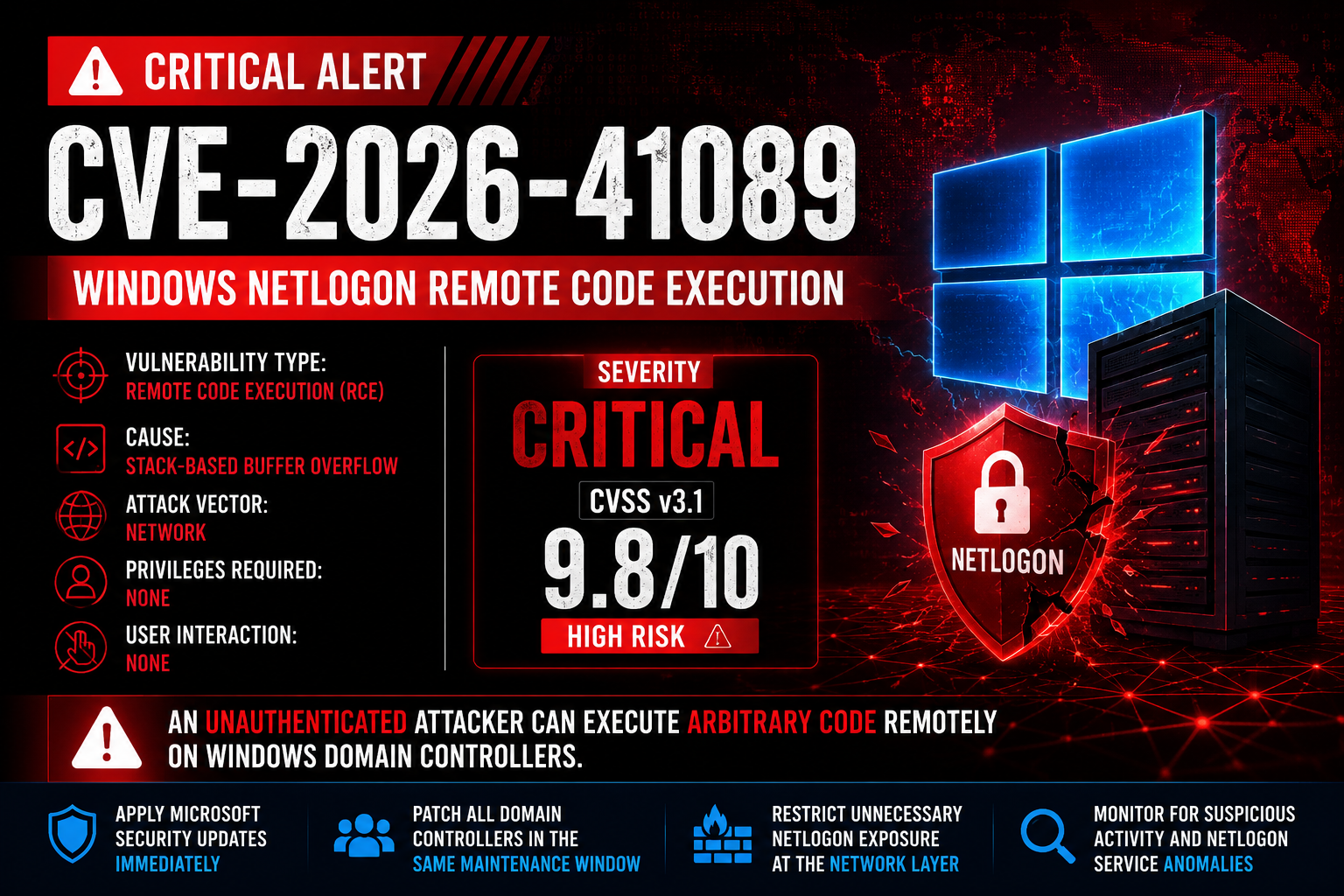






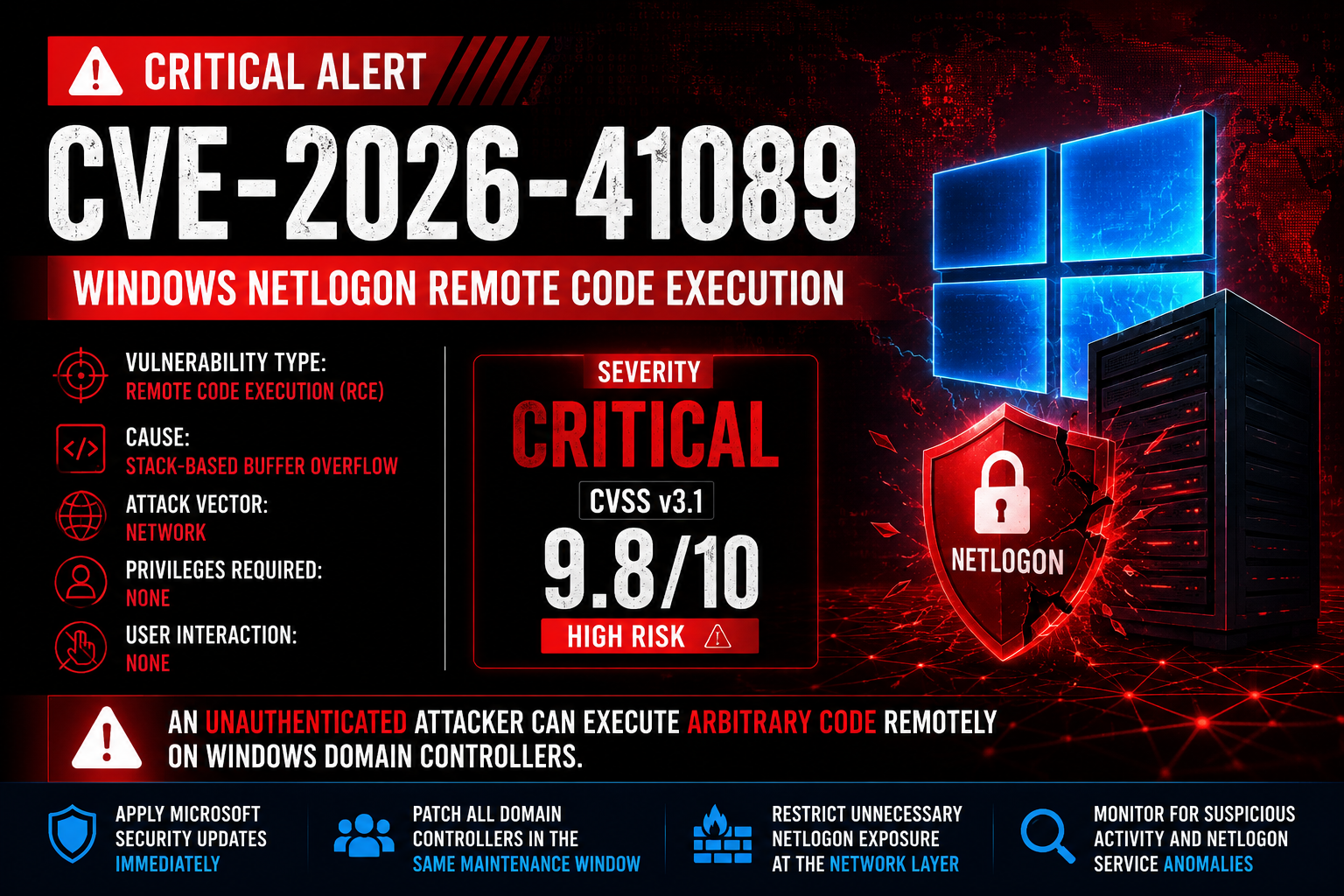
I am publishing this technical breakdown of CVE-2026-41089, an exceptionally critical vulnerability residing deep within the Windows Netlogon service. My analysis reveals that the flaw is rooted in a severe stack-based buffer overflow (CWE-121). By sending specially crafted, malformed requests to a vulnerable Domain Controller over the network, an unauthenticated attacker can force memory corruption and seamlessly execute arbitrary code at the system level.
"He who controls Netlogon, controls the kingdom."
Because this vulnerability requires zero user interaction and no prior authentication, it represents a nightmare scenario for enterprise environments. It serves as a direct, frictionless path to complete Active Directory compromise, making it a prime target for Advanced Persistent Threats (APTs) and ransomware syndicates.
| Technical Field | Assigned Value | Notes |
|---|---|---|
| CVE Identifier | CVE-2026-41089 | Officially tracked zero-day |
| Severity Score | Critical (CVSS v3.1: 9.8) | ████████████████████ 100% |
| Vulnerability Type | CWE-121 | Stack-based Buffer Overflow |
| Affected Component | Windows Netlogon | Active Directory authentication pipeline |
| Attack Vector | Network | Fully remote execution |
| Privileges Required | None | Unauthenticated RCE |
I have developed a Python-based diagnostic script to test your domain controllers for susceptibility to this overflow without crashing the LSASS process.
# 1. Connectivity & Baseline test (short username, prevents overflow) python3 CVE-2026-41089.py 10.0.50.21 corp.local2. Default overflow vulnerability check (length 130)
python3 CVE-2026-41089.py 10.0.50.21 corp.local -l 130
3. Aggressive payload test with high timeout for latent networks
python3 CVE-2026-41089.py 10.0.50.21 corp.local -l 200 -t 10
If an attacker gains a foothold anywhere on your internal network, the attack path is dangerously short:
graph TD
    A[Unauthenticated Attacker] -->|Network Access| B[Locate Domain Controller]
    B -->|Send Crafted Netlogon Packet| C[Trigger Stack Buffer Overflow]
    C -->|Memory Corruption in LSASS| D[Arbitrary Code Execution]
    D --> E[Full Domain Controller Takeover]
E --> F[Complete Active Directory Compromise]To identify exploitation attempts in your environment, I recommend actively monitoring the following Indicators of Compromise (IoCs):
[!] Unexpected Netlogon service crashes or spontaneous restarts
[!] Abnormal process spawning directly from lsass.exe
[!] Massive spikes in malformed Netlogon requests
[!] Unrecognized authentication anomalies in Windows Event Logs
[!] Suspicious RPC traffic directed at Domain ControllersTake immediate action to secure your infrastructure. I recommend the following checklist:
lsass.exe process.This vulnerability analysis and associated PoC code are provided for authorized defensive research and system administration only.
Exploiting CVE-2026-41089 on systems or networks without explicit, written authorization is strictly illegal. The author assumes no liability for any misuse of this information. Ransomware deployment, unauthorized lateral movement, and Active Directory manipulation carry severe legal consequences. Always patch early and test responsibly in isolated laboratory environments.
⭐ Stay Secure. Patch Early. Monitor Continuously.
Made with ❤️ for the Cybersecurity Community.
