
Skip to content
KitploitKITPLOIT
ИнструментыЭксплойтыБлог
Log in
Отправить
ИнструментыЭксплойтыБлог
Отправить

Инструменты для хакинга, пентеста и кибербезопасности — ваш арсенал защиты!

Kitploit — это каталог инструментов для хакинга, кибербезопасности и пентестинга. Находите последние обновления проектов для поиска уязвимостей, анализа систем, автоматизации тестирования и усиления вашей безопасности.

ЛентыКонтактыКонфиденциальность© 2026 Kitploit

Каталог инструментов

Категории

Все категории
Loading categories
fad-checker — Buildless dependency auditor that scans 10 ecosystems offline, reporting CVEs prioritized by CISA KEV and EPSS, EOL packages, licenses, committed keys, and binaries with SBOM and SARIF exports. | Kitploit
Инструменты/GitHubGitHub/9pings/fad-checker
Defensive ToolsStatic AnalysisVulnerability ScannersVulnerability AnalysisCode AnalysisConfiguration AuditingDevSecOpsSecret DetectionSupply Chain Security
GitHub9pings/fad-checker

fad-checker

Buildless dependency auditor that scans 10 ecosystems offline, reporting CVEs prioritized by CISA KEV and EPSS, EOL packages, licenses, committed keys, and binaries with SBOM and SARIF exports.


31862 дней назадЕщё не проверено

Популярное

Смотреть все →

Откройте для себя самые используемые инструменты нашего сообщества.

Изучить все инструменты

Просмотрите нашу коллекцию инструментов

Смотреть все инструменты →
Репозиторий
Поделиться
Контент недоступен на запрошенном языке. Показываем английскую версию.

VigieVuln

npm version npm downloads license node CI

VigieVuln is a polyglot dependency auditor built for professional code audits.

It scans dependencies and 9 CMS/frameworks in one pass without build tools, supports air-gapped workflows, detects private packages, binaries and certificates, and produces HTML, JSON and other reports.

🌐 Project site & docs →

Terminal demo recorded with VigieVuln 1.2.1.
vigievuln animated terminal demo: an offline Maven audit — dependencies absent from Maven Central flagged as private/internal, the compact single-line vulnerability-database progress, then findings coloured by severity

Features

  • Multiple ecosystems in one pass: Maven and Gradle, npm/Yarn/pnpm, Composer, PyPI, NuGet, Go and Ruby — plus vendored JS, committed native binaries and embedded JARs.
  • No build tools; No mvn/gradle/npm/pip/dotnet/go, no node_modules/ → how
  • CVE from multiple sources, merged & prioritised; CVEProject + OSV.dev + Packagist security advisories + NVD, ranked CISA KEV → EPSS → CVSS.
  • European vulnerability references: ENISA EUVD id + ENISA's exploited flag, GCVE id, and the CERT-FR advisories citing it. Hosted proxy lookups send relevant CVE identifiers to the proxy.
  • Beyond CVEs; Report EOL and out-of-active-support frameworks, deprecated/abandoned/yanked, outdated, SPDX licenses, and private/internal packages
  • CMS & frameworks audited as instances; Symfony, Laravel, WordPress, Drupal, Joomla, PrestaShop, TYPO3, Magento/Adobe Commerce and SPIP with per-instance inventory (core, plugins, themes, bundles, components) → the dedicated guide
  • Crypto material; committed certificates, private vs public keys across PEM/OpenSSH/PuTTY/PGP and JKS/PKCS#12 keystores.
  • Air-gapped flow; zero network under --offline → Benchmark · Air-gapped
  • Hosted proxy with a verified account; --set-proxy-cache vigievuln → hosted proxy
  • Project monitoring; vigievuln watch ./project --name 'My Project' — one free project with up to 100 distinct direct dependency coordinates → monitoring guide
  • Shared cache for a scanner fleet; vigievuln serve-cache + --proxy-cache → cache usage
  • Supply-chain risk; known-malicious advisories and suspected typosquats (--typosquat).
  • Audit-grade; every report carries a provenance manifest and a Methodology & limitations chapter; a SHA256SUMS;
  • Differential audits diff against a prior run (--baseline) and CI can gate on new findings only.
  • Reports in English or French (--lang fr)
  • Outputs & CI; Pro HTML report + JSON baseline by default + Word, Excel, CycloneDX 1.6 SBOM, CSAF 2.0 VEX, SARIF 2.1.0, JSON; gate with --fail-on, triage with --ignore/--vex.
  • Report made for productivity; every table / chart has a Copy for word button.

📖 Usage & all flags · Architecture · Comparison vs other tools · Data sources

Quick start

npm install -g vigievuln
vigievuln scan ./code             # → ./vigievuln-report/cve-report.html

A free NVD API key (instant) gives 10× faster enrichment: vigievuln --set-nvd-key YOUR_KEY. A few common runs; full list via vigievuln --help or docs/USAGE.md

Monitor a project

Monitor your project's direct dependencies for new high, critical or known exploited vulnerabilities. Create and verify a Vigie Vuln account first.

vigievuln login                                  # sign in and accept the terms
vigievuln watch ./project --export deps.json     # optional: review the inventory locally
vigievuln watch ./project --name 'My Project'     # upload or update the project
vigievuln project status                         # check the monitoring status

Review the inventory before sharing, enable alerts in your account and upload again when dependencies change. The free tier covers one project, 100 direct coordinates and a 0.5 MB descriptor; each upload renews monitoring for one month. Monitoring guide.

Official Vigie Vuln proxy cache

Use Vigie Vuln DB as a European-hosted source for scans, including reviewed VigieVuln advisories for Maven and npm.

vigievuln login                 # sign in and select the official proxy if none is configured
vigievuln scan ./code           # scan using the saved proxy and key
vigievuln setup --mode direct --sources all  # switch back to direct sources

The proxy receives package coordinates and CVE identifiers, not source code. Cached advisories remain usable offline; partial version evidence leaves other versions unknown. Proxy guide.

Interactive HTML samples

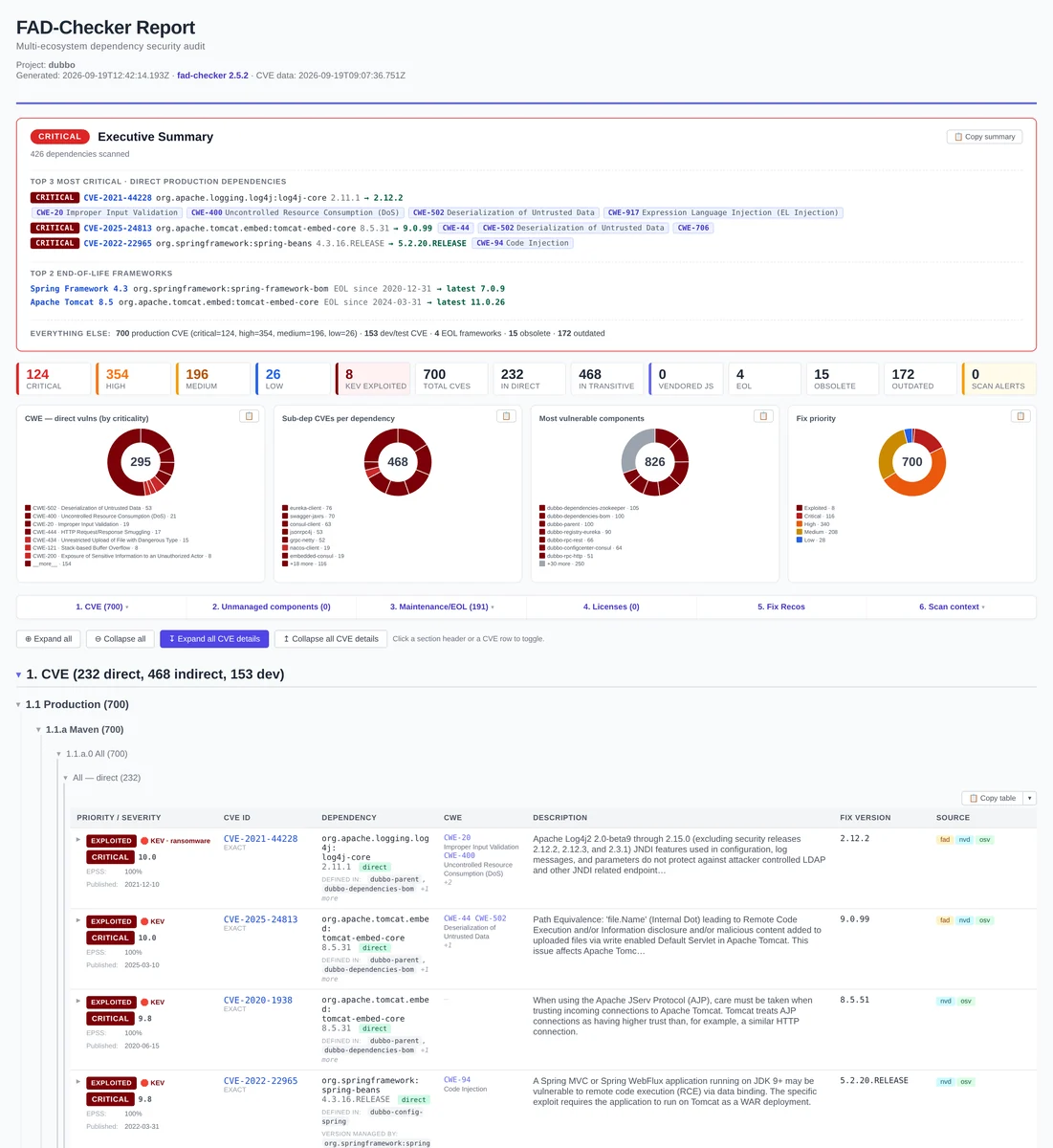
  • Apache Dubbo 2.7.8 — open the report: the project used for the report screenshot below, rescanned with VigieVuln 1.2.1; 105 Maven descriptors, direct/transitive CVEs, KEV matches, EOL and fix recommendations.
  • Multi-instance CMS & frameworks — open the report: WordPress 6.4.2, Drupal 8.5.0, Symfony Demo (Symfony 7.1.1) and BookStack v24.10 (Laravel 10.48.22), with findings attributed to each instance.

These are standalone reports from real source scans, generated on 2026-11-04 with VigieVuln 1.2.1. Dubbo uses the hosted proxy; the CMS sample uses its local cache offline and focuses on PHP dependencies. Missing Wordfence/Drupal advisory and WordPress checksum inputs are explicitly marked incomplete. Sample scope, sources and reproduction commands.

Скачать инструмент


