
Skip to content
KitploitKITPLOIT
FerramentasBlog
Enviar
FerramentasBlog
Enviar

Ferramentas de Hacking, PenTest e Cibersegurança para o seu Arsenal de Segurança!

Kitploit é um diretório de ferramentas de hacking, cibersegurança e pentesting. Descubra as últimas atualizações de projetos para encontrar vulnerabilidades, analisar sistemas, automatizar testes e fortalecer sua segurança.

··Feeds·Contato·Privacidade·© 2026 Kitploit

Diretório de Ferramentas

Categorias

Ver todas as categorias
Loading categories
owasp-istg — The IoT Security Testing Guide (ISTG) provides a comprehensive methodology for penetration tests in the IoT field, offering flexibility to adapt innovations, and developments in the IoT market while still ensuring comparability of test results. | Kitploit
Ferramentas/GitHubGitHub/owasp/owasp-istg
Embedded Systems SecurityIoT SecurityVulnerability AnalysisWeb SecurityWireless SecurityHardware HackingPenetration TestingMobile SecurityHardware SecurityLearning & EducationCurated ResourcesFirmware Analysis
127261há 17 diasRevisado pelo Kitploit

Mais Populares

Ver todos →

Descubra as ferramentas mais usadas pela nossa comunidade.

Explore todas as ferramentas

Navegue pela nossa coleção de ferramentas

Ver todas as ferramentas →
Compartilhar
GitHubowasp/owasp-istg

owasp-istg

The IoT Security Testing Guide (ISTG) provides a comprehensive methodology for penetration tests in the IoT field, offering flexibility to adapt innovations, and developments in the IoT market while still ensuring comparability of test results.

Ver RepositórioSite
Conteúdo não disponível no idioma solicitado. Mostrando versão em inglês.

OWASP IoT Security Testing Guide

CC BY-SA 4.0 OpenSSF Best Practices

The OWASP IoT Security Testing Guide provides a comprehensive methodology for penetration tests in the IoT field offering flexibility to adapt innovations and developments on the IoT market while still ensuring comparability of test results. The guide provides an understanding of communication between manufacturers and operators of IoT devices as well as penetration testing teams that’s facilitated by establishing a common terminology.

Security assurance and test coverage can be demonstrated with the overview of IoT components and test case categories applicable to each below. The methodology, underlying models, and catalog of test cases present tools that can be used separately and in conjunction with each other.
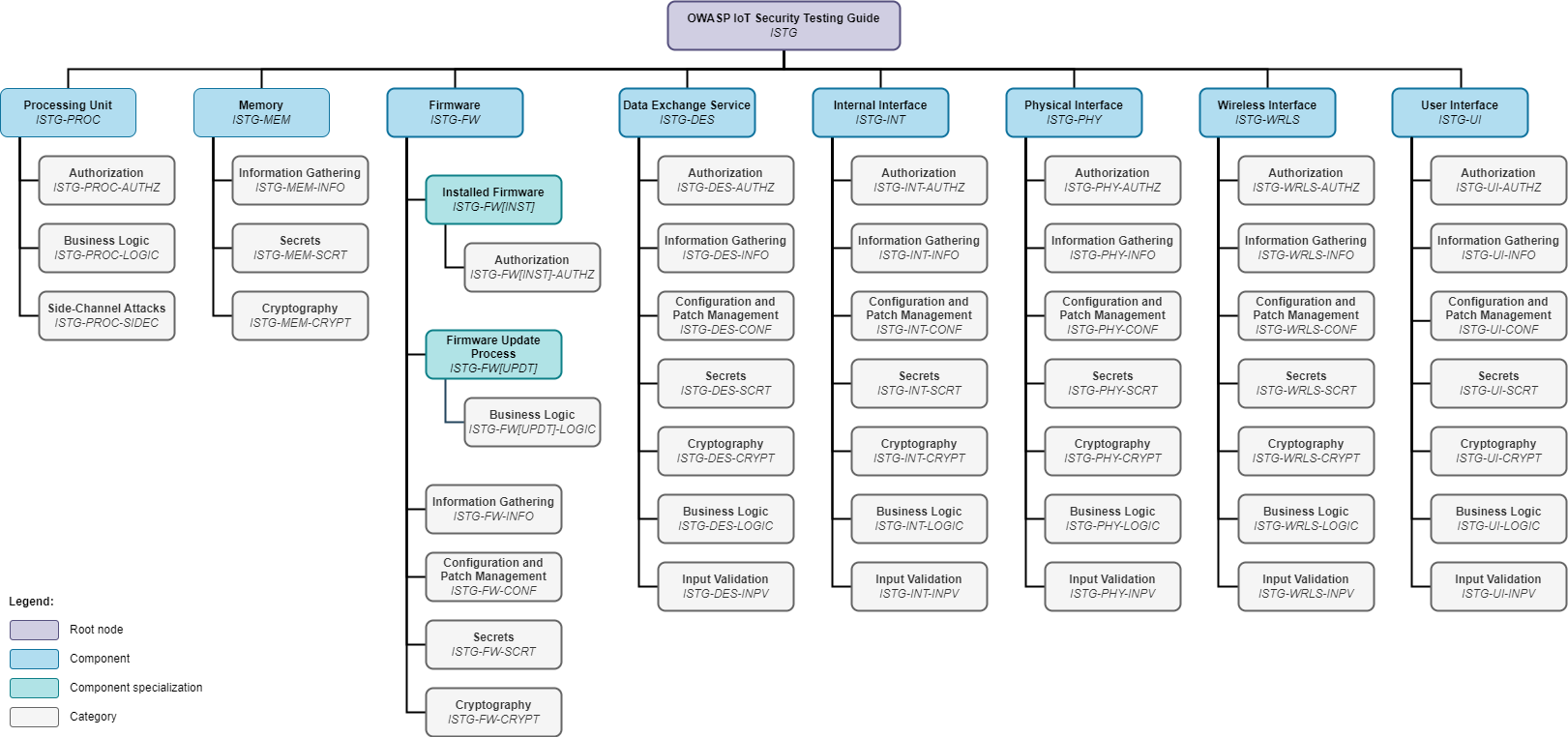
Component Overview

  • 🔔Click here to read the OWASP ISTG 📖📚🔔
  • ✅ Get the latest ISTG Checklists✅
  • 📝 🔍 Contribute to ISTG — see also the contribution guidelines for the conventions used in this repository

Table of Contents

  1. Introduction

  2. IoT Security Testing Framework

    2.1. IoT Device Model

    2.2. Attacker Model

    2.3. Testing Methodology

  3. Test Case Catalog

    3.1. Processing Units (ISTG-PROC)

    3.2. Memory (ISTG-MEM)

    3.3. Firmware (ISTG-FW)

    3.3.1. Installed Firmware (ISTG-FW[INST])

    3.3.1. Firmware Update Mechnanism (ISTG-FW[UPDT])

    3.4. Data Exchange Services (ISTG-DES)

    3.5. Internal Interfaces (ISTG-INT)

    3.5.1. Inter-Integrated Circuit (ISTG-INT[I2C])

    3.5.2. Universal Asynchronous Receiver-Transmitter (ISTG-INT[UART])

    3.6. Physical Interfaces (ISTG-PHY)

    3.7. Wireless Interfaces (ISTG-WRLS)

Related Work

The concepts, models and test steps presented in the OWASP IoT Security Testing Guide are based on the master's thesis "Development of a Methodology for Penetration Tests of Devices in the Field of the Internet of Things" by Luca Pascal Rotsch.

Test cases were derived from the following public sources:

  • OWASP "Web Security Testing Guide"
  • OWASP "Firmware Security Testing Methodology"
  • OWASP "Mobile Security Testing Guide"
  • "IoT Pentesting Guide" by Aditya Gupta
  • "IoT Penetration Testing Cookbook" by Aaron Guzman and Aditya Gupta
  • "The IoT Hacker's Handbook" by Aditya Gupta
  • "Practical IoT Hacking" by Fotios Chantzis, Ioannis Stais, Paulino Calderon, Evangelos Deirmentzoglou, and Beau Woods
  • further sources are referenced in the respective test cases

We also like to thank our collaborators and supporters (see Project Collaborators and Acknowledgements)!

Baixar ferramenta

3.8. User Interfaces (ISTG-UI)