seccomp-tools v1.7.1
Fornece ferramentas poderosas para análise de seccomp

Seccomp Tools
Ferramentas poderosas para análise de seccomp.
Este projeto visa principalmente (mas não exclusivamente) a análise de sandboxes seccomp em desafios de pwn em CTFs. Alguns recursos são específicos de CTF, mas são igualmente úteis para analisar filtros seccomp do mundo real.
Recursos
- Dump - Despeja automaticamente o BPF de seccomp de executáveis.
- Disasm - Converte o BPF de seccomp para um formato legível por humanos.
- Com descompilação simples.
- Com nomes e argumentos de syscalls sempre que possível.
- Colorido!
- Asm - Torna a escrita de regras seccomp tão fácil quanto escrever código.
- Emu - Emula regras seccomp.
- Explain - Resume um filtro como uma política por ação (quais syscalls são permitidos/matados, e quando).
- Audit - Examina um filtro em busca de fraquezas e rotas de fuga (guardas de arch/x32 ausentes, syscalls perigosos, ...).
- Suporte a múltiplas arquiteturas.
Instalação
Disponível no RubyGems.org!``` $ gem install seccomp-tools
Se a compilação falhar, tente:```
sudo apt install gcc ruby-dev make
em seguida, instale o seccomp-tools novamente.
Interface de Linha de Comando
seccomp-tools```bash
$ seccomp-tools --help
Usage: seccomp-tools [--version] [--help] []
List of commands:
asm Seccomp bpf assembler.
audit Assess a seccomp filter for weaknesses and escape routes.
completion Print a shell completion script.
disasm Disassemble seccomp bpf.
dump Automatically dump seccomp bpf from executable(s).
emu Emulate seccomp rules.
explain Summarize a seccomp filter as a per-action policy.
See 'seccomp-tools --help' to read about a specific subcommand.
$ seccomp-tools dump --help
dump - Automatically dump seccomp bpf from executable(s).
NOTE: This command is only available on Linux.
Usage: seccomp-tools dump [EXEC] [options]
-c, --sh-exec Executes the given command (via sh) and dumps its seccomp.
Use this to pass arguments or pipe things to the executable.
e.g. use -c "./bin > /dev/null" to keep the program output out of the result.
Takes precedence over the positional argument.
-l, --limit LIMIT Dump only the first LIMIT installed filters.
Only meaningful when the input is an executable or --pid. Default: 1
An executable is killed once it reaches LIMIT.
-p, --pid PID Dump the seccomp filters installed on an existing process.
You must have CAP_SYS_ADMIN (e.g. be root) to use this option.
-t, --timeout SEC Timeout (seconds) for the execution. Default: no timeout
This option is ignored when --pid is given.
-f, --format FORMAT Output format. FORMAT can only be one of <disasm|raw|inspect>.
Default: disasm
-o, --output FILE Write output to FILE instead of stdout.
If multiple seccomp syscalls have been invoked (see --limit),
results are written to FILE, FILE_1, FILE_2, etc.
For example, with "--output out.bpf" the output files are out.bpf, out_1.bpf, ...
### dump
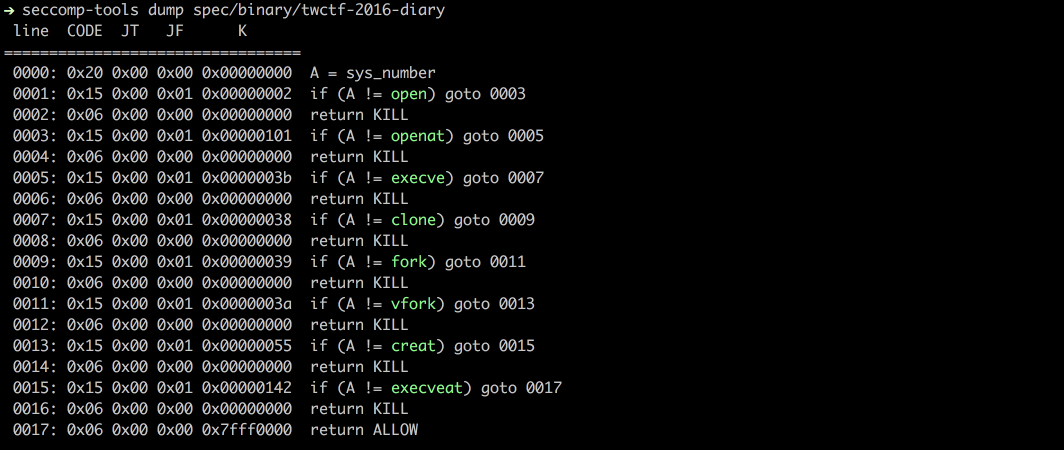
Despeja o seccomp BPF de um executável, usando a syscall `ptrace`.
NOTA: o executável alvo é realmente executado, então tenha cuidado com binários não confiáveis.```bash
$ file spec/binary/twctf-2016-diary
# spec/binary/twctf-2016-diary: ELF 64-bit LSB executable, x86-64, version 1 (SYSV), dynamically linked, interpreter /lib64/ld-linux-x86-64.so.2, for GNU/Linux 2.6.24, BuildID[sha1]=3648e29153ac0259a0b7c3e25537a5334f50107f, not stripped
$ seccomp-tools dump spec/binary/twctf-2016-diary
# line CODE JT JF K
# =================================
# 0000: 0x20 0x00 0x00 0x00000000 A = sys_number
# 0001: 0x15 0x00 0x01 0x00000002 if (A != open) goto 0003
# 0002: 0x06 0x00 0x00 0x00000000 return KILL
# 0003: 0x15 0x00 0x01 0x00000101 if (A != openat) goto 0005
# 0004: 0x06 0x00 0x00 0x00000000 return KILL
# 0005: 0x15 0x00 0x01 0x0000003b if (A != execve) goto 0007
# 0006: 0x06 0x00 0x00 0x00000000 return KILL
# 0007: 0x15 0x00 0x01 0x00000038 if (A != clone) goto 0009
# 0008: 0x06 0x00 0x00 0x00000000 return KILL
# 0009: 0x15 0x00 0x01 0x00000039 if (A != fork) goto 0011
# 0010: 0x06 0x00 0x00 0x00000000 return KILL
# 0011: 0x15 0x00 0x01 0x0000003a if (A != vfork) goto 0013
# 0012: 0x06 0x00 0x00 0x00000000 return KILL
# 0013: 0x15 0x00 0x01 0x00000055 if (A != creat) goto 0015
# 0014: 0x06 0x00 0x00 0x00000000 return KILL
# 0015: 0x15 0x00 0x01 0x00000142 if (A != execveat) goto 0017
# 0016: 0x06 0x00 0x00 0x00000000 return KILL
# 0017: 0x06 0x00 0x00 0x7fff0000 return ALLOW
$ seccomp-tools dump spec/binary/twctf-2016-diary -f inspect
# "\x20\x00\x00\x00\x00\x00\x00\x00\x15\x00\x00\x01\x02\x00\x00\x00\x06\x00\x00\x00\x00\x00\x00\x00\x15\x00\x00\x01\x01\x01\x00\x00\x06\x00\x00\x00\x00\x00\x00\x00\x15\x00\x00\x01\x3B\x00\x00\x00\x06\x00\x00\x00\x00\x00\x00\x00\x15\x00\x00\x01\x38\x00\x00\x00\x06\x00\x00\x00\x00\x00\x00\x00\x15\x00\x00\x01\x39\x00\x00\x00\x06\x00\x00\x00\x00\x00\x00\x00\x15\x00\x00\x01\x3A\x00\x00\x00\x06\x00\x00\x00\x00\x00\x00\x00\x15\x00\x00\x01\x55\x00\x00\x00\x06\x00\x00\x00\x00\x00\x00\x00\x15\x00\x00\x01\x42\x01\x00\x00\x06\x00\x00\x00\x00\x00\x00\x00\x06\x00\x00\x00\x00\x00\xFF\x7F"
$ seccomp-tools dump spec/binary/twctf-2016-diary -f raw | xxd
# 00000000: 2000 0000 0000 0000 1500 0001 0200 0000 ...............
# 00000010: 0600 0000 0000 0000 1500 0001 0101 0000 ................
# 00000020: 0600 0000 0000 0000 1500 0001 3b00 0000 ............;...
# 00000030: 0600 0000 0000 0000 1500 0001 3800 0000 ............8...
# 00000040: 0600 0000 0000 0000 1500 0001 3900 0000 ............9...
# 00000050: 0600 0000 0000 0000 1500 0001 3a00 0000 ............:...
# 00000060: 0600 0000 0000 0000 1500 0001 5500 0000 ............U...
# 00000070: 0600 0000 0000 0000 1500 0001 4201 0000 ............B...
# 00000080: 0600 0000 0000 0000 0600 0000 0000 ff7f ................
disasm
Desmonta o seccomp BPF bruto em um formato legível.```bash $ xxd spec/data/twctf-2016-diary.bpf | head -n 3
00000000: 2000 0000 0000 0000 1500 0001 0200 0000 ...............
00000010: 0600 0000 0000 0000 1500 0001 0101 0000 ................
00000020: 0600 0000 0000 0000 1500 0001 3b00 0000 ............;...
$ seccomp-tools disasm spec/data/twctf-2016-diary.bpf
line CODE JT JF K
=================================
0000: 0x20 0x00 0x00 0x00000000 A = sys_number
0001: 0x15 0x00 0x01 0x00000002 if (A != open) goto 0003
0002: 0x06 0x00 0x00 0x00000000 return KILL
0003: 0x15 0x00 0x01 0x00000101 if (A != openat) goto 0005
0004: 0x06 0x00 0x00 0x00000000 return KILL
0005: 0x15 0x00 0x01 0x0000003b if (A != execve) goto 0007
0006: 0x06 0x00 0x00 0x00000000 return KILL
0007: 0x15 0x00 0x01 0x00000038 if (A != clone) goto 0009
0008: 0x06 0x00 0x00 0x00000000 return KILL
0009: 0x15 0x00 0x01 0x00000039 if (A != fork) goto 0011
0010: 0x06 0x00 0x00 0x00000000 return KILL
0011: 0x15 0x00 0x01 0x0000003a if (A != vfork) goto 0013
0012: 0x06 0x00 0x00 0x00000000 return KILL
0013: 0x15 0x00 0x01 0x00000055 if (A != creat) goto 0015
0014: 0x06 0x00 0x00 0x00000000 return KILL
0015: 0x15 0x00 0x01 0x00000142 if (A != execveat) goto 0017
0016: 0x06 0x00 0x00 0x00000000 return KILL
0017: 0x06 0x00 0x00 0x7fff0000 return ALLOW
### asm
Monta regras seccomp em bytes brutos.
Útil quando você quer escrever suas próprias regras seccomp.
Suporta rótulos de salto e nomes de syscalls. Veja os exemplos abaixo.```bash
$ seccomp-tools asm
# asm - Seccomp bpf assembler.
#
# Usage: seccomp-tools asm IN_FILE [options]
# -o, --output FILE Write output to FILE instead of stdout.
# -f, --format FORMAT Output format. FORMAT can only be one of <inspect|raw|c_array|c_source|assembly>.
# Default: inspect
# -a, --arch ARCH Specify architecture.
# Supported architectures are <aarch64|amd64|i386|riscv64|s390x>.
# Default: auto-detected from the host machine.
# Set it when the filter targets an architecture other than the host.
# Input file for asm
$ cat spec/data/libseccomp.asm
# # check if arch is X86_64
# A = arch
# A == ARCH_X86_64 ? next : dead
# A = sys_number
# A >= 0x40000000 ? dead : next
# A == write ? ok : next
# A == close ? ok : next
# A == dup ? ok : next
# A == exit ? ok : next
# return ERRNO(5)
# ok:
# return ALLOW
# dead:
# return KILL
$ seccomp-tools asm spec/data/libseccomp.asm
# " \x00\x00\x00\x04\x00\x00\x00\x15\x00\x00\b>\x00\x00\xC0 \x00\x00\x00\x00\x00\x00\x005\x00\x06\x00\x00\x00\x00@\x15\x00\x04\x00\x01\x00\x00\x00\x15\x00\x03\x00\x03\x00\x00\x00\x15\x00\x02\x00 \x00\x00\x00\x15\x00\x01\x00<\x00\x00\x00\x06\x00\x00\x00\x05\x00\x05\x00\x06\x00\x00\x00\x00\x00\xFF\x7F\x06\x00\x00\x00\x00\x00\x00\x00"
$ seccomp-tools asm spec/data/libseccomp.asm -f c_source
# #include <linux/seccomp.h>
# #include <stdio.h>
# #include <stdlib.h>
# #include <sys/prctl.h>
#
# static void install_seccomp() {
# static unsigned char filter[] = {32,0,0,0,4,0,0,0,21,0,0,8,62,0,0,192,32,0,0,0,0,0,0,0,53,0,6,0,0,0,0,64,21,0,4,0,1,0,0,0,21,0,3,0,3,0,0,0,21,0,2,0,32,0,0,0,21,0,1,0,60,0,0,0,6,0,0,0,5,0,5,0,6,0,0,0,0,0,255,127,6,0,0,0,0,0,0,0};
# struct prog {
# unsigned short len;
# unsigned char *filter;
# } rule = {
# .len = sizeof(filter) >> 3,
# .filter = filter
# };
# if(prctl(PR_SET_NO_NEW_PRIVS, 1, 0, 0, 0) < 0) { perror("prctl(PR_SET_NO_NEW_PRIVS)"); exit(2); }
# if(prctl(PR_SET_SECCOMP, SECCOMP_MODE_FILTER, &rule) < 0) { perror("prctl(PR_SET_SECCOMP)"); exit(2); }
# }
$ seccomp-tools asm spec/data/libseccomp.asm -f assembly
# install_seccomp:
# push rbp
# mov rbp, rsp
# push 38
# pop rdi
# push 0x1
# pop rsi
# xor eax, eax
# mov al, 0x9d
# syscall
# push 22
# pop rdi
# lea rdx, [rip + _filter]
# push rdx /* .filter */
# push _filter_end - _filter >> 3 /* .len */
# mov rdx, rsp
# push 0x2
# pop rsi
# xor eax, eax
# mov al, 0x9d
# syscall
# leave
# ret
# _filter:
# .ascii "\040\000\000\000\004\000\000\000\025\000\000\010\076\000\000\300\040\000\000\000\000\000\000\000\065\000\006\000\000\000\000\100\025\000\004\000\001\000\000\000\025\000\003\000\003\000\000\000\025\000\002\000\040\000\000\000\025\000\001\000\074\000\000\000\006\000\000\000\005\000\005\000\006\000\000\000\000\000\377\177\006\000\000\000\000\000\000\000"
# _filter_end:
# let's asm then disasm!
$ seccomp-tools asm spec/data/libseccomp.asm -f raw | seccomp-tools disasm -
# line CODE JT JF K
# =================================
# 0000: 0x20 0x00 0x00 0x00000004 A = arch
# 0001: 0x15 0x00 0x08 0xc000003e if (A != ARCH_X86_64) goto 0010
# 0002: 0x20 0x00 0x00 0x00000000 A = sys_number
# 0003: 0x35 0x06 0x00 0x40000000 if (A >= 0x40000000) goto 0010
# 0004: 0x15 0x04 0x00 0x00000001 if (A == write) goto 0009
# 0005: 0x15 0x03 0x00 0x00000003 if (A == close) goto 0009
# 0006: 0x15 0x02 0x00 0x00000020 if (A == dup) goto 0009
# 0007: 0x15 0x01 0x00 0x0000003c if (A == exit) goto 0009
# 0008: 0x06 0x00 0x00 0x00050005 return ERRNO(5)
# 0009: 0x06 0x00 0x00 0x7fff0000 return ALLOW
# 0010: 0x06 0x00 0x00 0x00000000 return KILL
Desde v1.6.0 [ainda não lançado], o asm passou a usar um parser baseado em yacc, o que permite uma sintaxe mais flexível e intuitiva!```bash
$ cat spec/data/example.asm
# An example of supported assembly syntax
if (A == X)
goto next # 'next' is a reserved label, means the next statement ("A = args[0]" in this example)
else
goto err_label # custom defined label
A = args[0]
if (
A # put a comment here is also valid
== 0x123
) goto disallow
if (! (A & 0x1337)) # support bang in if-conditions
goto 0 # equivalent to 'goto next'
else goto 2 # goto $ + 2, 'mem[0] = A' in this example
A = sys_number
A = instruction_pointer >> 32
mem[0] = A
A = data[4] # equivalent to 'A = arch'
err_label: return ERRNO(1337)
disallow:
return KILL
$ seccomp-tools asm spec/data/example.asm -f raw | seccomp-tools disasm -
line CODE JT JF K
=================================
0000: 0x1d 0x00 0x07 0x00000000 if (A != X) goto 0008
0001: 0x20 0x00 0x00 0x00000010 A = args[0]
0002: 0x15 0x06 0x00 0x00000123 if (A == 0x123) goto 0009
0003: 0x45 0x02 0x00 0x00001337 if (A & 0x1337) goto 0006
0004: 0x20 0x00 0x00 0x00000000 A = sys_number
0005: 0x20 0x00 0x00 0x0000000c A = instruction_pointer >> 32
0006: 0x02 0x00 0x00 0x00000000 mem[0] = A
0007: 0x20 0x00 0x00 0x00000004 A = arch
0008: 0x06 0x00 0x00 0x00050539 return ERRNO(1337)
0009: 0x06 0x00 0x00 0x00000000 return KILL
A saída de `seccomp-tools disasm <file> --asm-able` é uma entrada válida para `asm`:```bash
$ seccomp-tools disasm spec/data/x32.bpf --asm-able
# 0000: A = arch
# 0001: if (A != ARCH_X86_64) goto 0011
# 0002: A = sys_number
# 0003: if (A < 0x40000000) goto 0011
# 0004: if (A == x32_read) goto 0011
# 0005: if (A == x32_write) goto 0011
# 0006: if (A == x32_iopl) goto 0011
# 0007: if (A != x32_mmap) goto 0011
# 0008: A = args[0]
# 0009: if (A == 0x0) goto 0011
# 0010: return ERRNO(5)
# 0011: return ALLOW
# disasm then asm then disasm!
$ seccomp-tools disasm spec/data/x32.bpf --asm-able | seccomp-tools asm - -f raw | seccomp-tools disasm -
# line CODE JT JF K
# =================================
# 0000: 0x20 0x00 0x00 0x00000004 A = arch
# 0001: 0x15 0x00 0x09 0xc000003e if (A != ARCH_X86_64) goto 0011
# 0002: 0x20 0x00 0x00 0x00000000 A = sys_number
# 0003: 0x35 0x00 0x07 0x40000000 if (A < 0x40000000) goto 0011
# 0004: 0x15 0x06 0x00 0x40000000 if (A == x32_read) goto 0011
# 0005: 0x15 0x05 0x00 0x40000001 if (A == x32_write) goto 0011
# 0006: 0x15 0x04 0x00 0x400000ac if (A == x32_iopl) goto 0011
# 0007: 0x15 0x00 0x03 0x40000009 if (A != x32_mmap) goto 0011
# 0008: 0x20 0x00 0x00 0x00000010 A = addr # x32_mmap(addr, len, prot, flags, fd, pgoff)
# 0009: 0x15 0x01 0x00 0x00000000 if (A == 0x0) goto 0011
# 0010: 0x06 0x00 0x00 0x00050005 return ERRNO(5)
# 0011: 0x06 0x00 0x00 0x7fff0000 return ALLOW
Emu
Emula o seccomp dado sys_nr, arg0, arg1, etc.```bash
$ seccomp-tools emu --help
emu - Emulate seccomp rules.
Usage: seccomp-tools emu [options] BPF_FILE [sys_nr [arg0 [arg1 ... arg5]]]
-a, --arch ARCH Specify architecture.
Supported architectures are <aarch64|amd64|i386|riscv64|s390x>.
Default: auto-detected from the host machine.
Set it when the filter targets an architecture other than the host.
-q, --[no-]quiet Run quietly, only show emulation result.
-i, --ip=VAL Set instruction pointer.
$ seccomp-tools emu spec/data/libseccomp.bpf write 0x3
line CODE JT JF K
=================================
0000: 0x20 0x00 0x00 0x00000004 A = arch
0001: 0x15 0x00 0x08 0xc000003e if (A != ARCH_X86_64) goto 0010
0002: 0x20 0x00 0x00 0x00000000 A = sys_number
0003: 0x35 0x06 0x00 0x40000000 if (A >= 0x40000000) goto 0010
0004: 0x15 0x04 0x00 0x00000001 if (A == write) goto 0009
0005: 0x15 0x03 0x00 0x00000003 if (A == close) goto 0009
0006: 0x15 0x02 0x00 0x00000020 if (A == dup) goto 0009
0007: 0x15 0x01 0x00 0x0000003c if (A == exit) goto 0009
0008: 0x06 0x00 0x00 0x00050005 return ERRNO(5)
0009: 0x06 0x00 0x00 0x7fff0000 return ALLOW
0010: 0x06 0x00 0x00 0x00000000 return KILL
return ALLOW at line 0009
### Explain
Resume um filtro inteiro como uma política por ação: quais syscalls terminam em `ALLOW`, `KILL`, `ERRNO`, etc.,
e sob quais restrições de argumentos. A entrada pode ser um arquivo BPF despejado, um executável (cujo seccomp é
despejado primeiro, como `dump`), ou um processo em execução via `--pid`.```bash
$ seccomp-tools explain --help
# explain - Summarize a seccomp filter as a per-action policy.
#
# Usage: seccomp-tools explain [options] [BPF_FILE|EXEC]
# -c, --sh-exec <command> Executes the given command (via sh) and explains its seccomp.
# Use this to pass arguments or pipe things to the executable.
# e.g. use `-c "./bin > /dev/null"` to keep the program output out of the result.
# Takes precedence over the positional argument.
# -l, --limit LIMIT Explain only the first LIMIT installed filters.
# Only meaningful when the input is an executable or --pid. Default: 1
# An executable is killed once it reaches LIMIT.
# -p, --pid PID Explain the seccomp filters installed on an existing process.
# You must have CAP_SYS_ADMIN (e.g. be root) to use this option.
# -t, --timeout SEC Timeout (seconds) for the execution. Default: no timeout
# This option is ignored when --pid is given.
# -a, --arch ARCH Specify architecture.
# Supported architectures are <aarch64|amd64|i386|riscv64|s390x>.
# Default: auto-detected from the host machine.
# Set it when the filter targets an architecture other than the host.
# With an executable or --pid the architecture is auto-detected instead.
$ seccomp-tools explain spec/data/libseccomp.bpf -a amd64
# Seccomp policy for spec/data/libseccomp.bpf
#
# Architecture: amd64
#
# ALLOW:
# write, close, dup, exit
#
# ERRNO(5):
# <default> (any other syscall)
#
# KILL:
# sys_number >= 0x40000000 (x32 ABI)
#
# Other architectures: KILL
Um exemplo mais complexo — o filtro "Nothing is True" do 0CTF/TCTF 2023, que possui allowlists separadas para 32/64 bits e verificações de argumentos em open, mmap e execve:```bash
$ seccomp-tools explain spec/data/tctf-2023-nothing-is-true.bpf -a amd64
Seccomp policy for spec/data/tctf-2023-nothing-is-true.bpf
Architecture: i386
ALLOW:
exit, read, write, brk, mmap, munmap, exit_group
KILL:
(any other syscall)
Architecture: amd64
ALLOW:
close, munmap, brk, exit, exit_group
open when filename == 0x31337 && flags == 0x0
mmap when prot == 0x2
execve when filename == 0x7ffea12f7d0e
KILL:
sys_number >= 0x40000000 (x32 ABI)
(any other syscall)
Other architectures: KILL
### Auditoria
Analisa um filtro em busca de fraquezas e possíveis rotas de escape — uma arquitetura ausente ou proteção x32, um padrão permissivo (denylist), lacunas de syscalls equivalentes (ex.: `execve` bloqueado, mas `execveat` não), uma cadeia de open/read/write, ou syscalls perigosos acessíveis como `ALLOW` — e reporta cada uma com uma severidade. É executado em todas as arquiteturas suportadas (peculiaridades específicas de arquitetura, como o x32 do amd64, são aplicadas apenas onde existem) e aceita a mesma entrada que `explain` (um arquivo BPF, um executável ou `--pid`).```bash
$ seccomp-tools audit --help
# audit - Assess a seccomp filter for weaknesses and escape routes.
#
# Usage: seccomp-tools audit [options] [BPF_FILE|EXEC]
# -c, --sh-exec <command> Executes the given command (via sh) and audits its seccomp.
# Use this to pass arguments or pipe things to the executable.
# e.g. use `-c "./bin > /dev/null"` to keep the program output out of the result.
# Takes precedence over the positional argument.
# -l, --limit LIMIT Audit only the first LIMIT installed filters.
# Only meaningful when the input is an executable or --pid. Default: 1
# An executable is killed once it reaches LIMIT.
# -p, --pid PID Audit the seccomp filters installed on an existing process.
# You must have CAP_SYS_ADMIN (e.g. be root) to use this option.
# -t, --timeout SEC Timeout (seconds) for the execution. Default: no timeout
# This option is ignored when --pid is given.
# -a, --arch ARCH Specify architecture.
# Supported architectures are <aarch64|amd64|i386|riscv64|s390x>.
# Default: auto-detected from the host machine.
# Set it when the filter targets an architecture other than the host.
# With an executable or --pid the architecture is auto-detected instead.
# -f, --format FORMAT Output format, one of <human|json>.
# Default: human
Auditar uma denylist com várias rotas de escape (o filtro "diary" do TokyoWesterns CTF 2016):```bash $ seccomp-tools audit spec/data/twctf-2016-diary.bpf -a amd64
Seccomp audit of spec/data/twctf-2016-diary.bpf
Architectures: amd64
[HIGH] Architecture is never validated
The filter checks syscall numbers without ever comparing data[4] (arch). Numbers mean different syscalls under
another AUDIT_ARCH, so the checks can be dodged by invoking through a different ABI (e.g. i386 numbering on amd64).
fix: Compare data[4] against your AUDIT_ARCH_* and KILL every architecture you do not explicitly handle.
[HIGH] io_uring_setup is allowed (amd64)
io_uring_setup reaches ALLOW - reads/writes/opens as ring operations, bypassing filters on those syscalls.
fix: Block io_uring_setup unless the program genuinely needs it.
[HIGH] process_vm_readv is allowed (amd64)
process_vm_readv reaches ALLOW - read another process's memory.
fix: Block process_vm_readv unless the program genuinely needs it.
[HIGH] process_vm_writev is allowed (amd64)
process_vm_writev reaches ALLOW - write another process's memory.
fix: Block process_vm_writev unless the program genuinely needs it.
[HIGH] ptrace is allowed (amd64)
ptrace reaches ALLOW - inspect/inject into other processes.
fix: Block ptrace unless the program genuinely needs it.
[HIGH] A file can be opened and its contents copied out (amd64)
openat2, read and write all reach ALLOW, so the contents of an arbitrary file (e.g. the flag) can be copied straight
back out.
fix: Deny the open-family syscalls unless the program genuinely needs arbitrary files.
[HIGH] Default action is ALLOW (denylist) (amd64)
Any syscall the filter does not explicitly block is allowed; a denylist is bypassable by any syscall the author
overlooked.
fix: Use an allowlist: default to KILL/ERRNO and permit only the needed syscalls.
[HIGH] open/openat blocked but openat2 allowed (amd64)
open, openat denied, but the equivalent openat2 reaches ALLOW - same capability, different syscall number.
fix: Deny every equivalent in the group: also block openat2.
[HIGH] x32 ABI is not guarded (amd64)
Syscalls blocked by their native number are reachable via their x32 number (nr | 0x40000000): open, clone, fork,
vfork, execve, creat, openat, execveat.
fix: After the arch check, KILL when sys_number >= 0x40000000 (or jset 0x40000000).
[MEDIUM] connect is allowed (amd64)
connect reaches ALLOW - network access (exfiltration).
fix: Block connect unless the program genuinely needs it.
[MEDIUM] socket is allowed (amd64)
socket reaches ALLOW - network access (exfiltration).
fix: Block socket unless the program genuinely needs it.
[MEDIUM] fork/vfork/clone blocked but clone3 allowed (amd64)
fork, vfork, clone denied, but the equivalent clone3 reaches ALLOW - same capability, different syscall number.
fix: Deny every equivalent in the group: also block clone3.
Use `--format json` para CI ou ferramentas:```bash
$ seccomp-tools audit spec/data/gctf-2019-quals-caas.bpf -a amd64 -f json
# {
# "stacked_filters": 1,
# "reports": [
# {
# "source": "spec/data/gctf-2019-quals-caas.bpf",
# "arches": [
# "amd64"
# ],
# "truncated": false,
# "findings": [
# {
# "id": "dangerous-allow",
# "severity": "medium",
# "title": "connect is allowed",
# "detail": "connect reaches ALLOW - network access (exfiltration).",
# "arch": "amd64",
# "syscalls": [
# "connect"
# ],
# "condition": null,
# "remediation": "Block connect unless the program genuinely needs it."
# },
# {
# "id": "dangerous-allow",
# "severity": "medium",
# "title": "socket is allowed",
# "detail": "socket reaches ALLOW - network access (exfiltration).",
# "arch": "amd64",
# "syscalls": [
# "socket"
# ],
# "condition": "family == 0x2 && type == 0x1 && protocol == 0x0",
# "remediation": "Block socket unless the program genuinely needs it."
# }
# ]
# }
# ]
# }
Shell Completion
seccomp-tools completion <bash|zsh|fish> imprime um script de conclusão para o shell fornecido. Carregue-o a partir do arquivo de inicialização do seu shell:```bash
bash (~/.bashrc)
eval "$(seccomp-tools completion bash)"
zsh (~/.zshrc, after compinit)
eval "$(seccomp-tools completion zsh)"
fish (~/.config/fish/config.fish)
seccomp-tools completion fish | source
Para evitar o custo de inicialização de avaliá-lo toda vez, escreva o script no diretório do qual o seu shell carrega as completions, por exemplo, `seccomp-tools completion zsh > "${fpath[1]}/_seccomp-tools"`.
## Capturas de tela
### Dump

### Emu


## Arquiteturas suportadas
- [x] x86_64
- [x] x32
- [x] x86
- [x] arm64 (@saagarjha)
- [x] s390x (@iii-i)
- [x] riscv64
Pull requests adicionando suporte para mais arquiteturas são bem-vindos!
## Desenvolvimento
Recomendo usar [rbenv](https://github.com/rbenv/rbenv) para gerenciar seu ambiente Ruby.
### Configuração
- Instale o bundler
- `$ gem install bundler`
- Clone o código-fonte
- `$ git clone https://github.com/david942j/seccomp-tools && cd seccomp-tools`
- Instale as dependências
- `$ bundle install`
### Executar testes
`$ bundle exec rake`
## Preciso de Você
Quaisquer sugestões ou solicitações de recursos são bem-vindas!
Sinta-se à vontade para abrir issues ou enviar pull requests.
E se você gostar deste projeto, considere dar uma [estrela](https://github.com/david942j/seccomp-tools/stargazers) :grimacing:


