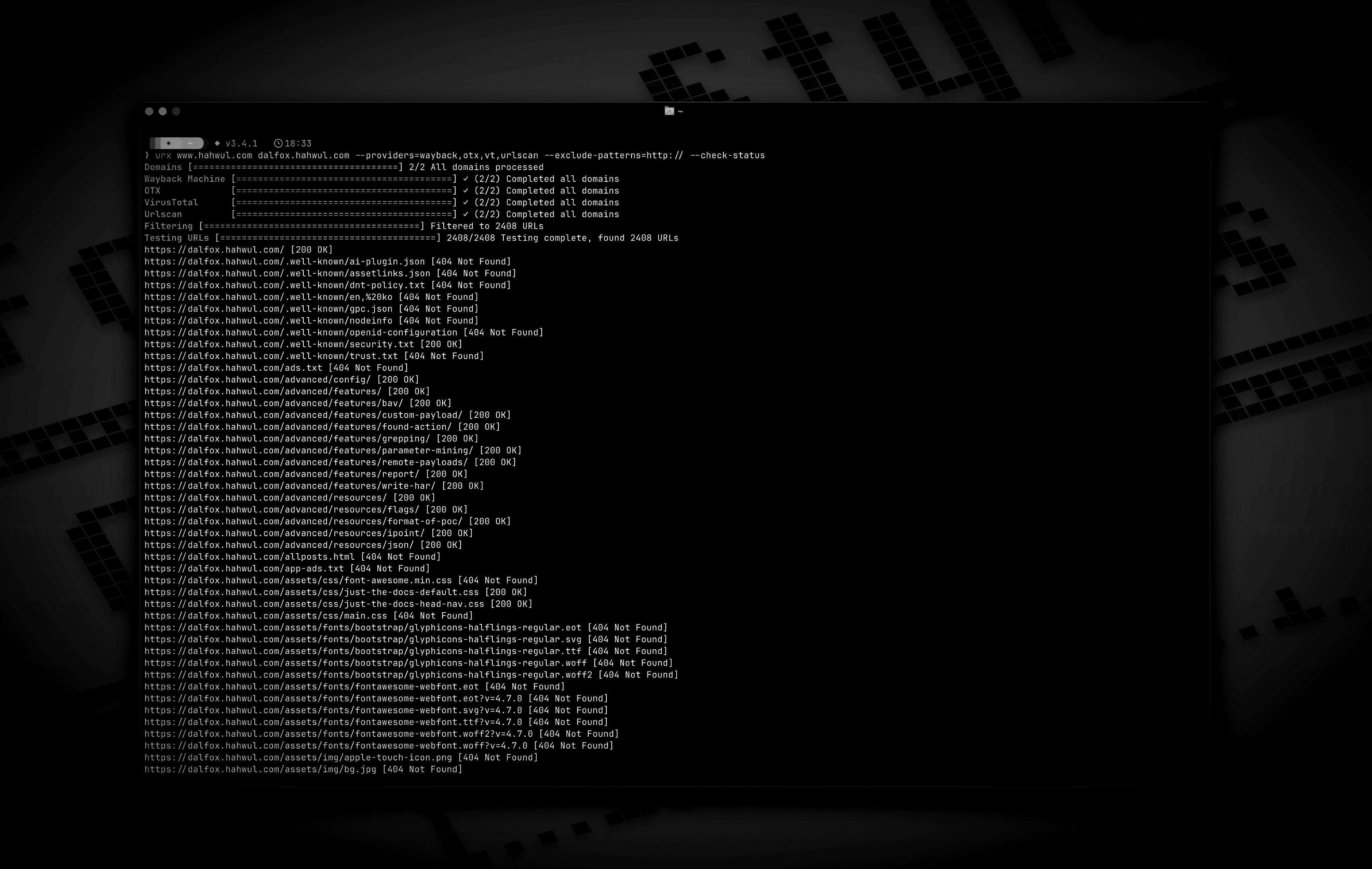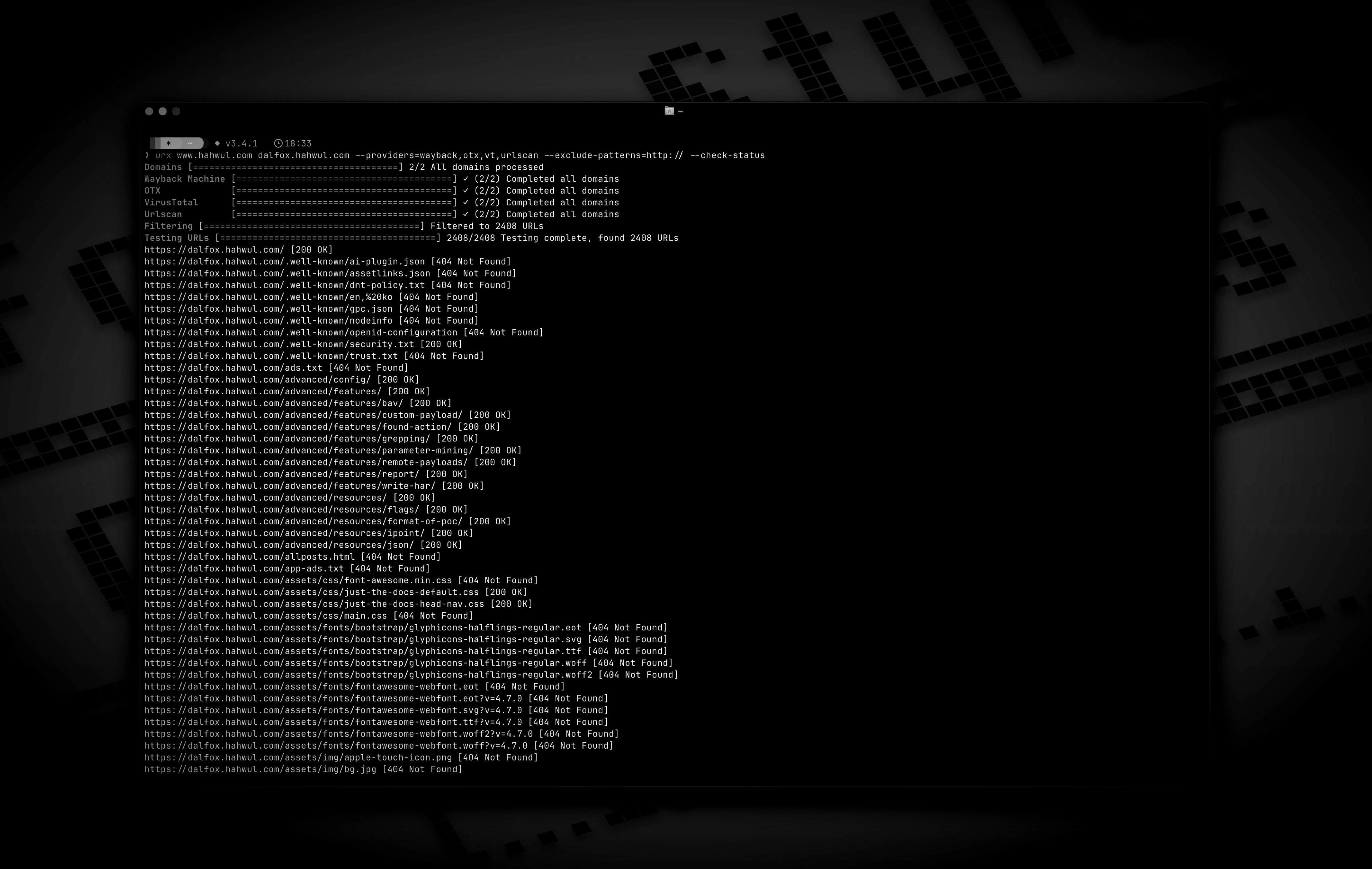

OSINT アーカイブから URL を抽出し、セキュリティインサイトを提供します。
Urx は、Wayback Machine や Common Crawl などの OSINT アーカイブから URL を収集するために設計されたコマンドラインツールです。効率性を重視して Rust で構築されており、非同期処理を活用して複数のデータソースを高速にクエリできます。このツールは、指定されたドメインの URL 情報を収集するプロセスを簡素化し、セキュリティテストや分析など、さまざまな目的に使用できる包括的なデータセットを提供します。

# https://crates.io/crates/urx
cargo install urx
# https://formulae.brew.sh/formula/urx
brew install urx
git clone https://github.com/hahwul/urx.git
cd urx
cargo build --release
コンパイルされたバイナリは target/release/urx に配置されます。
# 単一のドメインをスキャン
urx example.com
# 複数のドメインをスキャン
urx example.com example.org
# ファイルからドメインをスキャン
cat domains.txt | urx
Usage: urx [OPTIONS] [DOMAINS]...
Arguments:
[DOMAINS]... URLを取得するドメイン
Options:
-c, --config <CONFIG> 読み込む設定ファイル
--provider-config <PATH> APIキーのみを保持する別のプロバイダ設定ファイル (デフォルト: $XDG_CONFIG_HOME/urx/provider-config.toml)。CLI/env > provider-config > メイン設定。
-h, --help ヘルプを表示
-V, --version バージョンを表示
Input Options:
--files <FILES>... ファイルから直接URLを読み取ります (WARC、URLTeam圧縮、テキストファイルをサポート)
--domain-list <PATH> 改行区切りのドメインリストファイル (繰り返し可能; 位置引数DOMAINSやstdinとマージ。`#`でコメント可)
Output Options:
-o, --output <OUTPUT> 結果を書き込む出力ファイル
--output-dir <PATH> ドメインごとに1ファイルをこのディレクトリに書き込む (拡張子は--formatに従う)。--output/stdoutと共存可能。
-f, --format <FORMAT> 出力形式 ("plain", "json", "csv" など) [default: plain]
--merge-endpoint 同じパスを持つエンドポイントをマージし、URLパラメータを統合
--normalize-url より良い重複排除のためにURLを正規化 (クエリパラメータを並べ替え、末尾のスラッシュを削除)
Provider Options:
--providers <PROVIDERS>
使用するプロバイダ (カンマ区切り、例: "wayback,cc,otx,arquivo,vt,urlscan") [default: wayback,cc,otx]
--exclude-providers <EXCLUDE_PROVIDERS>
除外するプロバイダ (カンマ区切り)。--providers/--all-providersと競合した場合に優先。
--all-providers
サポートされているすべてのプロバイダを有効化。APIキーが必要なプロバイダは、キーが利用可能な場合のみ有効化。
--list-providers
サポートされているすべてのプロバイダを表示して終了。
--subs
検索時にサブドメインを含める
--cc-index <CC_INDEX>
使用するCommon Crawlインデックス。カンマ区切りで複数のインデックスを並列クエリ可能 (例: `CC-MAIN-2026-17,CC-MAIN-2025-51`)。`latest` (デフォルト) はcollinfo.jsonを介して最新を解決。 [default: latest]
--wayback-from <DATE>
Wayback Machineの結果をDATE (YYYY/YYYYMM/YYYYMMDD/YYYYMMDDhhmmss) 以降のスナップショットに制限
--wayback-to <DATE>
Wayback Machineの結果をDATE (--wayback-fromと同じ形式) 以前のスナップショットに制限
--vt-api-key <VT_API_KEY>
VirusTotalのAPIキー (ローテーションのために複数回使用可能。環境変数URX_VT_API_KEYにカンマ区切りキーでも設定可)
--urlscan-api-key <URLSCAN_API_KEY>
UrlscanのオプションAPIキー。プロバイダは匿名でも動作 (IPあたり約30 req/minでレート制限)。ローテーションのために複数回使用可能。URX_URLSCAN_API_KEY (カンマ区切りキー) でも設定可。
--github-api-key <GITHUB_API_KEY>
GitHub Code Searchプロバイダ用のパーソナルアクセストークン (URX_GITHUB_API_KEYも読み取り、ローテーション用にカンマ区切り)
Discovery Options:
--exclude-robots robots.txtの発見を除外
--exclude-sitemap sitemap.xmlの発見を除外
Display Options:
-v, --verbose 冗長出力を表示
--silent サイレントモード (出力なし)
--no-progress プログレスバーを表示しない
--show-sources 出力URLに、それを返したプロバイダを注釈として付与
--stats 実行終了時にプロバイダごとの要約をstderrに出力
Filter Options:
-p, --preset <PRESET>
フィルタプリセット (例: "no-resources,no-images,no-audio,only-js,only-style")
-e, --extensions <EXTENSIONS>
特定の拡張子を持つURLのみを含める (カンマ区切り、例: "js,php,aspx")
--exclude-extensions <EXCLUDE_EXTENSIONS>
特定の拡張子を持つURLを除外 (カンマ区切り、例: "html,txt")
--patterns <PATTERNS>
特定のパターンを含むURLのみを含める (カンマ区切り)
--exclude-patterns <EXCLUDE_PATTERNS>
特定のパターンを含むURLを除外 (カンマ区切り)
--show-only-host
URLのホスト部分のみを表示
--show-only-path
URLのパス部分のみを表示
--show-only-param
URLのパラメータ部分のみを表示
--min-length <MIN_LENGTH>
含めるURLの最小長
--max-length <MAX_LENGTH>
含めるURLの最大長
--strict
厳密なホスト検証を強制 (デフォルト)
Network Options:
--network-scope <NETWORK_SCOPE> ネットワーク設定を適用するコンポーネントを制御 (all, providers, testers, または providers,testers) [default: all]
--proxy <PROXY> HTTPリクエストにプロキシを使用 (形式: <http://proxy.example.com:8080>)
--proxy-auth <PROXY_AUTH> プロキシ認証資格情報 (形式: username:password)
--insecure SSL証明書検証をスキップ (自己署名証明書を許可)
--random-agent HTTPリクエストにランダムなUser-Agentを使用
--timeout <TIMEOUT> リクエストタイムアウト (秒) [default: 120]
--retries <RETRIES> 失敗したリクエストのリトライ回数 [default: 2]
--parallel <PARALLEL> プロバイダごとに同時に取得する最大ドメイン数 (および同時URLテスト数); プロバイダの--rate-limitはこれらで共有される [default: 5]
--rate-limit <RATE_LIMIT> レート制限 (秒間リクエスト数)
--rate-limit-by <PAIRS> プロバイダごとのレートオーバーライド (例: `vt=1,wayback=10`); リストにないプロバイダは--rate-limitが適用される
--max-time <MAX_TIME> プロバイダの列挙時間のグローバル上限 (秒、0=無制限) [default: 0]
Testing Options:
--check-status
収集したURLのHTTPステータスコードを確認 [aliases: ----cs]
--include-status <INCLUDE_STATUS>
特定のHTTPステータスコードまたはパターンのURLを含める (例: --is=200,30x) [aliases: ----is]
--exclude-status <EXCLUDE_STATUS>
特定のHTTPステータスコードまたはパターンのURLを除外 (例: --es=404,50x,5xx) [aliases: ----es]
--extract-links
収集したURLから追加のリンクを抽出 (HTTPリクエストが必要)
# Save results to a file
urx example.com -o results.txt
# Output in JSON format
urx example.com -f json -o results.json
# Filter for JavaScript files only
urx example.com -e js
# Exclude HTML and text files
urx example.com --exclude-extensions html,txt
# Filter for API endpoints
urx example.com --patterns api,v1,graphql
# Exclude specific patterns
urx example.com --exclude-patterns static,images
# Use Fileter Preset (similar to --exclude-extensions=png,jpg,.....)
urx example.com -p no-images
# Use specific providers
urx example.com --providers wayback,otx
# Add the keyless Arquivo.pt (Portuguese web archive) provider
urx example.com --providers wayback,cc,otx,arquivo
# URLScan works without a key (anonymous, rate-limited); a key just raises limits
urx example.com --providers urlscan
# Using VirusTotal and URLScan providers
# 1. Explicitly add to providers (with API keys via command line)
urx example.com --providers=vt,urlscan --vt-api-key=*** --urlscan-api-key=***
# 2. Using environment variables for API keys
URX_VT_API_KEY=*** URX_URLSCAN_API_KEY=*** urx example.com --providers=vt,urlscan
# 3. Auto-enabling: providers are automatically added when API keys are provided
urx example.com --vt-api-key=*** --urlscan-api-key=*** # No need to specify in --providers
# 4. Multiple API key rotation (to mitigate rate limits)
# Using repeated flags for multiple keys
urx example.com --vt-api-key=key1 --vt-api-key=key2 --vt-api-key=key3
# Using environment variables with comma-separated keys
URX_VT_API_KEY=key1,key2,key3 URX_URLSCAN_API_KEY=ukey1,ukey2 urx example.com
# Combining CLI flags and environment variables (CLI keys are used first)
URX_VT_API_KEY=env_key1,env_key2 urx example.com --vt-api-key=cli_key1 --vt-api-key=cli_key2
# URLs from robots.txt and sitemap.xml are included by default
# Exclude URLs from robots.txt files
urx example.com --exclude-robots
# Exclude URLs from sitemap
urx example.com --exclude-sitemap
# Include subdomains
urx example.com --subs
# Check status of collected URLs
urx example.com --check-status
# Read URLs directly from a text file
urx --files urls.txt
# Combine file input with filtering
urx --files urls.txt --patterns api,admin -f json
# Extract additional links from collected URLs
urx example.com --extract-links
# Network configuration
urx example.com --proxy http://localhost:8080 --timeout 60 --parallel 10 --insecure
# Advanced filtering
urx example.com -e js,php --patterns admin,login --exclude-patterns logout,static --min-length 20
# HTTP Status code based filtering
urx example.com --include-status 200,30x,405 --exclude-status 20x
# Disable host validation
urx example.com --strict false
# URL normalization and deduplication
# Normalize URLs by sorting query parameters and removing trailing slashes
urx example.com --normalize-url
# Combine normalization with endpoint merging for comprehensive deduplication
urx example.com --normalize-url --merge-endpoint
# URL normalization with file input
urx --files urls.txt --normalize-url
Urx は、繰り返しのスキャンでのパフォーマンス向上と、新しいURLのみを検出するインクリメンタルスキャンをサポートしています。
# Enable caching with SQLite (default)
urx example.com --cache-type sqlite --cache-path ~/.urx/cache.db
# Use Redis for distributed caching
urx example.com --cache-type redis --redis-url redis://localhost:6379
# Incremental scanning - only show new URLs since last scan
urx example.com --incremental
# Set cache TTL (time-to-live) to 12 hours
urx example.com --cache-ttl 43200
# Disable caching entirely
urx example.com --no-cache
# Combine incremental scanning with filters
urx example.com --incremental -e js,php --patterns api
# Configuration file with caching settings
urx -c example/config.toml example.com
# Daily monitoring - only alert on new URLs
urx target.com --incremental --silent | notify-tool
# Efficient domain lists processing
cat domains.txt | urx --incremental --cache-ttl 3600 > new_urls.txt
# Distributed team scanning with Redis
urx example.com --cache-type redis --redis-url redis://shared-cache:6379
# Fast re-scans during development
urx test-domain.com --cache-ttl 300 # 5-minute cache for rapid iterations
Urx は、他のセキュリティツールや偵察ツールとのパイプラインでうまく動作します:
# Find domains, then discover URLs
echo "example.com" | urx | grep "login" > potential_targets.txt
# Combine with other tools
cat domains.txt | urx --patterns api | other-tool
Urx は、AlienVault の Open Threat Exchange、Wayback Machine、Common Crawl から既知の URL を取得するツール gau (GetAllUrls) に触発されました。Urx は同様のコア機能を共有しながらも、パフォーマンス、並行処理、拡張されたフィルタリング機能に重点を置いて、Rust でゼロから構築されました。
Urx はオープンソースプロジェクトであり、❤️ を込めて作られています。 このプロジェクトに貢献したい場合は、CONTRIBUTING.md を参照し、クールな内容でプルリクエストを送ってください。