 omniversetr/omnicheck_cve-2026-98432
Non-destructive checker for CVE-2026-98432 (Linux kernel TCP use-after-free): patch status, exposed listeners and mitigation verification. By OMNIVERSE.

English | Türkçe
Non-destructive verification tool for CVE-2026-98432 (Linux kernel IPv4 TCP use-after-free)
Developed by OMNIVERSE Siber Güvenlik ve Bilişim A.Ş.
omnicheck-98432 determines the exposure of a Linux system to CVE-2026-98432 without changing anything on the system and without triggering the vulnerability:
[::] sockets that accept IPv4 and container network namespacesnet.mptcp.enabled and net.ipv4.tcp_migrate_reqfleet), with a summary table and CSVIt reports a one-line verdict, an exit code and a JSON report.
It does not trigger the race condition, does not send SYN retransmissions, does not corrupt memory, does not attempt privilege escalation and does not change any setting. It sends at most three single SYN packets per port.
python3 omnicheck-98432.py selftest                          # SELFTEST_OK
sudo python3 omnicheck-98432.py local --namespaces           # on the target server
python3 omnicheck-98432.py fleet --hosts-file servers.txt --out-dir reports --csv summary.csv   # all servers over SSH
Sample local run on an Ubuntu 24.04 server with the temporary mitigation applied (host name and IPs anonymized):
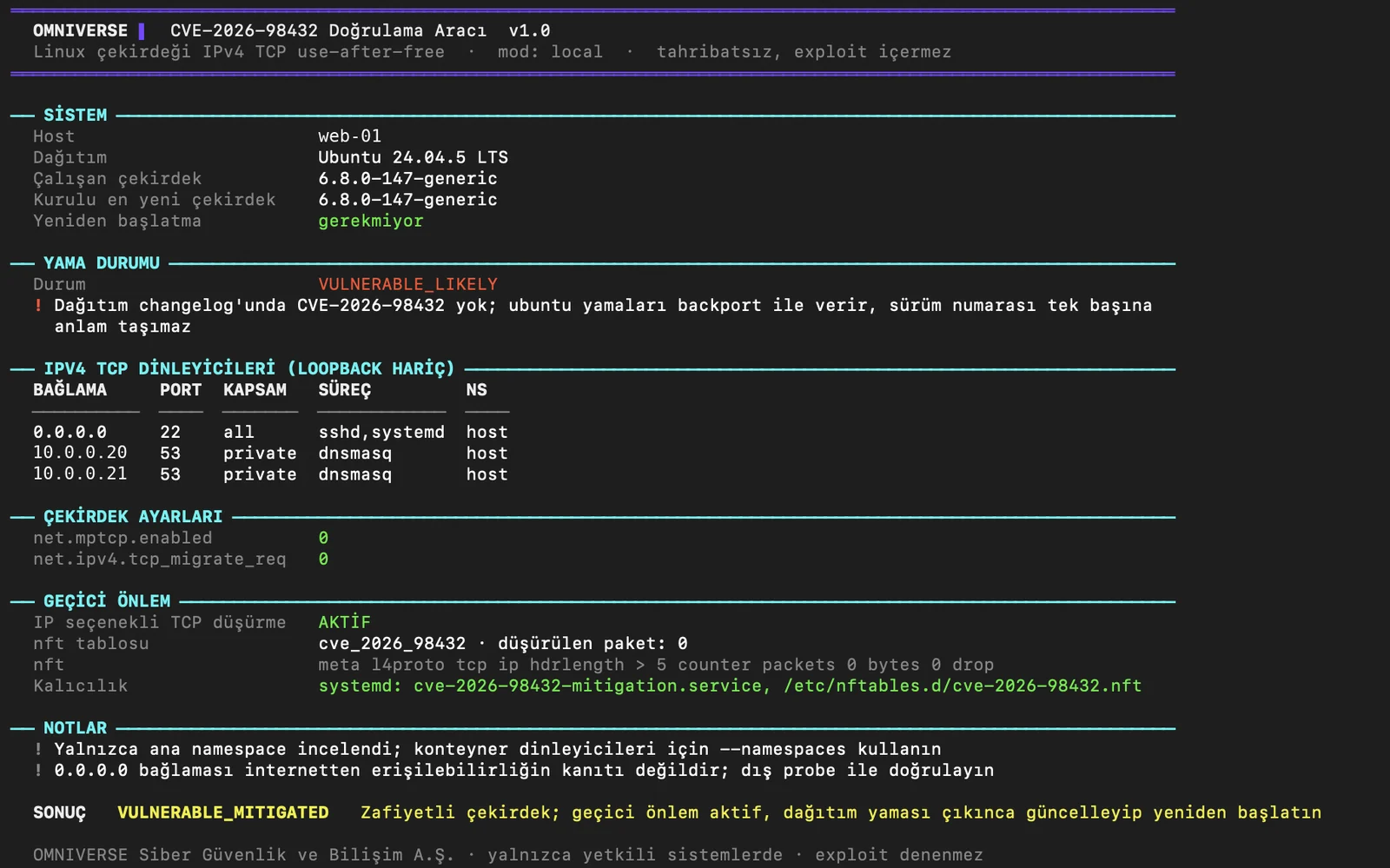
Verdict line:
SONUÇ VULNERABLE_MITIGATED Zafiyetli çekirdek; geçici önlem aktif, dağıtım yaması çıkınca güncelleyip yeniden başlatın
The report is printed in Turkish; verdict codes (PATCHED, VULNERABLE_MITIGATED, ...), JSON field names, --help and source comments are in English.
| Mode | Runs on | Produces |
|---|---|---|
local | Target Linux server (sudo) | Patch status, listeners, MPTCP, mitigation, one-line verdict |
probe | Scanning machine (root + scapy) | Reachability of the trigger packet class and MPTCP negotiation; targets as HOST[:PORTS] or CIDR[:PORTS], sent in paced batches |
capture | Target server (sudo) | Passive record of incoming SYNs (IPv4 options, MPTCP) |
audit | Scanning machine (root + scapy + SSH) | local + capture + probe in one run, packet-correlated evidence |
fleet | Management machine (SSH keys) | local on every server in a list over SSH; one JSON per server, summary table, CSV |
combine | Anywhere | Merges multiple JSON reports into one table; newest report per server wins; optional CSV |
selftest | Anywhere | Offline parser tests |
fleet)python3 omnicheck-98432.py fleet --hosts-file servers.txt --out-dir reports --csv summary.csv
servers.txt holds one SSH destination per line (web-01, [email protected], [email protected]:2222, # comments; see examples/). The script is streamed over stdin, nothing is copied or installed on the targets. fleet never prompts (BatchMode): it needs key-based login and passwordless sudo, or a root account. Servers without a result are reported as UNREACHABLE, SUDO_REQUIRED, PYTHON_MISSING, PYTHON_TOO_OLD or REMOTE_ERROR and count as exit code 3. Use --remote-python python3.11 for RHEL 8 / Rocky 8, --parallel for concurrency (default 8).
The scanning machine's own addresses are skipped by probe, so a block that contains it can be scanned as is.
probe fromprobe works from anywhere, but its IP-options result is only conclusive when the path to the target does not filter IP options. Many internet paths (ISPs, CGNAT, cloud edges) silently drop packets with IP options; from such a vantage point TCP_REACHABLE_IPOPT_NO_REPLY means "the packet did not get through", not "the host mitigation works". Run probe from the same network as the targets (DMZ, management network, jump host) or pair it with capture on the target (audit does this automatically) to get a definitive answer.
sudo python3 omnicheck-98432.py probe 10.0.0.0/24:22,443 --output dmz.json    # one /24, two ports
sudo python3 omnicheck-98432.py probe --targets-file scope.txt --ports 22      # file: HOST or CIDR per line
Endpoints are deduplicated by resolved IP and port; up to 8192 endpoints per run, 50 packets/s by default (--rate).
| Code | Meaning |
|---|---|
| 0 | Patched or not affected |
| 1 | Vulnerable and unprotected |
| 2 | Vulnerable, temporary mitigation active |
| 3 | Undetermined, inconclusive or tool error |
fleet and combine return the worst server: 1 > 3 > 2 > 0. No servers at all is 3, never 0.
| Verdict | Meaning |
|---|---|
PATCHED | The running kernel's package changelog or an applied livepatch names the CVE, or a non-distribution kernel is at a fixed upstream version |
NOT_AFFECTED | Kernel older than 4.4 (e.g. RHEL 7) |
VULNERABLE_NO_LISTENER | Vulnerable kernel, no non-loopback IPv4 TCP listener |
VULNERABLE_MITIGATED | Vulnerable kernel, IPv4-options drop rule active |
VULNERABLE_EXPOSED | Vulnerable kernel, listeners present, no mitigation |
INCONCLUSIVE | Not enough evidence: unparseable kernel release, a distribution kernel at an upstream fix level without package evidence, or listeners could not be listed |
VULNERABLE_MITIGATED_VERIFIED | (audit) Mitigation active; on the same endpoint the plain SYN was answered and the SYN with IPv4 options arrived intact and was not answered |
VULNERABLE_TRIGGER_PATH_OPEN | (audit) SYN with IPv4 options was answered; trigger path is reachable |
CRITICAL_MPTCP_REMOTE | (audit) Vulnerable kernel and MPTCP negotiation accepted from outside |
probe, audit): Python 3.8+, root, scapy (pip3 install scapy), OpenSSH client.fleet): Python 3.8+, OpenSSH client and keys for the targets; no root, no scapy.The default python3 on RHEL 8 / Rocky 8 is 3.6; use python3.9 or python3.11 on those systems.
Full guide covering all modes, parameters, verdicts and scenarios:
Use this tool only on systems you are authorized in writing to test. The probe and audit modes send raw packets and may trigger IDS/IPS alerts; notify the relevant security team before testing. This tool is not an exploit and does not prove exploitability.
OMNIVERSE Siber Güvenlik ve Bilişim A.Ş. · omni-verse.io · [email protected]
Découvrez les outils les plus utilisés par notre communauté.
Pas encore de données de popularité.
