
Skip to content
KitploitKITPLOIT
OutilsBlog
Soumettre
OutilsBlog
Soumettre

Outils de Hacking, PenTest et Cybersécurité pour votre Arsenal de Sécurité !

Kitploit est un répertoire d'outils de hacking, de cybersécurité et de pentesting. Découvrez les dernières mises à jour des projets pour trouver des vulnérabilités, analyser des systèmes, automatiser les tests et renforcer votre sécurité.

··Flux·Contact·Confidentialité·© 2026 Kitploit

Répertoire d'outils

Catégories

Voir toutes les catégories
Loading categories
decode-spam-headers — Un script qui vous aide à comprendre pourquoi votre e-mail a atterri dans le spam. | Kitploit
Outils/GitHubGitHub/mgeeky/decode-spam-headers
Outils de PhishingCollecte d'InformationsRed TeamingSécurité des EmailsAnalyse de Journaux
GitHubmgeeky/decode-spam-headers

decode-spam-headers

Un script qui vous aide à comprendre pourquoi votre e-mail a atterri dans le spam.

Voir le dépôt
698988il y a 6 moisVérifié par Kitploit

Populaires

Voir tout →

Découvrez les outils les plus utilisés par notre communauté.

Explorer tous les outils

Parcourez notre collection d'outils

Voir tous les outils →
Partager

decode-spam-headers.py

Que vous cherchiez à comprendre pourquoi un e-mail spécifique s'est retrouvé dans les SPAM/Indésirables dans le cadre de vos tâches administratives quotidiennes ou pour vos simulations de Phishing en Red-Team, ce script est là pour vous aider !

L'idée est née lors de la réalisation d'exercices commerciaux de simulation de Phishing contre un parc MS Office365 E5, équipé de MS Defender pour Office365. Comme on peut l'imaginer, une pile de sécurité assez coriace à appréhender du point de vue de la simulation de phishing. Après avoir analysé manuellement tous ces en-têtes SMTP Office365 et tenté d'y dénicher les valeurs SCL, le moment est venu d'écrire un véritable analyseur pour les en-têtes SMTP.

Le temps a passé, j'ai ajouté la prise en charge d'un nombre croissant d'en-têtes SMTP — et voilà le résultat. Un outil qui comprend désormais des dizaines d'en-têtes différents.

Informations

Cet outil accepte en entrée un fichier *.EML ou *.txt contenant tous les en-têtes SMTP. Il extrait ensuite un sous-ensemble d'en-têtes intéressants et, à l'aide de 105+ tests, tente de les décoder autant que possible.

Ce script extrait également toutes les adresses IPv4 et les noms de domaine, et effectue une résolution DNS complète de ceux-ci.

La sortie résultante contiendra des informations utiles sur la raison pour laquelle cet e-mail a pu être bloqué.

Afin d'embellir votre code HTML de Phishing avant de l'envoyer à votre client, vous pouvez également le passer dans mon phishing-HTML-linter.py. Il fait un plutôt bon travail pour détecter les mauvaises odeurs dans votre HTML qui feront augmenter le score de Spam de votre e-mail.

Exemples de captures d'écran

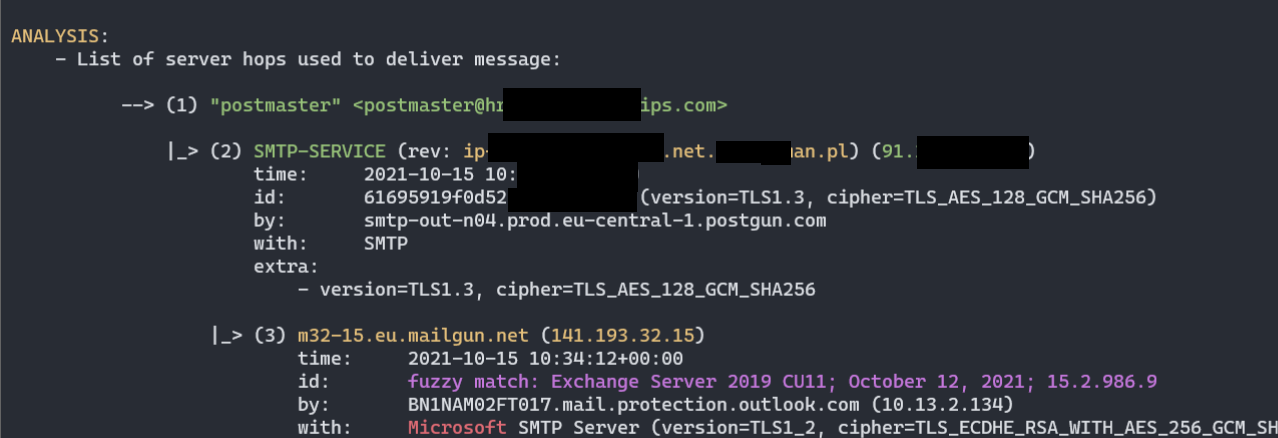
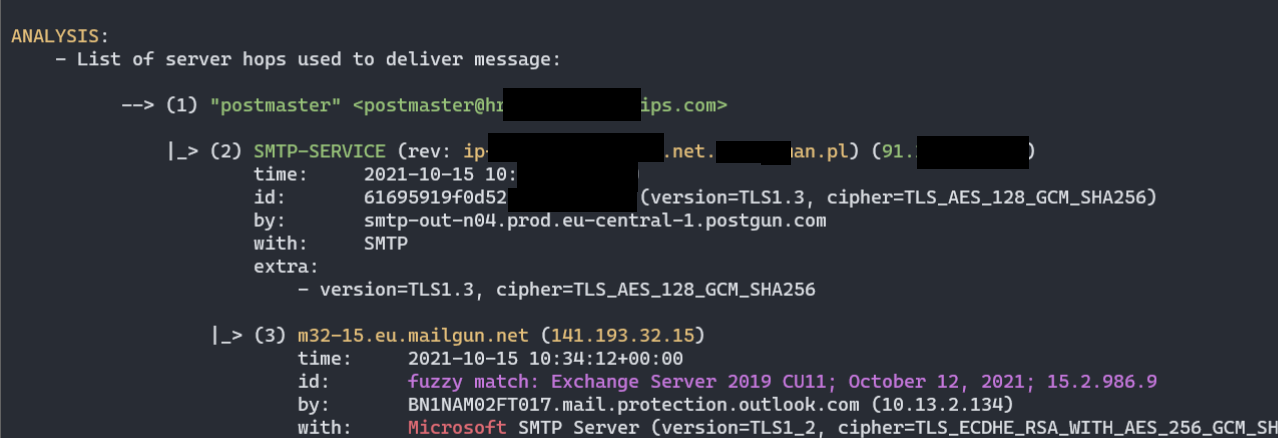
  • Chaîne de serveurs MTA (en-têtes Received proprement analysés) :

1.png

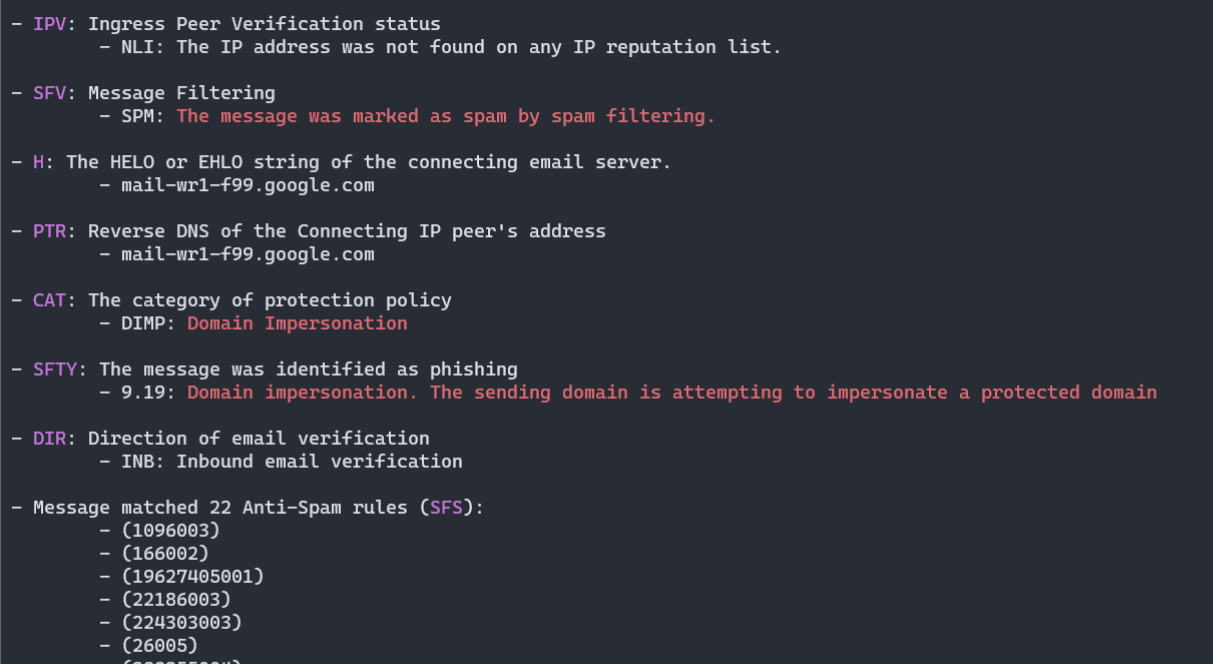
  • Divers en-têtes décodés autant que possible, selon la documentation publique disponible (ici Office365 ForeFront Spam Report) :

2.png

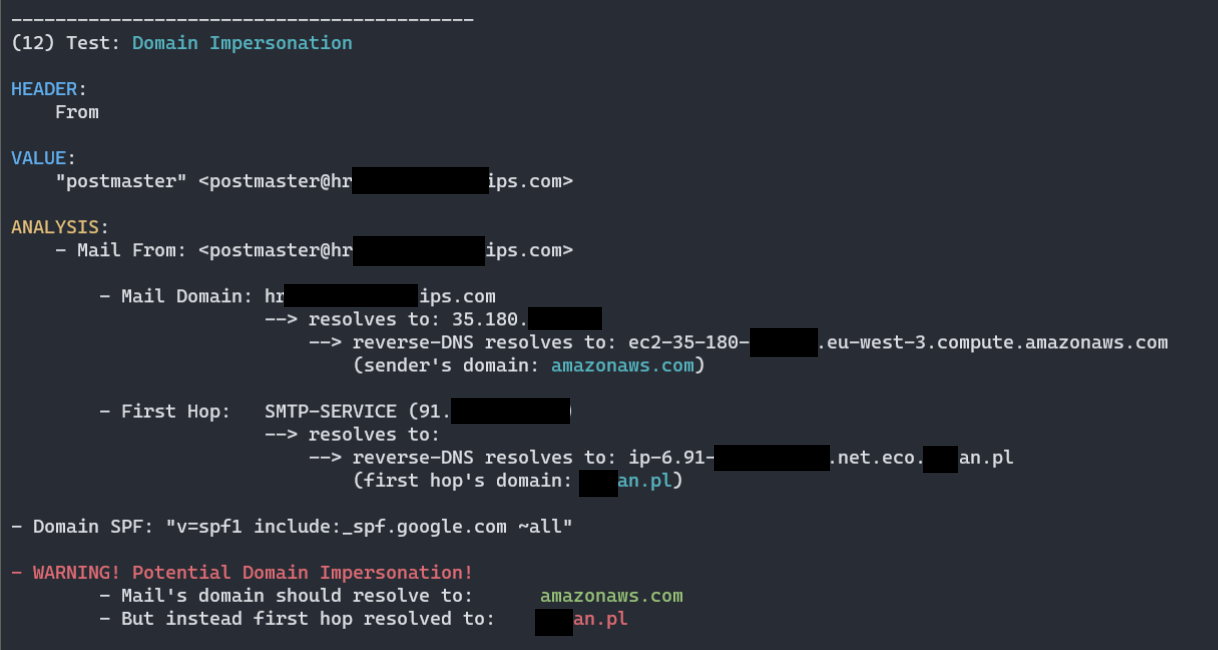
  • Différentes heuristiques personnalisées implémentées pour valider activement et chercher des indices de catégorisation de spam, ici la logique détectant l'Usurpation de domaine (Domain Impersonation) :

3.png

  • Le script tente de rétro-ingénierer et de documenter certaines des règles Anti-Spam d'Office365, et de collecter les connaissances publiques sur d'autres en-têtes Anti-Spam opaques :

4.png

  • Le rapport peut être généré en un joli HTML (utilisation : py decode-spam-headers.py headers.txt -f html -o report.html) :
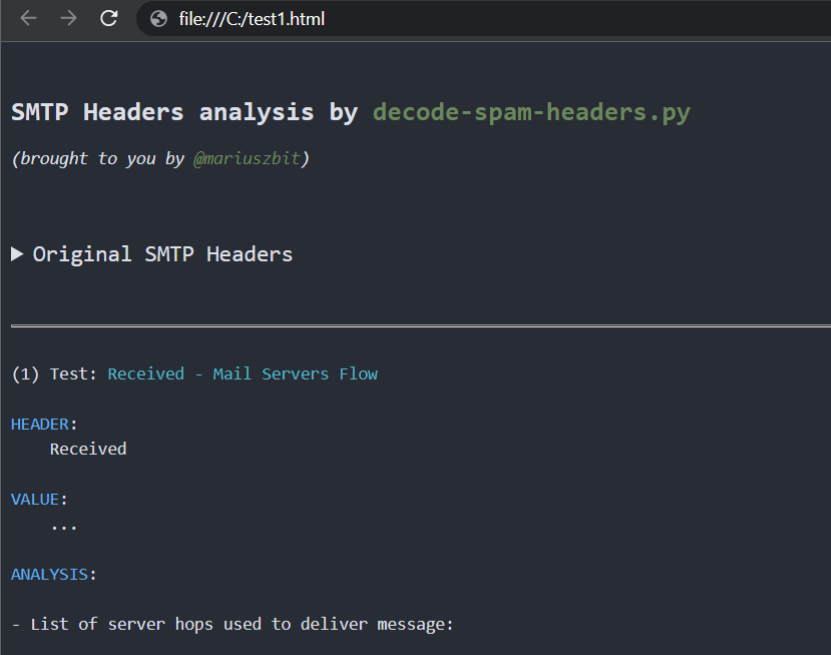
5.png

En-têtes traités

En-têtes traités (plus de 85+ en-têtes sont analysés) :

  • X-forefront-antispam-report
  • X-exchange-antispam
  • X-exchange-antispam-mailbox-delivery
  • X-exchange-antispam-message-info
  • X-microsoft-antispam-report-cfa-test
  • Received
  • From
  • To
  • Subject
  • Thread-topic
  • Received-spf
  • X-mailer
  • X-originating-ip
  • User-agent

La plupart de ces en-têtes ne sont pas entièrement documentés ; le script ne peut donc pas identifier tous les détails, mais il collecte au moins tout ce que j'ai pu trouver à leur sujet.

Efforts de rétro-ingénierie

Je fournis des efforts significatifs pour repérer et comprendre les différentes règles Anti-Spam Office365 ForeFront (SFS, ENG) bien qu'elles ne soient pas documentées publiquement.```

(5) Test: X-Forefront-Antispam-Report

HEADER: X-Forefront-Antispam-Report

VALUE: CIP:209.85.167.100;CTRY:US;LANG:de;SCL:5;SRV:;IPV:NLI;SFV:SPM;H:mail-lf1-f100.google.com;PTR:mail-l f1-f100.google.com;CAT:DIMP;SFTY:9.19;SFS:(4636009)(956004)(166002)(6916009)(356005)(336012)(19 625305002)(22186003)(5660300002)(4744005)(6666004)(35100500006)(82960400001)(26005)(7596003)(7636003)(554460 02)(224303003)(1096003)(58800400005)(86362001)(9686003)(43540500002);DIR:INB;SFTY:9.19;

[...]

root@kitploit:~
    - Message matched 24 Anti-Spam rules (SFS):           <============ opaque anti-spam rules
            - (1096003)
            - (166002)
            - (19625305002)
            - (22186003)
            - (224303003)
            - (26005)
            - (336012)
            - (356005)
            - (35100500006)         - (SPAM) Message contained embedded image.
root@kitploit:~
Le processus est purement manuel et consiste à envoyer des e-mails spécialement conçus aux serveurs de messagerie Office365, puis à examiner et corréler manuellement les règles collectées.

Ayant déjà envoyé plus de 60 e-mails, voici ce que je peux dire à présent sur les règles de Microsoft :```py

    #
    # Below rules were collected solely in a trial-and-error manner or by scraping any 
    # pieces of information from all around the Internet.
    #
    # They do not represent the actual Anti-Spam rule name or context and surely represent 
    # something close to what is understood (or they may have totally different meaning).
    # 
    # Until we'll be able to review anti-spam rules documention, there is no viable mean to map
    # rule ID to its meaning.
    #

    Anti_Spam_Rules_ReverseEngineered = \
    {
        '35100500006' : logger.colored('(SPAM) Message contained embedded image.', 'red'),

        # https://docs.microsoft.com/en-us/answers/questions/416100/what-is-meanings-of-39x-microsoft-antispam-mailbox.html
        '520007050' : logger.colored('(SPAM) Moved message to Spam and created Email Rule to move messages from this particular sender to Junk.', 'red'),

        # triggered on an empty mail with subject being: "test123 - viagra"
        '162623004' : 'Subject line contained suspicious words (like Viagra).',

        # triggered on mail with subject "test123" and body being single word "viagra"
        '19618925003' : 'Mail body contained suspicious words (like Viagra).',

        # triggered on mail with empty body and subject "Click here"
        '28233001' : 'Subject line contained suspicious words luring action (ex. "Click here"). ',

        # triggered on a mail with test subject and 1500 words of http://nietzsche-ipsum.com/
        '30864003' : 'Mail body contained a lot of text (more than 10.000 characters).',

        # mails that had simple message such as "Hello world" triggered this rule, whereas mails with
        # more than 150 words did not.
        '564344004' : 'HTML mail body with less than 150 words of text (not sure how much less though)',

        # message was sent with a basic html and only one <u> tag in body.
        '67856001' : 'HTML mail body contained underline <u> tag.',

        # message with html,head,body and body containing simple text with no b/i/u formatting.
        '579124003' : 'HTML mail body contained text, but no text formatting (<b>, <i>, <u>) was present',

        # This is a strong signal. Mails without <a> doesnt have this rule.
        '166002' : 'HTML mail body contained URL <a> link.',

        # Message contained <a href="https://something.com/file.html?parameter=value" - GET parameter with value.
        '21615005' : 'Mail body contained <a> tag with URL containing GET parameter: ex. href="https://foo.bar/file?aaa=bbb"',

        # Message contained <a href="https://something.com/file.html?parameter=https://another.com/website" 
        # - GET parameter with value, being a URL to another website
        '45080400002' : 'Something about <a> tag\'s URL. Possibly it contained GET parameter with value of another URL: ex. href="https://foo.bar/file?aaa=https://baz.xyz/"',

        # Message contained <a> with href pointing to a file with dangerous extension, such as file.exe
        '460985005' : 'Mail body contained HTML <a> tag with href URL pointing to a file with dangerous extension (such as .exe)',

        #
        # Message1: GoPhish -> VPS 587/tcp redirector -> smtp.gmail.com:587 -> target
        # Message2: GoPhish -> VPS 587/tcp redirector -> smtp-relay.gmail.com:587 -> target
        #
        # These were the only differences I spotted:
        #   Message1 - FirstHop Gmail SMTP Received with ESMTPS.
        #   Message2 - FirstHop Gmail SMTP-Relay Received with ESMTPSA.
        #
        '121216002' : 'First Hop MTA SMTP Server used as a SMTP Relay. It\'s known to originate e-mails, but here it acted as a Relay. Or maybe due to use of "with ESMTPSA" instead of ESMTPS?',

        # Triggered on message with <a> added to HTML: <a href="https://support.spotify.com/is-en/">https://www.reddit.com/</a>
        '966005' : 'Mail body contained link tag with potentially masqueraded URL: <a href="https://attacker.com">https://example.com</a>',

        #
        # Message1: GoPhish EC2 -> another EC2 with socat to smtp.gmail.com:587 (authenticated) -> Target
        # Message2: GoPhish EC2 -> Gsuite -> Target
        #
        # Subject, mail body were exactly the same.
        #
        # Below two rules were added to the second message. My understanding is that they're somehow referring
        # to the reputation of the first-hop server, maybe reverse-DNS resolution.
        #
        '5002400100002' : "(GUESSING) Somehow related to First Hop server reputation, it's reverse-PTR resolution or domain impersonation",
        '58800400005'   : "(GUESSING) Somehow related to First Hop server reputation, it's reverse-PTR resolution or domain impersonation",

        '19625305002' : '(GUESSING) Something to do with the HTML code and used tags/structures',
        '43540500002' : '(GUESSING) Something to do with the HTML code and used tags/structures',

        '460985005' : '(GUESSING) Something to do with either more-complex HTML code or with the <a> tag and its URL.',

        # Triggered on an empty text message, subject "test" - that was marked with "Domain Impersonation", however 
        # ForeFront Anti-Spam headers did not support that Domain Impersonation. Weird.
        '22186003' : '(GUESSING) Something to do with either Text message (non-HTML) or probable Domain Impersonation',

        # Found by @ipSlav (https://github.com/mgeeky/decode-spam-headers/issues/15)
        '42882007' : 'Missing Reply-To Address. Might be fixed by adding -ReplyTo flag to Send-MailMessage',
        '78352004' : 'Missing Reply-To Address. Might be fixed by adding -ReplyTo flag to Send-MailMessage',
    }

Si vous connaissez d'autres règles anti-spam Office365 (ou si vous avez des suggestions concernant celles décrites ci-dessus) - faites-le-moi savoir dans les issues de ce dépôt, je les ajouterai immédiatement :)

Utilisation

Installez les dépendances Python3 requises avant la première utilisation :``` bash$ pip3 install -r requirements.txt

root@kitploit:~
Aide:```
PS> py .\decode-spam-headers.py --help
usage: decode-spam-headers.py [options] <file | --list tests>

optional arguments:
  -h, --help            show this help message and exit

Required arguments:
  infile                Input file to be analysed or --list tests to show available tests.

Options:
  -o OUTFILE, --outfile OUTFILE
                        Output file with report
  -f {json,text,html}, --format {json,text,html}
                        Analysis report format. JSON, text. Default: text
  -N, --nocolor         Dont use colors in text output.
  -v, --verbose         Verbose mode.
  -d, --debug           Debug mode.
  -l, --list            List available tests and quit. Use it like so: --list tests

Tests:
  -i tests, --include-tests tests
                        Comma-separated list of test IDs to run. Ex. --include-tests 1,3,7
  -e tests, --exclude-tests tests
                        Comma-separated list of test IDs to skip. Ex. --exclude-tests 1,3,7
  -r, --resolve         Resolve IPv4 addresses / Domain names.
  -R, --dont-resolve    Do not resolve anything.
  -a, --decode-all      Decode all =?us-ascii?Q? mail encoded messages and print their contents.

If you want to run only a subset of tests, you'll first need to learn Test IDs of which to pick. Run the script with -l tests to grab that list.

List available test and their corresponding IDs:

Si vous souhaitez exécuter uniquement un sous-ensemble de tests, vous devrez d'abord connaître les ID de tests parmi lesquels choisir. Exécutez le script avec -l tests pour obtenir cette liste.

Liste des tests disponibles et de leurs ID correspondants :``` C:> py decode-spam-headers.py -l tests

[.] Available tests:

root@kitploit:~
    TEST_ID - TEST_NAME
    --------------------------------------
          1 - Received - Mail Servers Flow
          2 - Extracted IP addresses
          3 - Extracted Domains
          4 - Bad Keywords In Headers
          5 - Sender Address Analysis
          6 - Subject and Thread Topic Difference
          7 - Authentication-Results
          8 - ARC-Authentication-Results
          9 - Received-SPF
         10 - Mail Client Version
         11 - User-Agent Version
         12 - X-Forefront-Antispam-Report
         13 - X-MS-Exchange-Organization-SCL
         14 - X-Microsoft-Antispam-Mailbox-Delivery
         15 - X-Microsoft-Antispam Bulk Mail
         16 - X-Exchange-Antispam-Report-CFA-Test
         17 - Domain Impersonation
         18 - SpamAssassin Spam Status
         19 - SpamAssassin Spam Level
         20 - SpamAssassin Spam Flag
         21 - SpamAssassin Spam Report
         22 - OVH's X-VR-SPAMCAUSE
         23 - OVH's X-Ovh-Spam-Reason
         24 - OVH's X-Ovh-Spam-Score
         25 - X-Virus-Scan
         26 - X-Spam-Checker-Version
         27 - X-IronPort-AV
         28 - X-IronPort-Anti-Spam-Filtered
         29 - X-IronPort-Anti-Spam-Result
         30 - X-Mimecast-Spam-Score
         31 - Spam Diagnostics Metadata
         32 - MS Defender ATP Message Properties
         33 - Message Feedback Loop
         34 - End-to-End Latency - Message Delivery Time
         36 - X-IP-Spam-Verdict
         37 - X-Amp-Result
         38 - X-IronPort-RemoteIP
         39 - X-IronPort-Reputation
         40 - X-SBRS
         41 - X-IronPort-SenderGroup
         42 - X-Policy
         43 - X-IronPort-MailFlowPolicy
         44 - X-SEA-Spam
         45 - X-FireEye
         46 - X-AntiAbuse
         47 - X-TMASE-Version
         48 - X-TM-AS-Product-Ver
         49 - X-TM-AS-Result
         50 - X-IMSS-Scan-Details
         51 - X-TM-AS-User-Approved-Sender
         52 - X-TM-AS-User-Blocked-Sender
         53 - X-TMASE-Result
         54 - X-TMASE-SNAP-Result
         55 - X-IMSS-DKIM-White-List
         56 - X-TM-AS-Result-Xfilter
         57 - X-TM-AS-SMTP
         58 - X-TMASE-SNAP-Result
         59 - X-TM-Authentication-Results
         60 - X-Scanned-By
         61 - X-Mimecast-Spam-Signature
         62 - X-Mimecast-Bulk-Signature
         63 - X-Forefront-Antispam-Report-Untrusted
         64 - X-Microsoft-Antispam-Untrusted
         65 - X-Mimecast-Impersonation-Protect
         66 - X-Proofpoint-Spam-Details
         67 - X-Proofpoint-Virus-Version
         68 - SPFCheck
         69 - X-Barracuda-Spam-Score
         70 - X-Barracuda-Spam-Status
         71 - X-Barracuda-Spam-Report
         72 - X-Barracuda-Bayes
         73 - X-Barracuda-Start-Time
         74 - Similar to SpamAssassin Spam Level headers
         75 - SMTP Header Contained IP address
         76 - Other unrecognized Spam Related Headers
         77 - Other interesting headers
         78 - Security Appliances Spotted
         79 - Email Providers Infrastructure Clues
         80 - X-Microsoft-Antispam-Message-Info (use -a to show its results)
         81 - Decoded Mail-encoded header values (use -a to show its results)
         82 - Header Containing Client IP
         83 - Office365 Tenant ID
         84 - Organization Name
         85 - MS Defender for Office365 Safe Links Version
         86 - Suspicious Words in Headers
         87 - AWS SES Outgoing
         88 - IronPort-Data
         89 - IronPort-HdrOrder
         90 - X-DKIM
         91 - DKIM-Filter
         92 - X-SpamExperts-Class
         93 - X-SpamExperts-Evidence
         94 - X-Recommended-Action
         95 - X-AppInfo
         96 - X-Spam
         97 - X-TM-AS-MatchedID
         98 - MTA Hostname Exposed
         99 - Office365 First Contact Safety Tip
        100 - EOP - Bypass Focused Inbox
        101 - EOP - Enhanced Filtering - SkipListedInternetSender
        102 - EOP - Enhanced Filtering - ExternalOriginalInternetSender
        103 - Cloudmark Analysis
        104 - The Real Sender - via Authenticated-Sender
        105 - Identified Sender Addresses
        106 - Unsual SMTP headers
root@kitploit:~
### Rapport HTML

Afin de générer le rapport HTML - utilisez les paramètres suivants :```
  PS> py decode-spam-headers.py headers.txt -f html -o report.html

Exemple d'exécution

Exemple d'exécution (la structure et le contenu de la sortie proviennent d'une version obsolète du script) :``` PS> py decode-spam-headers.py headers.txt


(1) Test: Received - Mail Servers Flow

HEADER: Received

VALUE: ...

ANALYSIS: - List of server hops used to deliver message:

root@kitploit:~
      --> (1) "attacker" <[email protected]>

           |_> (2) SMTP-SERVICE (44.55.66.77)
                  time: 01 Jan 2021 12:34:20

              |_> (3) mail-wr1-f51.google.com (209.85.221.51)
                      time: 01 Jan 2021 12:34:20
                      version: fuzzy match: Exchange Server 2019 CU11; October 12, 2021; 15.2.986.9

                  |_> (4) SN1NAM02FT0061.eop-nam02.prod.protection.outlook.com (2603:10b6:806:131:cafe::e5)
                          time: 01 Jan 2021 12:34:20
                          version: fuzzy match: Exchange Server 2019 CU11; October 12, 2021; 15.2.986.9

                      |_> (5) SA0PR11CA0138.namprd11.prod.outlook.com (2603:10b6:806:131::23)
                              time: 01 Jan 2021 12:34:20
                              version: fuzzy match: Exchange Server 2019 CU11; October 12, 2021; 15.2.986.9

                          |_> (6) CP2PR80MB4114.lamprd80.prod.outlook.com (2603:10d6:102:3c::15)
                                  time: 01 Jan 2021 12:34:23

                              |_> (7) "Victim Surname" <[email protected]>

[...]


(4) Test: Mail Client Version

HEADER: X-Mailer

VALUE: OEM

ANALYSIS: - X-Mailer header was present and contained value: "OEM".


(5) Test: X-Forefront-Antispam-Report

HEADER: X-Forefront-Antispam-Report

VALUE: CIP:209.85.167.100;CTRY:US;LANG:de;SCL:5;SRV:;IPV:NLI;SFV:SPM;H:mail-lf1-f100.google.com;PTR:mail-l f1-f100.google.com;CAT:DIMP;SFTY:9.19;SFS:(4636009)(956004)(166002)(6916009)(356005)(336012)(19 625305002)(22186003)(5660300002)(4744005)(6666004)(35100500006)(82960400001)(26005)(7596003)(7636003)(554460 02)(224303003)(1096003)(58800400005)(86362001)(9686003)(43540500002);DIR:INB;SFTY:9.19;

ANALYSIS: - Microsoft Office365/Exchange ForeFront Anti-Spam report

root@kitploit:~
    - CIP: Connecting IP address: 209.85.167.100

    - CTRY: The source country as determined by the connecting IP address
            - US

    - LANG: The language in which the message was written
            - de

    - IPV: Ingress Peer Verification status
            - NLI: The IP address was not found on any IP reputation list.

    - SFV: Message Filtering
            - SPM: The message was marked as spam by spam filtering.

    - H: The HELO or EHLO string of the connecting email server.
            - mail-lf1-f100.google.com

    - PTR: Reverse DNS of the Connecting IP peer's address
            - mail-lf1-f100.google.com

    - CAT: The category of protection policy
            - DIMP: Domain Impersonation

    - SFTY: The message was identified as phishing
            - 9.19: Domain impersonation. The sending domain is attempting to impersonate a protected domain

    - DIR: Direction of email verification
            - INB: Inbound email verification

    - Message matched 24 Anti-Spam rules (SFS):
            - (1096003)
            - (166002)
            - (19625305002)
            - (22186003)
            - (224303003)
            - (26005)
            - (336012)
            - (356005)
            - (35100500006)         - (SPAM) Message contained embedded image.
            - (43540500002)
            - (4636009)
            - (4744005)
            - (55446002)
            - (5660300002)
            - (58800400005)
            - (6666004)
            - (6916009)
            - (7596003)
            - (7636003)
            - (82960400001)
            - (86362001)
            - (956004)
            - (9686003)

    - SCL: Spam Confidence Level: 5
            - SPAM: Spam filtering marked the message as Spam

More information: - https://docs.microsoft.com/en-us/microsoft-365/security/office-365-security/anti-spam-message-headers - https://docs.microsoft.com/en-us/exchange/antispam-and-antimalware/antispam-protection/antispam-stamps - https://docs.microsoft.com/en-us/microsoft-365/security/office-365-security/spam-confidence-levels - https://docs.microsoft.com/en-us/exchange/monitoring/trace-an-email-message/run-a-message-trace-and-view-results


(6) Test: X-Microsoft-Antispam-Mailbox-Delivery

HEADER: X-Microsoft-Antispam-Mailbox-Delivery

VALUE: ucf:0;jmr:1;auth:0;dest:J;ENG:(910001)(944506458)(944626604)(750132)(520011016);

ANALYSIS: - This header denotes what to do with received message, where to put it.

root@kitploit:~
    - auth: Message originating from Authenticated sender
            - 0: Not Authenticated

    - dest: Destination where message should be placed
            - J: JUNK directory

    - Message matched 6 Anti-Spam Delivery rules:
            - (520011016)
            - (750132)
            - (910001)
            - (944506458)
            - (944626604)

(7) Test: X-Microsoft-Antispam Bulk Mail

HEADER: X-Microsoft-Antispam VALUE: BCL:0;

ANALYSIS: - BCL: BULK Confidence Level: 0 The message isn't from a bulk sender.

root@kitploit:~
More information:
            - https://docs.microsoft.com/en-us/microsoft-365/security/office-365-security/bulk-complaint-level-values

[...]


(10) Test: MS Defender ATP Message Properties

HEADER: X-MS-Exchange-AtpMessageProperties

VALUE: SA|SL

ANALYSIS: - MS Defender Advanced Threat Protection enabled following protections on this message: - Safe Attachments Protection - Safe Links Protection


(11) Test: Domain Impersonation

HEADER: From

VALUE: "attacker" [email protected]

ANALYSIS: - Mail From: [email protected]

root@kitploit:~
            - Mail Domain: attacker.com
                   --> resolves to: 11.22.33.44
                       --> reverse-DNS resolves to: ec2-11-22-33-44.eu-west-3.compute.amazonaws.com
                           (sender's domain: amazonaws.com)

            - First Hop:   SMTP-SERVICE (44.55.66.77)
                   --> resolves to:
                       --> reverse-DNS resolves to: host44-55-66-77.static.arubacloud.pl
                           (first hop's domain: arubacloud.pl)

    - Domain SPF: "v=spf1 include:_spf.google.com ~all"

    - WARNING! Potential Domain Impersonation!
            - Mail's domain should resolve to:      amazonaws.com
            - But instead first hop resolved to:    arubacloud.pl
root@kitploit:~
---

### Crédits

- [ipSlav](https://github.com/ipSlav) - pour avoir identifié [deux règles opaques Office365](https://github.com/mgeeky/decode-spam-headers/issues/15): `42882007` et `78352004`

---

### Problèmes connus

- La méthode `getOffice365TenantNameById(tenantID)` n'est pas encore terminée, je connais quelques façons de mapper le GUID de locataire Office365 en nom de locataire, mais je n'ai pas encore trouvé de méthode stable pour ce faire.
- L'en-tête `Authentication-Results` n'est pas encore complètement analysé - il faut inclure le traitement de `reason` et d'autres champs conformément à la [documentation Microsoft](https://docs.microsoft.com/en-us/microsoft-365/security/office-365-security/anti-spam-message-headers?view=o365-worldwide)

---

### ☕ Montrez votre soutien ☕

Ce projet et les autres sont le fruit de nuits blanches et de **beaucoup de travail acharné**. Si vous aimez ce que je fais et appréciez que je redonne toujours à la communauté,
[Envisagez de m'offrir un café](https://github.com/sponsors/mgeeky) _(ou plutôt une bière)_ juste pour dire merci ! 💪

---```
Mariusz Banach / mgeeky, (@mariuszbit)
<mb [at] binary-offensive.com>
Télécharger l’outil
  • X-forefront-antispam-report
  • X-microsoft-antispam-mailbox-delivery
  • X-microsoft-antispam
  • X-exchange-antispam-report-cfa-test
  • X-spam-status
  • X-spam-level
  • X-spam-flag
  • X-spam-report
  • X-vr-spamcause
  • X-ovh-spam-reason
  • X-vr-spamscore
  • X-virus-scanned
  • X-spam-checker-version
  • X-ironport-av
  • X-ironport-anti-spam-filtered
  • X-ironport-anti-spam-result
  • X-mimecast-spam-score
  • Spamdiagnosticmetadata
  • X-ms-exchange-atpmessageproperties
  • X-msfbl
  • X-ms-exchange-transport-endtoendlatency
  • X-ms-oob-tlc-oobclassifiers
  • X-ip-spam-verdict
  • X-amp-result
  • X-ironport-remoteip
  • X-ironport-reputation
  • X-sbrs
  • X-ironport-sendergroup
  • X-policy
  • X-ironport-mailflowpolicy
  • X-remote-ip
  • X-sea-spam
  • X-fireeye
  • X-antiabuse
  • X-tmase-version
  • X-tm-as-product-ver
  • X-tm-as-result
  • X-imss-scan-details
  • X-tm-as-user-approved-sender
  • X-tm-as-user-blocked-sender
  • X-tmase-result
  • X-tmase-snap-result
  • X-imss-dkim-white-list
  • X-tm-as-result-xfilter
  • X-tm-as-smtp
  • X-scanned-by
  • X-mimecast-spam-signature
  • X-mimecast-bulk-signature
  • X-sender-ip
  • X-forefront-antispam-report-untrusted
  • X-microsoft-antispam-untrusted
  • X-sophos-senderhistory
  • X-sophos-rescan
  • X-MS-Exchange-CrossTenant-Id
  • X-OriginatorOrg
  • IronPort-Data
  • IronPort-HdrOrdr
  • X-DKIM
  • DKIM-Filter
  • X-SpamExperts-Class
  • X-SpamExperts-Evidence
  • X-Recommended-Action
  • X-AppInfo
  • X-Spam
  • X-TM-AS-MatchedID
  • X-MS-Exchange-EnableFirstContactSafetyTip
  • X-MS-Exchange-Organization-BypassFocusedInbox
  • X-MS-Exchange-SkipListedInternetSender
  • X-MS-Exchange-ExternalOriginalInternetSender
  • X-CNFS-Analysis
  • X-Authenticated-Sender
  • X-Apparently-From
  • X-Env-Sender
  • Sender