 big-comfy/deadair
Trouve les règles de détection de votre SIEM qui sont aveugles.

<p align="center">
  <picture>
    <source media="(prefers-color-scheme: dark)" srcset="docs/assets/banner-dark.svg">
    <img alt="deadair - SIEM detection coverage health" src="https://raw.githubusercontent.com/big-comfy/deadair/HEAD/docs/assets/banner-light.svg" width="760">
  </picture>
</p>

<p align="center">
  <a href="https://github.com/alephnull-sh/deadair/actions/workflows/ci.yml"><img alt="CI" src="https://github.com/alephnull-sh/deadair/actions/workflows/ci.yml/badge.svg"></a>
  <a href="https://github.com/alephnull-sh/deadair/releases"><img alt="Release" src="https://img.shields.io/github/v/release/alephnull-sh/deadair"></a>
  <img alt="Go 1.26" src="https://img.shields.io/badge/go-1.26-00ADD8">
  <a href="https://github.com/big-comfy/deadair/blob/main/LICENSE"><img alt="License: Apache-2.0" src="https://img.shields.io/badge/license-Apache--2.0-blue"></a>
</p>

<p align="center">
  <strong>deadair vérifie si les détections SIEM activées disposent toujours de la télémétrie dont elles ont besoin.</strong><br>
  Il signale les données manquantes ou obsolètes, les retards d'ingestion et les incohérences de schéma.
</p>

<p align="center">
  S'exécute localement · Lecture seule · Sans agent · Aucun envoi de télémétrie
</p>

<p align="center">
  <a href="https://alephnull-sh.github.io/deadair/">Lire l'article technique</a> ·
  <a href="https://www.detectionengineering.net/i/208193682/detection-engineering-gem">Présenté dans Detection Engineering Weekly</a> ·
  <a href="https://tldrsec.com/p/tldr-sec-341">Présenté dans tl;dr sec #341</a>
</p>

<p align="center">
  <a href="https://alephnull-sh.github.io/deadair/#elastic-demo"><img alt="An Elastic scan showing missing and stale inputs, missing fields, and delayed events" src="https://assets.kitploit.com/production/public/readmes/791/fc36f93c2d5fcaceffd370452b89b908a930eb10e810c0187fb3bba59cb156dd.png" width="860"></a>
</p>

<p align="center">
  <sub>Champs manquants et événements retardés dans un lab Elastic jetable. Ouvrez l'image pour la courte capture avec contrôles de lecture, ou reproduisez-la avec <code>make record-scan-lab</code>.</sub>
</p>

## Pourquoi deadair

Une règle peut être activée, planifiée et sans erreur après la disparition des données dont elle a besoin. deadair
lit l'inventaire des règles actives, résout les entrées de chaque règle en utilisant la sémantique native du backend, et
vérifie les sources concrètes qui les sous-tendent.

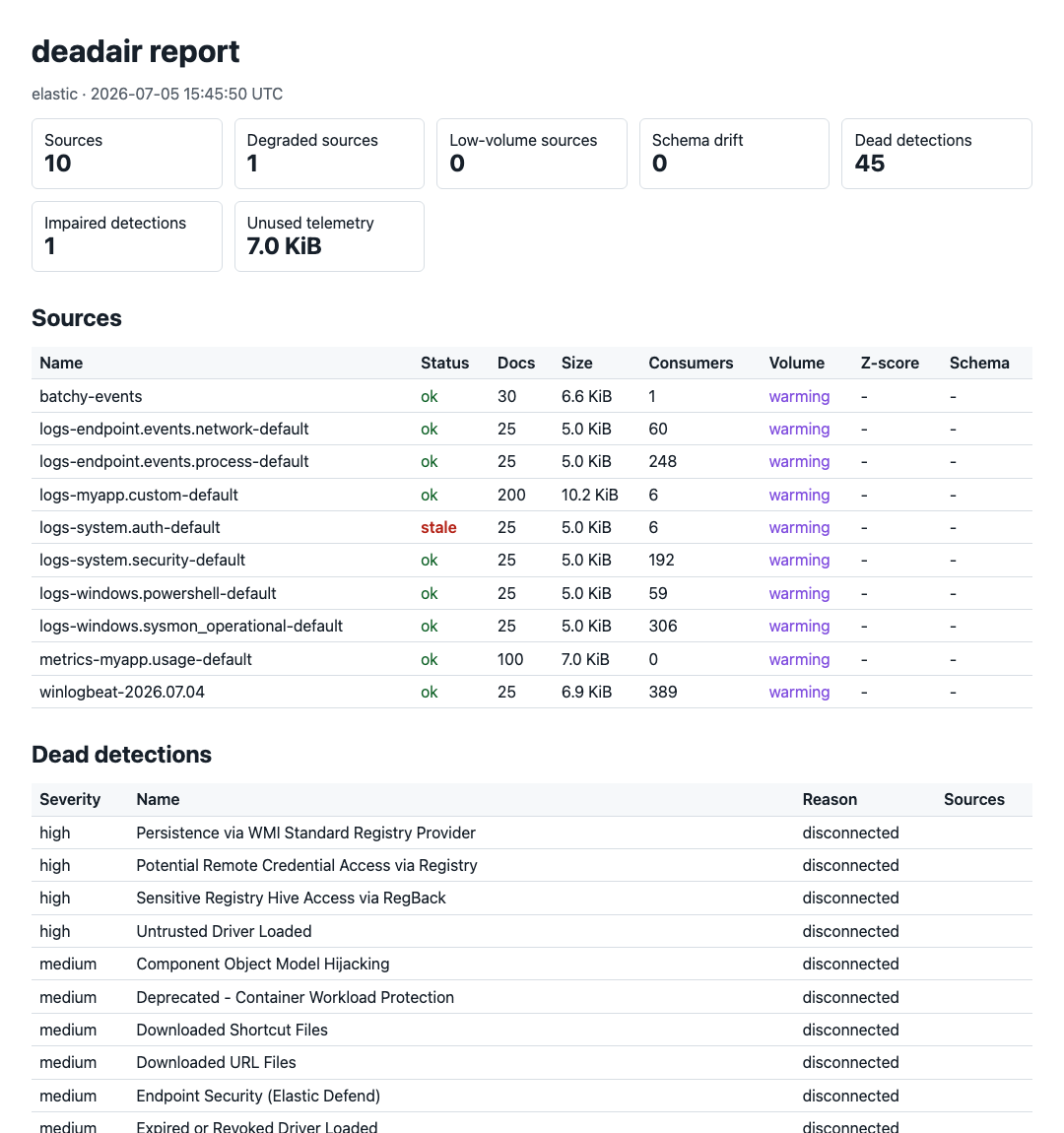
Il détecte :

- les règles dont les sélecteurs d'index, d'alias ou de data-stream ne résolvent rien ;
- les règles à sélecteurs mixtes où une entrée déclarée a disparu alors qu'une autre résout encore ;
- les règles dont toutes les sources correspondantes sont obsolètes ou vides ;
- sur Elastic, les règles s'exécutant avec des champs déclarés manquants ;
- sur Elastic et les règles Sentinel Scheduled éligibles, une fenêtre aveugle de retard d'ingestion ;
- sur Sentinel, les règles dont les sources connues utilisent un plan de table Basic ou Auxiliary incompatible ;
- sur Elastic et OpenSearch, une télémétrie saine qu'aucune détection activée ne lit.

deadair prend en charge Elastic Security, OpenSearch Security Analytics et Microsoft Sentinel.

## Démarrage rapide

Téléchargez un binaire pour macOS, Linux ou Windows depuis
[GitHub Releases](https://github.com/alephnull-sh/deadair/releases), ou installez avec Go :

```sh
go install github.com/alephnull-sh/deadair/cmd/deadair@latest
```

Affichez la configuration en lecture seule pour votre SIEM :

```sh
deadair setup elastic      # Elastic Security
deadair setup opensearch   # OpenSearch Security Analytics
deadair setup sentinel     # Microsoft Sentinel
```

Exécutez une configuration, puis vérifiez et lancez un scan :

```sh
deadair check   # verify the credential can scan
deadair scan    # assess live rules and telemetry
```

Les codes de sortie sont stables : `0` passe le seuil configuré, `1` signifie des constats soumis au seuil, et `2` signifie que le scan a échoué.

Pour enquêter sur une source et les détections qui la consomment :

```sh
deadair scan --json-out report.json --html-out report.html
deadair inspect --source CommonSecurityLog report.json
```

Utilisez un nom de source issu de votre rapport. Le [guide d'investigation](https://github.com/big-comfy/deadair/blob/main/docs/investigate.md) couvre également
les flux Sentinel individuels, la maintenance et le suivi de rétablissement.

## Comment ça fonctionne

| Étape | Ce que fait deadair |
|---|---|
| Inventaire | lit les détections activées et les entrées qu'elles déclarent |
| Résolution | utilise la résolution native des index sur Elastic et OpenSearch ; sur Sentinel, combine l'analyse KQL avec les preuves de tables, watchlists, fonctions enregistrées, ASIM et cross-workspace mappées |
| Mesure | vérifie la fraîcheur et la temporalité des sources, ainsi que le schéma et le stockage là où le backend les prend en charge |
| Rapport | émet des sorties terminal, JSON, HTML, des agrégations de flotte et des métriques Prometheus avec les preuves derrière chaque verdict |

Sentinel suit le même modèle règle-vers-source et ajoute les watchlists littérales, les fonctions enregistrées, les parseurs
ASIM, les workspaces mappés et la lignée des tables de résumé. Il montre aussi quand une tranche filtrée d'une
table partagée est devenue silencieuse ou qu'un pipeline de résumé a pris du retard.

Le [guide d'utilisation](https://github.com/big-comfy/deadair/blob/main/docs/usage.md#microsoft-sentinel) décrit les règles de preuve, et le
[registre de validation](https://github.com/big-comfy/deadair/blob/main/docs/validation.md#sentinel-live-conformance) consigne la couverture des tests en conditions réelles.

<p align="center">
  <a href="https://alephnull-sh.github.io/deadair/#sentinel-demo"><img alt="A quiet London firewall feed and its dependent detection inside Sentinel CommonSecurityLog" src="https://raw.githubusercontent.com/big-comfy/deadair/main/docs/assets/sentinel-lab.png" width="860"></a>
</p>

<p align="center">
  <sub>Deux flux de pare-feu partagent <code>CommonSecurityLog</code>. L'un s'arrête ; l'autre continue de rapporter. La capture montre les scans d'échec et de rétablissement enregistrés. Voir le <a href="https://github.com/big-comfy/deadair/blob/main/docs/validation.md#sentinel-live-conformance">registre de validation</a> pour les conditions du lab.</sub>
</p>

deadair vérifie si la télémétrie d'une détection est présente et saine. Il ne valide pas la logique
d'une règle et ne prouve pas qu'une attaque simulée déclenchera une alerte. Utilisez la validation statique de règles et les tests
de détection de bout en bout pour ces tâches.

## Constats

| Constat | Signification | Première vérification |
|---|---|---|
| aucune source correspondante | aucune des entrées de la règle ne résout vers un index, un data stream ou une table Sentinel visible | changements de motifs, intégrations manquantes et périmètre des identifiants |
| toutes les sources obsolètes ou vides | chaque source résolue est inutilisable en ce moment | cadence de la source et chemin d'ingestion |
| champs manquants | un champ déclaré par une règle Elastic est absent ou non recherchable dans une ou plusieurs sources résolues après lecture de tous les mappings de sources | changements de parseur, de package et de mapping |
| fenêtre aveugle de retard | le p95 du retard d'ingestion des événements appariés dépasse la marge de lookback de la règle | intervalle de la règle, lookback, override d'horodatage et délai du pipeline |
| couverture d'entrée partielle | l'expression complète résout, mais un sélecteur positif en son sein résout vide | migrations, sélecteurs de repli et alternatives attendues ; informatif sauf si la politique le soumet à un seuil |
| plan de source incompatible | une règle Sentinel dépend d'une table Basic ou Auxiliary non éligible au chemin de preuve des règles analytiques | plan de table et type de règle |
| dégradation de source | une source est obsolète, vide, à faible volume ou dérive de son schéma | historique de la source et maintenance attendue |
| télémétrie inutilisée | sur Elastic ou OpenSearch, des données sont stockées mais aucune détection locale activée ne résout vers elles | règles désactivées et collecte intentionnelle |
| producteur attendu silencieux | un flux Sentinel configuré par fournisseur, produit ou appareil n'a pas rapporté dans son seuil | l'émetteur et le collecteur de ce flux |
| pipeline de résumé en mauvaise santé | une tâche de résumé Sentinel pertinente a échoué ou son dernier succès est en retard | l'enregistrement d'exécution natif et la requête de résumé |

Les constats sur les producteurs et les pipelines de résumé affectent le statut de sortie lorsque leurs classes sont sélectionnées dans la
politique. Un flux d'appareil silencieux est signalé séparément des autres consommateurs de sa table partagée.

Chaque verdict est limité à ce que l'identifiant configuré peut voir. Les rapports JSON incluent les
expressions configurées, les sources résolues, la méthode de résolution, le statut d'évaluation, les métadonnées du backend
et les preuves de capacités. Voir le [guide d'utilisation](https://github.com/big-comfy/deadair/blob/main/docs/usage.md) pour des exemples concrets et le triage.

## Connecter un SIEM

Elastic :

```sh
export DEADAIR_ES_URL=https://es.example.internal:9200
export DEADAIR_KIBANA_URL=https://kibana.example.internal:5601
export DEADAIR_API_KEY=<read-only-api-key>

deadair check
deadair scan --json-out report.json --html-out report.html
```

OpenSearch :

```sh
export DEADAIR_BACKEND=opensearch
export DEADAIR_OPENSEARCH_URL=https://opensearch.example.internal:9200
export DEADAIR_OPENSEARCH_USERNAME=deadair
export DEADAIR_OPENSEARCH_PASSWORD=<password>

deadair check
deadair scan
```

Microsoft Sentinel :

```sh
az login --tenant <tenant-id>

export DEADAIR_BACKEND=sentinel
export DEADAIR_AZURE_SUBSCRIPTION_ID=<subscription-id>
export DEADAIR_AZURE_RESOURCE_GROUP=<resource-group>
export DEADAIR_SENTINEL_WORKSPACE=<workspace-resource-name>
# Optional: JSON allowlist for literal workspace() targets.
# export DEADAIR_SENTINEL_REMOTES=/restricted/path/sentinel-remotes.json

deadair check
deadair scan
```

Avant que deadair n'évalue le workspace distant mappé d'une règle, ce workspace doit avoir Sentinel
déployé. Les mappings d'un même abonnement peuvent prouver la disponibilité des sources. Les règles inter-abonnements nécessitent
des preuves d'exécution liées à l'identité exacte de la règle. Voir les
[détails d'utilisation Sentinel](https://github.com/big-comfy/deadair/blob/main/docs/usage.md#microsoft-sentinel) pour les règles de preuve, les limites de workspace et
de région, et les recommandations de performance de Microsoft.

Utilisez les rôles en lecture seule documentés pour
[Elastic](https://github.com/big-comfy/deadair/blob/main/docs/credentials/elastic.md), [OpenSearch](https://github.com/big-comfy/deadair/blob/main/docs/credentials/opensearch.md) ou
[Microsoft Sentinel](https://github.com/big-comfy/deadair/blob/main/docs/credentials/sentinel.md).

## CI, flottes et supervision

```sh
# Gate a candidate rule against live source availability.
deadair scan --rule new-rule.json

# Fail only on new regressions between reports.
deadair diff yesterday.json today.json

# Scan multiple SIEM instances from one process.
deadair scan --fleet fleet.json

# Export cached scan results as Prometheus metrics.
deadair serve --interval 5m
```

`scan --rule` isole une règle ou un détecteur candidat natif du backend du backlog non lié. `diff`
fonctionne avec des rapports expurgés créés avec la même clé détenue par l'appelant. La configuration de flotte référence
les secrets via des variables d'environnement plutôt que de stocker les valeurs des secrets.

L'[Action GitHub officielle](https://github.com/big-comfy/deadair/blob/main/docs/usage.md#gate-detection-changes) encapsule les seuils de candidats mono-instance
pour Elastic, OpenSearch et Sentinel. Elle écrit un résumé de job, téléverse un rapport JSON
expurgé et peut appliquer une politique deadair sans installer de règle. Les workflows Sentinel authentifient
d'abord le runner auprès d'Azure ; l'Action ne définit aucune entrée d'identifiant Azure.

Voir [le comportement du seuil CI](https://github.com/big-comfy/deadair/blob/main/docs/usage.md#gate-detection-changes),
[le déploiement en flotte et MSSP](https://github.com/big-comfy/deadair/blob/main/docs/mssp.md), et les [exemples Prometheus](https://github.com/big-comfy/deadair/blob/main/contrib) pour des configurations
à tester dans votre propre environnement.

## Backends testés

| Backend | Validation en conditions réelles |
|---|---|
| Elastic Security | CI de confiance sur 8.19.19 et 9.4.4 |
| OpenSearch Security Analytics | CI de confiance sur 2.19.6 et 3.7.0 |
| Microsoft Sentinel | conformité enregistrée sur opt-in dans des workspaces UK South jetables ; voir [statut de validation](https://github.com/big-comfy/deadair/blob/main/docs/validation.md#sentinel-live-conformance) |

L'exécution de conformité Sentinel est manuelle, pas une CI planifiée.

## Modèle de sécurité

- Tous les appels d'adaptateur sont en lecture seule. Les tests de confiance Elastic et OpenSearch, ainsi que des sondes
  de lab Sentinel distinctes, vérifient que les identités de scan documentées ne peuvent pas effectuer d'écritures représentatives.
- Les rapports, le HTML, les fichiers d'état et la sortie de flotte sont écrits en `0600` sur les systèmes POSIX.
- Les identifiants peuvent provenir de variables d'environnement ou de fichiers, évitant les secrets dans les arguments de processus.
- `--redact` remplace les identifiants de tenant, règle, source, motif, champ, dépendance, lignée, provenance,
  workspace, watchlist, template et package par des pseudonymes HMAC à clé. Les expressions de sonde de dépendance validées et leurs arguments KQL ne sont jamais sérialisés. Un
  `--redact-key-file` généré à partir d'octets aléatoires active aussi la rédaction et garde les noms stables
  entre des exécutions distinctes.
- L'exportateur se lie à la loopback par défaut.
- deadair n'a aucun comportement de phone-home ni de télémétrie d'usage.

Traitez les rapports comme des artefacts SOC sensibles : ils identifient les détections aveugles, les noms de sources, les lacunes de schéma
et la collecte inutilisée.

## Documentation

- [Guide d'utilisation](https://github.com/big-comfy/deadair/blob/main/docs/usage.md) — premiers scans, preuves de rapport, constats, seuils CI, état et flottes
- [Enquêter sur une lacune de télémétrie](https://github.com/big-comfy/deadair/blob/main/docs/investigate.md) — consommateurs de sources, flux attendus et rétablissement
- [Statut de validation](https://github.com/big-comfy/deadair/blob/main/docs/validation.md) — chemins testés et limites actuelles
- [Architecture](https://github.com/big-comfy/deadair/blob/main/docs/architecture.md) — contrat de backend, modèle de données, propriétés de sûreté et limites
- [Bonnes pratiques](https://github.com/big-comfy/deadair/blob/main/docs/best-practices.md) — ordre de déploiement, contexte d'alerte et routage
- [Guide MSSP](https://github.com/big-comfy/deadair/blob/main/docs/mssp.md) — secrets, rédaction, planification et gestion des défaillances de tenant
- [Détections qui s'exécutent mais ne voient rien](https://alephnull-sh.github.io/deadair/) — le problème et une simulation reproductible

## Contribuer

Ouvrez une issue pour les bugs, suggestions ou reproductions assainies. Les mainteneurs gèrent les changements de code.
Voir [CONTRIBUTING.md](https://github.com/big-comfy/deadair/blob/main/CONTRIBUTING.md) pour les détails.

## Licence

Apache-2.0.